Maxpower MP-5000 5.12 kWh Lithium Battery (48V class)
Rs 252,500 verified 2 Aug 2026 — prices in Pakistan move weekly
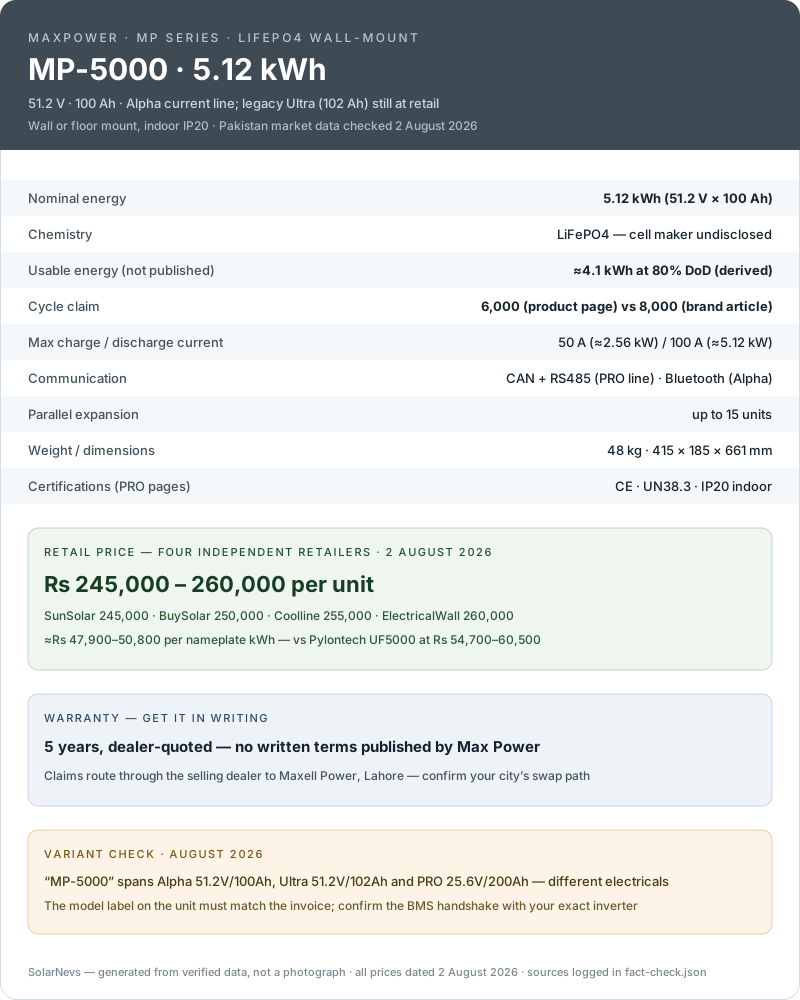
Specifications
| nominalEnergy | 5.12 kWh (51.2V x 100Ah); Ultra retail variant 5.22 kWh (102Ah) |
|---|---|
| chemistry | LiFePO4 (per Max Power and retail listings; cell maker undisclosed) |
| usableEnergy | not published — ~4.1 kWh at the 80% DoD retailers quote (derived) |
| cycleClaim | 6,000-cycle guarantee (official product page); 8,000 claimed in Max Power's May 2026 article |
| maxChargeCurrent | 50A (~2.56 kW) |
| maxDischargeCurrent | 100A (~5.12 kW) |
| comms | CAN + RS485 on PRO line; Bluetooth monitoring on Alpha |
| parallel | up to 15 units |
| weightDimensions | 48 kg; 415 x 185 x 661 mm; IP20 indoor wall/floor mount |
| Warranty | 5 years, dealer-quoted (BuySolar adds "lifetime free service"); no written warranty terms published on maxpower.com.pk — get the warranty card and claim procedure in writing before paying. |
The Maxpower MP-5000 is a 5.12 kWh (51.2V, 100Ah) LiFePO4 wall-mount battery from Lahore's Maxell Power (Pvt) Ltd, and the volume seller of the brand's lithium range. As of 2 August 2026 it retails for Rs 245,000-260,000 across four independent Pakistani retailers.
It is the standard "one-battery" pairing for a 5-6 kW hybrid inverter: 48 kg on the wall, roughly 4.1 kWh of usable overnight backup at 80% depth of discharge, and a claimed 6,000-cycle life whose only enforceable backing is the dealer-quoted 5-year warranty.
Specifications
Spec | Value |
|---|---|
Nominal energy | 5.12 kWh (51.2V × 100Ah); retail "Ultra" variant 5.22 kWh (102Ah) |
Chemistry | LiFePO4 (cell manufacturer undisclosed) |
Usable energy | Not published — ≈4.1 kWh at 80% DoD (derived, not a spec) |
Cycle life | "6,000 life cycle guarantee" (official page); 8,000 claimed in Max Power's May 2026 article |
Max charge current | 50A (≈2.56 kW) |
Max discharge current | 100A (≈5.12 kW) |
Operating range | 40-58.4V |
Communication | CAN + RS485 (PRO line); Bluetooth monitoring (Alpha) |
Parallel expansion | Up to 15 units |
Weight / dimensions | 48 kg · 415 × 185 × 661 mm |
Protection / certs | IP20 (indoor only) · CE, UN38.3 (stated on PRO pages) |
Warranty | 5 years (dealer-quoted; not published on official site) |
Honest assessment
Pros. The price is the argument: Rs 245,000-260,000 (2 August 2026) buys the same nameplate energy that costs Rs 280,000-310,000 in a Pylontech UF5000, and availability across Lahore-based retailers is good. The 100A discharge rating means it can actually feed a 5 kW hybrid at full tilt, which some budget 5 kWh packs cannot. The official Alpha page publishes real numbers — charge/discharge currents, parallel limit of 15, weight, dimensions — rather than pure marketing.
Cons. Nobody will tell you whose cells are inside, and without a named cell maker the 6,000-cycle claim is unverifiable — note that Max Power's own May 2026 article says 8,000 cycles for the same line, a contradiction the company leaves standing. Usable energy and DoD are simply not published. The model naming actively works against buyers: "MP-5000" covers a 51.2V/100Ah Alpha, a 51.2V/102Ah legacy Ultra still common in shops, and a 25.6V/200Ah PRO — electrically different products under one number. And the 50A charge limit means a full recharge from solar takes about 2 hours at best, longer in practice — fine for daily cycling, slower than the 100A-charge rivals.
Who should buy. Buyers on a 5-6 kW hybrid from the published compatibility list who want maximum kWh per rupee from a locally-serviced brand and will get the warranty procedure in writing. If documented cell provenance matters more than the ~Rs 40,000 saving, buy Pylontech; if the budget is tighter still, Fronus lists a 5.12 kWh unit at Rs 185,000 — with its own trade-offs covered in our Fronus guide.
Pakistan reality check
Heat. LiFePO4 is the right chemistry for Punjab and Sindh summers — it tolerates heat far better than other lithium types — but the published charge window tops out at 55°C cell temperature and the pack is IP20: indoor, ventilated, out of direct sun. A battery in a west-facing garage hits derating territory in June. Cycle-life claims are lab numbers at 25°C; expect real Pakistani duty to land under them, which is one more reason the 5-year written warranty matters more than the 6,000-cycle sticker. Our battery-life guide covers the heat math.
The BMS handshake. Run the battery on CAN or RS485 with the inverter, not on dumb voltage mode. Maxpower publishes its compatibility list on the PRO pages (Solis, Growatt, Sofar, GoodWe, SMA, Deye and others); the Alpha page advertises Bluetooth monitoring but does not restate the protocol list, so make protocol confirmation for your exact inverter a condition of sale, cable included. Tubular-to-lithium upgrades fail on this exact point more than on anything else.
Variant check at the counter. Ask which unit is physically in the box: Alpha (current), Ultra (legacy, off the official catalogue but still sold), or PRO (25.6V — wrong voltage class for a 48V inverter unless you are building a 24V system). The serial and model label on the unit must match the invoice; a "same thing, brother" answer is not acceptable at Rs 250,000.
Warranty claim reality. Five years via the selling dealer, honoured by Maxell Power in Lahore. Buyers in Karachi, Islamabad or smaller cities should ask in writing who swaps a failed unit locally and on what timeline — we could find no published service-centre list. An absent paper trail is the single most common reason lithium warranty claims die in Pakistan; see the warranty reality table.
Price context vs rivals (August 2026)
5 kWh-class battery | Price (Aug 2026) | Rs per nameplate kWh |
|---|---|---|
Fronus Titan TP-LD51 5.12 kWh | Rs 185,000 | ~Rs 36,100 |
Maxpower MP-5000 5.12 kWh | Rs 245,000-260,000 | Rs 47,900-50,800 |
Dyness DL5.0C 5.12 kWh | Rs 249,000-260,000 | Rs 48,600-50,800 |
Pylontech UF5000 5.12 kWh | Rs 280,000-310,000 | Rs 54,700-60,500 |
Rival prices from SolarPanelRates' lithium list (updated 14 July 2026, checked 2 August 2026). The MP-5000 sits mid-market: a real saving against the imported tier, a premium over the cheapest local badges, with cell provenance as the invisible line item. If your loads justify 10 kWh, the MP-10000 is meaningfully cheaper per kWh (Rs ~43,000 vs ~49,000).
Frequently asked questions
What does the Maxpower MP-5000 cost in Pakistan today?
Rs 245,000-260,000 as of 2 August 2026, across SunSolar (Rs 245,000), BuySolar (Rs 250,000), Coolline Energy (Rs 255,000) and ElectricalWall (Rs 260,000). Sold-out pages still showing Rs 340,000-375,000 predate the 2025-26 lithium price slide — ignore them.
How much backup does one MP-5000 actually give?
Nameplate is 5.12 kWh, but at the 80% depth of discharge its cycle rating assumes, usable energy is roughly 4.1 kWh — enough for fans, lights, fridge and a TV overnight in most homes, not for ACs. Max discharge is 100A (~5.12 kW), so it can also carry a brief motor start.
What is the difference between MP-5000 Ultra, Alpha and PRO?
The Alpha (current official line) is 51.2V/100Ah with Bluetooth monitoring; retail "Ultra" stock is a near-identical 51.2V/102Ah build that has dropped off the official catalogue; the MP-5000 PRO is a different 25.6V/200Ah unit with CAN/RS485. Same 5.12 kWh label, different electrical realities — confirm which one you are being quoted.
Will the MP-5000 work with my inverter?
Max Power's PRO-line compatibility list names Solis, Growatt, Sofar, SAJ, ATESS, MUST, GoodWe, SMA, Deye, Megarevo, SRNE, Victron, LuxPowerTek and Voltronic. The Alpha page does not repeat the CAN/RS485 protocol list, so confirm protocol support for your exact inverter model and get the comms cable included — protocol mismatch is Pakistan's most common lithium-upgrade failure.
Who makes the cells inside the MP-5000?
Undisclosed. Neither Max Power's product pages nor any retailer listing we opened on 2 August 2026 names the LiFePO4 cell manufacturer or the assembly location. Ask the dealer for the cell datasheet; that answer is part of what you are paying for.
References
- Max Power official — MP-5000 Alpha specs — accessed 2 Aug 2026
- Max Power official — MP-5000 PRO (25.6V variant — accessed 2 Aug 2026
- Max Power official — MP-series price article (21 May 2026) — accessed 2 Aug 2026
- SunSolar — MP5000 Ultra Rs 245 — accessed 2 Aug 2026
- BuySolar — MP-5000 Ultra Rs 250 — accessed 2 Aug 2026
- Coolline Energy — MP-5000 Rs 255 — accessed 2 Aug 2026
- ElectricalWall — MP-5000 Alpha Rs 260 — accessed 2 Aug 2026
- SastaSolar — stale Rs 375 — accessed 2 Aug 2026
- SolarPanelRates — lithium price list (updated 14 Jul 2026) — accessed 2 Aug 2026