Honri VE
Rs 3,599,000 verified 26 Jul 2026 — prices in Pakistan move weekly
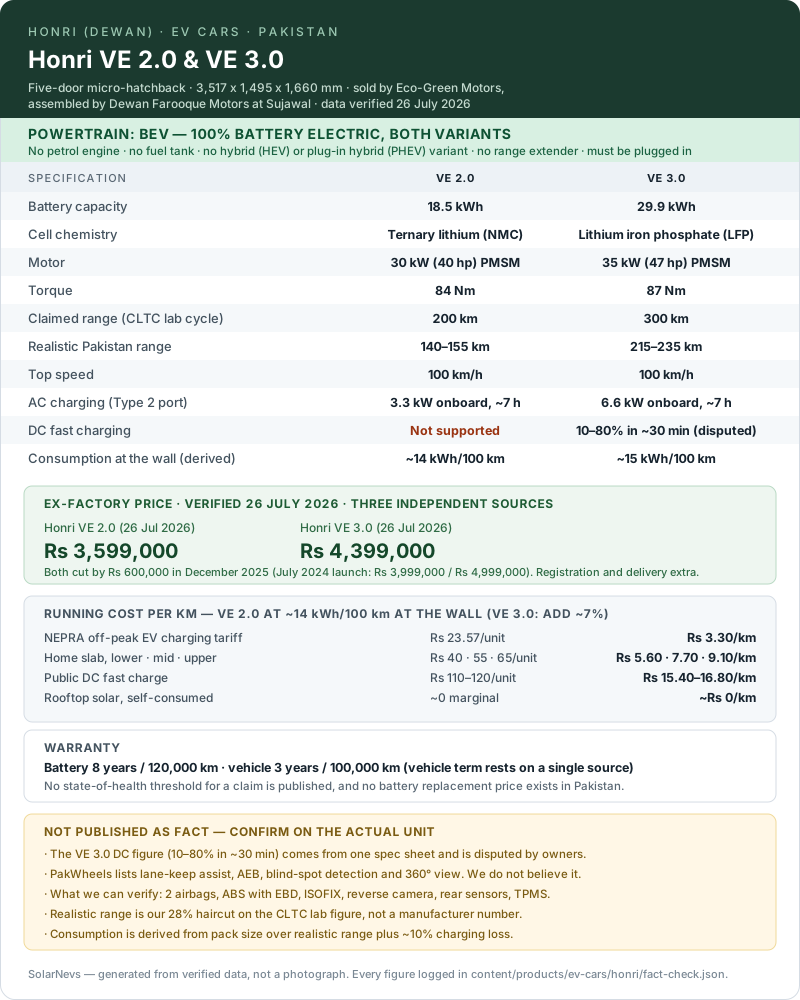
Specifications
| batteryKwh | VE 2.0 — 18.5 (ternary lithium / NMC); VE 3.0 — 29.9 (LFP / lithium iron phosphate) |
|---|---|
| claimedRangeKm | VE 2.0 — 200 km CLTC; VE 3.0 — 300 km CLTC |
| realisticRangeKm | VE 2.0 — 140-155; VE 3.0 — 215-235 |
| kwhPer100km | approx 14 at the wall (VE 2.0), approx 15 at the wall (VE 3.0) — derived, not published by the assembler |
| acCharging | VE 2.0 — 7 hours on a 3.3 kW onboard charger; VE 3.0 — 7 hours on a 6.6 kW onboard charger, Type 2 port |
| dcCharging | VE 2.0 — NOT supported; VE 3.0 — 10-80% in approx 30 min per spec sheet, disputed by owners |
| motorKw | VE 2.0 — 30 kW (40 hp); VE 3.0 — 35 kW (47 hp) |
| torqueNm | VE 2.0 — 84; VE 3.0 — 87 |
| topSpeedKmh | 100 |
| zeroTo100 | not published — the car tops out at 100 km/h, so the figure is close to meaningless here |
| Powertrain | BEV |
| Warranty | Battery 8 years / 120,000 km; vehicle 3 years / 100,000 km. The vehicle term comes from a single source and should be confirmed in writing. Battery replacement cost is not published anywhere in Pakistan, and the warranty does not state a state-of-health threshold for a claim. |
The Honri VE is a five-door battery-electric (BEV) micro-hatchback, assembled in Pakistan by Dewan Farooque Motors at Sujawal under a toll-manufacturing contract for Eco-Green Motors, which owns the brand and sells the cars. As of 26 July 2026 it lists at Rs 3,599,000 ex-factory for the VE 2.0 and Rs 4,399,000 for the VE 3.0 — both cut by Rs 600,000 in December 2025.
It is a pure EV: no petrol engine, no fuel tank, no range extender, no self-charging mode. It is also genuinely small — 3,517 mm long, about 130 mm shorter than a Suzuki Alto, and capped at 100 km/h.
Variants and price
Variant | Battery | Claimed range | Ex-factory (26 Jul 2026) | Was (pre-Dec 2025) |
|---|---|---|---|---|
Honri VE 2.0 | 18.5 kWh ternary lithium (NMC) | 200 km CLTC | Rs 3,599,000 | Rs 4,199,000 |
Honri VE 3.0 | 29.9 kWh lithium iron phosphate (LFP) | 300 km CLTC | Rs 4,399,000 | Rs 4,999,000 |
At launch in July 2024 the cars were Rs 3,999,000 and Rs 4,999,000. Price is ex-factory; registration, insurance, freight and dealer charges sit on top. These are not the same car with a bigger battery — the chemistries differ, and in Pakistani heat that matters.
Specifications
Both variants are BEV — battery electric only, and share a body: 3,517 x 1,495 x 1,660 mm on a 2,495 mm wheelbase, 130 mm ground clearance, 165/55 R15 tyres, Type 2 charge port, 100 km/h top speed, approx 7 hours for a full AC charge, five seats (realistically four) and two airbags.
Item | VE 2.0 | VE 3.0 |
|---|---|---|
Battery | 18.5 kWh ternary lithium (NMC) | 29.9 kWh LFP |
Motor | 30 kW (40 hp) PMSM | 35 kW (47 hp) PMSM |
Torque | 84 Nm | 87 Nm |
Claimed range | 200 km CLTC | 300 km CLTC |
Realistic PK range | 140-155 km | 215-235 km |
Onboard AC charger | 3.3 kW | 6.6 kW |
DC fast charging | Not supported | 10-80% in approx 30 min {/* VERIFY */} |
A warning on the safety spec. PakWheels' variant pages list lane keep assist, AEB, blind-spot detection and 360-degree surround view on both trims. ProPakistani's launch coverage lists only a driver airbag, ABS, EBD, reverse camera and ISOFIX. We do not believe this car carries a full ADAS suite and have not published it as fact. {/* VERIFY */} Confirm every safety item on the unit itself before you sign.
Running cost per kilometre
Eco-Green publishes no consumption figure, so we derive one: 18.5 kWh over a realistic 145 km is about 12.8 kWh/100 km at the battery, plus roughly 10% charging loss — approximately 14 kWh per 100 km at the wall for the VE 2.0, around 15 for the 3.0.
Formula: cost per km = (14 / 100) x tariff.
Electricity source | Tariff (Rs/unit) | Cost per km | 1,000 km/month |
|---|---|---|---|
NEPRA off-peak EV tariff | 23.57 | Rs 3.30 | Rs 3,300 |
Home slab, lower end | 40.00 | Rs 5.60 | Rs 5,600 |
Home slab, mid | 55.00 | Rs 7.70 | Rs 7,700 |
Home slab, upper end | 65.00 | Rs 9.10 | Rs 9,100 |
Public DC fast charge | 110.00 | Rs 15.40 | Rs 15,400 |
Public DC fast charge | 120.00 | Rs 16.80 | Rs 16,800 |
Rooftop solar (self-consumed) | ~0 marginal | ~Rs 0 | ~Rs 0 |
For the VE 3.0 add roughly 7% to every row.
Petrol comparison at Rs 331.52/litre (24 July 2026): a Suzuki Alto VXR, the car most Honri buyers cross-shop, returns roughly 16 km/L in real city use — Rs 20.72/km, or Rs 20,720 a month at 1,000 km. A Cultus or WagonR at 13 km/L costs Rs 25.50/km.
This is the one page in our EV catalogue where the payback maths genuinely works. The VE 2.0 costs Rs 604,139 more than an Alto VXR (Rs 2,994,861, 26 July 2026), and a Rs 55 home slab saves about Rs 13,020 a month — the premium is repaid in under four years, or under three on off-peak or solar charging. That is a real result, and we will not pretend otherwise just because the rest of the car is compromised.
The solar answer
Charging from your own rooftop in daylight is ~Rs 0/km marginal. At 585W panels producing roughly 2.3 kWh/day in Pakistani conditions:
Your daily driving | Energy needed | 585W panels required |
|---|---|---|
20 km/day | 2.8 kWh | 2 panels |
30 km/day | 4.2 kWh | 2 panels |
40 km/day | 5.6 kWh | 3 panels |
60 km/day | 8.4 kWh | 4 panels |
80 km/day | 11.2 kWh | 5 panels |
Rule of thumb: one 585W panel per 16 km of daily driving. Being light and slow makes this the least demanding EV in our catalogue to run off a roof — three panels cover most city commutes. A 3 kWh solar box was reported as included at launch; treat that as unconfirmed today. {/* VERIFY */}
Honest assessment
Pros. The price cut is real and the running-cost case stands up. PakWheels' tester found better cabin insulation than an Alto or WagonR, no body roll on broken surfaces and adequate instant torque for city overtakes, with suspension reportedly retuned during local assembly. The 3.0's LFP pack tolerates Pakistani heat and daily 100% charging.
Cons. Owners of the first CKD batch are unhappy: side-mirror controls present on the CBU demo cars were deleted, steering-wheel multimedia and call controls were removed without physical replacements — forcing screen interaction while driving — bulbs failed within a month, and ride quality and brakes drew complaints. Two airbags, a 100 km/h ceiling, and no DC charging at all on the 2.0. And the assembler, Dewan Farooque Motors, carried negative Rs 3.2 billion shareholders' equity as of June 2023 with lenders pursuing Rs 6.88 billion.
Who should buy it. A household in a major city wanting a second car for school runs and short commutes, that owns its roof, has solar or intends to, drives under 60 km a day and can absorb an unknown resale value. Who should not: anyone needing one car to do everything, anyone driving intercity (a 100 km/h ceiling is unsafe on a motorway, not just slow), anyone in a flat without a charge point, and anyone who needs certainty the manufacturer will exist in eight years.
The Pakistan reality
Real range vs claimed. Both figures are CLTC — a Chinese lab cycle run at low average speeds, and the most optimistic standard in common use. Pakistani owners report roughly 28% below claimed at speed with the AC running, giving 140-155 km for the VE 2.0 and 215-235 km for the VE 3.0. ProPakistani's launch coverage claimed 180 km and 280 km realistic; we consider those optimistic. In Karachi summer, plan on the lower end.
Battery replacement and warranty. Cover is 8 years / 120,000 km on the battery and 3 years / 100,000 km on the vehicle. The vehicle term rests on a single source, and no state-of-health threshold is published — the number deciding whether a degraded pack is a valid claim or your problem. Nobody in Pakistan publishes a Honri VE battery replacement price. On a car this cheap that risk is proportionally larger, not smaller: a pack could plausibly cost more than half the car's residual value. Get the booklet in writing, and ask who honours it if Eco-Green or Dewan stops trading.
A note on the 2.0's chemistry. Its ternary lithium (NMC) pack is denser but less heat-tolerant than the 3.0's LFP, and dislikes being held at 100%. Several Pakistani outlets wrongly describe both variants as LFP. If you buy the 2.0, charge to 80% daily and park in shade.
Charging at home after net billing. NEPRA replaced net metering with net billing in February 2026. Exports now earn roughly Rs 11/unit against import rates above Rs 40, so exporting is dead economics. Self-consuming your own generation is now the highest-value use of a rooftop system, and a Honri VE on a 10am-4pm timer is close to a perfect solar load — the 2.0 draws just 3.3 kW. Prosumers who signed before 9 February 2026 are grandfathered. Note too that household EV charging attracts no equivalent to the commercial EV subsidy, roughly doubling per-km cost against the headline Rs 23.57 figure.
Charging network. NEECA has issued 72 licences since the October 2024 regulations, but as of January 2026 only around 20 public charging points were operational nationwide — 13 licences became real projects and five units reached sites. Grid connections, separate meters and DISCO no-objection certificates are the bottleneck; the target is 3,000 stations by 2030. For this car it matters less than for most: the 2.0 cannot DC charge anyway, and a 145 km range means intercity was never on the table. Home charging is the entire plan, and load-shedding will still interrupt it.
Monsoon and flooding. EV packs are typically sealed to IP67, but we could not confirm the rating for the Pakistan-spec car. {/* VERIFY */} With 130 mm of clearance it sits lower than almost anything here, and August street flooding will reach it. The rule is absolute: if it has been submerged, do not restart it and do not plug it in. Recover it on a flatbed and have the pack inspected.
Resale. At 30 units in May 2026 and 20 in June, there is effectively no used market and no price discovery — no standard battery state-of-health report, no independent way to verify pack condition. Assume a heavy discount and a long search for a buyer. This is the largest uncosted risk in owning one.
Price context
Car | Type | Ex-factory price | Dated |
|---|---|---|---|
Honri VE 2.0 | BEV | Rs 3,599,000 | 26 Jul 2026 |
Honri VE 3.0 | BEV | Rs 4,399,000 | 26 Jul 2026 |
Rinco Aria EV | BEV | Rs 2,340,000 {/* VERIFY */} | 26 Jul 2026 |
Suzuki Alto VXR Upgraded | Petrol | Rs 2,994,861 | 26 Jul 2026 |
MG Binguo Pro | BEV | Rs 5,699,000 | 26 Jul 2026 |
The Rinco Aria undercuts the VE 2.0 with a comparable 17 kWh pack and the same 100 km/h ceiling, though its listing is ambiguous enough that we flag it — the Honri VE is not the cheapest EV car in Pakistan. The Alto is the real competitor: Rs 604,000 cheaper to buy, with a service network on every high street in the country. The MG Binguo Pro at Rs 5,699,000 is the honest upgrade — Rs 2.1M more, but with 333 km of range, DC fast charging and MG's nationwide 3S network behind it.
We do not sell cars and take no dealer money. Prices dated 26 July 2026, subject to change on any duty or budget notification.
Frequently asked questions
What does the Honri VE cost in Pakistan right now?
Rs 3,599,000 ex-factory for the VE 2.0 and Rs 4,399,000 for the VE 3.0, as listed on 26 July 2026. Both were cut by Rs 600,000 in December 2025. Registration and delivery are extra.
Is the Honri VE a full EV or a hybrid?
Full battery-electric (BEV). No petrol engine, no fuel tank, no range extender, no self-charging mode. It must be plugged in.
Is it really the cheapest EV in Pakistan?
No. The Rinco Aria EV lists lower, and quadricycles like the Nora EV and Alektra Metro are far cheaper. The Honri VE is the cheapest EV from a locally assembling, stock-exchange-listed manufacturer.
What range will I actually get?
Plan for 140-155 km in the VE 2.0 and 215-235 km in the VE 3.0. The 200 and 300 km figures are CLTC lab numbers, the most optimistic cycle in use.
What does it cost per kilometre to run?
About Rs 3.30/km on the off-peak EV tariff, Rs 5.60-9.10/km on a home slab, and Rs 15-17/km at public DC chargers. A Suzuki Alto costs roughly Rs 20/km on petrol.
Why do so few people buy it?
30 units in May 2026, 20 in June. Buyers hesitate over Dewan's history of shutdowns, unproven parts supply, two airbags, a 100 km/h ceiling and no resale track record.
References
- PakWheels — Honri VE price, images, specs and reviews — accessed 26 Jul 2026
- PakWheels — Honri VE 2.0 price, specs and features — accessed 26 Jul 2026
- PakWheels — Honri VE 3.0 price, specs and features — accessed 26 Jul 2026
- DrivePK — Dewan Motors slashes Honri VE prices in Pakistan — accessed 26 Jul 2026
- ProPakistani — Price, features and booking details of new Honri VE electric cars — accessed 26 Jul 2026
- TechJuice — How Punjab's big bet on the Honri VE gave Dewan Motors a second life — accessed 26 Jul 2026
- PakWheels — Pakistan car sales surge 29% MoM in June 2026, PAMA report — accessed 26 Jul 2026
- Express Tribune — NEPRA approves Rs 23.57/kWh tariff for EV charging stations — accessed 26 Jul 2026
- Arab News — Pakistan plans 3,000 EV charging stations — accessed 26 Jul 2026