Charging an EV with Solar in the UAE (August 2026)
Updated 4 August 2026 · By SolarNevs Research Desk, Dealer surveys + verified sources · 6 sources · Method ↗
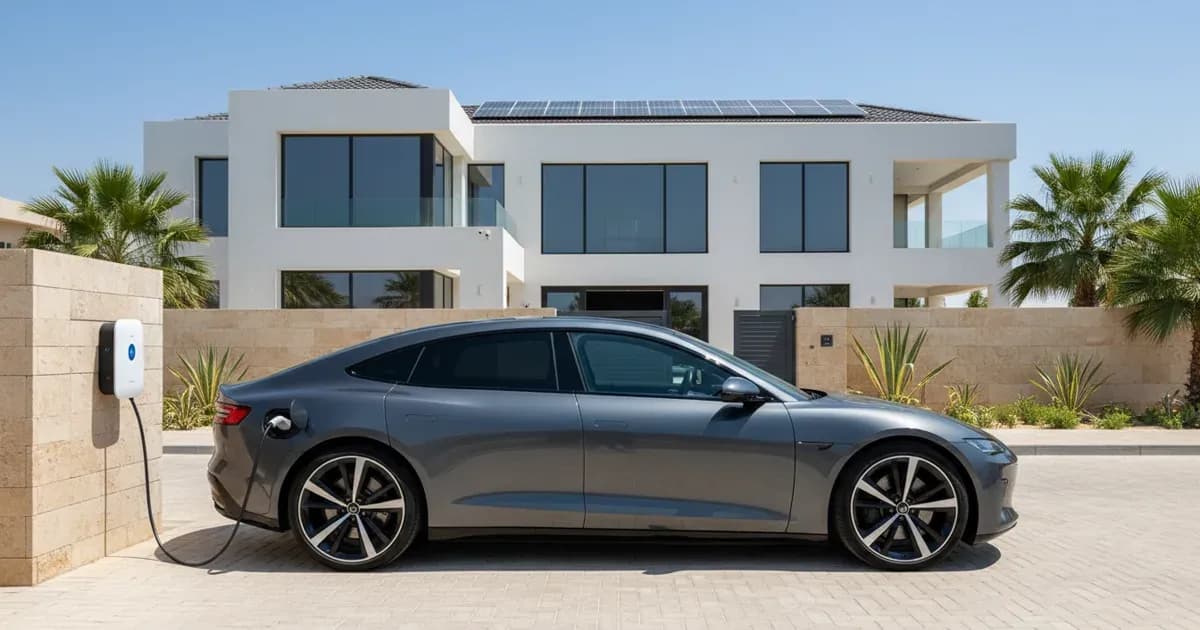
Charging an EV with Solar in the UAE
{/* visual_plan: stat_block */}
Key Takeaways
- Dubai's Shams Dubai scheme connects rooftop solar to the grid under net metering: surplus is credited against future bills, never paid out as cash.
- Because credits offset billed consumption rather than earning money, charging your EV during solar generation hours captures the most value from every kilowatt-hour — that is arithmetic, not marketing.
- Shams Dubai installations must go through DEWA-enrolled consultants and contractors; DEWA publishes the enrolled list and a free solar calculator.
- Home charging hardware is a modest cost next to the system itself — Tesla's UAE Wall Connector, for example, is AED 2,300 (August 2026).
Can you charge an electric car from rooftop solar in Dubai?
Yes, and Dubai is one of the better-regulated places in the region to do it. DEWA's Shams Dubai initiative — established under Dubai Executive Council Resolution No. 46 of 2014 as part of the Distributed Renewable Resources Generation programme — lets building owners connect rooftop photovoltaic systems to DEWA's network. In DEWA's own framing, the electricity is used on site and the surplus is exported to the network.
An EV charger is simply another load on your home's electrical system. When your panels are generating and your car is plugged in, the charger draws solar power first; anything the panels cannot cover comes from the grid as normal. There is no special "solar EV charging" application — a Shams Dubai connection plus a home charge point is the whole stack.
How does Shams Dubai net metering actually work?
This is where the detail matters, because the scheme's design directly shapes the best charging strategy. Under Shams Dubai's net-metering arrangement, surplus energy exported to DEWA's network is credited and used to offset future electricity consumption. DEWA's FAQ is explicit on the key point: the producer is not paid any money for the excess electricity. Credits reduce future bills; they never convert to cash. DEWA also notes that no tax or other incentives are currently offered for commercial and industrial solar — the incentive is bill savings, full stop.
The detailed rules live in DEWA's DRRG Connection Conditions, published on the Shams Dubai publications page, and capacity is limited relative to your premises' total connected load under those conditions.
Feature | Shams Dubai rule |
|---|---|
Surplus solar energy | Exported to DEWA network, credited via net metering |
Cash payment for exports | None — credits offset future consumption only |
Who can apply | DEWA-enrolled consultants and contractors on the owner's behalf |
Capacity limit | Capped relative to the premises' total connected load per the Connection Conditions |
Large systems | Above 100 kW: plant performance test required; above 400 kW: possible additional grid-integration equipment cost |
Figures as of August 2026.
Why does daytime charging beat exporting your solar power?
Follow the scheme's own logic. Every kilowatt-hour your panels generate can go one of two ways: consumed on site, where it directly replaces electricity you would otherwise buy, or exported, where it becomes a credit that offsets some future billed unit. Since exports earn credits rather than cash, self-consumed energy is always worth at least as much as exported energy — and an EV is the largest flexible load most households own.
That makes the strategy straightforward: plug in during generation hours whenever the car is home. A vehicle that sits in the driveway through the day — common for a second car, or for anyone working from home — can soak up generation that would otherwise be exported for credit. This is not a claimed percentage saving; it is the structure of the scheme doing the work. No number is needed to make the point, and DEWA publishes no per-household figure to quote.
For households whose cars are away all day, the choice is between charging overnight on grid power (with solar credits offsetting part of the bill) or adding battery storage to time-shift solar energy into the evening — a real option, but one whose economics deserve their own sums.
What hardware do you need to charge an EV from solar at home?
Three components: the rooftop PV system, a home charge point, and optionally a battery. The PV system must be installed and connected under Shams Dubai rules — applications go through DEWA-enrolled consultants and contractors only, and DEWA publishes the current enrolled list on its website. The connection process runs through defined stages of permits, installation, inspection, and meter installation before generation begins.
The charge point is the simple part. A dedicated AC wall charger is the standard home solution; as one verified UAE price point, Tesla's Wall Connector sells for AED 2,300 (August 2026) on its official UAE channel, with a portable Mobile Connector at AED 909 (August 2026). Other brands' chargers are quoted through their UAE distributors and installers. Installation cost varies with your distribution board and cable run, and is quoted per property.
Home batteries — Tesla's Powerwall is sold through the official UAE channel — let solar energy charge the car after sunset. Whether that premium earns its keep depends on your tariff, driving pattern, and system size; it is an enhancement, not a requirement.
How do you estimate what your roof can generate?
DEWA provides a free public tool for exactly this: the Shams Dubai Calculator, which estimates potential electricity production and bill savings based on your location, shading from nearby buildings, and roof orientation and tilt. DEWA attaches its own accuracy caveat — actual production depends on final design, equipment, and maintenance such as panel cleaning — but it is the right first step before speaking to an enrolled contractor.
For EV planning, the useful mental model is to compare the calculator's estimated daytime generation with your car's consumption. An EV's demand depends on your daily mileage and the vehicle's efficiency, so a contractor can size a system that covers household load plus a realistic share of charging, rather than guessing.
What about public charging when solar is not enough?
Rooftop solar and public infrastructure are complements, not competitors. DEWA operates the EV Green Charger initiative, with charger types, usage instructions, and station locations published on dewa.gov.ae, and a regulatory framework for EV charging infrastructure is in place for Dubai. Long trips, apartment living, and cloudy stretches (rare as they are) all have a public-network answer.
The economic hierarchy for a Dubai EV owner with rooftop solar is clear: solar self-consumption first, then home charging on the residential tariff softened by net-metering credits, then public charging for flexibility. Each step is more expensive than the one before, which is exactly why the daytime-charging habit at the top of this article is the cheapest kilometre you can buy.
Is charging an EV with solar worth it in the UAE?
The honest answer is that the combination is structurally sound rather than magically profitable. Dubai's abundant solar resource, a regulated grid-connection scheme, credited (if unpaid) exports, and officially sold EVs and charging hardware mean every piece of the chain exists and works today. The value case rests on displacing purchased electricity with self-generated power at the moment of use — and an EV parked at home during daylight is the single best tool a household has for doing exactly that. Run the DEWA calculator, get quotes from enrolled contractors, and let your own roof's numbers decide.
Can you charge an electric car from rooftop solar in Dubai?
Yes. Under DEWA's Shams Dubai scheme, grid-connected rooftop solar powers your home — including an EV charger — with surplus exported to the network and credited against future consumption.
Does DEWA pay you for surplus solar power?
No. DEWA's Shams Dubai FAQ states the producer is not paid money for excess electricity; surplus is credited through net metering to offset future consumption. The incentive is bill savings, not cash.
Why is it better to charge an EV during the day with solar?
Because surplus solar is credited rather than paid out, every kilowatt-hour you use directly — such as daytime EV charging — captures full value, while exported energy only offsets later billed consumption.
Who can install a Shams Dubai solar system?
Only DEWA-enrolled consultants and contractors can submit Shams Dubai connection applications; DEWA publishes the list of enrolled firms on its website.
References
Frequently asked questions
Can you charge an electric car from rooftop solar in Dubai?
Yes. Under DEWA's Shams Dubai scheme, grid-connected rooftop solar powers your home — including an EV charger — with surplus exported to the network and credited against future consumption.
Does DEWA pay you for surplus solar power?
No. DEWA's Shams Dubai FAQ states the producer is not paid money for excess electricity; surplus is credited through net metering to offset future consumption. The incentive is bill savings, not cash.
Why is it better to charge an EV during the day with solar?
Because surplus solar is credited rather than paid out, every kilowatt-hour you use directly — such as daytime EV charging — captures full value, while exported energy only offsets later billed consumption.
Who can install a Shams Dubai solar system?
Only DEWA-enrolled consultants and contractors can submit Shams Dubai connection applications; DEWA publishes the list of enrolled firms on its website.
References
- DEWA – Shams Dubai — accessed 4 August 2026
- DEWA – Shams Dubai FAQ — accessed 4 August 2026
- DEWA – Shams Dubai Connection Process — accessed 4 August 2026
- DEWA – Shams Dubai Calculator — accessed 4 August 2026
- DEWA – EV Green Charger Initiative — accessed 4 August 2026
- Tesla UAE — accessed 4 August 2026
Related guides
More from this cluster.