Rs 400,000 E-Rickshaw Subsidy in Pakistan: The Honest Maths
Updated 2 August 2026 · By SolarNevs Research Desk, Dealer surveys + verified sources · 15 sources · Method ↗
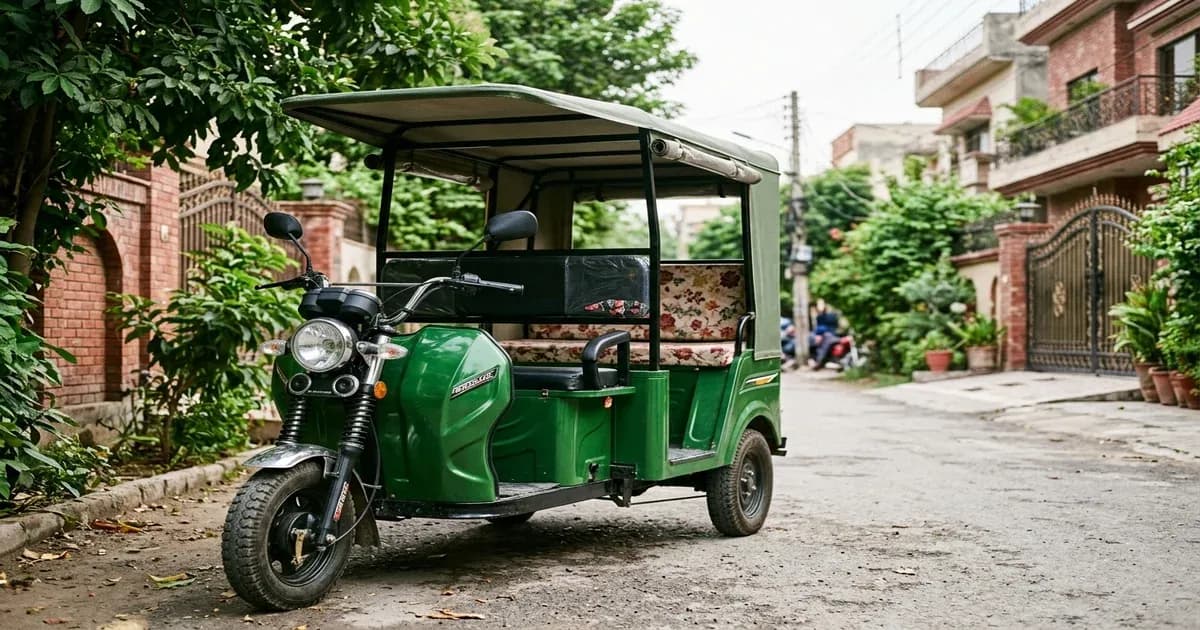
Rs 400,000 E-Rickshaw Subsidy in Pakistan The Honest Maths
{/* visual_plan: stat_block */}
Key Takeaways
- The Rs 400,000 subsidy is the self-finance figure. Buy the same rickshaw on bank lease and the subsidy drops to Rs 200,000 (pave.gov.pk scheme terms, checked 26 July 2026).
- The Economic Coordination Committee approved Phase 2 on 5 May 2026 and scrapped balloting for first-come-first-served, ranked on precise application timestamps.
- Phase 1 drew 269,161 applications and released 40,000 e-two-wheelers plus just 1,000 e-three-wheelers at the e-balloting held 2 October 2025.
- Petrol reached Rs 331.52 per litre effective 24 July 2026, a Rs 4.40 jump, under OGRA's new daily pricing mechanism adopted in mid-July 2026.
- At 120 km a day, a 25 km/litre petrol rickshaw burns about Rs 1,591 of fuel. The same distance in a 6.5 kWh e-rickshaw costs Rs 240 to Rs 330 of electricity (July 2026 tariffs).
How much is the e-rickshaw subsidy, and why do most drivers only get half of it?
This is the part the headlines skip, and it decides whether the scheme is worth anything to you.
The Pakistan Accelerated Vehicle Electrification (PAVE) programme pays two different subsidies on the same three-wheeler, depending on how you pay for it:
Vehicle | Self-finance subsidy | Bank lease subsidy |
|---|---|---|
E-rickshaw / e-loader (three-wheeler) | Rs 400,000 | Rs 200,000 |
E-bike / scooter (two-wheeler) | Rs 80,000 | Rs 50,000 |
Self-finance means you pay the dealer the full price out of your own pocket, register the vehicle, and the Engineering Development Board releases the subsidy through the State Bank of Pakistan after it verifies delivery and registration. You are reimbursed. You are not discounted.
Read that again with a driver's bank balance in mind. To collect the larger Rs 400,000, you must first produce roughly Rs 450,000 to Rs 650,000 in cash for a typical e-rickshaw, and then wait for the state to pay you back. A driver who had that money sitting idle would probably not be applying for a transport subsidy. The people who genuinely need the help are the ones who take the bank lease, and the bank lease pays precisely half.
There is also a reporting conflict worth knowing about. PakWheels and ProPakistani describe the subsidy as flowing to the OEM through the State Bank after verification, while The Express Tribune reported it going into the approved bank accounts of applicants. Both mechanisms have been described in official briefings at different points in the rollout. Confirm with your dealer, in writing, which route applies to your booking before you hand over money, because it changes who you chase if the payment stalls.
Who is eligible for the PAVE e-rickshaw subsidy?
The three-wheeler category has stricter conditions than the e-bike category. As listed on pave.gov.pk (checked 26 July 2026):
- Age 21 to 65. The e-bike category opens at 18; rickshaws and loaders start at 21.
- Valid CNIC, and Pakistani citizenship. Residents of Azad Jammu and Kashmir and Gilgit-Baltistan are included.
- A valid driver licence is mandatory for the rickshaw and loader categories. This is not required for e-bikes and it is the single most common reason three-wheeler applications get rejected.
- No prior government EV subsidy. If you or your CNIC has already taken a vehicle under any federal or provincial EV scheme, you are out.
- Proof of income or a bank account, proof of residence, a recent photograph, and whatever the financing bank demands on top.
The published 25 percent female quota attaches to the e-bike category. Do not assume it carries over to three-wheelers.
How do you apply at pave.gov.pk, and what changed when balloting was scrapped?
{/* visual_plan: step_flow */}
Phase 1 used a computerised e-balloting draw, held on 2 October 2025. It attracted 269,161 applications and allocated 40,000 e-two-wheelers and 1,000 e-three-wheelers. Your odds in the three-wheeler pool were, to put it plainly, dreadful.
On 5 May 2026 the ECC approved Phase 2 with a Rs 9.0 billion allocation for FY 2025-26, covering 76,000 e-bikes and 2,170 rickshaws and loaders. The steering committee's recommendation was accepted: balloting is gone, replaced by first-come-first-served, with Phase 1 waitlisted applicants prioritised on their exact original application timestamps. Mandatory 100 percent third-party verification was also dropped in favour of a risk-based approach, which is how they intend to move faster.
The practical consequences for you are these. Your timestamp is now the whole game, so an application filed at the moment the window opens beats a better-prepared one filed a day later. If you were waitlisted in Phase 1, you already hold a place in the queue and should not file fresh. And because the three-wheeler pool across the entire programme is only 3,170 units against 116,000 e-bikes, the rickshaw queue clears fast.
The steps themselves are unremarkable, requiring you to register on pave.gov.pk with your CNIC, pick self-finance or bank lease, select a model from the pre-approved EDB list, upload licence and residence documents, and wait for the allocation message before paying anyone anything.
One warning that matters more than any of the above. The official portal is pave.gov.pk and nothing else. Search results are crowded with lookalike domains, such as pavegov.org.pk, pavegovpk.pk, pavegovpk.com, pave.pk, pave.com.pk, pavegov.com.pk and others, none of which are government sites. Some are ad farms; assume any of them asking for your CNIC or a fee is harvesting you. A federal scheme does not charge an application fee.
What does a petrol rickshaw cost to run at Rs 331.52 a litre?
{/* visual_plan: comparison */}
Petrol hit Rs 331.52 per litre effective 24 July 2026, up Rs 4.40 in a single revision. Since mid-July 2026 OGRA has moved to daily price notification, calculating each night from the trailing seven-day international average, with weekend prices held from Friday. So this number will have moved by the time you read it, and it has been moving upward.
A petrol auto-rickshaw in Pakistani conditions averages about 25 km per litre. At 120 km of daily running:
Line item | Petrol rickshaw | E-rickshaw |
|---|---|---|
Daily distance | 120 km | 120 km |
Consumption | 4.8 litres | ~6.9 kWh at the meter |
Unit price (July 2026) | Rs 331.52 / litre | Rs 34.53 / kWh off-peak |
Daily energy cost | Rs 1,591 | Rs 238 |
Same at worst-case rate |
| Rs 326 at Rs 47.20 / kWh |
The electricity figure assumes a 6.5 kWh lithium pack delivering a conservative 130 km per charge, plus roughly 15 percent charging and battery losses that you pay for but never drive on. The Rs 34.53 rate is the domestic Time-of-Use off-peak variable rate under NEPRA S.R.O. 279(I)/2026 (February 2026); Rs 47.20 is the top unprotected domestic slab if you charge on an ordinary meter during the day.
You will see "Rs 1 per kilometre" quoted for e-rickshaws across Pakistani blogs. That was true at older tariffs. At February 2026 rates it is Rs 1.98 to Rs 2.72 per km, and the petrol comparison is still overwhelming, so nobody needed to exaggerate.
What does the battery do to those numbers?
Here is where most e-rickshaw articles stop and this one keeps going.
The saving above is roughly Rs 1,265 to Rs 1,353 a day. Against that you must set a battery replacement fund, because the pack is a consumable and it is the most expensive single component on the vehicle.
A 6.5 kWh LiFePO4 pack at Pakistani July 2026 pricing of Rs 40,000 to Rs 55,000 per kWh costs Rs 260,000 to Rs 357,500 to replace. Spread across four years of daily commercial use, that is Rs 178 to Rs 245 a day you should be putting aside and almost nobody does.
The net realistic saving is roughly Rs 1,020 to Rs 1,175 a day, or about Rs 26,500 to Rs 30,500 a month over 26 working days.
Two things make this worse if you are careless. Cheap lead-acid packs are still sold on budget e-rickshaws and they die in two to three years, not four to five, which roughly doubles the daily amortisation. And a driver who runs 150 km a day rather than 120 cycles the pack harder and reaches replacement sooner. Ask the dealer for the pack chemistry in writing, the cell manufacturer, and the warranty term in years and cycles. A warranty quoted only in years, with no cycle limit, is a warranty designed to expire before it pays out.
Is the subsidy worth chasing?
For a working driver, yes, with clear eyes about which door you enter through.
Take a Rs 500,000 e-rickshaw. On self-finance, the Rs 400,000 reimbursement leaves you Rs 100,000 down, which the fuel saving repays in roughly three and a half months. That is an extraordinary return and it explains the queue. On bank lease, the Rs 200,000 subsidy leaves Rs 300,000 to finance, which the saving repays in about ten to eleven months before markup, which is still good, but a different proposition.
The catch that no amount of maths fixes is supply. There are 3,170 three-wheelers in the whole programme, first-come-first-served, with Phase 1 waitlisters ahead of you. Treat the subsidy as a lottery ticket you should absolutely buy, not as a plan you can build on. Also note that a Sazgar Shuttle EV 125AH lists at Rs 1,330,000 (2025-26 listing), so on a premium locally-assembled three-wheeler the Rs 400,000 covers only about 30 percent of the price, not most of it. The subsidy is transformative on a Rs 450,000-650,000 imported-kit rickshaw and merely helpful on a Rs 1.3 million one.
Frequently Asked Questions
How much is the e-rickshaw subsidy in Pakistan?
Rs 400,000 if you buy the rickshaw with your own money and claim reimbursement. Only Rs 200,000 if you take it on bank lease. Most drivers end up on the lease side and get half.
Is the PAVE scheme still using balloting?
No. The ECC approved Phase 2 on 5 May 2026 and replaced computerised balloting with first-come-first-served, ranked on exact application timestamps, with Phase 1 waitlisted applicants prioritised.
How many e-rickshaws are available under the scheme?
3,170 three-wheelers for the entire country across the whole programme, against 116,000 e-bikes. Phase 1 released just 1,000 three-wheelers from 269,161 total applications.
How much does an e-rickshaw save on fuel per day?
Around Rs 1,300 per day at 120 km, comparing petrol at Rs 331.52 per litre against off-peak charging. Setting aside a battery replacement fund cuts the real figure to roughly Rs 1,000-1,175.
References
- PAVE official portal, scheme categories, subsidy amounts and eligibility
- Express Tribune on the first PAVE e-balloting and subsidies up to Rs 400,000
- ProPakistani on ECC approval of PAVE Phase 2 and the switch to first-come-first-served
- PakWheels on PAVE subsidy transfers beginning and the OEM payment route
- Express Tribune on PAVE subsidies and bank lease financing
- The Nation on the government raising petrol to Rs 331.52 per litre for 24 July 2026
- Profit by Pakistan Today on the same 24 July 2026 petrol and diesel revision
- Geo News on the shift to daily fuel price revision
- PakWheels review of the electric rickshaw in Pakistan, battery and running cost
- IESCO tariff guide showing domestic ToU off-peak and peak rates under S.R.O. 279(I)/2026
- Nation on the launch of the PM Electric Bike and Rickshaw Scheme 2026
- Nation on 40,000 applicants winning e-bikes and rickshaws in the first PAVE e-balloting
Frequently asked questions
How much is the e-rickshaw subsidy in Pakistan?
Rs 400,000 if you buy the rickshaw with your own money and claim reimbursement. Only Rs 200,000 if you take it on bank lease. Most drivers end up on the lease side and get half.
Is the PAVE scheme still using balloting?
No. The ECC approved Phase 2 on 5 May 2026 and replaced computerised balloting with first-come-first-served, ranked on exact application timestamps, with Phase 1 waitlisted applicants prioritised.
How many e-rickshaws are available under the scheme?
3,170 three-wheelers for the entire country across the whole programme, against 116,000 e-bikes. Phase 1 released just 1,000 three-wheelers from 269,161 total applications.
How much does an e-rickshaw save on fuel per day?
Around Rs 1,300 per day at 120 km, comparing petrol at Rs 331.52 per litre against off-peak charging. Setting aside a battery replacement fund cuts the real figure to roughly Rs 1,000-1,175.
References
- The Express Tribune — accessed 26 July 2026
- PAVE (Punjab) — accessed 26 July 2026
- The Nation — accessed 26 July 2026
- PakWheels — accessed 26 July 2026
- ProPakistani — accessed 26 July 2026
- The Express Tribune — accessed 26 July 2026
- The Nation — accessed 26 July 2026
- Profit by Pakistan Today — accessed 26 July 2026
- Geo News — accessed 26 July 2026
- Profit by Pakistan Today — accessed 26 July 2026
- PakWheels — accessed 26 July 2026
- IESCO — accessed 26 July 2026
- PAVE (Punjab) — accessed 26 July 2026
- PAVE (Punjab) — accessed 26 July 2026
- The Nation — accessed 26 July 2026
Related guides
More from schemes, subsidies & financing.