Solar Panel Price in KSA (August 2026)
Updated 4 August 2026 · By SolarNevs Research Desk, Dealer surveys + verified sources · 5 sources · Method ↗
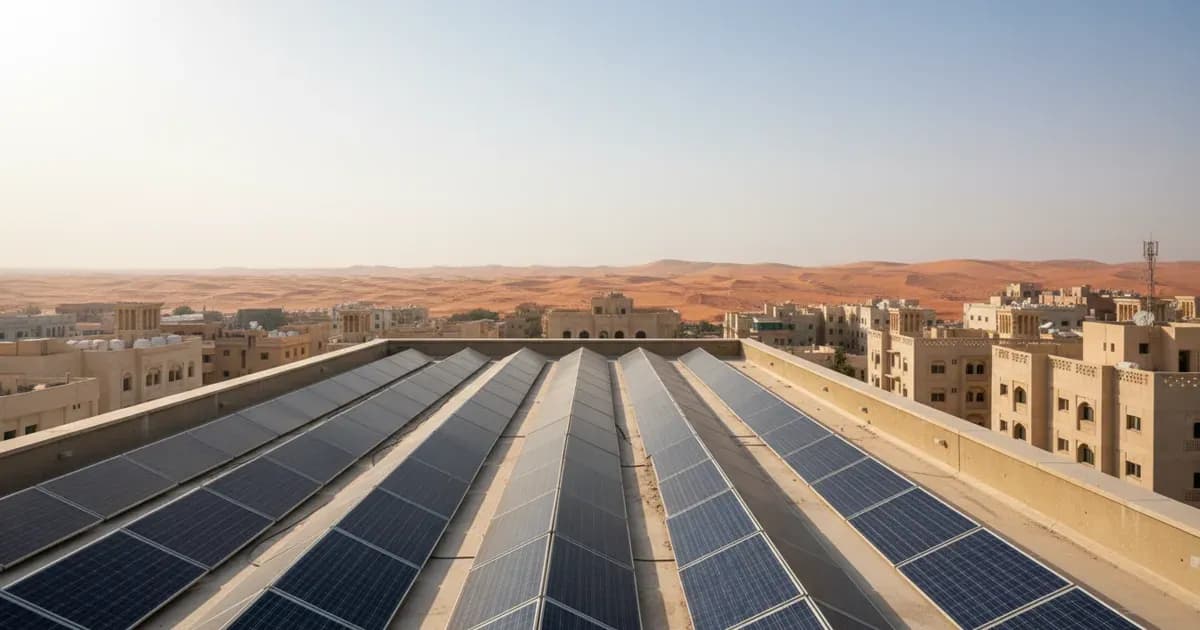
Solar Panel Price in KSA
{/* visual_plan: stat_block */}
Key Takeaways
- In-stock Longi 630W to 660W panels cost SAR 750 to SAR 950 (August 2026) at Saudi specialty store solarcells.sa, roughly 1.19 to 1.44 SAR per watt.
- The big Saudi solar distributors are quote-only; public SAR pricing lives on smaller specialty stores and marketplaces, not distributor websites.
- Stock turns over fast — several Canadian Solar listings were out of stock at the time of checking, so every price must be confirmed on the day you buy.
- Saudi Arabia runs a net billing scheme for rooftop solar, which rewards self-consumption rather than exporting to the grid.
What is the current solar panel price in KSA today?
The clearest verified answer comes from solarcells.sa, a Saudi Salla-platform specialty store that publishes real add-to-cart prices in SAR. At the time of checking, in-stock Longi modules ranged from SAR 750 (August 2026) for a 630W panel up to SAR 950 (August 2026) for a 660W panel. That translates to a per-watt band of roughly 1.19 to 1.44 SAR per watt for large-format brand-name modules.
Canadian Solar modules were also listed — SAR 660 (August 2026) for 395W and 405W panels and SAR 760 (August 2026) for a 420W panel — but all three were showing as out of stock when checked. Out-of-stock prices are useful as a reference point, not as a buying figure, because restocked inventory can arrive at a different price.
Brand and wattage | Price (SAR) | Per-watt rate | Stock at time of check |
|---|---|---|---|
Longi 630W | 750 | ~1.19 SAR/W | In stock |
Longi 640W | 850 | ~1.33 SAR/W | In stock |
Longi 645W | 850 | ~1.32 SAR/W | In stock |
Longi 650W | 900 | ~1.38 SAR/W | In stock |
Longi 660W | 950 | ~1.44 SAR/W | In stock |
Canadian Solar 420W | 760 | ~1.81 SAR/W | Out of stock |
Canadian Solar 395W/405W | 660 | ~1.63–1.67 SAR/W | Out of stock |
Figures as of August 2026.
Why do most Saudi solar suppliers not publish prices?
This is the structural quirk of the Saudi market. The large, well-known distributors — PowernSun, Zayel Solar, and Solar Arabia — all operate on a request-a-quote model. Their websites list products but no prices, because their core business is project supply and installation rather than retail.
There is also a detail buyers should know: PowernSun's "Riyadh" and "Jeddah" landing pages belong to a company whose published address is in the Hamriyah Free Zone in the United Arab Emirates. It may still be a legitimate supplier for Saudi projects, but it is not a Saudi retail price source, and its localised pages should not be read as local Saudi pricing.
The practical consequence is that public SAR pricing lives almost entirely on smaller Salla-platform specialty stores — such as solarcells.sa for panels and dlel.sa for inverters and systems — plus marketplaces like Amazon.sa. Those are the places where a homeowner can actually see a number before picking up the phone.
Which panel brands can you actually buy at listed prices?
Based on what was verifiable at the time of writing, Longi is the brand with the deepest in-stock, publicly priced presence in the Saudi retail channel. Its 630W to 660W large-format modules were available to add to cart at solarcells.sa across the full range.
Canadian Solar has a listed presence at the same store, but availability was patchy — every Canadian Solar SKU checked was out of stock. Other global brands sold through Saudi distributors are generally only available through quotes, so their street prices cannot be verified publicly.
If a brand matters to you, the sensible approach is to confirm the exact model number and stock state with the store on the day you intend to order, since specialty-store inventory in this market visibly turns over.
How does Amazon.sa compare as a second price source?
Amazon.sa serves the same role in Saudi Arabia that general marketplaces serve in other solar markets: a second, independent reference point rather than a primary anchor. Its solar listings are dominated by inverters, small panels, and portable kits from third-party sellers, and prices are public in SAR.
Brand-name large-format panels — the 600W-class modules a rooftop system actually uses — are thin on Amazon.sa. So for panels specifically, the marketplace is better used to sanity-check the general price level than to buy project hardware. Marketplace listings are also volatile: sellers change, prices move, and a listing seen one week may be gone the next.
The dual-source rule still works in Saudi Arabia today: specialty store for the primary price, marketplace for the cross-check. If the two disagree wildly, that is a signal to investigate before paying.
What does a full solar system cost beyond the panels?
Panels are only part of the bill. On the inverter side, one verified reference point is a three-phase 11kW hybrid inverter at Riyadh-registered specialty store dlel.sa for SAR 3,471 (August 2026). Batteries, mounting structure, cabling, protection equipment, and installation labour all add to the total.
Because most Saudi installers quote on a whole-project basis, the panel per-watt rate is best used as a negotiating reference inside a quote rather than as a way to predict the final system price. If a turnkey quote implies a panel cost far above the published retail band of roughly 1.19 to 1.44 SAR per watt (August 2026), ask the installer to itemise.
A separate guide in this series covers verified Saudi inverter and battery prices in detail.
How does Saudi Arabia's net billing scheme affect panel economics?
Saudi Arabia's rooftop solar scheme, run through Saudi Electricity Company (now branding itself "Saudi Energy") under a framework issued by the sector regulator, is a net billing arrangement rather than net metering. Under net billing, electricity you export to the grid is credited at a fixed rate that is lower than the rate you pay for imports.
Multiple secondary sources report the residential export credit at 7 halalas per kWh, well below residential import tariffs; the exact import slab figures are widely reported but were not primary-verified for this article, so treat any specific import rate you see quoted elsewhere with care.
The qualitative consequence is clear regardless of exact figures: in Saudi Arabia, solar pays back fastest when you consume your own generation rather than export it. That pushes system design towards matching daytime load — and it is a very different calculation from markets with one-to-one net metering. A dedicated guide in this series explains the SEC application process and the net billing rules.
Why is solar becoming normal in Saudi Arabia?
The backdrop is the National Renewable Energy Program under Vision 2030, which has driven utility-scale projects such as Sakaka and Sudair through competitive procurement rounds. That programme is aimed at developers and bidders, not homeowners — but it has made solar generation a mainstream, government-backed part of the Saudi energy story.
For a household buyer, the relevant institutions are different: the SEC small-scale solar application service and the regulator's framework for systems connected at the distribution level. The utility-scale build-out simply means the technology, the supply chain, and the regulatory acceptance are all in place.
How should you verify prices before buying?
Treat every Saudi solar price as valid only on the date it was accessed. The verified figures in this article were pulled on a specific day in August 2026, and specialty-store stock was already showing turnover on that day.
A simple verification routine: confirm the exact brand, model, and wattage in writing; check the listing is in stock rather than a placeholder; cross-check against a second independent source such as Amazon.sa; and get the final delivered price, including VAT and shipping, before paying. If a supplier will only quote by phone, ask for the quote in writing with a validity date.
What is the price of a solar panel in KSA today?
In-stock Longi panels at Saudi specialty store solarcells.sa ranged from SAR 750 for 630W to SAR 950 for 660W (August 2026), which works out to roughly 1.19 to 1.44 SAR per watt.
What is the solar panel price per watt in Saudi Arabia?
Based on in-stock brand-name listings at solarcells.sa, the per-watt band was approximately 1.19 to 1.44 SAR per watt (August 2026) for large-format Longi modules.
Why do most Saudi solar suppliers not show prices?
The large distributors such as PowernSun, Zayel Solar, and Solar Arabia operate on a request-a-quote model aimed at project buyers. Public SAR pricing currently lives on smaller Salla-platform specialty stores and marketplaces like Amazon.sa.
Are solar panel prices in KSA stable?
No. Stock at specialty stores turns over quickly, and several Canadian Solar listings were out of stock at the time of checking (August 2026). Treat any published price as valid on the date it was accessed and confirm before ordering.
References
Frequently asked questions
What is the price of a solar panel in KSA today?
In-stock Longi panels at Saudi specialty store solarcells.sa ranged from SAR 750 for 630W to SAR 950 for 660W (August 2026), which works out to roughly 1.19 to 1.44 SAR per watt.
What is the solar panel price per watt in Saudi Arabia?
Based on in-stock brand-name listings at solarcells.sa, the per-watt band was approximately 1.19 to 1.44 SAR per watt (August 2026) for large-format Longi modules.
Why do most Saudi solar suppliers not show prices?
The large distributors such as PowernSun, Zayel Solar, and Solar Arabia operate on a request-a-quote model aimed at project buyers. Public SAR pricing currently lives on smaller Salla-platform specialty stores and marketplaces like Amazon.sa.
Are solar panel prices in KSA stable?
No. Stock at specialty stores turns over quickly, and several Canadian Solar listings were out of stock at the time of checking (August 2026). Treat any published price as valid on the date it was accessed and confirm before ordering.
References
- Solar Cells KSA — solar panels category (Longi 630–660W, SAR 750–950) — accessed 4 August 2026
- Amazon.sa — solar equipment marketplace listings in SAR — accessed 4 August 2026
- Dleel Al-Taqah — Saudi solar store with public SAR prices — accessed 4 August 2026
- PowernSun Riyadh page — quote-only, UAE-registered address — accessed 4 August 2026
- SEC (Saudi Energy) — small-scale solar PV service page — accessed 4 August 2026
Related guides
More from this cluster.