Ireland TAMS 3 Solar Capital Investment Scheme Farm Grant Guide
Updated 18 September 2026 · By SolarNevs Research Desk, Dealer surveys + verified sources · 4 sources · Method ↗
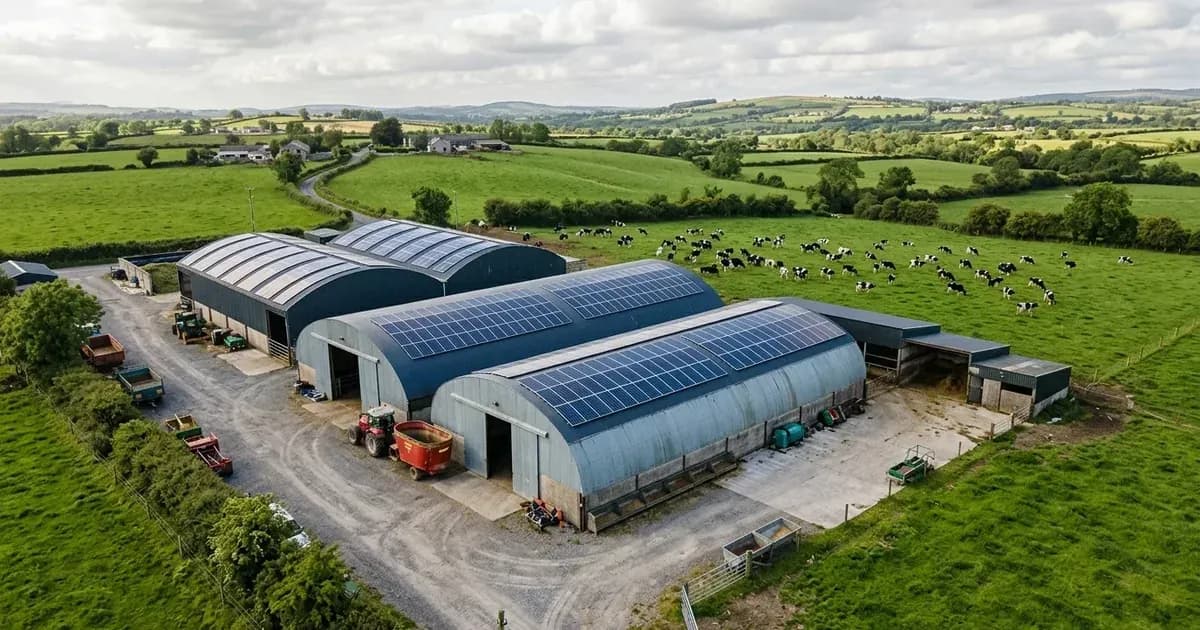
Key Takeaways
- The Solar Capital Investment Scheme (SCIS) provides financial support for installing solar PV on Irish farms.
- Eligibility requires a minimum of 5 hectares of declared land or 20 production units for intensive enterprises.
- The scheme offers a grant aid rate of 60% of eligible costs, up to a ring-fenced investment ceiling of €90,000.
- A DAFM Solar PV Survey is mandatory to ensure the system is sized for on-farm agricultural electricity demand.
What is the TAMS 3 Solar Capital Investment Scheme (SCIS)?
The Solar Capital Investment Scheme (SCIS) is a targeted grant program under TAMS 3 (Targeted Agriculture Modernisation Schemes) in Ireland. It is designed to support farmers in investing in solar photovoltaic (PV) systems to meet their on-farm electricity needs. The scheme is administered by the Department of Agriculture, Food and the Marine (DAFM) and is funded by the Irish Government, with part-financing from the European Union.
The SCIS aims to enhance the sustainability and energy independence of Irish agricultural holdings. It provides significant financial assistance for the installation of solar PV panels, helping farmers reduce operational costs and their carbon footprint. The scheme operates under specific EU and Irish regulations, including Ireland's CAP Strategic Plan 2023 – 2027.
How the SCIS Grant Operates for Irish Farms
The SCIS grant operates within the broader TAMS 3 framework, focusing specifically on solar PV investments. The core principle is to support solar installations that primarily serve the agricultural electricity demand of the farm. This means systems must be sized to meet on-farm consumption, rather than for commercial generation solely for export to the grid.
Farmers can integrate solar PV systems to power various agricultural operations. For dairy farms, this often includes synchronising with vacuum pump loads, direct expansion bulk milk cooling, and water heating, which typically peak during morning and evening milking times. Poultry farms can align solar generation with variable speed fan ventilation and cooling systems, particularly during high ambient summer temperatures when solar output is also high. Mounting hardware and inverters for poultry sheds must meet ammonia resistance requirements due to the specific environment.
The scheme provides financial aid as a percentage of eligible reference investment costs. This support is crucial for farmers looking to modernise their operations and improve energy efficiency.
SCIS Grant Rates, Investment Ceilings, and Eligibility Rules
The Solar Capital Investment Scheme offers specific financial incentives and has clear criteria for eligibility. These rules ensure that the grant aid is directed towards viable agricultural solar projects.
Requirement / Item | Specification / Threshold | Notes |
|---|---|---|
Grant Aid Rate | 60% | Of eligible reference investment costs. |
Investment Ceiling | €90,000 | Ring-fenced per holding, separate from other TAMS 3 ceilings. |
Minimum Land | 5 hectares | For registered farming holdings with declared land. |
Minimum Production Units | 20 Production Units | For intensive poultry or pig enterprises. |
On-Farm Consumption | Mandatory | System must be sized to meet on-farm agricultural demand based on a DAFM Solar PV Survey. |
Application Access | agfood account or GCPS | Online application system. |
To qualify, your farming holding must be registered and meet either the minimum land holding or production unit threshold. The system you propose must be sized based on an approved DAFM Solar PV Survey calculation, which can use electricity bills or a stock-based consumption model. This ensures the investment directly benefits the farm's agricultural activities.
Application Process, Solar PV Survey, and Payment Claim Compliance
Applying for the SCIS grant involves a structured online process through the Department of Agriculture, Food and the Marine's systems. Compliance with documentation and procedural steps is essential for a successful application and subsequent payment claim.
- Access the Application System: Log in via GCPS (Generic Claims/Payment System) using your Agent/Client User ID, Password, and PIN. Applications can also be made through your agfood account.
- Client Selection: If you are an advisor, select the relevant client from the list, searchable by Business ID or surname.
- Create Application: Choose to create a new application.
- Complete Data Capture: Navigate through various tabs including Declarations, Application Details, Production Units, Proposed Investments, Alternative Contact, and Documents Upload.
- Declarations: Complete all required declarations.
- Application Details: Enter your enterprise type (e.g., livestock, intensive), and the address of the proposed investments if different from your home address.
- Production Units: If you have an intensive enterprise, input stock numbers or hectares. A minimum of 20 production units is required for eligibility.
- Proposed Investments: Select "Solar Photovoltaic (PV) Panels". Provide an identifier from your Farmyard Layout Plan, the proposed cost, and add sub-investments with quantities or dimensions.
- Document Upload: Upload all necessary supporting documents. Crucially, a copy of the DAFM Solar PV Survey must be uploaded at the time of application. This survey calculates your farm's electricity demand and ensures the proposed solar system is appropriately sized.
- Save, Validate, and Submit: Use the "Save Draft Application" button to save your progress. "Validate Application" checks for completeness. Once satisfied, click "Submit Application". Note that amendments cannot be made after submission.
For payment claims, you must provide specific documentation:
- Receipts for work carried out by persons other than the applicant.
- Records of your own labour or machinery supplied by you or a family member.
- Ensure that any contractors meet tax clearance requirements.
What the published sources do not tell you
While the official documentation provides comprehensive details on the SCIS grant, certain practical aspects and specific calculations are not fully elaborated.
- Grid Connection Capacity: The scheme documents do not detail potential delays or limitations related to securing grid connection capacity with ESB Networks. This is a critical practical step for any solar PV installation.
- Battery Storage Reference Costs: Specific reference cost caps for battery storage components are not explicitly outlined in the provided scheme details. This can impact the grant-aided portion of systems incorporating energy storage.
- Non-Agricultural Load Allocation: The precise methodology for allocating electricity consumption between agricultural and non-agricultural (e.g., domestic house) loads, and any restrictions on grant-aiding systems that partially serve domestic demand, are not detailed. The scheme focuses on on-farm agricultural demand.
- Specific Tranche Dates: The exact dates for application submission tranches are not provided in the general scheme documents. These are typically announced separately by DAFM.
- Detailed Penalty for Export: While general penalties for non-compliance exist, detailed penalty clauses specifically for exporting solar energy beyond incidental amounts are not explicitly outlined.
- Reference Cost Calculations: The full methodology for reference cost calculations is mentioned as being in "Explanatory Notes on Costings for TAMS 3," but this document is not publicly available with the main scheme terms.
- Payment Claim Timelines: The exact timelines for processing payment claims after submission are not detailed in the user manuals.
Frequently asked questions
What is the grant rate for solar PV under TAMS 3 SCIS?
The Solar Capital Investment Scheme (SCIS) provides grant aid at an enhanced rate of 60% of eligible reference investment costs. This rate applies to approved solar photovoltaic (PV) installations on Irish farms.
What is the maximum grant amount available for farm solar PV?
The scheme has a ring-fenced investment ceiling of €90,000 per holding. This ceiling is separate from other general TAMS 3 investment ceilings.
What are the minimum eligibility requirements for land or production units?
To qualify for the SCIS, you must operate a registered farming holding with a minimum of 5 hectares of declared land. For intensive poultry or pig enterprises, a minimum of 20 production units is required.
Is a Solar PV Survey required for the application?
Yes, a DAFM Solar PV Survey is mandatory. A copy of this survey must be uploaded at the time of application for TAMS 3 Grant Aid to demonstrate the system is sized for on-farm agricultural demand.
How do I apply for the TAMS 3 SCIS grant?
Applications are made online through your agfood account or via GCPS. You will need an Agent/Client User ID, Password, and PIN to access the application form and submit supporting documents.
References
- Solar Capital Investment Scheme (SCIS) Overview — accessed 28 August 2026
- TAMS 3 Solar Terms and Conditions — accessed 28 August 2026
- Solar Capital Investment Scheme User Manual — accessed 28 August 2026
- Solar Capital Investment Scheme Marking Sheet — accessed 28 August 2026
Related guides
More from schemes, subsidies & financing.