Huawei SUN2000-10KTL-M1 10kW Three-Phase On-Grid Inverter
Rs 252,000–255,000 verified 2 Aug 2026 — the spread is real, not an estimate; see the table below for what sits at each end
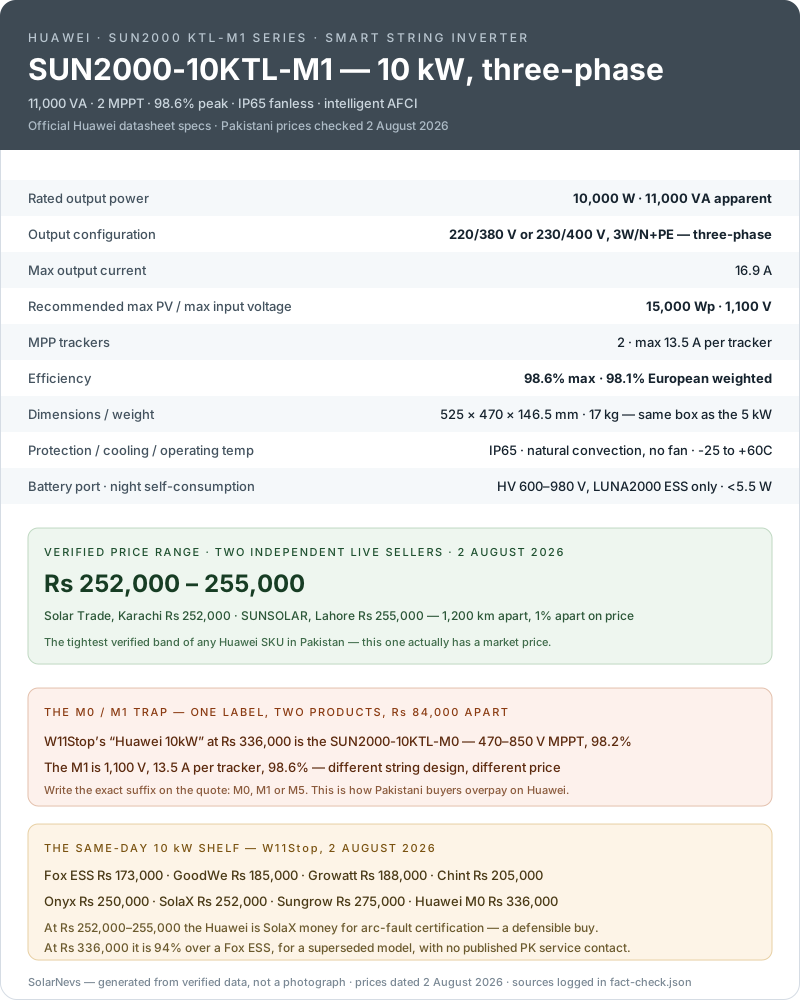
Specifications
| ratedOutput | 10,000 W |
|---|---|
| maxApparentPower | 11,000 VA |
| outputConfiguration | 220V AC / 380V AC or 230V AC / 400V AC, 3W/N+PE - three-phase |
| maxOutputCurrent | 16.9 A |
| recommendedMaxPV | 15,000 Wp |
| maxInputVoltage | 1,100 V |
| mppTrackers | 2, max 13.5 A per MPPT |
| maxEfficiency | 98.6% (European weighted 98.1%) |
| dimensions | 525 x 470 x 146.5 mm |
| weight | 17 kg |
| protection | IP65, natural convection (fanless) |
| operatingTemp | -25C to +60C |
| nightConsumption | <5.5 W |
| communication | RS485; WLAN/Ethernet via Smart Dongle-WLAN-FE; 4G via Smart Dongle-4G |
| batteryInterface | HV battery port, 600-980V operating range, LUNA2000 ESS only |
| Warranty | Huawei's Smart PV Warranty Policy (Non-European), dated 13 April 2026, gives residential inverters 10 years and C&I inverters 5. Extended cover can be bought before the standard term expires, but that document publishes no list of extension lengths or prices - it says only that the period and price depend on storage and operating conditions, so any specific extension term has to come from a written quote. SUNSOLAR advertises 5 years; Solar Trade states no term. In distribution mode the warranty starts on the 180th day after Huawei ships the unit, and cover terminates automatically if the product was transferred to a third party not named in the original sales contract. On-site labour is excluded - the standard term ships a spare part in two business days and leaves the swap to you. Get the term, the honouring party and the serial on the invoice. |
| Monitoring app | FusionSolar |
The Huawei SUN2000-10KTL-M1 is a 10kW three-phase grid-tied string inverter - 11,000 VA apparent power, two MPP trackers, 98.6% peak efficiency, 15,000 Wp recommended array, IP65 and fanless - and it is the one Huawei SKU in Pakistan with a price you can trust. On 2 August 2026 it was Rs 252,000 at Solar Trade in Karachi and Rs 255,000 at SUNSOLAR in Lahore: two independent sellers, 1,200 km apart, one percent apart on price.
That matters because the rest of the Pakistani Huawei shelf has no anchor at all. The same capacity from W11Stop is Rs 336,000 - but that listing is the older SUN2000-10KTL-M0, so it is a Rs 84,000 gap between two different products wearing the same "Huawei 10kW" label.
Specifications
Spec | Value |
|---|---|
Rated output power | 10,000 W |
Max apparent power | 11,000 VA |
Output | 220V AC / 380V AC or 230V AC / 400V AC, 3W/N+PE - three-phase |
Max output current | 16.9 A |
Recommended max PV power | 15,000 Wp |
Max input voltage | 1,100 V |
MPP trackers | 2, max 13.5 A per tracker |
Max efficiency | 98.6% (European weighted 98.1%) |
Dimensions / weight | 525 x 470 x 146.5 mm / 17 kg |
Protection / cooling | IP65 / natural convection, no fan |
Operating temperature | -25C to +60C |
Night self-consumption | <5.5 W |
Battery port | HV, 600-980V operating range - LUNA2000 ESS only |
Communication | RS485; WLAN/Ethernet or 4G via a separately-bought Smart Dongle |
Same chassis and weight as the 5kW M1 - 17 kg, identical footprint - for twice the output. If you are already committing to three-phase, the 10kW is the better engineering buy per rupee.
Honest assessment
Pros. At Rs 252,000-255,000 the value case is genuinely strong, because that is the same money as a SolaX 10kW and Rs 20,000 less than a Sungrow on W11Stop's shelf the same day. For it you get intelligent AFCI that Huawei says cuts a DC arc within 0.5 seconds, China's first CGC L4 arc-protection certification, 98.6% peak efficiency (the highest number in its class here), two MPPTs, a fanless IP65 body with no wear part to replace, and a documented optimiser path if you later want module-level shutdown and per-panel diagnostics. It is also the most familiar inverter on Pakistani net-metering and DISCO paperwork, which removes friction from an approval process that punishes obscure brands.
Cons. The upside disappears at W11Stop's Rs 336,000, where it becomes the most expensive 10kW on the shelf by Rs 61,000. It is on-grid only - no backup, no islanding operation - which since February 2026 is the wrong product shape for a home unless you add Huawei's own battery at Rs 610,000 for 7kWh. The Smart Dongle and the Rs 60,000 Smart Power Sensor are separate line items. Powerhouse Express, one of the larger listers, shows the M1 sold out with a minimum order quantity of ten, which tells you something about the volume this SKU moves. And Huawei has no Pakistani service presence to escalate to: no published hotline, no named distributor, no service address.
Who should buy. A three-phase home or small commercial site with 12-15 kWp of panels, buying at the Rs 252,000-255,000 level, that will actually consume most of what it generates. Somebody who specifically wants arc protection and optimisers on a large or shaded roof. Not somebody sizing an array to export - net billing at roughly Rs 11 per unit has ended that arithmetic - and not somebody being quoted Rs 336,000 without being told it is a different model.
Pakistan reality check
M0 and M1 are not the same inverter. W11Stop's 10kW page names the SUN2000-10KTL-M0 and quotes a 470-850V MPPT window and 98.2% efficiency. Huawei's M1 sheet says 98.6% with a 1,100V ceiling and 13.5A per tracker. Two models, one shelf label, Rs 84,000 apart. Before any comparison shop, write the exact suffix on the quote - M0, M1, or M5 - because it changes the price, the efficiency and the string design. This is the single most common way Pakistani buyers overpay on Huawei.
The warranty clock probably started before you bought it. Huawei's Smart PV Warranty Policy (Non-European), dated 13 April 2026, gives residential inverters 10 years and C&I inverters 5. But in distribution contract mode the period starts on the 180th day after Huawei ships the unit - not on your invoice date. Warehouse time is your time. Two further clauses matter in a market with no named Pakistani distributor: cover is void on parts whose serial or model information has been altered or damaged, and it "is automatically terminated" if the product was transferred to a third party not specified in the original product sales contract. Ask who bought it from Huawei. Get the answer, the serial and the term on the invoice, and photograph the label before it goes on the wall.
Nobody is coming to your roof under warranty. The standard service covers remote support (9x5 for "other countries/regions"), software updates and advance spare-parts shipment within two business days. Huawei's policy states plainly that on-site support is not included and must be bought separately, and that under the default term the customer performs the swap and returns the faulty part within 15 working days or is billed for it at list price. Practically: the seller's own technical competence is worth more than the badge on this purchase. Ask what happens on day one of a fault, in writing, before you pay.
Sizing under net billing. Net metering closed to new connections in February 2026; exports now credit at roughly Rs 11 per unit against import tariffs several times that. A 10kW three-phase array that dumps midday surplus to the grid is now optimising for the cheapest kilowatt-hour in the system. Either size the array to daytime self-consumption - offices, shops, factories with daytime load are the natural buyers of this inverter - or budget the storage. Huawei's storage path is closed: only LUNA2000 packs work, at Rs 610,000 for 7kWh at SUNSOLAR, or Rs 1,250,000 for SUNSOLAR's packaged 8kW hybrid plus 7kWh bundle. Compare that against a Solis or Deye-platform hybrid with an open battery list before you lock yourself in.
Grid alarms are the daily reality, not a defect. On weak Pakistani feeders the alarms you will actually see are 2032 grid failure during load shedding, 2033 undervoltage, 2034 overvoltage where a 230V feeder legally sits near 253V, and 2062 low insulation resistance in monsoon humidity. Huawei's guidance on the grid family is that occasional occurrences self-clear and frequent ones mean the network is out of band and the power operator should be called - and that widening the trip threshold requires the operator's consent. Installers here widen it anyway to stop customers complaining. That is a bypass, not a repair. Our SUN2000 error-code guide covers the full alarm set and which ones mean stop and call someone.
Monitoring and its Android catch. FusionSolar is the only platform for this inverter - Solarman and SmartESS are other brands' systems and do not connect to a SUN2000. Huawei's own installer FAQ routes Android users to Huawei AppGallery, the solar.huawei.com website download or a QR code; Google Play is not among the options. iOS is a normal App Store install. Register the plant in your own name, and get written confirmation of who holds the installer account, because the Cause ID that identifies a failed component is only visible at that level.
Mounting. IP65, fanless, -25C to +60C. Convection cooling means it needs clearance above and below and shade in summer. North or east wall, out of direct afternoon sun; a west wall in Multan or Sukkur in June will cost you yield and life.
Price context vs rivals (August 2026)
W11Stop's 10kW three-phase on-grid shelf, all opened 2 August 2026, with the two live Huawei M1 listings placed at their real prices:
10kW on-grid inverter | Price (2 Aug 2026) | Where |
|---|---|---|
Fox ESS T10-G3 | Rs 173,000 | W11Stop |
GoodWe 10kW | Rs 185,000 | W11Stop |
Growatt 10kW X2 Pro | Rs 188,000 | W11Stop |
Hopewind 10kW | Rs 190,000 | W11Stop |
Growatt MOD 10KTL3-X2 Pro | Rs 193,000 | W11Stop |
Chint 10kW | Rs 205,000 | W11Stop |
Onyx 10kW | Rs 250,000 | W11Stop |
Huawei SUN2000-10KTL-M1 | Rs 252,000 | Solar Trade, Karachi |
SolaX 10kW | Rs 252,000 | W11Stop |
Huawei SUN2000-10KTL-M1 | Rs 255,000 | SUNSOLAR, Lahore |
Sungrow 10kW | Rs 275,000 | W11Stop |
Huawei SUN2000-10KTL-M0 | Rs 336,000 | W11Stop - different SKU |
The whole Huawei premium argument turns on which of those two Huawei rows you buy. At Rs 252,000-255,000 you are paying SolaX money for arc-fault certification and the largest inverter manufacturer in the world - a straightforward yes. At Rs 336,000 you are paying 94% more than a Fox ESS for a superseded model, in a country where Huawei publishes no service contact. Same brand, same capacity, opposite verdicts. The brand hub has the rest of the shelf and the warranty small print.
Frequently asked questions
What does the Huawei SUN2000-10KTL-M1 cost in Pakistan?
Rs 252,000-255,000 as of 2 August 2026 - Solar Trade in Karachi at Rs 252,000 and SUNSOLAR in Lahore at Rs 255,000, both naming the M1. That 1% spread is the tightest verified price band we have found for any Huawei SKU in Pakistan and makes this the one Huawei model with something like a real market price.
Why does W11Stop list a 10kW Huawei at Rs 336,000 then?
Because it is a different product. W11Stop's page names the SUN2000-10KTL-M0, an earlier three-phase model with 470-850V MPPT range and 98.2% efficiency, against the M1's 98.6%. "Huawei 10kW" covers at least two SKUs in Pakistan at a Rs 84,000 gap, which is exactly why the full model string belongs on the invoice.
Is 10kW too big for a Pakistani home?
Usually, and the sizing question is the real one. The M1 recommends up to 15,000 Wp of panels - roughly 25 modules at 600W - and is three-phase, which most domestic connections are not. Since net metering closed to new connections in February 2026 and exports credit at about Rs 11 per unit, a 10kW array sized for export no longer pays the way it did. Size to self-consumption, or add storage.
Can I add a LUNA2000 battery to this later?
Yes, through the HV battery port (600-980V operating range), and only a Huawei battery. No Pylontech, Dyness, BYD or local pack will work. On 2 August 2026 a LUNA 7kW HV module was Rs 610,000 at SUNSOLAR, and SUNSOLAR's packaged 8kW hybrid plus 7kWh battery was Rs 1,250,000. That is the real cost of the "battery-ready" line in the sales pitch.
Is Huawei worth Rs 336,000 when Fox ESS 10kW is Rs 173,000?
Not at Rs 336,000. On W11Stop's own shelf on 2 August 2026 the 10kW on-grid rack ran Fox ESS T10-G3 Rs 173,000, GoodWe Rs 185,000, Growatt Rs 188,000, Hopewind Rs 190,000, Chint Rs 205,000, Onyx Rs 250,000, SolaX Rs 252,000 and Sungrow Rs 275,000. At Rs 252,000-255,000 from Solar Trade or SUNSOLAR, Huawei sits level with SolaX and below Sungrow - and at that price the arc protection, the optimiser ecosystem and the tier-one badge are a defensible buy.
What is not in the quote?
The Smart Dongle for WLAN or 4G monitoring, and the Smart Power Sensor - Rs 60,000 at W11Stop - which is the part that performs export limiting and which the FusionSolar alarm 2067 complains about when it goes missing or misconfigured. Optimisers are extra again. Ask for a line-itemised quote before comparing two dealers' totals.
References
- Huawei official - SUN2000-3/4/5/6/8/10KTL-M1 specifications — accessed 2 Aug 2026
- Huawei official - SUN2000-M1 three-phase product page (AFCI 0.5s, CGC L4, 1400+ tests, up to 30% optimiser yield claim) — accessed 2 Aug 2026
- Huawei official - Smart PV Warranty Policy (Non-European), document dated 2026-04-13 — accessed 2 Aug 2026
- Solar Trade (Karachi) - HUAWEI SUN2000-10KTL-M1 Three Phase, Rs 252,000 — accessed 2 Aug 2026
- SUNSOLAR - Huawei 10KW Sun2000-M1 Ongrid Inverter (5Y), Rs 255,000, in stock — accessed 2 Aug 2026
- W11Stop - Huawei 10kW On-Grid [SUN2000-10KTL M0], Rs 336,000, price dated 2 August 2026, In Stock — accessed 2 Aug 2026
- W11Stop - on-grid inverter shelf, rival 10kW prices same store and day — accessed 2 Aug 2026
- W11Stop - Huawei Solar category (Smart Power Sensor Rs 60,000) — accessed 2 Aug 2026
- Powerhouse Express - SUN2000-10KTL-M1 listing: sold out, Rs 0, minimum order quantity 10 — accessed 2 Aug 2026
- Quantum Mechanics (Pvt) Ltd - SUN2000-3/4/5/6/8/10KTL page, no price published — accessed 2 Aug 2026
- SUNSOLAR - Huawei 8kW Hybrid Inverter + 7kWh Battery (HV 3 Phase) (10Y), Rs 1,250,000 — accessed 2 Aug 2026
- SUNSOLAR - Huawei Luna 7KW HV Battery IP20 (5Y), Rs 610,000 — accessed 2 Aug 2026
- Huawei Smart PV Pakistan - official Pakistan residential lineup (MAP0 / MB0 / LUNA2000-S1 / SmartGuard) — accessed 2 Aug 2026
- Huawei official installer FAQ - FusionSolar app download routes (AppGallery / website / QR, no Google Play) — accessed 2 Aug 2026
- Solar Citizen - Huawei price guide, SUN2000-10KTL banded at Rs 2.5-3.5 lakh (published 24 Apr 2026, last verified 19 May 2026 - stale) — accessed 2 Aug 2026