Knox Krypton Eco 4000 3 kW Hybrid Solar Inverter (PV4000, 24 V)
Rs 73,000–90,000 verified 2 Aug 2026 — the spread is real, not an estimate; see the table below for what sits at each end
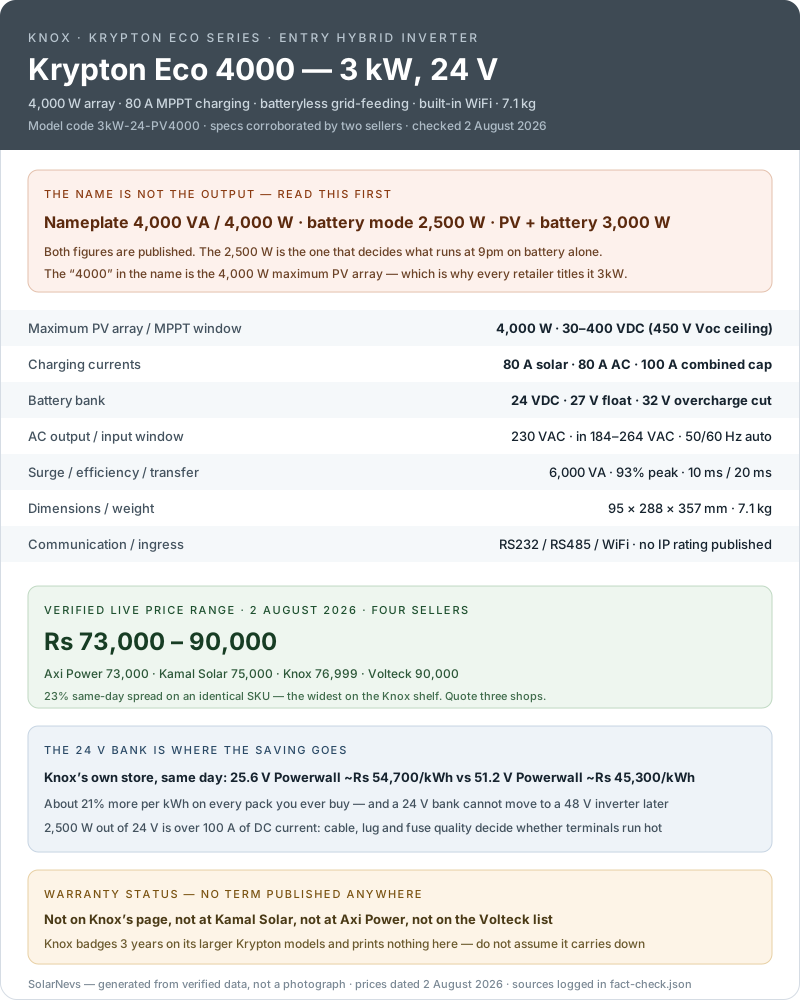
Specifications
| type | Single-phase hybrid, on-grid with storage; batteryless grid-feeding supported |
|---|---|
| modelCode | 3kW-24-PV4000 (retailer spec table) |
| nameplateRatedPower | 4,000 VA / 4,000 W |
| batteryModePowerW | 2500 |
| pvPlusBatteryOutputPowerW | 3000 |
| ratingConflictWarning | The badge says 4000 and the nameplate says 4,000 VA / 4,000 W, but the same spec table gives 2,500 W in battery mode and 3,000 W PV-plus-battery output - which is why every Pakistani retailer titles it 3kW. Size loads to 2,500 W on battery, not 4,000 W. |
| maxPVArrayPowerW | 4000 |
| mpptVoltageRangeVDC | 30-400 |
| maxPVOpenCircuitVoltageVDC | 450 |
| maxSolarChargingCurrentA | 80 |
| maxACChargingCurrentA | 80 |
| maxTotalChargingCurrentA | 100 |
| batteryVoltageVDC | 24 nominal, 27 float, 32 overcharge protection |
| acOutputVoltage | 230 VAC nominal; 184-264 VAC / 195.5-253 VAC windows |
| frequency | 50 / 60 Hz auto-sensing |
| transferTimeMs | 10 (PCs) / 20 (appliances) |
| surgePowerVA | 6000 |
| peakEfficiencyPct | 93 |
| dimensionsMm | 95 x 288 x 357 |
| weightKg | 7.1 |
| ipRating | Not published; Knox's page describes a built-in anti-dust kit, which is not an ingress rating |
| communication | RS232 / RS485 / built-in WiFi; Android and iOS app; BMS supported, no protocol named |
| bmsProtocolList | None published |
| warranty | Not stated on Knox's product page or on any retailer listing opened 2 August 2026 |
| Warranty | No warranty term is published for this model anywhere SolarNevs could open on 2 August 2026 - not on Knox's own product page, not at Kamal Solar, not at Axi Power, not on the Volteck price list. Knox badges 3 Years Warranty on its larger Krypton 9000 and 9055 pages but prints nothing on the Eco 4000, and its FAQ states only that warranty details vary by model and that claims need the invoice and serial number. Treat the term as unknown and get it handwritten on the invoice before paying. |
| Monitoring app | Built-in WiFi with Android and iOS app support per Knox's product page. No app is named by Knox; retailers name SmartESS on sibling Krypton models. Have the dealer log in on the actual unit before payment. |
The Knox Krypton Eco 4000 is the cheapest hybrid inverter Knox sells and one of the cheapest in Pakistan: Rs 73,000 to Rs 90,000 (verified 2 August 2026) across four live listings, a 23% same-day spread on an identical SKU. It is a small 7.1 kg wall unit that takes 4,000 W of array, feeds the grid with no battery fitted, and carries built-in WiFi.
Two things about it are not obvious from the price, and both cost money later. It is badged 4000 and its nameplate reads 4,000 VA / 4,000 W, but the same spec table gives 2,500 W in battery mode and 3,000 W PV-plus-battery output - which is why every Pakistani retailer titles it "3kW". And it is the only current Krypton hybrid on a 24 VDC bank, in a market where everything else is 48 V. Those are the two sentences to read before you buy the cheapest hybrid on the shelf.

Read this before you buy: the 4000 is not the output
Knox's own product page and Kamal Solar's independent spec table agree, and together they tell the whole story:
Figure | Value | What it actually is |
|---|---|---|
Model name | Krypton Eco 4000 | The 4,000 W maximum PV array |
Nameplate rated power | 4,000 VA / 4,000 W | The inverter's headline rating |
Battery mode power | 2,500 W | What you get from the battery during load shedding |
PV + battery output power | 3,000 W | What you get with sun and battery together |
Nothing here is hidden - both figures are published - but the name and the nameplate are the ones a buyer reads, and the 2,500 W is the one that decides whether the fridge and the fans and the water pump all run at 9pm. Size the evening load to 2,500 W. If you need more than that on battery, this is the wrong inverter and no discount fixes it.
Specifications
Specification | Value |
|---|---|
Type | Single-phase hybrid, on-grid with storage; batteryless grid-feeding supported |
Model code (retailer spec table) | 3kW-24-PV4000 |
Nameplate rated power | 4,000 VA / 4,000 W |
Battery mode power | 2,500 W |
PV + battery output power | 3,000 W |
Maximum PV array power | 4,000 W |
MPPT operating voltage range | 30-400 VDC |
Maximum PV open-circuit voltage | 450 VDC |
Maximum solar charging current | 80 A |
Maximum AC charging current | 80 A |
Maximum total charging current | 100 A |
Battery voltage | 24 VDC nominal, 27 VDC float, 32 VDC overcharge protection |
AC output | 230 VAC nominal; 184-264 VAC / 195.5-253 VAC windows |
Frequency | 50 / 60 Hz auto-sensing |
Surge power | 6,000 VA |
Transfer time | 10 ms (PCs) / 20 ms (appliances) |
Peak efficiency | 93% |
Dimensions / weight | 95 x 288 x 357 mm / 7.1 kg |
IP ingress rating | Not published (page describes a built-in anti-dust kit) |
Communication | RS232 / RS485 / built-in WiFi; Android and iOS app |
Published BMS protocol list | None |
Warranty | Not published for this model by Knox or any retailer opened today |
Power, MPPT, charging, battery, AC, surge, efficiency and mechanical rows appear on both Knox's own product page and Kamal Solar's spec table; the battery-mode and PV-plus-battery output figures come from Kamal Solar and are consistent with every retailer titling the unit 3kW.
Honest assessment
What holds up. For Rs 73,000-77,000 you get a real MPPT charge controller with an unusually wide 30-400 VDC operating window and a 450 V ceiling, 80 A of solar charging, a 100 A combined charging cap, 6,000 VA of surge for a motor start, batteryless grid-feeding so the unit is useful before you can afford storage, built-in WiFi rather than a paid dongle, and a 93% peak efficiency figure that is honest for the class. The 184-264 VAC input window handles Pakistani feeder swing. At 7.1 kg it mounts anywhere indoors and one person can carry it. Two independent sources publish the same spec table, so this is corroborated data, not one shop's copy.
What does not. The naming, first: a unit sold as "4000" that delivers 2,500 W from battery invites a mis-sized system, and the number a buyer needs most is the one furthest down the page. The 24 V bank, second - see below, it is the expensive part. Then the usual Knox gaps: no IP rating (an "anti-dust kit" is a filter, not an ingress class), no datasheet PDF or manual, no BMS protocol list despite BMS support being advertised, and - uniquely on this model - no published warranty term at all, on Knox's page or any retailer's. Knox badges 3 Years on the bigger Krypton 9000 and 9055 and prints nothing here; do not assume it carries down.
Owner feedback: none exists, and SolarNevs will not invent sentiment. The Daraz listing for this model shows "No Ratings" and no independent long-form owner account was retrievable on 2 August 2026.
Who should buy. A first solar step on a small load: lights, fans, a fridge, a TV, a router - under 2,500 W in the evening - bought in person from a dealer who will write the warranty on the invoice, with either no battery at all (grid-feeding mode) or a modest 24 V bank the buyer accepts as a dead end. Who should not. Anyone planning to grow the system, anyone with an air conditioner or a pump on the backup circuit, anyone who wants 48 V lithium, and anyone buying online sight-unseen.
Pakistan reality check
The 24 V bank is where the saving goes. This is the only current Krypton hybrid on 24 VDC; the Krypton 6000, 9000, 9055 and everything above run 48 V. Two consequences. First, price per stored kWh: on Knox's own store on 2 August 2026 the 25.6 V Powerwall 3.1 is Rs 139,999 for 2.56 kWh - about Rs 54,700 per kWh - while the 51.2 V Powerwall 6.1 is Rs 231,999 for 5.12 kWh, about Rs 45,300 per kWh. The low-voltage route costs roughly 21% more per kWh at the same shop, on the same day, from the same brand. Second, the bank is not portable: a 24 V pack cannot be reused when you upgrade to a 48 V inverter, so the Rs 21,000-38,000 saved against the 48 V Krypton 6000 is spent again the first time the system grows. Third, physics: 2,500 W out of a 24 V bank is well over 100 A through the DC cabling, so cable sizing, lug quality and fuse rating matter more here than on a 48 V system - a cheap install on this unit is a hot-terminal install.
No IP rating means indoors, and this one is fan-and-filter cooled. Knox publishes IP66 only for Xenon and Zynex; the Krypton platform is described by retailers as IP21, and this page offers an "anti-dust kit" instead of an ingress class. Mount it inside, shaded, with clearance, and clean the filter before each summer. Locked-fan and over-temperature are the two most common faults on this platform in Punjab and Sindh - see the Knox error-code guide.
Cold mornings decide your string, not hot afternoons. MPPT window 30-400 VDC, absolute ceiling 450 VDC. Panel open-circuit voltage rises as cell temperature falls, so a string sized against a June reading in Multan can breach 450 V on a clear January morning in Islamabad - and the PV over-voltage fault appears months after the installer has been paid. Size to winter Voc.
Lithium is open-loop until proven otherwise. Knox advertises BMS support and lists RS232/RS485 ports, but names no protocol, no battery brand and no firmware version anywhere. On a 24 V bank with 100 A of combined charging current, wrong voltage settings are how packs get cooked. Set the parameters manually against the battery manufacturer's numbers, and get the battery brand plus the settings used written on the handover note.
Warranty: unknown, and that is the finding. Knox prints no term on this page; nor does Kamal Solar, Axi Power or the Volteck list. Knox's FAQ states only that "warranty details vary by product model" and that claims need "your invoice and product serial number", and Knox publishes no service-centre address beyond one Lahore office (69 Gulshan Block, Allama Iqbal Town). On a Rs 73,000 unit that is a real risk, not a formality: make the seller handwrite the duration, the covered parts and the physical claim address on the invoice, and photograph the rating plate before it is wallboxed.
Do not confuse the families. "Eco" is a different and weaker product from the same-numbered Krypton, the Argon VM II is off-grid rather than hybrid, and the Krypton 6000 - a 4 kW, 48 V hybrid at Rs 111,000-118,000 - is the model most buyers who outgrow this one actually want.
Price context vs rivals (August 2026)
The like-for-like comparison at this price is thin, because almost nothing else in Pakistan sells a hybrid this cheap. Same store, same day - Volteck, 2 August 2026:
Entry hybrid | Price (2 Aug 2026) | Class |
|---|---|---|
Fronus PV 2200 | Rs 60,000 | 1.6 kW hybrid |
Fronus PV 3200 | Rs 70,000 | 2.6 kW hybrid |
Knox Krypton Eco 4000 | Rs 73,000 - 90,000 | 3 kW hybrid, 24 V (2,500 W on battery) |
Knox Argon VM II 3 kW PV4000 | Rs 79,000 | 3 kW off-grid |
Knox Krypton 6000 | Rs 111,000 - 118,000 | 4 kW hybrid, 48 V |
Knox Krypton Eco 5000 | Rs 97,000 - 105,000 | 4.2 kW, batteryless MPPT |
The honest framing of this shelf: at the Rs 73,000 end the Eco 4000 is excellent value for a small, static, grid-feeding install. At the Rs 90,000 end it is Rs 20,000 away from the 48 V Krypton 6000, which is the version you can still expand - and that is the comparison to run in the shop, because the difference in battery cost per kWh will exceed the difference in inverter price on the very first pack.
Related
- Knox brand hub - the full lineup, the three-website corporate picture and the warranty conflict
- Knox Krypton 9055 - the 6.5 kW dual-MPPT flagship at the other end of the range
- Knox inverter error codes - the fault table for this platform
- Fronus batteries - the low-cost storage brand these units usually get paired with
Frequently asked questions
What is the price of the Knox Krypton Eco 4000 in Pakistan?
Rs 73,000 to Rs 90,000, verified across four live listings on 2 August 2026 - Rs 73,000 at Axi Power, Rs 75,000 at Kamal Solar, Rs 76,999 on Knox's own store and Rs 90,000 at Volteck. That is a 23% same-day spread on an identical SKU, the widest on the Knox shelf, so quote at least three sellers before paying.
Is the Krypton Eco 4000 a 3 kW or a 4 kW inverter?
Both numbers are printed, and the difference matters. Its nameplate rated power is 4,000 VA / 4,000 W, but the same spec table gives battery-mode power as 2,500 W and PV-plus-battery output as 3,000 W - which is why every Pakistani retailer titles it 3kW. On a load-shedding evening running from the battery alone, plan for 2,500 W, not 4,000 W. The 4000 in the name also matches the 4,000 W maximum PV array.
Why does the 24 V battery bank matter on this model?
Because it is the hidden cost. The Eco 4000 is the only current Krypton hybrid on a 24 VDC bank while the rest of the line - and effectively the rest of the market - is 48 V. On Knox's own store on 2 August 2026 the 25.6 V Powerwall 3.1 gives 2.56 kWh for Rs 139,999 (about Rs 54,700 per kWh) while the 51.2 V Powerwall 6.1 gives 5.12 kWh for Rs 231,999 (about Rs 45,300 per kWh). Saving Rs 38,000 against the cheapest 48 V Knox hybrid - the Krypton 6000 at Rs 111,000 - can cost you roughly 21% more per kWh on every battery you ever buy for it, and you cannot move that bank to a 48 V inverter later.
How much solar can the Krypton Eco 4000 take?
4,000 W of array with an MPPT operating window of 30-400 VDC and a 450 VDC maximum open-circuit ceiling, at 80 A maximum solar charging current. Maximum AC charging is also 80 A and total combined charging is capped at 100 A. Size string open-circuit voltage to 450 V absolute using cold-morning figures, because panel Voc rises as cell temperature falls.
What warranty comes with the Krypton Eco 4000?
None is published. Knox prints no warranty term on this product page, and neither Kamal Solar, Axi Power nor the Volteck price list states one - while Knox badges 3 Years on its larger Krypton 9000 and 9055 pages. Knox's FAQ says only that warranty details vary by product model. Do not assume the 3-year badge carries down the range; get the term handwritten on the invoice.
Can I mount the Krypton Eco 4000 outdoors?
No IP rating is published for it. Knox's page mentions a built-in anti-dust kit, which is a filter, not an ingress rating, and Knox badges IP66 only on its Xenon and Zynex lines. At 7.1 kg and 95 mm deep this is a small indoor wall unit - mount it shaded, ventilated and inside.
References
- KNOX Pakistan - Krypton Eco 4000 product page (price and full spec list) — accessed 2 Aug 2026
- Kamal Solar - Krypton Eco PV-4000 (model code, battery-mode and PV+battery output figures) — accessed 2 Aug 2026
- Axi Power - Krypton Eco 4000 3kW (Rs 73,000, in stock) — accessed 2 Aug 2026
- Volteck - Knox price list (ECO-4000 3kW Rs 90,000) — accessed 2 Aug 2026
- Volteck - all-brand inverter shelf (rival prices, same store) — accessed 2 Aug 2026
- KNOX Pakistan - home page (Powerwall battery prices and capacities) — accessed 2 Aug 2026
- KNOX Pakistan - FAQs (warranty wording, no durations) — accessed 2 Aug 2026
- KNOX Pakistan - Contact Us (single Lahore address) — accessed 2 Aug 2026
- Knox Solar (knoxpv.com) - Krypton Eco 4000 shop page (no price, no specs published) — accessed 2 Aug 2026
- Daraz - Krypton Eco 4000 listing, titled 3KW with 4000W PV, No Ratings — accessed 2 Aug 2026
- Burn Cart - sibling Krypton 8000 sold as Pure Voltronic with SmartESS and IP21 — accessed 2 Aug 2026