Ziewnic Max Dual Series PV7000 Solar Hybrid Inverter (marketed 5.5 kW)
Rs 154,000 verified 25 Jul 2026 — prices in Pakistan move weekly
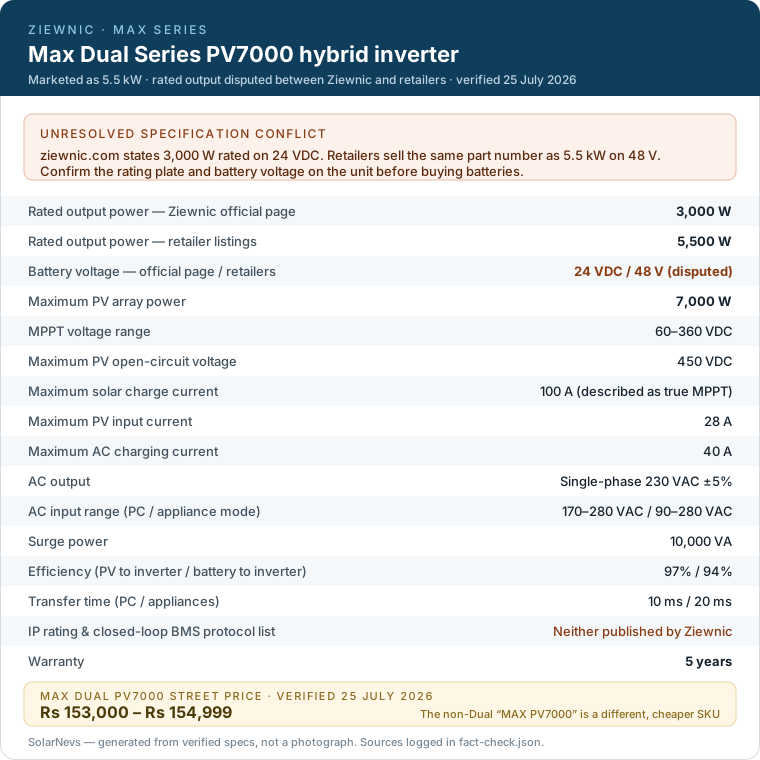
Specifications
| type | Hybrid (solar / battery / grid, dual load output) |
|---|---|
| ratedOutputPowerW_ziewnicOfficialPage | 3000 |
| ratedOutputPowerW_retailerClaim | 5500 |
| ratingConflictWarning | UNRESOLVED. Ziewnic's own product page for SOLAR HYBRID INVERTER MAX PV7000 gives rated power 3,000 W on a 24 VDC bank; retailers sell a MAX DUAL (5.5 KW) PV7000 at 48 V. PV7000 denotes maximum PV array watts, not inverter output. Confirm the rating plate and battery voltage before ordering batteries. |
| maxPVInputPowerW | 7000 |
| batteryVoltageVDC_ziewnicOfficialPage | 24 |
| batteryVoltageVDC_retailerClaim | 48 |
| mpptRangeVDC | 60-360 (Ziewnic official page); retailers state 60-450 |
| maxPVOpenCircuitVoltageVDC | 450 |
| maxSolarChargeCurrentA | 100 (described as TRUE MPPT) |
| maxPVInputCurrentA | 28 |
| maxACChargingCurrentA | 40 |
| maxCombinedChargingCurrentA_retailerClaim | up to 160 A (AC + solar) — retailer figure only |
| phases | Single-phase, 230 VAC +/-5% |
| acInputVoltageRangeVAC | 170-280 (PC mode) / 90-280 (appliance mode) |
| surgePowerVA | 10000 |
| efficiencyPVtoInverterPct | 97 |
| efficiencyBatteryToInverterPct | 94 |
| maxSolarChargerEfficiencyPct | 98 |
| transferTimeMs | 10 (PC) / 20 (appliances) |
| operatingTemperatureC | 0 to 50 |
| storageTemperatureC | -15 to 60 |
| humidity | 5-95% RH non-condensing |
| dimensionsMm | Not published by Ziewnic |
| ipRating | Not stated by Ziewnic; retailers claim IP21 — unverified |
| batteryChemistrySupport | Retailers list lithium / LiFePO4 / AGM / gel / lead-acid; Ziewnic marketing says compatible with all lithium batteries |
| bmsProtocols | None published |
| monitoring | Wi-Fi optional (iOS / Android); dongle not included |
| warrantyYears | 5 |
| Warranty | Five years, stated by Idrees Electronics and ShahrukhSolarHouse on 2026-07-25 and consistent with the five-year badge on Ziewnic's Z5 and Diamond datasheets. Ziewnic publishes no Max-series catalogue PDF, so the warranty term is retailer-stated rather than datasheet-printed for this line. No sourced account of a claim outcome exists. |
| Monitoring app | "ziewnic inverter" (Android com.eybond.ziewnicsmart, iOS id6739390671), published by Growatt Pk Private Limited. Wi-Fi requires an optional dongle that is not included. |
The Ziewnic Max Dual Series PV7000 is a single-phase hybrid solar inverter with a 7,000 W maximum PV array and dual load outputs, sold in Pakistan at Rs 153,000 to Rs 154,999 (verified 2026-07-25). Its rated output power is genuinely disputed: Ziewnic's own product page states 3,000 W on a 24 VDC bank while retailers market the same part number as 5.5 kW on 48 V, so SolarNevs does not publish a single rated power for this model.

Read this before you buy: two different products share one part number
On 2026-07-25 the "MAX - DUAL SERIES (5.5 KW) PV7000" was Rs 154,999 in stock at Power Plus Generator (marked down from Rs 159,999) and Rs 153,000 at Solar-Inverters.pk in Lahore, while a separate non-Dual "MAX (5.5 KW) PV7000" sold for Rs 109,999 at Onestopmall.pk and Rs 110,000 at Idrees Electronics. A 41% gap is a different product, not city price variance — if a quote for a "Dual" unit comes in around Rs 110,000, ask what is actually in the box.
"PV7000" is the 7,000 W PV-array ceiling, not the inverter's output — and the rated power is contradicted by the manufacturer's own site. Ziewnic's page for SOLAR HYBRID INVERTER MAX PV7000 gives "RATED POWER 3000W", "Battery Voltage 24 VDC" and "Floating Charge Voltage 27.4 VDC"; ShahrukhSolarHouse lists the Dual as "System Voltage: 48V, Power Output: 5.5KW"; Idrees Electronics sells it under a "5.5 KW" title while reprinting Ziewnic's own 3,000 W / 24 VDC table underneath — the channel is copy-pasting, not checking. Ziewnic publishes no Max-series catalogue PDF that would settle it. {/* VERIFY */}
Specifications
Specification | Value |
|---|---|
Type | Hybrid, dual load output |
Rated output power — Ziewnic official page | 3,000 W |
Rated output power — retailer listings | 5,500 W (disputed) |
Battery voltage — official page / retailers | 24 VDC / 48 V (disputed) |
Maximum PV array power | 7,000 W |
MPPT voltage range | 60–360 VDC (retailers state 60–450) |
Maximum PV open-circuit voltage | 450 VDC |
Maximum solar charge current | 100 A (described as true MPPT) |
Maximum PV input current | 28 A |
Maximum AC charging current | 40 A |
Maximum combined charging current | Up to 160 A (retailer figure only) |
AC output | Single-phase 230 VAC ±5% |
AC input range | 170–280 VAC (PC mode) / 90–280 VAC (appliance mode) |
Surge power | 10,000 VA |
Efficiency, PV to inverter | 97% |
Efficiency, battery to inverter | 94% |
Maximum solar charger efficiency | 98% |
Transfer time | 10 ms (PC) / 20 ms (appliances) |
Operating temperature | 0 to 50 °C |
Storage temperature | -15 to 60 °C |
Humidity | 5–95% RH non-condensing |
Dimensions and weight | Not published by Ziewnic |
IP ingress rating | Not published by Ziewnic |
Closed-loop BMS protocols | Not published by Ziewnic |
Monitoring | Optional Wi-Fi dongle, not included |
Warranty | 5 years (retailer-stated) |
Solar-charger, efficiency, surge and temperature rows come from Ziewnic's own MAX PV7000 product page, fetched 2026-07-25. Retailer-only figures are labelled as such.
Honest assessment
What holds up. The solar-charger block is the most credible part of this unit and is stated consistently by Ziewnic itself: 7,000 W of array, a 450 V open-circuit ceiling, 100 A of true-MPPT charge current at 98% charger efficiency, and a 90–280 VAC appliance-mode input window well matched to Pakistani grid behaviour.
What does not. The rating conflict is the manufacturer's own documentation failure, not a rumour — a buyer sizing a battery bank needs to know 24 V from 48 V and 3 kW from 5.5 kW. Beyond that: no published dimensions, IP rating or Max-series datasheet (Ziewnic publishes a full PDF for the Z5; for Max you are buying from retailer copy), no BMS protocol list (open-loop lithium only, on a bank voltage you must confirm yourself), and mixed line-health signals — Max is absent from Ziewnic Global's export site, the Max PV2500 was sold out, and the Max Dual PV5000 was out of stock at two of three retailers on 2026-07-25.
Owner feedback: none exists for this model, and SolarNevs will not invent sentiment. No model-specific reviews were retrievable on 2026-07-25 and Ziewnic's official Daraz storefront carries no rating base; the brand's only numerically rated owner signal is the separate ZIEWNIC storage app at 1.0 out of 5 from 4 App Store ratings — four people, about software.
Who should buy it. Someone standing in a shop who can read the rating plate, confirm 48 V and a 5.5 kW nameplate, and wants 7 kW of array capacity in one box with a service centre in their city. Who should not: anyone buying online sight-unseen, anyone who needs published mechanical or ingress data, and anyone ordering the battery bank before the inverter arrives.
Pakistan reality check
Heat and dust. Rated 0 to 50 °C — the bottom of that band is ten degrees narrower than the Z5's -10 °C, which matters for northern winters. No IP rating is published; the IP21 retailers assert appears on no Ziewnic document (ingress ratings are marketed only on Roux, IP54, and Lenox, IP65). Mount indoors, shaded, with airflow, and clean the intake before summer.
Grid instability. Appliance-mode AC input down to 90 VAC handles deep brownouts, and 10,000 VA of surge covers a motor start. Since the NEPRA Prosumer Regulations of February 2026 moved Pakistan from net metering to net billing, size to self-consumption rather than export.
Service. Ziewnic's 18 branded service centres with published addresses and direct mobile numbers cover Punjab, Sindh and Khyber Pakhtunkhwa — none in Balochistan, Islamabad proper, Azad Jammu and Kashmir or Gilgit-Baltistan. Given the Max line is absent from Ziewnic's own export catalogue, ask the centre directly whether it stocks Max boards before you commit.
Counterfeit and mislabelling. Targeted searches on 2026-07-25 found no counterfeit reports, recall notices or brand warnings, and no serial-verification portal exists, so that silence is weak evidence either way. The evidenced risk on this SKU is Dual/non-Dual label confusion at a roughly Rs 43,000 price difference: buy from a dealer on Ziewnic's own where-to-buy or service-centre lists, insist on a printed invoice naming the exact variant, and photograph the rating plate.
Warranty. Five years, stated by retailers and consistent with the badge on Ziewnic's other datasheets — but not datasheet-printed, because there is no Max datasheet. No sourced first-hand account of a claim outcome exists in either direction.
Price context
At Rs 153,000–154,999 (verified 2026-07-25) the Max Dual PV7000 is priced above Ziewnic's own Z5 PV8500 at Rs 124,999–145,999 — the awkward comparison, because the Z5 has a full published datasheet, an unambiguous 6,500 W rating on a documented 48 V bank, and a wider -10 to 50 °C range. On documentation alone the Z5 is the safer buy at less money.
Against other brands it sits in the same 5 kW-class single-phase hybrid bracket as the Inverex Veyron II 6kW, the Fronus PV5200 and the Crown Micro Elego-VI-6KW IP21; SolarNevs has not independently verified those rivals' street prices as of 2026-07-25 and does not borrow figures between pages. One last data point on how polluted this SKU's pricing is online: an EMD-style micro-site quoted Rs 409,000 for the same unit — excluded from every figure above, and a reminder that a Ziewnic price on a search-results page is not a market price.
Related
- Ziewnic brand hub — ownership, service network, warranty reality
- Ziewnic Z5 6.5 kVA 6G PV8500 — better-documented 48 V alternative
- Ziewnic Z5 4.5 kVA 6G PV6500 — the 24 V entry unit
- Ziewnic error codes — fault-code reference (codes observed only; no manufacturer table published)
Frequently asked questions
What is the price of the Ziewnic Max Dual PV7000 in Pakistan?
Rs 153,000 to Rs 154,999 (verified 2026-07-25) — Rs 154,999 in stock at Power Plus Generator and Rs 153,000 at Solar-Inverters.pk in Lahore. Listings around Rs 110,000 are for the non-Dual "MAX (5.5 KW) PV7000", which is a different SKU; the only Dual-titled listing near that price was marked out of stock.
Is the Ziewnic Max PV7000 really 5.5 kW?
Unresolved, and it matters. Ziewnic's own product page for SOLAR HYBRID INVERTER MAX PV7000 states rated power 3,000 W on a 24 VDC battery bank, while retailers sell a MAX DUAL (5.5 KW) PV7000 at 48 V. PV7000 refers to the 7,000 W maximum PV array, not to inverter output. SolarNevs will not publish a single rated power until a rating plate photo or a Max-series datasheet exists — read the plate on the unit before you buy batteries.
Is the Ziewnic Max PV7000 a 24 V or 48 V inverter?
Disputed. Ziewnic's own page specifies 24 VDC with a floating charge voltage of 27.4 VDC; ShahrukhSolarHouse and other retailers list the Dual variant as 48 V. Because the battery bank is the most expensive decision in the system, confirm the voltage on the rating plate in the shop before ordering a single cell.
How many panels can the Ziewnic Max PV7000 take?
Maximum PV array power is 7,000 W with an MPPT range of 60–360 VDC, a maximum PV open-circuit voltage of 450 VDC, a maximum PV input current of 28 A and 100 A of solar charge current described as true MPPT (ziewnic.com product page, fetched 2026-07-25). Design string open-circuit voltage to 450 V absolute, and keep the operating window inside 60–360 V.
Does the Ziewnic Max PV7000 support closed-loop lithium batteries?
Ziewnic publishes no BMS protocol list for the Max series — no CAN or RS485 protocol table exists anywhere on ziewnic.com, and its own Z-BOX battery lists RS485, RS232 and CAN as optional ports without naming an inverter protocol. Assume open-loop, voltage-based charging and set the parameters manually.
Is the Ziewnic Max series being discontinued?
Unclear as of 2026-07-25. The Max SKUs remain on Ziewnic's live Pakistani product index, so SolarNevs records the status as active. However, the Max series does not appear on Ziewnic Global's export site at all, the Max PV2500 showed sold out at the retailer listing it, and the Max Dual PV5000 was out of stock at two of three retailers checked. Confirm stock and warranty support with your dealer.
References
- Power Plus Generator — Ziewnic Max Dual Series 5.5 kW PV7000 (Rs 154,999, in stock)
- Solar-Inverters.pk, Lahore (Harmain Centre, 36 Mall Rd) — Ziewnic price list (Rs 153,000)
- Idrees Electronics — non-Dual MAX (5.5 KW) PV7000, a different and cheaper SKU (Rs 110,000)
- Ziewnic official product page — SOLAR HYBRID INVERTER MAX PV7000 (states 3,000 W / 24 VDC)