Sazgar Deluxe EV Electric Rickshaw (90Ah / 125Ah)
Rs 1,100,000–1,270,000 verified 2 Aug 2026 — the spread is real, not an estimate; see the table below for what sits at each end
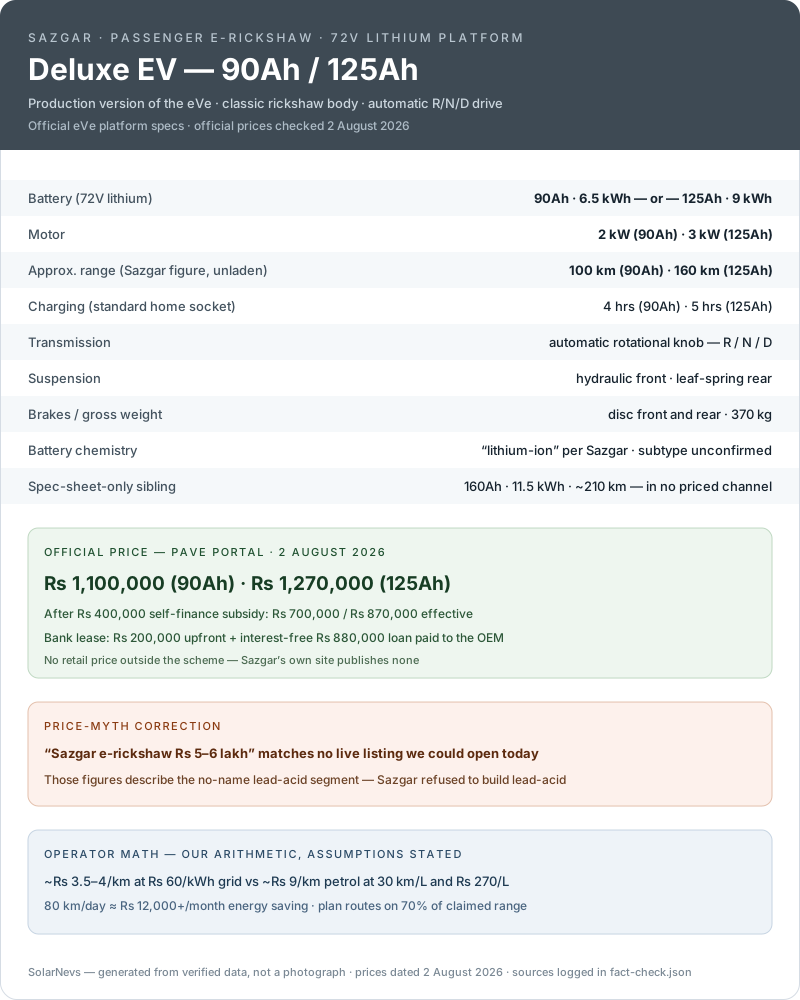
Specifications
| body | classic passenger rickshaw (production version of the Sazgar eVe shown since 2020) |
|---|---|
| battery | 72V lithium - 90Ah (~6.5 kWh) or 125Ah (~9 kWh); chemistry subtype unconfirmed by Sazgar |
| motor | 2 kW (90Ah) / 3 kW (125Ah) per Sazgar's eVe spec page |
| range | Sazgar approximate figures: 100 km (90Ah) / 160 km (125Ah) |
| charging | home socket; 4 hrs (90Ah) / 5 hrs (125Ah) |
| transmission | automatic rotational knob - Reverse / Neutral / Drive |
| chassis | hydraulic front suspension, leaf-spring rear, disc brakes front and rear, 370 kg gross weight |
| seating | driver + 4 passengers (typical Deluxe body) |
| Warranty | Sazgar publishes no warranty terms for the Deluxe EV. Third-party PAVE-scheme coverage advertises 3 years / 40,000 km battery and 2 years / 40,000 km vehicle warranty on the sibling Shuttle EV 125Ah - single unofficial source, unconfirmed for the Deluxe. Get battery years and km in writing before paying; the battery is roughly half the vehicle's value. |
The Sazgar Deluxe EV is the production version of the eVe - the classic Pakistani passenger rickshaw body, re-engineered around a 72V lithium battery - and as of 2 August 2026 it is one of the very few electric rickshaws in Pakistan with an official, government-published price: Rs 1,100,000 for the 90Ah variant and Rs 1,270,000 for the 125Ah on the PAVE portal's three-wheeler list. Under the scheme's self-finance path, the Rs 400,000 subsidy brings those to an effective Rs 700,000 and Rs 870,000.
Two honesty notes up front. First, the "Sazgar electric rickshaw for Rs 5-6 lakh" you may have read - including in our own July 2026 guide - matches no live listing we could open today; those numbers belong to the no-name lead-acid segment. Second, Sazgar has never published a retail price for this vehicle outside the scheme (Gari.pk's spec page literally lists it at "PKR 0"), and we found zero marketplace listings - the scheme is the channel.
Specifications
Sazgar publishes no separate Deluxe EV datasheet; the official eVe spec page is the source for the platform, and the PAVE list's battery options match it exactly:
Spec | 90Ah variant | 125Ah variant |
|---|---|---|
Battery | 72V, 90Ah, 6.5 kWh | 72V, 125Ah, 9 kWh |
Motor | 2 kW | 3 kW |
Approx. range (Sazgar) | 100 km | 160 km |
Charging time | 4 hrs | 5 hrs |
Charging source | standard home socket | standard home socket |
Transmission | automatic knob: R / N / D | automatic knob: R / N / D |
Front / rear suspension | hydraulic / leaf spring | hydraulic / leaf spring |
Brakes | disc front and rear | disc front and rear |
Gross weight | 370 kg | 370 kg |
The eVe page also lists a 160Ah / 11.5 kWh / 210 km variant with a 3 kW motor - it exists on the spec sheet but is in no priced channel we could find. Chemistry: Sazgar says only "lithium-ion... the same batteries used in electric cars"; third-party scheme coverage says LiFePO4; the subtype is unconfirmed by the maker.
Honest assessment
Pros. The body is the Deluxe - the best-selling rickshaw shape in the country, with parts and panel availability everywhere Sazgar's dealer network reaches. The drivetrain removes the engine-maintenance line entirely: no oil, no filters, no clutch, R-N-D knob instead of gears. The lithium-only policy means the pack should outlast several lead-acid swap cycles, and Sazgar's iteration history (2015 prototype, 2018 lithium prototype, 2020 launch, 2021 redesign, 2024 license) is that of a manufacturer, not an importer with stickers.
Cons. Sticker price is the obvious one: Rs 1.1-1.27 million buys two petrol rickshaws, and without a PAVE allocation there is no way we could verify to buy this vehicle at all. Documentation is thin for a flagship: no published motor torque or top-speed figures beyond the old eVe page, no payload rating, no official warranty terms, and range numbers that are the maker's own approximations. The 2 kW motor on the 90Ah variant is modest for a fully loaded rickshaw on flyover ramps - the 3 kW / 125Ah is the one built for real commercial duty.
Who should buy. An operator with scheme access who runs 60-140 km/day and can charge at home overnight - the fuel arithmetic (below) pays the lithium premium back fastest for exactly this profile. Buyers needing intercity range, or who cannot wait out e-balloting, should look at the hub page for the wider market picture first.
Pakistan reality check
Buying route. Register at pave.gov.pk (ages 21-65, valid license, active bank account), enter e-balloting against a national allocation of 3,170 three-wheelers. Self-finance: pay order to Sazgar for the full Rs 1,100,000 / 1,270,000, delivery within 60 days, Rs 400,000 back to your bank after document verification. Bank lease: Rs 200,000 upfront subsidy plus an interest-free Rs 880,000 loan paid to the OEM - which covers Rs 1,080,000, leaving a cash gap of Rs 20,000 (90Ah) or Rs 190,000 (125Ah) plus fees, repaid monthly through partner banks.
The commercial math, stated as arithmetic. A 125Ah full charge is 9 kWh. At a Rs 60/kWh tariff that is ~Rs 540 per charge; against Sazgar's 160 km claim, Rs 3.4/km - call it Rs 4/km loaded and hot. A petrol rickshaw at ~30 km/L and ~Rs 270/L is ~Rs 9/km, plus oil changes and tune-ups the EV skips. At 80 km/day, 26 days/month: roughly Rs 10,500-11,500/month saved on energy alone. Against the ~Rs 370,000-870,000 premium over a petrol rickshaw (depending on subsidy), that is a roughly 3-7 year energy-only payback - the subsidy is what makes the case work, so get the allocation before you get excited.
Range honesty. 100/160 km are Sazgar's approximations for what we assume is an unladen vehicle in mild conditions. Three passengers, 45C afternoons, and two years of pack aging will take real double-digit percentages off. Plan routes on 70% of claimed range and treat anything better as margin.
Battery replacement reality. The e-rickshaw market's defining cost is the lead-acid swap: Rs 90,000-100,000 of batteries every 12-15 months on cheap vehicles. The Deluxe EV's lithium pack avoids that cycle, but no official replacement price for an out-of-warranty pack is published anywhere we could find - and at roughly half the vehicle's value, that unknown is the single biggest line in the 5-year cost model. Ask the dealer for the pack replacement price in writing; the answer (or refusal) is information.
Charging and DISCO reality. 4-5 hours from a home socket at 9 kWh is a ~2 kW draw - within any normal domestic sanctioned load, no special meter or three-phase needed. Overnight charging also lands in off-peak windows where DISCOs offer them. A solar-charged unit (panels + daytime charging) takes the marginal cost per km toward zero, which is the whole game for owner-operators.
Price context vs rivals (August 2026)
Official PAVE list, passenger rickshaws, 2 August 2026:
Model | Battery | Official price | After Rs 400k subsidy |
|---|---|---|---|
Pak Star Tez Raftar 1800W | n/p | Rs 800,000 | Rs 400,000 |
Tezmo Ricky 3000W | 150Ah | Rs 1,035,000 | Rs 635,000 |
Sazgar Deluxe EV 90Ah | 72V 90Ah | Rs 1,100,000 | Rs 700,000 |
Nova EcoDost Electric Rickshaw | n/p | Rs 1,176,000 | Rs 776,000 |
Sazgar Deluxe EV 125Ah | 72V 125Ah | Rs 1,270,000 | Rs 870,000 |
Sazgar's premium over the cheapest listed rickshaw is Rs 300,000+; over Nova's comparable model, Rs 94,000 at the 125Ah level. What it buys is the license-first record, the biggest three-wheeler dealer network in the country, and a listed company to hold the warranty - once you have that warranty in writing, which is the step this market skips. The loader sibling is on its own page: Tempo Electric Loader.
Frequently asked questions
What is the price of the Sazgar Deluxe EV in Pakistan?
On the official PAVE portal on 2 August 2026, Rs 1,100,000 for the 90Ah and Rs 1,270,000 for the 125Ah. After the scheme's Rs 400,000 self-finance subsidy the effective cost is Rs 700,000 / Rs 870,000. There is no verified retail price outside the scheme - Sazgar's own website publishes none.
Is the Deluxe EV the same as the Sazgar eVe?
Functionally yes. The eVe is the electric rickshaw Sazgar unveiled in January 2020 and re-designed in 2021 on the classic rickshaw body; the PAVE list sells it as "Deluxe (Electric Vehicle)" in the same 72V 90Ah and 125Ah battery options the eVe spec page describes. Sazgar has not published a separate Deluxe EV datasheet.
How far does it really go on a charge?
Sazgar's own figures are approximate - 100 km for the 90Ah and 160 km for the 125Ah - and are unladen claims. Expect meaningfully less with three passengers, summer heat and an aging pack. No independent range test of this vehicle has been published that we could find.
What does charging cost per day?
Arithmetic with stated assumptions - a full 9 kWh charge at a Rs 60/kWh grid tariff is about Rs 540 for up to 160 km, or roughly Rs 3.5-4/km. A petrol rickshaw at ~30 km/L and ~Rs 270/L runs ~Rs 9/km. Charging from rooftop solar during daytime shifts pushes the marginal cost toward zero.
Which variant should a commercial operator pick?
The 125Ah, in almost every case. It costs Rs 170,000 more but carries a 3 kW motor (vs 2 kW), about 39% more energy and 60% more claimed range - the difference between one charge per working day and charging mid-shift. The 90Ah suits short fixed routes with guaranteed midday charging access.
References
- PAVE official portal - Electric Vehicles three-wheeler tab (both Deluxe EV prices) — accessed 2 Aug 2026
- PAVE official portal - program home (subsidy and financing paths) — accessed 2 Aug 2026
- pavegovpk.com - scheme price list (corroborates both prices) — accessed 2 Aug 2026
- Sazgar official - eVe vehicle specs (battery — accessed 2 Aug 2026
- Sazgar official - eVe news category (2020 unveiling — accessed 2 Aug 2026
- Gari.pk - Sazgar eVe page (retail price listed as PKR 0 - never published) — accessed 2 Aug 2026
- OLX Pakistan - Sazgar Electric search — accessed 2 Aug 2026
- pavegov.com.pk - Shuttle EV 125Ah page (sibling model's advertised warranty terms) — accessed 2 Aug 2026