Sazgar Tempo Electric Loader (90Ah / 125Ah)
Rs 1,120,000–1,250,000 verified 2 Aug 2026 — the spread is real, not an estimate; see the table below for what sits at each end
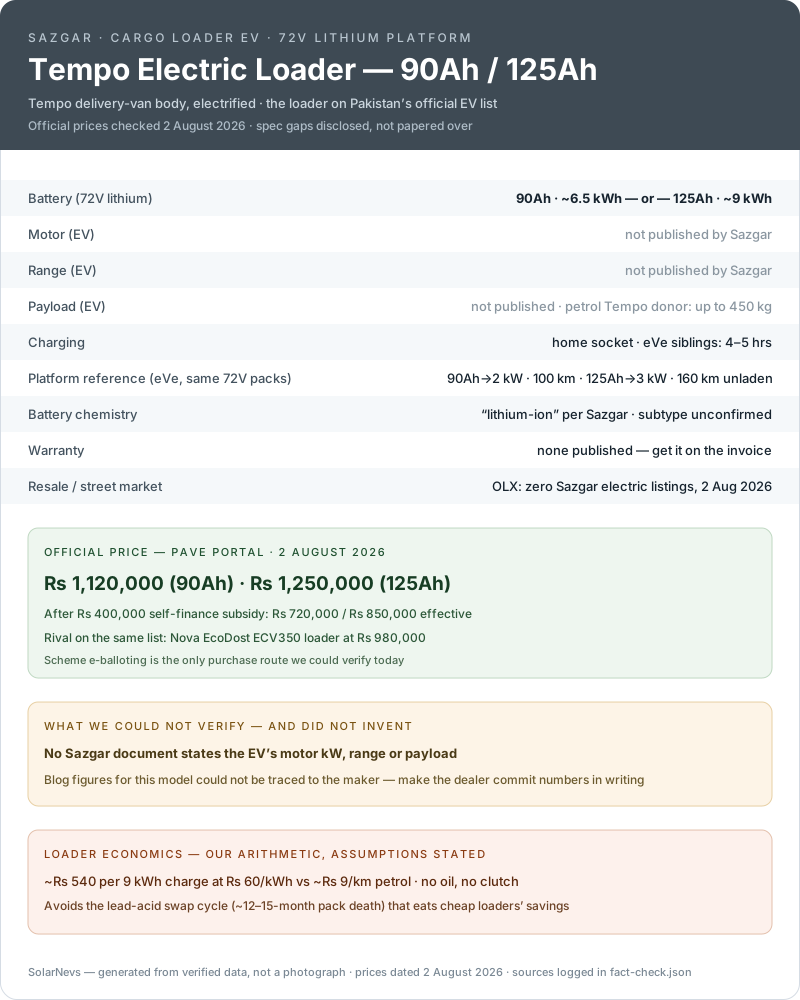
Specifications
| body | Tempo cargo loader / delivery van body (the petrol Tempo platform, electrified) |
|---|---|
| battery | 72V lithium - 90Ah (~6.5 kWh) or 125Ah (~9 kWh); chemistry subtype unconfirmed by Sazgar |
| motor | not published by Sazgar for the Tempo EV |
| range | not published by Sazgar for the Tempo EV |
| payload | not published for the EV; Sazgar rates the petrol Tempo Delivery at up to 450 kg |
| charging | 72V platform charges from a home socket; eVe siblings take 4-5 hrs |
| Warranty | Sazgar publishes no warranty terms for the Tempo Electric Loader. Third-party PAVE-scheme coverage advertises 3 years / 40,000 km battery and 2 years / 40,000 km vehicle warranty on the sibling Shuttle EV - single unofficial source, unconfirmed for the Tempo. For a vehicle bought to work every day, get battery years and km on the invoice or walk. |
The Sazgar Tempo Electric Loader is the cargo variant of Sazgar's EV three-wheeler family - the Tempo delivery-van body on the 72V lithium platform - and on 2 August 2026 it carries an official price of Rs 1,120,000 (90Ah) or Rs 1,250,000 (125Ah) on the PAVE portal's three-wheeler list. After the scheme's Rs 400,000 self-finance subsidy: Rs 720,000 / Rs 850,000 effective.
This page is deliberately shorter on specs than we would like, because Sazgar is: the company publishes no motor rating, no range figure and no payload number for the Tempo EV. What is verified is the price, the battery options, the subsidy structure, and the donor platform. Where a number is our arithmetic or a petrol-Tempo figure, we say so - and the range/spec figures circulating on scheme-adjacent blogs, which we could not trace to any Sazgar document, are not repeated here.
Specifications
Spec | 90Ah variant | 125Ah variant |
|---|---|---|
Official price (2 Aug 2026) | Rs 1,120,000 | Rs 1,250,000 |
Battery | 72V, 90Ah (~6.5 kWh, arithmetic) | 72V, 125Ah (~9 kWh, arithmetic) |
Motor | not published | not published |
Range | not published | not published |
Payload (EV) | not published | not published |
Payload (petrol Tempo donor) | up to 450 kg (Sazgar figure) | up to 450 kg (Sazgar figure) |
Charging | home socket; eVe siblings: 4 hrs | home socket; eVe siblings: 5 hrs |
Body | Tempo cargo loader / delivery van | Tempo cargo loader / delivery van |
On the same 72V platform, the passenger eVe pairs the 90Ah pack with a 2 kW motor and the 125Ah with 3 kW; whether the heavier Tempo gets a bigger motor is exactly the kind of question Sazgar's documentation does not answer. Ask the dealer, in writing.
Honest assessment
Pros. For a commercial loader, the drivetrain economics are the product: no petrol, no oil changes, no clutch wear on stop-start delivery routes, and a lithium pack instead of the lead-acid swap cycle that quietly eats Rs 7,000-8,000/month on cheap electric loaders. The Tempo body is a proven working van with 20 years of parts in the market, and Sazgar is the only loader maker on the official EV list with a stock exchange listing behind the warranty. At Rs 850,000 effective (125Ah, after subsidy), it undercuts its own passenger sibling while carrying cargo that earns.
Cons. Buying a work vehicle with no published payload, motor or range figures means the load-planning risk is yours. The unsubsidized Rs 1.12-1.25 million is far above petrol loaders (Sazgar's own Shandar/Jaandar petrol range trades well under half that) and above Nova's EcoDost ECV350 loader at Rs 980,000 on the same list. There is no visible retail or resale channel - OLX had zero Sazgar electric listings on 2 August 2026 - so the exit price of this asset is unknown. And the whole case leans on winning a PAVE ballot slot from a national allocation of 3,170 three-wheelers.
Who should buy. Delivery fleets and shopkeeper-operators with predictable daily routes of 50-100 km, overnight charging at base, and scheme access - the profile where energy savings are largest and range uncertainty matters least. A buyer who needs guaranteed 450 kg at guaranteed range should make the dealer commit those numbers to paper first, or buy the petrol Tempo until Sazgar documents the EV.
Pakistan reality check
How you buy one. Same route as every Sazgar EV: pave.gov.pk registration, e-balloting, ages 21-65 (fleet operators under defined limits). Self-finance: full pay order to Sazgar, delivery within 60 days, Rs 400,000 subsidy to your bank after verification. Bank lease: Rs 200,000 upfront subsidy plus interest-free Rs 880,000 loan to the OEM - Rs 1,080,000 covered, leaving Rs 40,000 (90Ah) or Rs 170,000 (125Ah) cash gap plus fees.
Cost per km for a working loader - arithmetic, assumptions stated. A 9 kWh charge at Rs 60/kWh is ~Rs 540. Assume the loaded Tempo does 100-130 km on it (a discount from the unladen passenger eVe's 160 km claim, since Sazgar publishes nothing): Rs 4-5.5/km. A petrol loader at ~30 km/L and ~Rs 270/L is ~Rs 9/km before oil and tune-ups. A 70 km/day, 26-day month: roughly Rs 6,500-9,000/month saved on energy. Against the ~Rs 400,000+ premium over a comparable petrol loader after subsidy, energy-only payback is on the order of 4-6 years - solar charging at base, or higher daily km, shortens it fast. These are our derivations, not Sazgar's.
The lead-acid loader trap this vehicle exists to avoid. The cheap electric loaders that dominate listing sites at Rs 380,000-650,000 run lead-acid banks that Pakistani heat and daily deep-cycling kill in 12-15 months. Amortize a ~Rs 95,000 pack swap over 14 months and the "cheap" loader carries an invisible Rs 6,800/month battery bill - most of the fuel savings, gone. Sazgar's lithium-only policy (it built a lead-acid prototype in 2015 and refused to sell it) is the difference between the two business models. But note honestly: lithium's advantage assumes the pack lasts, and Sazgar publishes no official replacement price for an out-of-warranty pack - ask before you sign.
Charging at a shop or godown. ~2 kW from a normal socket over 4-5 hours - no three-phase, no sanctioned-load drama for a single vehicle. Fleets charging several units simultaneously should do the arithmetic against their connection before committing; five loaders is a 10 kW evening draw.
Price context vs rivals (August 2026)
Official PAVE list, loaders and nearest rickshaws, 2 August 2026:
Model | Type | Official price | After Rs 400k subsidy |
|---|---|---|---|
Nova EcoDost ECV350 | loader | Rs 980,000 | Rs 580,000 |
Sazgar Tempo Electric Loader 90Ah | loader | Rs 1,120,000 | Rs 720,000 |
Sazgar Tempo Electric Loader 125Ah | loader | Rs 1,250,000 | Rs 850,000 |
Sazgar Deluxe EV 125Ah (passenger) | rickshaw | Rs 1,270,000 | Rs 870,000 |
Nova undercuts the Tempo by Rs 140,000-270,000. Sazgar's counter-case is the dealer network, the licensed-manufacturer record and the listed-company balance sheet - which is worth real money on a vehicle you intend to work for five years, provided the warranty makes it onto paper. The passenger sibling is covered on the Deluxe EV page, and the full lineup with the price-myth correction is on the Sazgar hub.
Frequently asked questions
What does the Sazgar electric loader cost in Pakistan?
On the official PAVE portal on 2 August 2026, Rs 1,120,000 for the 90Ah and Rs 1,250,000 for the 125Ah. The scheme's Rs 400,000 self-finance subsidy brings the effective cost to Rs 720,000 / Rs 850,000. No retail price outside the scheme could be verified today.
How much can the Tempo Electric Loader carry?
Sazgar has not published a payload figure for the EV version. The petrol Tempo Delivery it is built from is rated for up to 450 kg. Treat the EV's real-world payload as unverified until Sazgar documents it, and remember every kilogram of cargo costs range.
What is the range of the electric Tempo?
Sazgar publishes no range figure for the Tempo EV. On the same 72V platform, the passenger eVe claims 100 km (90Ah) and 160 km (125Ah) unladen - a loaded cargo van will do meaningfully less. Scheme-adjacent blogs print range figures for this model, but we could not trace them to any Sazgar document, so we do not repeat them.
Is the electric loader cheaper to run than a Shandar or Jaandar petrol loader?
On energy, dramatically - arithmetic with stated assumptions puts a full 9 kWh charge at about Rs 540 (Rs 60/kWh), versus roughly Rs 9/km for a petrol loader at ~30 km/L and ~Rs 270/L. For a delivery route of 70 km/day, that is on the order of Rs 10,000-12,000/month saved on fuel, plus skipped oil changes and tune-ups.
Why is the 125Ah loader listed cheaper than the 125Ah Deluxe passenger rickshaw?
The official list prices the Tempo Electric Loader 125Ah at Rs 1,250,000 versus Rs 1,270,000 for the Deluxe EV 125Ah - a Rs 20,000 gap the portal does not explain. Cargo bodies are simpler than passenger cabins; beyond that we can only report the published numbers.
References
- PAVE official portal - Electric Vehicles three-wheeler tab (both Tempo EV prices) — accessed 2 Aug 2026
- PAVE official portal - program home (subsidy amounts — accessed 2 Aug 2026
- pavegovpk.com - scheme price list (corroborates both prices) — accessed 2 Aug 2026
- Sazgar official - products page (petrol Tempo Delivery — accessed 2 Aug 2026
- Sazgar official - eVe vehicle specs (the 72V 90/125Ah platform the Tempo EV shares) — accessed 2 Aug 2026
- Sazgar official - eVe news category (EV license — accessed 2 Aug 2026
- OLX Pakistan - Sazgar Electric search — accessed 2 Aug 2026