Pylontech US3000C 3.55kWh (48V LiFePO4)
Rs 185,000–260,000 verified 2 Aug 2026 — the spread is real, not an estimate; see the table below for what sits at each end
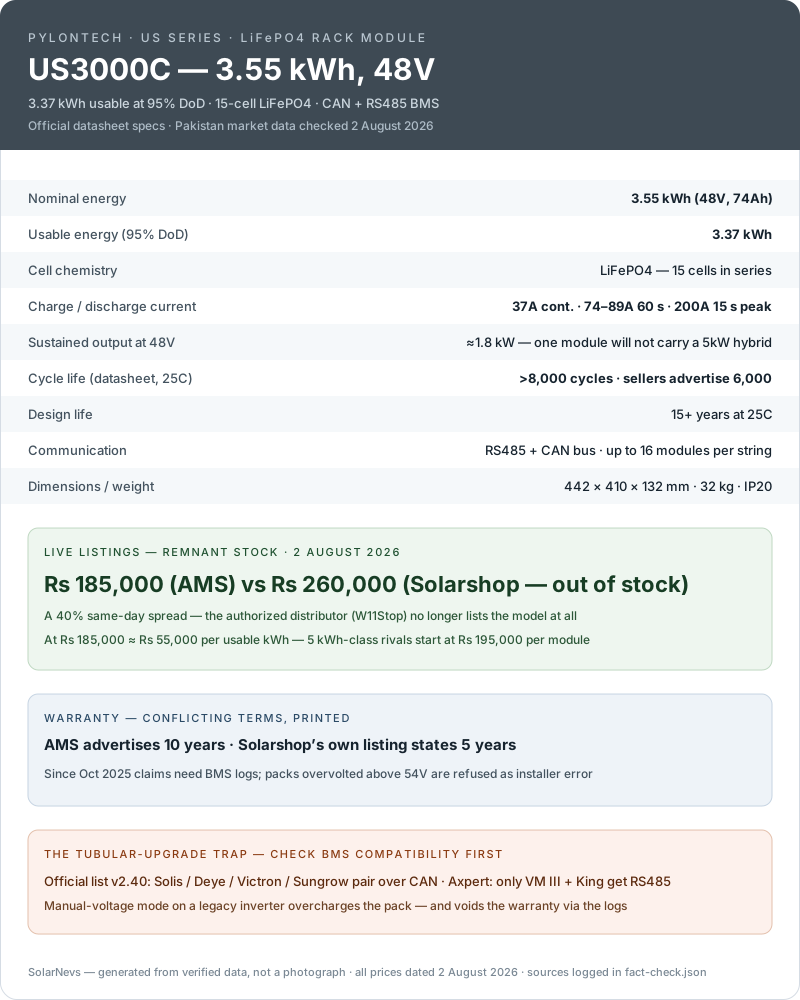
Specifications
| nominalEnergy | 3.55 kWh (48V, 74Ah) |
|---|---|
| usableEnergy | 3.37 kWh at 95% depth of discharge |
| chemistry | LiFePO4, 15 cells in series |
| chargeDischarge | 37A continuous; 74-89A for 60 s; 90-200A 15-second peak |
| cycleLife | >8,000 cycles at 25C (current datasheet); sellers advertise 6,000 |
| designLife | 15+ years at 25C |
| communication | RS485 + CAN bus |
| dimensions | 442 x 410 x 132 mm (19-inch rack) |
| weight | 32 kg |
| Warranty | Advertised terms conflict between the two live listings - AMS advertises a 10-year warranty on its Pylontech stock while Solarshop's US3000C page states 5 years. Since October 2025 claims require the BMS log files; overvolted packs (above 54V) are refused as installer error. Whatever you are promised, get the years and the serial on the invoice. |
The Pylontech US3000C is a 48V, 3.55kWh LiFePO4 rack module - 3.37kWh usable at the datasheet's 95% depth of discharge - long the entry point into Pylontech ownership in Pakistan. As of 2 August 2026 the two live listings we could open price it at Rs 185,000 (AMS, claims stock) and Rs 260,000 (Solarshop, out of stock) - a 40% same-day spread, because the model is leaving the market: W11Stop, the authorized distributor, no longer lists any US-series module.
We print both numbers rather than pretend there is "a price." A 40% spread on remnant stock is itself the buying information.
Specifications
Spec | Value |
|---|---|
Nominal energy | 3.55 kWh (48V nominal, 74Ah) |
Usable energy | 3.37 kWh (95% DoD, datasheet) |
Cell chemistry | LiFePO4, 15 cells in series |
Charge / discharge current | 37A continuous; 74-89A for 60 s; 90-200A 15-s peak |
Cycle life | >8,000 cycles at 25C (datasheet) |
Design life | 15+ years at 25C |
Communication | RS485 + CAN bus |
Modules per string | up to 16 (datasheet) |
Dimensions / weight | 442 x 410 x 132 mm / 32 kg |
Protection / operating temp | IP20; charge 0-55C, discharge -10-55C |
The number to respect is 37A continuous - about 1.8kW of sustained draw at 48V. The 74-89A figure many sellers quote is a 60-second rating, not an operating point.
Honest assessment
Pros. Everything that made the US series the reference: real manufacturer LiFePO4 cells, a BMS with both CAN and RS485, presence on Pylontech's official versioned compatibility list, 95% usable DoD, and a modular rack format that parallels up to 16 units. At AMS's Rs 185,000 it is the cheapest genuine-Pylontech entry ticket in the market today - roughly Rs 55,000 per usable kWh, which undercuts the UF5000 at W11Stop's Rs 310,000 (about Rs 64,000 per usable kWh).
Cons. The 37A continuous limit makes a single module a poor match for the 5-6kW hybrids Pakistani homes actually install - it backs up the essentials, not the house. The model is exiting the local channel, so expansion stock will get harder to find, and today's units are of unverifiable age unless you check the logs. The two live sellers disagree by 40% on price and by 5 years on warranty (AMS advertises 10 years; Solarshop's own listing states 5). That is not a market; that is a clearance.
Who should buy. Owners of an existing US-series bank adding a matched module, or small-load buyers (UPS-style backup: fans, lights, router, TV) pairing with a CAN-capable hybrid who can get the Rs 185,000 price with a written warranty and a verifiable serial. First-time whole-home buyers should compare the current-generation options on the hub page instead.
Pakistan reality check
Channel status. On 2 August 2026 W11Stop's Pylontech shelf carries UF5000, FIDUS, FIDUS Plus, UP2500 and Force H3 - no US3000C. BatteryMax lists no US-series either. The US3000C still appears on Pylontech's global datasheet and compatibility list; what has ended is the official Pakistani pipeline. Buy accordingly: serial verification first, payment second.
The tubular-upgrade trap. The US3000C is the module most commonly bolted onto an existing "solar" inverter that spent years on tubular batteries - and that is where Pakistan's lithium horror stories come from. Most legacy and Voltronic-Axpert-platform inverters cannot speak to the Pylontech BMS: per the official compatibility list, only Axpert VM III and King types support RS485 communication; everything else runs manual voltage settings. In manual mode the inverter will happily push a tubular charge profile (bulk 54-58V) into a pack that wants to stop near 53V - and since October 2025 Pylontech's warranty process reads the BMS logs and refuses claims where pack voltage repeatedly exceeded 54V, attributing the damage to wrong inverter settings. If your inverter is not on the list with CAN or RS485 against its name, budget for a compatible hybrid (Solis S6-EH1P class, Deye SUN-SG class) as part of the lithium upgrade, not as an afterthought.
Genuine vs grey. Holographic seal on the unit; label serial (format like HPTCR03261A32603) that the seller can verify against Pylontech's official portal - AMS, an authorized dealer, states genuine serials verify there; installer pulls the BMS log and confirms the log serial matches the label and the production date is recent; serial and warranty years written on the invoice. Any step refused is your answer.
Heat and siting. LiFePO4 handles Pakistani ambient better than any other lithium chemistry, but datasheet cycle life is rated at 25C and the BMS derates charging as temperature rises. Ground floor, ventilation, never the rooftop shed.
Price context vs rivals (August 2026)
The US3000C's real rivals today are 5kWh-class modules that cost little more per unit and much less per kWh - live listings, 2 August 2026:
Module | Price (2 Aug 2026) | Approx. Rs per usable kWh |
|---|---|---|
Fronus Titan 5.12kWh (W11Stop) | Rs 195,000 | ~40,000 |
Narada 4.8kWh (W11Stop) | Rs 230,000 | ~50,000 |
Pylontech US3000C 3.55kWh (AMS) | Rs 185,000 | ~55,000 |
Dyness DL5.0C 5.12kWh (W11Stop) | Rs 255,000 | ~52,000 |
Pylontech UF5000 5.12kWh | Rs 240,000-310,000 | ~49,000-64,000 |
Pylontech US3000C (Solarshop, out of stock) | Rs 260,000 | ~77,000 |
Rupee-per-kWh, the smaller module carries a premium - the classic small-pack penalty. You buy the US3000C to match an existing bank or to keep entry cost minimal, not for value per kWh; at Solarshop's Rs 260,000 the math stops working entirely. See also the US5000 page for why the 4.8kWh sibling has no published price at all.
Frequently asked questions
What does a Pylontech US3000C cost in Pakistan today?
The two live listings we could open on 2 August 2026 are Rs 185,000 (AMS, which claims stock) and Rs 260,000 (Solarshop, marked out of stock) - a 40% spread that reflects a model leaving the market rather than a functioning price. The authorized distributor W11Stop no longer lists it at all.
Why is the price spread so large?
Because the official channel has moved to the 51.2V UF5000/FIDUS generation as of August 2026, remaining US3000C units are remnant or grey stock and each seller prices on what their leftover units cost them. There is no anchor price anymore - negotiate accordingly and verify the serial before paying.
Is one US3000C enough for a 5-6kW hybrid inverter?
Usually not. Its continuous discharge is 37A (about 1.8kW at 48V) - fine for overnight fans, lights and electronics, but a 5kW inverter pulling hard will hit the BMS limit. The datasheet allows 74-89A only for 60 seconds. For full-power backup you need two modules in parallel or the US5000 class (100A continuous).
How much usable energy does it really have?
3.37kWh usable from 3.55kWh nameplate at the datasheet's 95% depth of discharge. At a 400W overnight load that is roughly 8 hours. Compare per usable kWh, not nameplate - at Rs 185,000 the US3000C works out to about Rs 55,000 per usable kWh.
Which inverters talk to the US3000C properly?
Per Pylontech's official compatibility list (Ver 2.40, 15 Aug 2025) - Solis S5/S6-EH1P and Deye SUN-SG series over CAN, Victron via Venus with Victron's type-A CAN cable, Sungrow SH5K over CAN. On Voltronic Axpert platforms only VM III and King types support RS485 comms; other Axperts run manual settings only, which risks overcharge and a refused warranty claim.
References
- AMS Security Vision - Pylontech price page — accessed 2 Aug 2026
- Solarshop Pakistan - US3000C listing — accessed 2 Aug 2026
- W11Stop - Pylontech list (no US3000C stocked) — accessed 2 Aug 2026
- Pylontech official - US series datasheet — accessed 2 Aug 2026
- Pylontech official - Compatibility List Ver 2.40 — accessed 2 Aug 2026
- Victron Energy - Pylontech compatibility manual — accessed 2 Aug 2026
- Solar Citizen - Pylontech prices (verified 19 May 2026 - stale) — accessed 2 Aug 2026
- Wattuneed - Pylontech logs and warranty guide — accessed 2 Aug 2026