BYD Shark 6
Rs 19,950,000 verified 26 Jul 2026 — prices in Pakistan move weekly
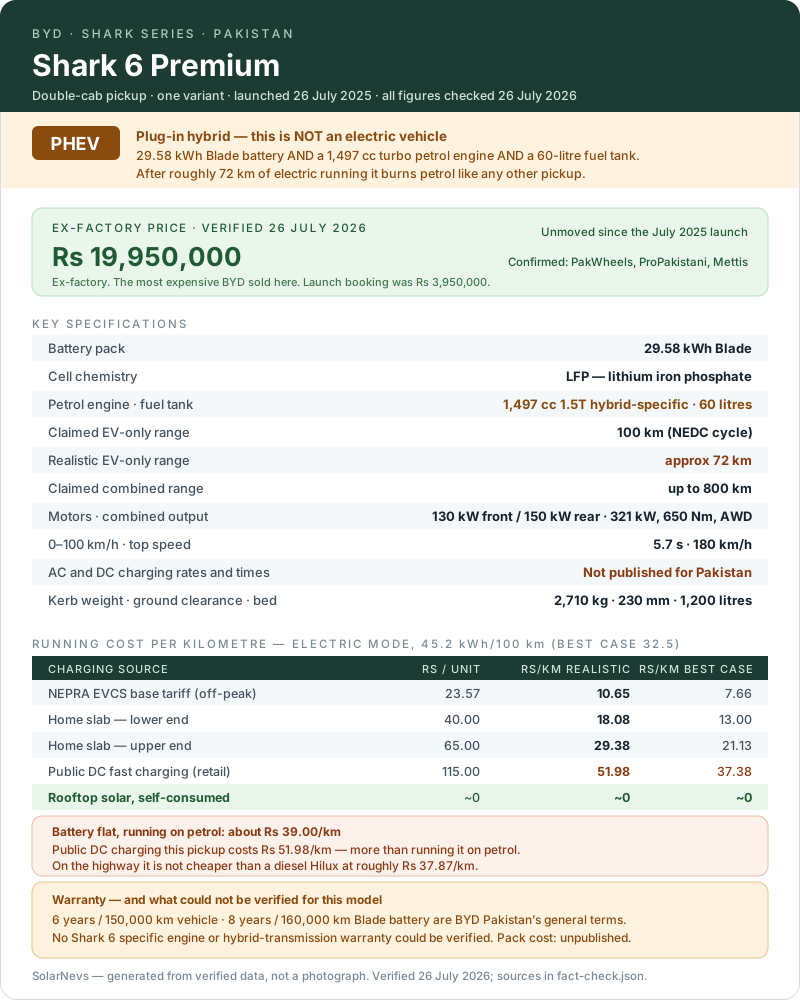
Specifications
| batteryKwh | 29.58 |
|---|---|
| claimedRangeKm | 100 EV-only; 800 combined |
| claimedRangeCycle | NEDC (EV-only figure) |
| realisticRangeKm | approx 72 EV-only |
| kwhPer100km | 45.2 in EV mode (best case 32.5) |
| acCharging | Not published for Pakistan |
| dcCharging | Not published for Pakistan |
| motorKw | 321 combined (130 front / 150 rear) |
| torqueNm | 650 combined |
| engine | 1497 cc 1.5T petrol, hybrid-specific |
| zeroToHundred | 5.7 s |
| topSpeedKmh | 180 |
| drivetrain | Dual-motor AWD |
| fuelTankL | 60 |
| Powertrain | PHEV |
| Warranty | BYD Pakistan's general terms are 6 years / 150,000 km vehicle and 8 years / 160,000 km Blade battery, but Shark 6 specific warranty terms — including coverage of the petrol engine and hybrid transmission — are not published in any source we could verify. Replacement battery cost is also unpublished. |
BYD Shark 6
The BYD Shark 6 is a plug-in hybrid (PHEV) double-cab pickup — not an electric vehicle — priced at Rs 19,950,000 ex-factory as of 26 July 2026. It launched on 26 July 2025 with a Rs 3,950,000 booking amount and is the most expensive vehicle BYD sells here.
Say the powertrain out loud, because Pakistani coverage routinely gets this wrong. It has a 29.58 kWh Blade battery and a 1,497 cc turbo petrol engine and a 60-litre tank. It is a PHEV, not a BEV. After roughly 72 km of electric running it burns petrol at Rs 331.52 a litre like any other pickup.
Variants and price
Variant | Powertrain | Battery | Engine | Price (ex-factory) | Date verified |
|---|---|---|---|---|---|
Shark 6 Premium | PHEV | 29.58 kWh | 1.5T petrol | Rs 19,950,000 | 26 Jul 2026 |
One variant, price unmoved since launch — confirmed against PakWheels, ProPakistani and Mettis.
Specifications
Item | Figure |
|---|---|
Powertrain | PHEV — plug-in hybrid, petrol engine plus battery |
Battery | 29.58 kWh Blade (LFP) |
Claimed EV-only range | 100 km (NEDC) |
Realistic EV-only range | approx 72 km |
Claimed combined range | up to 800 km |
Engine | 1,497 cc turbocharged, hybrid-specific |
Front motor | 130 kW / 170 Nm |
Rear motor | 150 kW / 340 Nm |
Combined output | 321 kW / 650 Nm |
Drivetrain | dual-motor AWD |
0–100 km/h | 5.7 s |
Top speed | 180 km/h |
Fuel tank | 60 litres |
Kerb weight | 2,710 kg |
Dimensions | 5,457 × 1,971 × 1,925 mm, 3,260 mm wheelbase |
Ground clearance | 230 mm |
Bed / boot | 1,200 litres |
Tyres | 265/65 R18 |
AC and DC charging rates | Not published for Pakistan {/* VERIFY: AC and DC charging power and times for PK-spec Shark 6 — not published by BYD Pakistan or PakWheels */} |
Running cost per kilometre
On a PHEV this depends entirely on how you drive.
In electric mode. Method: 29.58 kWh across a realistic 72 km is 41.1 kWh/100 km at the wheels; add 10 percent for charging losses and you draw about 45.2 kWh per 100 km from the meter — high, because this is a 2,710 kg pickup. Drive gently, see closer to BYD's 100 km NEDC claim, and it falls to about 32.5 kWh/100 km. Both columns derive from published figures; pick the one matching your driving.
Charging source | Rs / unit | Rs / km (realistic, 45.2) | Rs / km (best case, 32.5) | Rs / month at 1,500 km (realistic) |
|---|---|---|---|---|
NEPRA EVCS base tariff (off-peak) | 23.57 | 10.65 | 7.66 | 15,975 |
Home slab — lower end | 40.00 | 18.08 | 13.00 | 27,120 |
Home slab — upper end | 65.00 | 29.38 | 21.13 | 44,070 |
Public DC fast charging (retail) | 115.00 | 51.98 | 37.38 | 77,970 |
Rooftop solar, self-consumed | ~0 | ~0 | ~0 | ~0 |
In petrol mode, battery flat, we assume roughly 8.5 km/L for a 2.7-tonne pickup: about Rs 39.00/km. BYD's claimed 800 km on a 60-litre tank implies 11.7 km/L, or Rs 28.34/km, which we regard as optimistic. Neither is a manufacturer consumption rating.
Read those two together.
- Home-charged on a low slab, under 72 km a day: about Rs 18/km, roughly half a diesel Hilux.
- On a public DC charger: Rs 51.98/km, more than running it on petrol. Public charging a PHEV here is actively irrational.
- Battery flat on a long run: about Rs 39.00/km, against a Hilux Revo 2.8 diesel at roughly Rs 37.87/km (diesel Rs 378.66/L, assumed 10 km/L). On the highway this is not cheaper than a diesel pickup.
The solar line. Charged from panels you already own, the marginal cost per electric kilometre is effectively Rs 0. A 585 W panel makes roughly 2.3 kWh a day here.
Your daily driving | Energy needed / day | 585 W panels to cover it |
|---|---|---|
30 km | 13.6 kWh | 6 |
50 km | 22.6 kWh | 10 |
72 km (full realistic EV range) | 32.5 kWh | 15 |
Fifteen panels is roughly 8.8 kW — the honest cost of solar-charging a near-three-tonne pickup, and why this suits a farm far better than a townhouse.
Honest assessment
Pros. Genuinely quick — 5.7 seconds to 100 km/h in a pickup is absurd, and 650 Nm across two motors makes it effortless loaded. 230 mm of ground clearance and dual-motor AWD are real off-road credentials. For daily use under 70 km with occasional long trips, the PHEV format sidesteps the range anxiety and charging-network problems that dog every BEV here — it does not need the charging network to exist in order to be usable, which is more than can be said for the rest of BYD's lineup.
Cons. Rs 19,950,000 is Rs 4,111,000 above the dearest Hilux Revo and Rs 6,560,000 above the dearest D-Max — a steep premium for a running-cost advantage that only appears on short, home-charged trips. You own two powertrains: engine servicing on top of EV components, and two sets of things that can fail after warranty. Charging rates are unpublished here, and no Shark 6 warranty document covering engine and hybrid transmission could be verified.
Who should buy it. A business or farm with roof space, a site charger and short daily runs punctuated by occasional long hauls — or anyone who tows and wants the torque. Not someone buying it as an EV, and not someone driving mostly intercity: there, a diesel Hilux costs Rs 4–7 million less and runs for about the same per kilometre.
Pakistan reality check
Real versus claimed range. The 100 km EV figure is NEDC, the most lenient major cycle, and PHEV range claims are the most inflated numbers in the industry. Pakistani heat, AC load, speed and a loaded bed take roughly 28 percent off. Plan on about 72 km of electric running; beyond that it is a petrol vehicle.
Battery replacement and warranty. BYD Pakistan's general terms are 6 years / 150,000 km vehicle and 8 years / 160,000 km battery, but we could not verify a Shark 6 specific warranty document, nor establish how the petrol engine, turbocharger and hybrid transmission are covered. {/ VERIFY: Shark 6 specific warranty terms including engine and hybrid transmission coverage — not published */} BYD's December 2025 extension to 250,000 km applies to Europe and the UK, not confirmed here. {/ VERIFY: applicability of BYD's 250,000 km battery warranty in Pakistan /} And the replacement cost of a 29.58 kWh Blade pack in Pakistan is not published by anyone. {/ VERIFY: replacement 29.58 kWh Blade pack cost in PKR — unpublished in Pakistan */}
Charging at home after the February 2026 net-billing switch. Exported solar earns roughly Rs 11 per unit against imports at Rs 50 or more, so exporting is a losing trade and daytime self-consumption is the best use of a rooftop system. This matters more on a PHEV: the Shark 6's case rests entirely on starting every journey full. From solar it costs Rs 0/km; flat, Rs 39/km at a pump. It is only cheap if you never forget to plug it in.
Charging network. Pakistan has roughly 30–50 publicly accessible charging locations nationwide, concentrated in Karachi, Lahore and Islamabad, against a 3,000-by-2030 target. {/* VERIFY: count of genuinely operational public DC points — no authoritative register */} That scarcity matters less here than on a BEV — you always have the tank — but as the cost table shows, public DC charging this vehicle costs more per kilometre than petrol. For a Shark 6 the public network is not merely thin, it is economically pointless.
Monsoon and flooding. With 230 mm of ground clearance it wades better than any other BYD sold here, though the Pakistan-spec IP rating is not published. {/* VERIFY: official IP rating of PK-spec Shark 6 pack */} The rule is absolute, and applies doubly to a vehicle with both an engine air intake and a high-voltage pack: if it has been submerged, do not restart it and do not plug it in. Flatbed recovery only.
Resale and battery health. No used-market precedent exists in Pakistan for a Rs 20 million PHEV pickup, there is no accessible battery state-of-health readout, and the buyer pool has always bought Hilux and D-Max on proven durability. Resale here is the least predictable in this catalogue.
Price context
Rival | Powertrain | Price (ex-factory) | Date |
|---|---|---|---|
Toyota Hilux Revo (G 2.8 to Rocco) | Diesel | Rs 12,329,000 – 14,869,000 | 26 Jul 2026 |
Toyota Hilux Revo GR-S | Diesel | Rs 15,839,000 | 26 Jul 2026 |
Isuzu D-Max (V-Cross to X-Terrain) | Diesel | Rs 10,790,000 – 13,390,000 | 26 Jul 2026 |
Riddara RD6 | BEV pickup | Rs 13,300,000 – 17,000,000 | Apr 2026 |
The Shark 6 is Rs 4,111,000 dearer than the flagship Hilux Revo GR-S, Rs 6,560,000 above the top D-Max, and Rs 2,950,000 above the dearest Riddara RD6 — which is a fully electric pickup, so if that is what you want, there is a cheaper option that actually is one.
What the Shark 6 buys over these rivals is acceleration, refinement, and cheap running for the first 70-odd kilometres of each day. What it does not buy is a lower cost per kilometre on the highway, a proven parts record in Pakistan, or a predictable resale value.
Frequently asked questions
Is the BYD Shark 6 an electric vehicle?
No. It is a plug-in hybrid (PHEV). It has a 29.58 kWh battery and a 1.5-litre turbo petrol engine with a 60-litre fuel tank. Once the battery is depleted it burns petrol like any other pickup.
What does the Shark 6 cost in Pakistan?
Rs 19,950,000 ex-factory for the Premium variant as of 26 July 2026, unchanged since its July 2025 launch. Booking was Rs 3,950,000. It is the most expensive BYD sold here.
How far will it go on electricity alone?
BYD claims 100 km on the NEDC cycle. Realistically expect around 72 km in Pakistani conditions, less with a load in the bed or the AC working hard.
Is it cheaper to run than a diesel Hilux?
Only for the first 70 km or so each day, charged at home. Beyond that it runs on petrol and costs roughly what a diesel pickup costs per kilometre, while weighing 2,710 kg.
How many solar panels would cover its electric range?
About 15 585 W panels to refill the full realistic 72 km EV range daily, or roughly 10 panels for a 50 km commute, at about 2.3 kWh per panel per day.
What is the maintenance downside of a PHEV?
You own both a battery pack and a petrol engine. That means oil changes, filters and engine servicing on top of EV components, and two sets of things that can fail out of warranty.
References
- PakWheels — BYD Shark 6 price and specifications — accessed 26 Jul 2026
- ProPakistani — BYD Shark 6 PHEV launched as Pakistan's first plug-in hybrid pickup — accessed 26 Jul 2026
- Mettis Global — BYD Shark 6 PHEV launched at Rs 19.95m — accessed 26 Jul 2026
- PakWheels — BYD pricelist — accessed 26 Jul 2026
- PakWheels — Toyota Hilux price in Pakistan — accessed 26 Jul 2026
- PakWheels — Isuzu D-Max price in Pakistan — accessed 26 Jul 2026
- Express Tribune — NEPRA approves Rs 23.57/kWh tariff for EV charging stations — accessed 26 Jul 2026
- Charging Station Radar — EV charging prices in Pakistan 2026 — accessed 26 Jul 2026
- Daily Pakistan — New petrol price in Pakistan — accessed 26 Jul 2026
- Express Tribune — NEPRA rolls out new regulations abolishing net metering — accessed 26 Jul 2026