Deepal L07
Rs 13,999,000 verified 26 Jul 2026 — prices in Pakistan move weekly
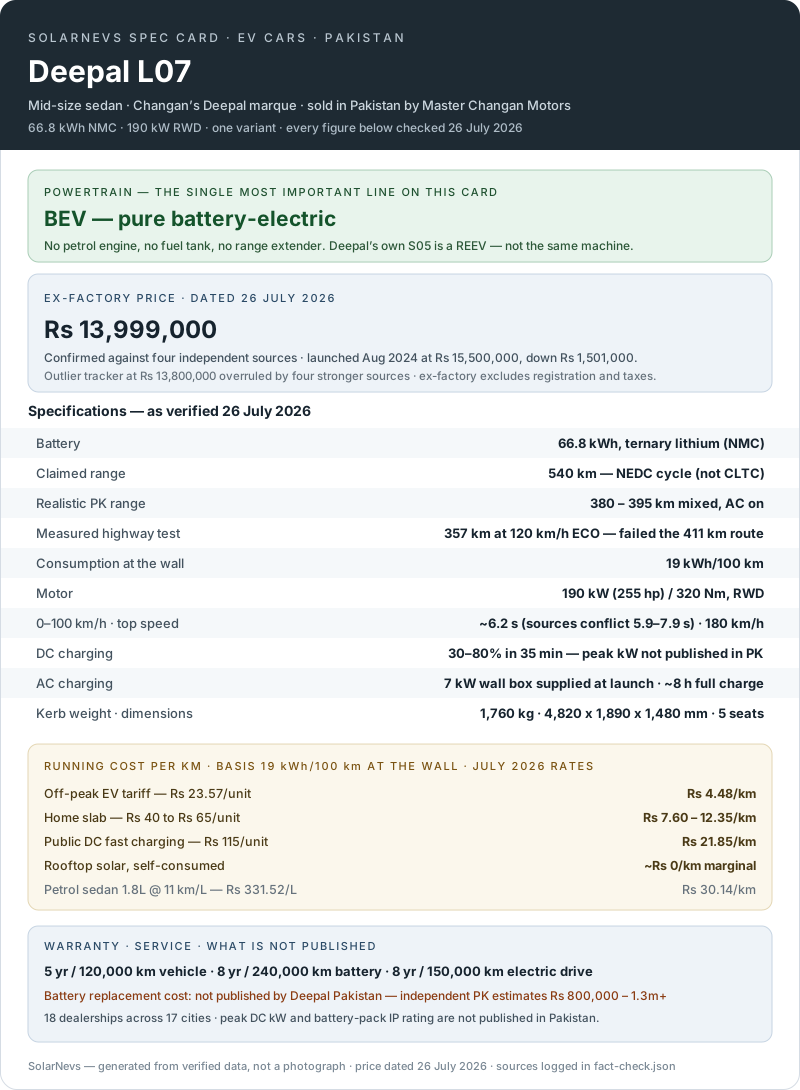
Specifications
| batteryKwh | 66.8 |
|---|---|
| batteryChemistry | Ternary lithium (NMC) |
| claimedRangeKm | 540 |
| claimedRangeCycle | NEDC |
| realisticRangeKm | 385 |
| kwhPer100km | 19 |
| acCharging | 7 kW wall box supplied at launch; ~8 hours quoted for a full AC charge |
| dcCharging | 30-80% in 35 minutes (peak kW not published in Pakistan) |
| motorKw | 190 |
| torqueNm | 320 |
| driveLayout | RWD |
| zeroTo100 | ~6.2 s (sources conflict, 5.9-7.9 s) |
| kerbWeightKg | 1760 |
| seats | 5 |
| Powertrain | BEV |
| Warranty | 5 years / 120,000 km vehicle; 8 years / 240,000 km battery; 8 years / 150,000 km electric drive system. Battery replacement cost is not published in Pakistan. |
What the Deepal L07 is
The Deepal L07 is a rear-wheel-drive, battery-electric (BEV) mid-size sedan from Deepal, the EV brand of Changan Automobile, imported and sold in Pakistan by Master Changan Motors. As of 26 July 2026 its ex-factory price is Rs 13,999,000 for the single EV variant — a figure that PakWheels, Deepal Pakistan's own site and Changan's Lahore dealership all quote identically.
It has no petrol engine, no fuel tank and no range extender. That matters because Deepal sells an EREV (range-extender) L07 in China and an EREV S05 in Pakistan, and Pakistani coverage routinely blurs the two. If a seller tells you the L07 "has a backup engine", they are describing a different car.
Variants and price
Variant | Powertrain | Battery | Price (ex-factory) | Dated |
|---|---|---|---|---|
L07 EV | BEV | 66.8 kWh | Rs 13,999,000 | 26 Jul 2026 |
There is one variant. Ex-factory excludes freight, registration and provincial taxes. Deepal Pakistan states freight and CVT are included in the quoted figure; confirm this in writing at the dealership, because "ex-factory" is used loosely in Pakistan.
Price history worth knowing: at the August 2024 launch the L07 was announced at Rs 15,500,000. It is now Rs 13,999,000 — roughly Rs 1.5 million lower. Prices moved down, not up. One outlier tracker (ccarprice.pk) lists Rs 13,800,000; four stronger sources agree on Rs 13,999,000.
Specifications
Item | Figure |
|---|---|
Powertrain | BEV (pure electric) |
Battery | 66.8 kWh, ternary lithium (NMC) |
Claimed range | 540 km, NEDC cycle |
Realistic PK range | ~380-395 km mixed; 357 km measured at 120 km/h |
Motor | 190 kW (255 hp), 320 Nm, RWD |
0-100 km/h | ~6.2 s (sources conflict) |
Top speed | 180 km/h |
DC charging | 30-80% in 35 minutes |
AC charging | 7 kW wall box supplied at launch; ~8 h full charge |
Kerb weight | 1,760 kg |
Dimensions | 4,820 x 1,890 x 1,480 mm |
Two honest gaps. Deepal Pakistan publishes no peak DC charging kW — international databases put this platform near 92 kW, but that is a single unverified source. And the 0-100 km/h claim is a mess: Gasgoo's launch spec says 6.2 s, PakWheels 5.9 s, ccarprice 7.4-7.9 s. Deepal Pakistan publishes none. Assume "quick enough", not a number.
{/ VERIFY: peak DC kW for PK-spec L07 — single source (ev.motorwatt, ~92 kW), no PK confirmation */} {/ VERIFY: 0-100 km/h — three sources conflict (5.9 / 6.2 / 7.4-7.9 s), Deepal PK publishes nothing */}
Running cost per km
Basis: 19 kWh per 100 km at the wall. That is the PakWheels-measured 17.9 kWh/100 km highway consumption plus roughly 10% AC charging loss. It is not the brochure number.
Electricity source | Rate (Rs/unit) | Cost per km | Per 100 km | 1,500 km/month |
|---|---|---|---|---|
Off-peak EV tariff (NEPRA) | 23.57 | Rs 4.48 | Rs 448 | Rs 6,717 |
Home slab — lower end | 40.00 | Rs 7.60 | Rs 760 | Rs 11,400 |
Home slab — upper end | 65.00 | Rs 12.35 | Rs 1,235 | Rs 18,525 |
Public DC fast charging | 115.00 | Rs 21.85 | Rs 2,185 | Rs 32,775 |
Rooftop solar (self-consumed) | ~0 marginal | ~Rs 0 | ~Rs 0 | ~Rs 0 |
Petrol sedan, 1.8L @ 11 km/L | Rs 331.52/L | Rs 30.14 | Rs 3,014 | Rs 45,207 |
Petrol reference: Rs 331.52/litre, OGRA revision effective 24 July 2026.
The SolarNevs line: charging off your own roof is the only way this car is genuinely cheap. Once the panels are paid for, the marginal cost of a kilometre is about Rs 0. At 19 kWh/100 km, a 585W panel producing roughly 2.3 kWh/day in Pakistani conditions covers about 12 km of driving per day. So:
- 30 km/day → 3 panels (~1.76 kW)
- 50 km/day → 5 panels (~2.93 kW)
- 80 km/day → 7 panels (~4.10 kW)
That is panels for the car only, on top of household load, and assumes you charge in daylight.
Honest assessment
Pros. Genuinely quick, genuinely quiet, and the interior is far above what Rs 14 million buys you in a petrol sedan — 14.6-inch Snapdragon 8155 screen, Sony 14-speaker system, panoramic roof. RWD with 320 Nm makes it pleasant to drive. Warranty on paper is the strongest part of the package.
Cons. The range claim is soft. PakWheels ran it Lahore to Islamabad and it did not make it — 357 km before 0%, 54 km short of the 411 km route, requiring a top-up at Bhera. Consumption drifted from 12.6 to 17.9 kWh/100 km once highway speeds settled. That is a 34% shortfall against the 540 km claim, worse than the ~28% Pakistani owners typically report, because 120 km/h punishes any EV. Everything lives in the touchscreen, and resale value for a Rs 14 million Chinese EV here is a question nobody can answer yet.
Who should buy it. Someone doing 40-100 km/day in Lahore, Karachi or Islamabad, who has — or will install — rooftop solar and a home charger, and who treats intercity trips as a planned exercise. If you regularly drive Lahore-Karachi, buy something else.
Pakistan reality check
Real vs claimed range. Claimed 540 km is NEDC — the most optimistic of the three common cycles, and not comparable to WLTP or EPA figures you may have seen for European or American EVs. Note the baseline figure circulating in Pakistani listings calls this "CLTC"; that is wrong. The 530 km CLTC number belongs to the 56.1 kWh L07, a different car. Plan around 380-395 km mixed, and around 350-360 km if you sit at 120 km/h with the AC fighting a July afternoon.
Battery and warranty. Coverage is 5 years / 120,000 km on the vehicle, 8 years / 240,000 km on the battery, and 8 years / 150,000 km on the electric drive system. That is a strong warranty by Pakistani standards. What is missing is the number every buyer actually wants: Deepal Pakistan has not published a battery replacement price. Independent Pakistani estimates for EV packs of this size sit between Rs 800,000 and Rs 1.3 million-plus, but no Deepal-specific figure exists in the public domain. Ask the dealer for it in writing before you sign. If they will not give it, that is information too.
{/* VERIFY: battery replacement cost for PK-spec L07 — unpublished by Deepal Pakistan */}
Home charging after net billing. Since 9 February 2026, new rooftop solar connections fall under net billing, not net metering: exports are bought back at roughly Rs 11/unit while imports cost Rs 50+ landed. Exporting is now a bad deal. Charging your L07 between 10am and 4pm off your own panels is the single highest-value thing a Pakistani rooftop system can do in 2026. Agreements signed before 9 Feb 2026 keep the old 1:1 terms for their contract period.
Charging network. This is the weak link. NEECA has licensed 70+ EV charging stations nationally, but licences are not chargers — 2025-26 reporting describes stubborn delays on DISCO connections, separate meters and NOCs, leaving only a small fraction energised (on the order of 20 genuinely reliable public points nationwide). Changan has pledged $50 million across the EV value chain and chargers in 17 cities; treat that as intent, not infrastructure. Public DC electricity is expensive — Rs 110-150/kWh, averaging Rs 112 in Karachi and Rs 115 in Lahore — against the NEV Policy's Rs 39.70/kWh cap, which nobody appears to be charging.
{/* VERIFY: count of genuinely operational public DC points nationwide — no authoritative published register */}
Load-shedding and monsoon. If your feeder drops for hours daily, a 7 kW wall box plus an unreliable grid means a solar-plus-battery setup is not optional. On flooding: EV packs of this class are sealed to roughly IP67 — good for standing water, not for submersion — but Deepal Pakistan does not publish the L07's rating. If the car has been in standing water above the sill, do not attempt to restart it. Tow it and have it inspected. A restarted submerged EV is a fire risk, and it will not be a warranty claim.
{/* VERIFY: official IP rating of PK-spec L07 battery pack — not published by Deepal Pakistan */}
Service network. 18 dealerships across 17 cities as of the Deepal rollout. Better than most EV importers in Pakistan, thinner than Toyota or Suzuki.
Price context
Car | Type | Price | Dated |
|---|---|---|---|
Deepal L07 | BEV sedan | Rs 13,999,000 | 26 Jul 2026 |
BYD Seal | BEV sedan | Rs 14,800,000 - 17,000,000 | Apr 2026 listing |
Dongfeng 007 | BEV sedan | Rs 11,900,000 - 13,900,000 | Apr 2026 listing |
Deepal S07 | BEV SUV | Rs 14,999,000 | 26 Jul 2026 |
The L07 undercuts the BYD Seal by roughly Rs 800,000 at the base and is the cheapest way into a 66+ kWh electric sedan with an eight-year battery warranty from an assembler with a real dealer network. The Dongfeng 007 is cheaper still; BYD has the deeper local commitment. Cross-shop all three before booking.
Frequently asked questions
Is the Deepal L07 a full EV or a hybrid?
The L07 sold in Pakistan is a pure battery-electric car (BEV). It has no petrol engine and no fuel tank. Deepal also sells range-extender (REEV) versions of this nameplate in China, and a REEV S05 in Pakistan — do not confuse them.
What range does the L07 actually do in Pakistan?
Claimed 540 km on the lenient NEDC cycle. A PakWheels test at 120 km/h in ECO mode returned 357 km. Expect roughly 380-395 km in mixed driving with AC on, and less in a Karachi or Multan summer.
What does it cost per km to run?
About Rs 4.48/km on the Rs 23.57 off-peak EV tariff, Rs 7.60-12.35/km on a typical home slab, and roughly Rs 21.85/km on public DC fast charging. A 1.8L petrol sedan costs about Rs 30/km at Rs 331.52/litre.
What happens if the battery fails after the warranty?
Deepal Pakistan does not publish a battery replacement price. Independent Pakistani estimates for EV packs run Rs 800,000 to Rs 1.3 million-plus, but nobody has published a Deepal-specific figure. Treat the 8-year/240,000 km battery warranty as your real protection.
Can I charge it from rooftop solar?
Yes, and after the February 2026 net-billing switch it is the smartest use of a rooftop system. Exports now earn about Rs 11/unit while imports cost Rs 50+, so charging in daylight beats exporting. Roughly five 585W panels cover 50 km/day.
Is the L07 a sensible long-distance car?
Not yet. It cannot do Lahore-Islamabad on one charge, and public DC chargers on that corridor are few. It is a good city and intercity-with-planning car, not a road-trip car.
References
- PakWheels — Deepal L07 new-car page — accessed 26 Jul 2026
- Deepal Pakistan (official) — L07 — accessed 26 Jul 2026
- PakWheels Blog — Deepal L07 Lahore to Islamabad on a single charge? — accessed 26 Jul 2026
- Changan Auto Lahore — Deepal L07 price and specs — accessed 26 Jul 2026
- ccarprice PK — Deepal L07 EV 2026 warranty and specs — accessed 26 Jul 2026
- Wikipedia — Deepal SL03 / L07 battery and range variants — accessed 26 Jul 2026
- Gasgoo — Deepal L07 debut specifications — accessed 26 Jul 2026
- The Express Tribune — Rs 23.57/kWh EV charging tariff approved — accessed 26 Jul 2026
- Charging Station Radar — EV charging prices in Pakistan 2026 — accessed 26 Jul 2026
- Dawn — Net metering to net billing — accessed 26 Jul 2026