Dongfeng Box
Rs 6,400,000 verified 26 Jul 2026 — prices in Pakistan move weekly
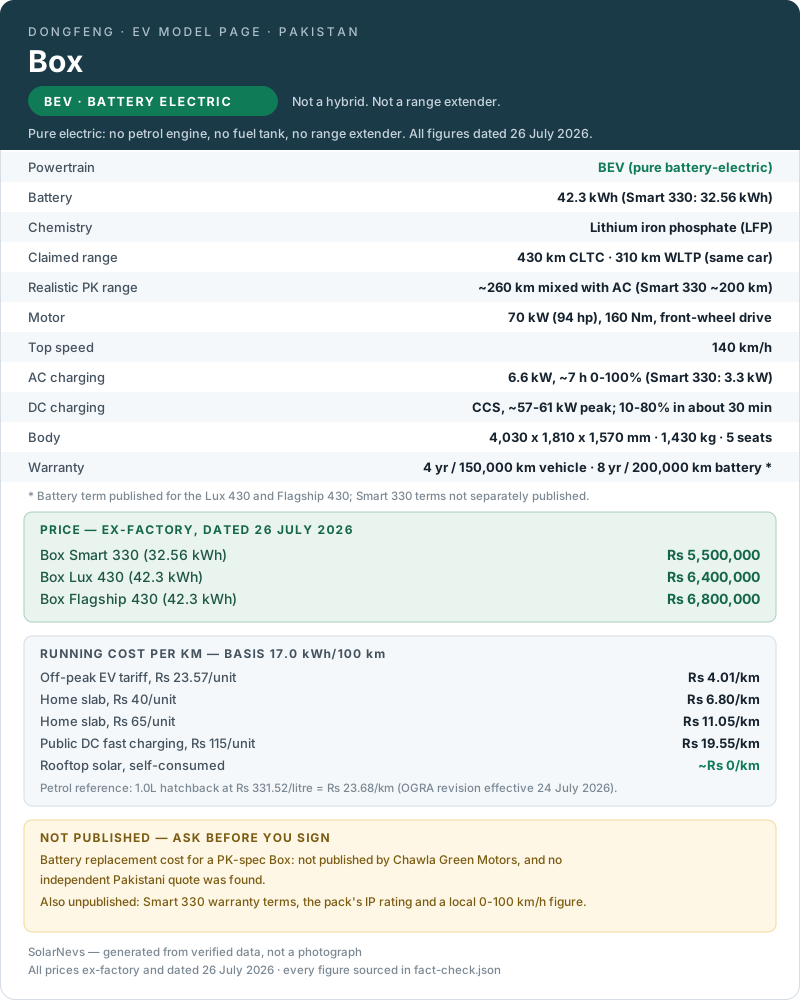
Specifications
| batteryKwh | 42.3 |
|---|---|
| batteryKwhSmart330 | 32.56 |
| batteryChemistry | Lithium iron phosphate (LFP) |
| claimedRangeKm | 430 |
| claimedRangeCycle | CLTC |
| claimedRangeWltpKm | 310 |
| realisticRangeKm | 260 |
| realisticRangeKmSmart330 | 200 |
| kwhPer100km | 17 |
| acCharging | 6.6 kW on Lux 430 / Flagship 430 (~7 h 0-100%); 3.3 kW on Smart 330 |
| dcCharging | CCS, ~57-61 kW peak; 10-80% in about 30 minutes |
| motorKw | 70 |
| motorHp | 94 |
| torqueNm | 160 |
| driveLayout | FWD |
| zeroTo100 | ~12.5 s (international spec; not published by the Pakistani distributor) |
| topSpeedKmh | 140 |
| kerbWeightKg | 1430 |
| seats | 5 |
| dimensionsMm | 4030 x 1810 x 1570, 2660 wheelbase |
| v2l | 3.6 kW (international spec) |
| Powertrain | BEV |
| Warranty | 4 years / 150,000 km vehicle; 8 years / 200,000 km battery (Lux 430 and Flagship 430 — Smart 330 terms not separately published). Battery replacement cost is not published in Pakistan. |
What the Dongfeng Box is
The Dongfeng Box is a small five-door, front-wheel-drive battery-electric (BEV) hatchback sold in Pakistan by Chawla Green Motors. As of 26 July 2026 it costs Rs 5,500,000 to Rs 6,800,000 ex-factory across three variants.
It is a pure EV — no petrol engine, no fuel tank, no range extender. In China the same car is the Nammi Box. If anyone offers you a "hybrid Box", they are describing a different vehicle.
Variants and price
Variant | Powertrain | Battery | Claimed range | Price (ex-factory) | Dated |
|---|---|---|---|---|---|
Box Smart 330 | BEV | 32.56 kWh LFP | 330 km (CLTC) | Rs 5,500,000 | 26 Jul 2026 |
Box Lux 430 | BEV | 42.3 kWh LFP | 430 km (CLTC) | Rs 6,400,000 | 26 Jul 2026 |
Box Flagship 430 | BEV | 42.3 kWh LFP | 430 km (CLTC) | Rs 6,800,000 | 26 Jul 2026 |
Ex-factory excludes freight, registration and provincial taxes. The Smart 330 arrived in April 2026 as a Rs 900,000 undercut of what had been the base car.
Read the Smart 330 spec sheet before you save that money. PakWheels' review found it deletes the infotainment screen and speakers, keyless entry, cruise control, wireless charging, rear defogger and heated mirrors, and it charges at 3.3 kW AC instead of 6.6 kW — roughly ten hours for a full fill rather than seven.
One piece of history. The same car launched twice here in 2025 — as the "GuGo Box" by GuGo Motors in February, then as the Dongfeng Box by Chawla Green Motors in April. Dongfeng named Chawla its sole local partner; GuGo cut prices by Rs 1,050,000 per variant afterwards. If you buy used, establish which channel the car came through, because warranty support follows the official distributor.
Specifications
Item | Figure |
|---|---|
Powertrain | BEV (pure electric) |
Battery | 42.3 kWh LFP (Smart 330: 32.56 kWh LFP) |
Claimed range | 430 km, CLTC cycle (310 km WLTP for the same car in Europe) |
Realistic PK range | ~260 km mixed; ~210-230 km at motorway speed with AC |
Motor | 70 kW (94 hp), 160 Nm, front-wheel drive |
0-100 km/h | ~12.5 s (international spec; not published locally) |
Top speed | 140 km/h |
AC charging | 6.6 kW, ~7 h 0-100% (Smart 330: 3.3 kW) |
DC charging | CCS, ~57-61 kW peak; 10-80% in about 30 minutes |
Kerb weight | 1,430 kg |
Dimensions | 4,030 x 1,810 x 1,570 mm, 2,660 mm wheelbase |
Boot | 326 L (945 L folded) |
Euro NCAP | 69% adult occupant protection (2025) |
Two things Pakistani listings get wrong. PakWheels' spec table calls the Box rear-wheel drive; every international source records front-wheel drive. And a secondary Pakistani site claims the Smart 330 uses a 35 kW motor — PakWheels' own variant table and EV Database both put it at 70 kW, the same motor as the 430s.
{/ VERIFY: drive layout — PakWheels PK listing says RWD, international sources say FWD */} {/ VERIFY: 0-100 km/h and peak DC kW for PK-spec Box — Chawla Green Motors publishes neither */}
Running cost per km
Basis: 17.0 kWh per 100 km at the wall for the Lux/Flagship 430 — EV Database's real-world 157 Wh/km plus roughly 10% charging loss. Pakistani reporting puts real consumption at 13-16 kWh/100 km in mild weather; 17 assumes the AC is running, which in Pakistan it is.
Electricity source | Rate (Rs/unit) | Cost per km | Per 100 km | 1,500 km/month |
|---|---|---|---|---|
Off-peak EV tariff (NEPRA) | 23.57 | Rs 4.01 | Rs 401 | Rs 6,010 |
Home slab — lower end | 40.00 | Rs 6.80 | Rs 680 | Rs 10,200 |
Home slab — upper end | 65.00 | Rs 11.05 | Rs 1,105 | Rs 16,575 |
Public DC fast charging | 115.00 | Rs 19.55 | Rs 1,955 | Rs 29,325 |
Rooftop solar (self-consumed) | ~0 marginal | ~Rs 0 | ~Rs 0 | ~Rs 0 |
Petrol hatchback, 1.0L @ 14 km/L | Rs 331.52/L | Rs 23.68 | Rs 2,368 | Rs 35,521 |
The Smart 330 is lighter, at about 16.0 kWh/100 km: Rs 3.77/km off-peak, Rs 6.40-10.40/km on a home slab, Rs 18.40/km on public DC. Petrol reference: Rs 331.52/litre, OGRA revision effective 24 July 2026.
The SolarNevs line: charging off your own roof is the only way this car is genuinely cheap — about Rs 0/km marginal once the panels are paid for. At 17 kWh/100 km, a 585W panel producing roughly 2.3 kWh/day in Pakistani conditions covers about 13.5 km/day: 30 km/day → 3 panels (~1.76 kW), 50 km/day → 4 panels (~2.34 kW), 80 km/day → 6 panels (~3.51 kW). Panels for the car alone, on top of household load, assuming you charge in daylight.
Honest assessment
Pros. Right size for Pakistani cities, and LFP is the more heat-tolerant, cycle-durable chemistry. Eight years / 200,000 km of battery cover is generous at this price. The Flagship's ambient lighting, wireless charging, heated and ventilated seats and 540-degree camera are well beyond what Rs 6.8 million buys in petrol. Consumption is genuinely low.
Cons. It is slow — 70 kW and roughly 12.5 seconds to 100 km/h makes motorway merging a planning exercise. The range claim is badly inflated by CLTC: PakWheels' own launch coverage conceded "around 300 km according to WLTP standards" against the 430 km headline. Euro NCAP's 69% adult occupant score is mid-table, not good. And the Smart 330's decontenting is aggressive enough that we would not recommend it as a family car.
Who should buy it. A city driver doing 30-70 km a day in Lahore, Karachi or Islamabad who has rooftop solar or will install it, and who owns or can borrow a second car for intercity trips. Buy the Lux 430 as the sensible middle. If you cannot charge at home, do not buy this car.
Pakistan reality check
Real versus claimed range. The 430 km headline is CLTC, the most generous cycle in common use. The identical car is homologated at 310 km WLTP, and EV Database's real-world combined figure is 255 km. Plan around 260 km mixed with the AC on and 210-230 km at 110-120 km/h — roughly 40% below the claim, worse than the ~28% shortfall Pakistani owners typically report, precisely because CLTC starts from a softer baseline than NEDC or WLTP. The Smart 330 lands near 200 km real against 330 claimed.
Battery and warranty. Coverage is 4 years / 150,000 km on the vehicle and 8 years / 200,000 km on the battery for the Lux 430 and Flagship 430. PakWheels attaches that battery term to those two trims specifically; the Smart 330's terms are not separately published, so confirm them. And Chawla Green Motors has not disclosed what a replacement 42.3 kWh LFP pack costs in Pakistan — no independent local quote exists either. Get it in writing before you sign. If the dealer will not put a figure on paper, that is information too.
{/ VERIFY: battery replacement cost for PK-spec Box — unpublished, no independent PK quote found */} {/ VERIFY: whether Smart 330 carries the same 8 yr / 200,000 km battery warranty as Lux/Flagship */}
Home charging after net billing. Since 9 February 2026 new rooftop solar connections fall under net billing: exports are bought back at roughly Rs 11/unit while imports land above Rs 50. Exporting has stopped paying. Charging a Box between 10am and 4pm off your own panels is now the highest-value thing a Pakistani rooftop system can do — and at 42.3 kWh a full fill is small enough that a modest array can genuinely do it. Agreements signed before 9 Feb 2026 keep their old 1:1 terms.
Charging network. NEECA had licensed around 71 stations nationally as of July 2025 with 128 applications pending — but a licence is not a charger. Reporting through 2025-26 documents stalled DISCO connections, separate-meter installations and pending NOCs, leaving roughly 20 genuinely operational public charging points nationwide against a target of 3,000 by 2030. Public DC runs Rs 110-150/kWh against a Rs 39.70/kWh policy cap that appears widely ignored — on a 42.3 kWh pack, a Rs 4,600-6,300 fill-up.
{/* VERIFY: count of genuinely operational public DC points nationwide — no authoritative public register exists */}
Load-shedding and monsoon. A 6.6 kW wall box needs about seven uninterrupted hours; on a feeder that drops for hours a day, solar plus storage stops being optional. Packs of this class are typically sealed to around IP67 — fine for standing water, not submersion — and Chawla Green Motors does not publish the Box's IP rating. If the car has stood in water above the sill, do not attempt to restart it. Tow it and have it inspected: a restarted submerged EV is a fire risk and will not be a warranty claim.
{/* VERIFY: official IP rating of PK-spec Box battery pack — not published */}
Resale. Pakistan has no used-EV price history worth the name and no standard battery state-of-health disclosure. Add the distributor dispute above and a used Box's provenance becomes a real question. Buy to keep through the warranty, not to trade in three years.
Price context
Car | Type | Price | Dated |
|---|---|---|---|
Dongfeng Box Smart 330 | BEV hatch | Rs 5,500,000 | 26 Jul 2026 |
Dongfeng Box Lux 430 | BEV hatch | Rs 6,400,000 | 26 Jul 2026 |
Dongfeng Box Flagship 430 | BEV hatch | Rs 6,800,000 | 26 Jul 2026 |
MG Binguo Pro | BEV hatch, 31.9 kWh, 333 km CLTC | Rs 5,699,000 | 19 May 2026 listing |
JMEV EV3 | BEV hatch, 30 kWh, 271 km WLTP | Rs 4,899,999 | Jul 2026 listing |
BYD Atto 2 | BEV crossover, 45.12 kWh, 323 km WLTP | Rs 7,290,000 | Jul 2026 listing |
The Lux 430 costs Rs 701,000 more than an MG Binguo Pro and gives you a third more battery, five real seats, twice the motor and a longer battery warranty — the strongest value case in the range. The JMEV EV3 undercuts even the Smart 330 while keeping a screen. The BYD Atto 2 asks Rs 490,000 more than the Flagship for 174 hp and a far deeper local service footprint. We do not sell cars and take no dealer money: cross-shop all four, and settle the home-charging question before the colour.
Frequently asked questions
Is the Dongfeng Box a full EV or a hybrid?
It is a pure battery-electric car (BEV). No petrol engine, no fuel tank, no range extender. Dongfeng sells petrol and hybrid models elsewhere, but every Box variant sold in Pakistan is fully electric.
What does the Box actually do on a charge in Pakistan?
The 430 km headline is CLTC, the most optimistic test cycle. The same car is rated 310 km on WLTP. Expect roughly 260 km mixed with the AC on, and about 210-230 km at motorway speed. The Smart 330 does roughly 200 km.
What does it cost per kilometre?
About Rs 4.01/km on the Rs 23.57 off-peak EV tariff, Rs 6.80-11.05/km on a typical home slab, and about Rs 19.55/km on public DC fast charging. A 1.0-litre petrol hatchback costs about Rs 23.68/km at Rs 331.52/litre.
Is the Smart 330 worth the Rs 900,000 saving?
For most buyers, no. PakWheels found it drops the infotainment screen, speakers, keyless entry, cruise control, wireless charging and rear defogger, and it charges at 3.3 kW AC instead of 6.6 kW. It is a fleet or second-car proposition.
What happens if the battery fails?
The pack is covered for 8 years / 200,000 km on the Lux and Flagship. Chawla Green Motors does not publish a replacement price for a 42.3 kWh LFP pack in Pakistan, and no independent Pakistani quote exists. Ask for it in writing.
Does it make sense with rooftop solar?
Yes — that is where the economics work. At 17 kWh/100 km, one 585W panel producing about 2.3 kWh/day covers roughly 13.5 km of driving. Fifty kilometres a day needs about four panels dedicated to the car.
References
- PakWheels — Dongfeng Box new-car page — accessed 26 Jul 2026
- PakWheels — Dongfeng Box full specifications by variant — accessed 26 Jul 2026
- ProPakistani — New affordable Dongfeng Box variant launched in Pakistan (Smart 330) — accessed 26 Jul 2026
- PakWheels Blog — Dongfeng BOX Smart 330 under 55 lacs, worth it? — accessed 26 Jul 2026
- PakWheels Blog — Unboxing Dongfeng Box EV, first look review — accessed 26 Jul 2026
- EV Database — Dongfeng Box 42.3 kWh — accessed 26 Jul 2026
- EV Database — Dongfeng Box 31.4 kWh — accessed 26 Jul 2026
- TechJuice — Dongfeng Box EV debuts in Pakistan — accessed 26 Jul 2026
- Profit by Pakistan Today — Dongfeng confirms Chawla Green Motors as exclusive distributor — accessed 26 Jul 2026
- The Express Tribune — Rs 23.57/kWh tariff for EV charging stations approved — accessed 26 Jul 2026
- Dawn — Net metering to net billing: who pays the price? — accessed 26 Jul 2026
- Arab News — Pakistan plans 3,000 EV charging stations — accessed 26 Jul 2026