BYD Atto 2
Rs 7,290,000 verified 26 Jul 2026 — prices in Pakistan move weekly
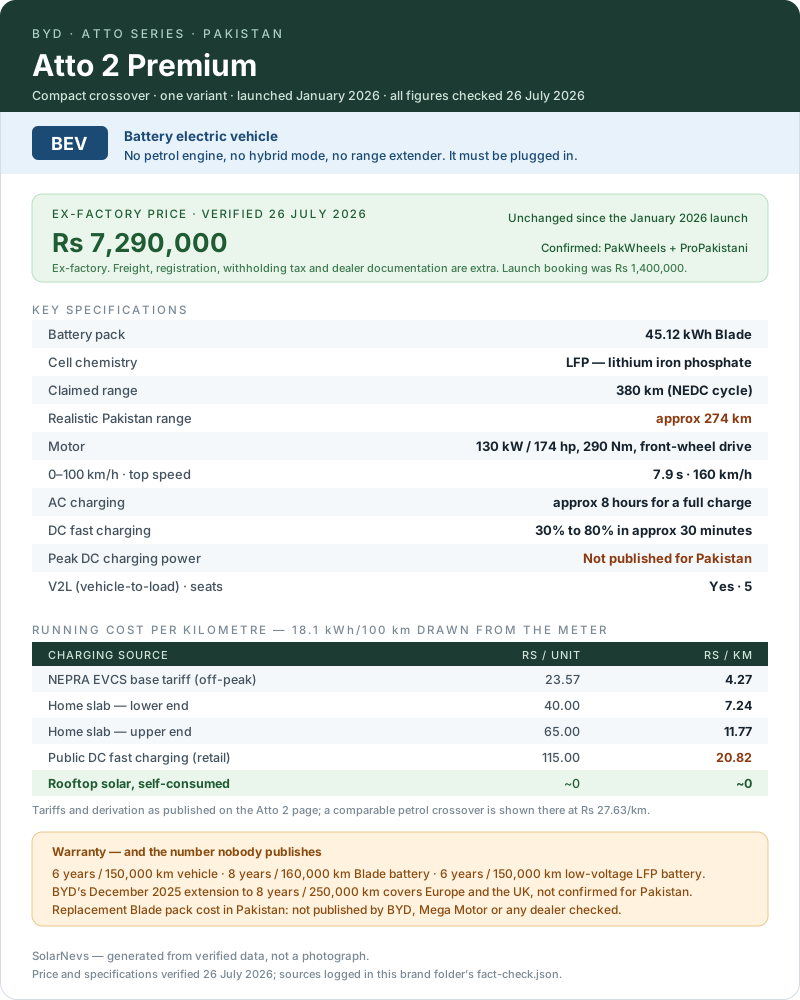
Specifications
| batteryKwh | 45.12 |
|---|---|
| claimedRangeKm | 380 |
| claimedRangeCycle | NEDC |
| realisticRangeKm | 274 |
| kwhPer100km | 18.1 |
| acCharging | Approx 8 hours for a full charge (onboard AC) |
| dcCharging | 30% to 80% in approximately 30 minutes |
| motorKw | 130 |
| motorHp | 174 |
| torqueNm | 290 |
| zeroToHundred | 7.9 s |
| topSpeedKmh | 160 |
| Powertrain | BEV |
| Warranty | 6 years / 150,000 km vehicle, 8 years / 160,000 km Blade battery, 6 years / 150,000 km low-voltage LFP battery, per PakWheels listing. Replacement battery cost is not published in Pakistan. |
BYD Atto 2
The BYD Atto 2 is a battery-electric (BEV) compact crossover — no engine, no hybrid mode, plug-in only — sold in Pakistan by Mega Motor Company at Rs 7,290,000 ex-factory as of 26 July 2026. It is BYD's cheapest car here and the entry point to the brand, launched in January 2026 against a Rs 1,400,000 booking amount.
At this price it is competing with a crowded field of Chinese crossovers, and its case rests almost entirely on BYD's Blade LFP battery and the running-cost maths below.
Variants and price
Variant | Powertrain | Price (ex-factory) | Date verified |
|---|---|---|---|
Atto 2 Premium | BEV | Rs 7,290,000 | 26 Jul 2026 |
One variant only. If someone offers you a "long range Atto 2" in Pakistan, ask which listing it appears on — we found none.
Specifications
Item | Figure |
|---|---|
Powertrain | BEV — battery electric, no engine |
Battery | 45.12 kWh Blade (LFP) |
Claimed range | 380 km (NEDC cycle) |
Realistic Pakistan range | approx 274 km |
Motor | 130 kW / 174 hp, 290 Nm, front-wheel drive |
0–100 km/h | 7.9 s |
Top speed | 160 km/h |
AC charging | approx 8 hours for a full charge |
DC fast charging | 30% to 80% in approx 30 minutes |
Peak DC charging kW | Not published for Pakistan {/* VERIFY: peak DC kW not stated by BYD Pakistan or PakWheels */} |
V2L (vehicle-to-load) | Yes |
Dimensions | 4310 × 1830 × 1675 mm |
Seats | 5 |
Running cost per kilometre
Method, so you can check it: realistic range 274 km from a 45.12 kWh pack is 16.5 kWh/100 km at the wheels; add 10 percent for charging losses and you draw about 18.1 kWh per 100 km from the meter. Cost per km = (18.1 ÷ 100) × tariff.
Charging source | Rs / unit | Rs / km | Rs / 100 km | Rs / month at 1,500 km |
|---|---|---|---|---|
NEPRA EVCS base tariff (off-peak) | 23.57 | 4.27 | 427 | 6,405 |
Home slab — lower end | 40.00 | 7.24 | 724 | 10,860 |
Home slab — upper end | 65.00 | 11.77 | 1,177 | 17,655 |
Public DC fast charging (retail) | 115.00 | 20.82 | 2,082 | 31,230 |
Rooftop solar, self-consumed | ~0 | ~0 | ~0 | ~0 |
Petrol crossover for comparison | Rs 331.52/L @ 12 km/L | 27.63 | 2,763 | 41,445 |
Petrol at Rs 331.52 per litre, OGRA rate effective 24 July 2026. Pakistan now revises fuel daily, so treat that number as a snapshot. The 12 km/L figure is our assumption for a comparable 1.5-litre petrol crossover in mixed city use, not a manufacturer claim.
The signature point: charged from panels you already own, the marginal cost per kilometre is effectively Rs 0. A 585 W panel yields roughly 2.3 kWh a day in Pakistani conditions.
Your daily driving | Energy needed / day | 585 W panels to cover it |
|---|---|---|
30 km | 5.4 kWh | 3 |
50 km | 9.1 kWh | 4 |
80 km | 14.5 kWh | 7 |
Note what the table above really says: public DC charging costs nearly five times what home or solar charging costs. An Atto 2 run mostly off public chargers saves you very little against petrol. The business case for this car is a home charger, ideally a solar-fed one.
Honest assessment
Pros. Genuinely quick for the class and money. LFP Blade chemistry tolerates Pakistani heat better than nickel-based packs and is more forgiving of being left at 100 percent. V2L lets the car run household loads during load-shedding, which in Pakistan is a real feature rather than a brochure line. The lowest entry price into a brand with actual showroom presence.
Cons. 45.12 kWh is a small pack; a realistic 274 km means intercity trips need planning, not spontaneity. Peak DC charging rate is unpublished, so "30 to 80 percent in 30 minutes" is unverifiable in local conditions. And the dealer experience is the recurring complaint — through 2026 PakWheels, TechJuice and Bloom Pakistan all documented BYD Pakistan buyers waiting months past promised delivery dates, some after paying in full, with dealerships deflecting VIN questions to a central support line that returned generic replies.
Who should buy it. Someone with a house, a wall socket, ideally solar, and a daily commute under about 80 km who wants the cheapest credible way into a modern EV. Someone who regularly drives Lahore–Islamabad and wants to do it without thinking should look at a bigger pack.
Pakistan reality check
Real versus claimed range. BYD claims 380 km on the NEDC cycle — an old, lenient standard that flatters every car tested on it. Pakistani owners consistently report roughly 28 percent below claimed on highways at speed with the AC running. Budget 274 km, and less than that in a Karachi July.
Battery replacement and warranty. The warranty is decent: 6 years / 150,000 km on the vehicle, 8 years / 160,000 km on the Blade battery, and 6 years / 150,000 km on the low-voltage LFP battery, per the PakWheels listing. BYD announced an extended 8-year / 250,000 km battery warranty in December 2025, but that covers the European Economic Area, Switzerland and the UK — we could not confirm it applies here. {/ VERIFY: whether BYD's 250,000 km battery warranty extension applies to Pakistan-market cars */} What nobody publishes is what a replacement pack costs in Pakistan. Not BYD, not Mega Motor, not any dealer we checked. {/ VERIFY: replacement Blade pack cost in PKR — unpublished */} Get it in writing before you buy, and note if you cannot.
Charging at home after the February 2026 net-billing switch. Exported solar now earns roughly Rs 11 per unit while imported grid power costs Rs 50 or more. Exporting is a losing trade. Daytime self-consumption is now the best use of a rooftop system, and EV charging is the ideal flexible daytime load. Charge between 10am and 4pm off your own panels, not overnight off the grid.
Charging network. Pakistan has roughly 30–50 publicly accessible charging locations nationwide, concentrated in Karachi, Lahore and Islamabad — far fewer energised sites than NEECA has issued licences for, against a government target of 3,000 by 2030. {/* VERIFY: exact count of genuinely operational public DC points — no authoritative public register exists */} Load-shedding also means your home charger is not always available. Plan buffer.
Monsoon and flooding. EV packs are typically sealed to IP67, and an EV is generally safer in standing water than an ICE air intake, but we could not confirm the IP rating for the Pakistan-spec Atto 2. {/* VERIFY: official IP rating of PK-spec Atto 2 pack — not published */} The rule that matters is absolute: if the car has been submerged, do not restart it and do not plug it in. Flatbed recovery and inspection only.
Resale. There is no meaningful used-EV market data in Pakistan yet, and no accessible battery state-of-health report at resale. Assume resale is opaque and price that risk in.
Price context
Rival | Powertrain | Price (ex-factory) | Date |
|---|---|---|---|
Dongfeng Vigo | BEV | Rs 6,999,000 – 7,499,000 | Apr 2026 |
Omoda E5 | BEV | Rs 8,990,000 | Apr 2026 |
Seres 3 | BEV | Rs 8,390,000 – 9,199,000 | Apr 2026 |
The Atto 2 undercuts the Omoda E5 and Seres 3 by roughly Rs 1.1–1.9 million and sits alongside the Dongfeng Vigo. Against the Vigo, you are paying a small premium for BYD's dealer network and battery warranty. Whether that network is worth it, given the delivery complaints above, is a judgement only you can make.
Frequently asked questions
What does the BYD Atto 2 cost in Pakistan?
Rs 7,290,000 ex-factory for the Premium variant as of 26 July 2026, unchanged since its January 2026 launch. Freight, registration, withholding tax and dealer documentation are extra.
Is the Atto 2 a hybrid?
No. It is a full battery-electric vehicle (BEV). There is no petrol engine and no hybrid mode. It must be plugged in.
How far will it really go on a charge in Pakistan?
Plan on about 274 km, not the claimed 380 km. The claim is an NEDC figure. Pakistani highway running at speed with the AC on typically lands around 28 percent below claimed.
What will it cost me per kilometre?
About Rs 4.27/km on the NEPRA EV tariff, Rs 7.24 to Rs 11.77/km on a home slab, and roughly Rs 20.82/km on public DC charging. A comparable petrol crossover runs about Rs 27.63/km.
How many solar panels would cover my driving?
About four 585 W panels for a 50 km daily commute, based on roughly 2.3 kWh per panel per day in Pakistani conditions. Three panels cover 30 km/day, seven cover 80 km/day.
What does a replacement battery cost?
BYD Pakistan does not publish it, and no dealer or Pakistani source we checked states a figure. This is the single biggest unquantified risk in owning the car.
References
- PakWheels — BYD Atto 2 price and specifications — accessed 26 Jul 2026
- BYD Pakistan (Mega Motor) — Atto 2 official page — accessed 26 Jul 2026
- ProPakistani — BYD Atto 2 and Sealion 7 prices in Pakistan revealed — accessed 26 Jul 2026
- PakWheels Blog — Electric car (EV) prices in Pakistan 2026 — accessed 26 Jul 2026
- Express Tribune — NEPRA approves Rs 23.57/kWh tariff for EV charging stations — accessed 26 Jul 2026
- Charging Station Radar — EV charging prices in Pakistan 2026 — accessed 26 Jul 2026
- Daily Pakistan — New petrol price in Pakistan — accessed 26 Jul 2026
- Express Tribune — NEPRA rolls out new regulations abolishing net metering — accessed 26 Jul 2026
- PakWheels Blog — BYD customers report delays in vehicle deliveries — accessed 26 Jul 2026