Seres 3
Rs 8,390,000 verified 26 Jul 2026 — prices in Pakistan move weekly
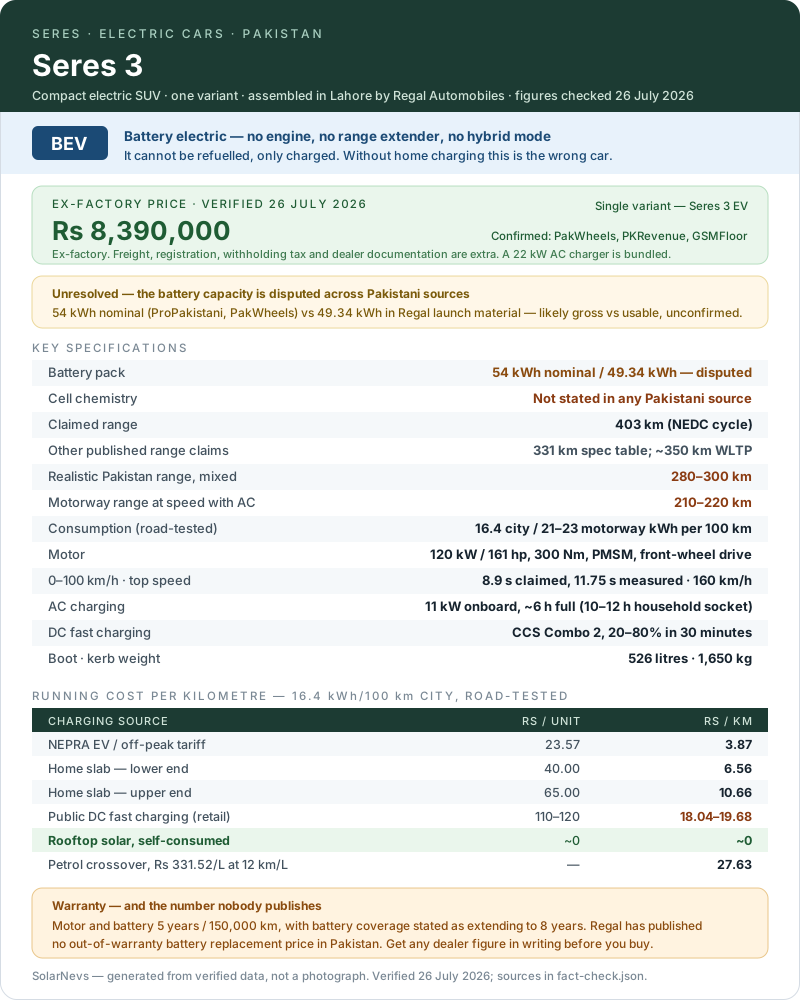
Specifications
| batteryKwh | 54 kWh nominal (49.34 kWh cited by Regal launch material — likely usable) |
|---|---|
| claimedRangeKm | 403 km (NEDC) |
| claimedRangeAlt | 331 km in PakWheels spec table; ~350 km WLTP in PakWheels road test |
| realisticRangeKm | 280-300 km mixed; 210-220 km motorway at speed with AC |
| kwhPer100km | 16.4 city / 21-23 motorway (PakWheels road test) |
| acCharging | 11 kW onboard AC, ~6 h full; 10-12 h on a household 16A socket |
| dcCharging | CCS Combo 2, 20-80% in 30 min |
| motorKw | 120 kW (161 hp), 300 Nm, PMSM, front-wheel drive |
| zeroTo100 | 8.9 s claimed; 11.75 s measured by PakWheels |
| topSpeedKmh | 160 |
| bootLitres | 526 |
| kerbWeightKg | 1650 |
| Powertrain | BEV |
| Warranty | Motor and battery 5 years / 150,000 km, with battery coverage stated as extending to 8 years. Battery replacement cost is not published in Pakistan. |
Seres 3
The Seres 3 is a five-seat compact electric SUV — a pure BEV, no petrol engine, no range extender, no hybrid assist — assembled in Lahore by Regal Automobiles Industries Limited. As of 26 July 2026 it lists at Rs 8,390,000 ex-factory, one trim, 22 kW AC wallbox bundled; freight, registration and taxes extra.
Unveiled 2 December 2024, it was Pakistan's first locally assembled EV — which explains the price, not the quality.
Variant and price
Variant | Powertrain | Price (ex-factory) | Priced on |
|---|---|---|---|
Seres 3 EV | BEV | Rs 8,390,000 | 26 July 2026 |
One variant; no hybrid and no second battery size exist here. Business Recorder reported Rs 8.399mn at approval; retail listings say Rs 8,390,000.
Specifications
Item | Figure |
|---|---|
Powertrain | BEV (battery electric only) |
Battery | 54 kWh nominal; 49.34 kWh in launch material {/* VERIFY */} |
Motor | 120 kW / 161 hp, 300 Nm, PMSM, FWD |
Claimed range | 403 km NEDC |
Realistic PK range | 280-300 km mixed, 210-220 km motorway |
Consumption | 16.4 kWh/100 km city, 21-23 motorway |
AC charging | 11 kW onboard, ~6 h (10-12 h household socket) |
DC charging | CCS Combo 2, 20-80% in 30 min |
0-100 km/h | 8.9 s claimed, 11.75 s measured |
Battery size is disputed across Pakistani sources: 54 kWh versus 49.34 kWh — likely gross versus usable, unconfirmed.
Running cost per kilometre
Computed as (kWh per 100 km ÷ 100) x tariff, on road-tested consumption.
Electricity rate | City @ 16.4 kWh/100 km | Motorway @ 22 kWh/100 km |
|---|---|---|
Rs 23.57 — NEPRA EV / off-peak | Rs 3.87/km | Rs 5.19/km |
Rs 40 — lower home slab | Rs 6.56/km | Rs 8.80/km |
Rs 65 — upper home slab | Rs 10.66/km | Rs 14.30/km |
Rs 110 — public DC, low end | Rs 18.04/km | Rs 24.20/km |
Rs 120 — public DC, typical | Rs 19.68/km | Rs 26.40/km |
Rooftop solar, self-consumed | ~Rs 0/km | ~Rs 0/km |
Petrol @ Rs 331.52/L | Rs 27.63/km (12 km/L) | Rs 22.10/km (15 km/L) |
Petrol is Rs 331.52/litre effective 24 July 2026. Note the last two rows: on the motorway at Rs 120/unit this car costs Rs 26.40/km, more than a petrol crossover. It saves money on a cheap home tariff, not on commercial DC, where the Rs 39.70/kWh policy cap is ignored.
Solar. At 16.4 kWh/100 km plus ~10% charging losses, one 585W panel yields ~2.3 kWh/day here — so 3 panels cover 30 km/day, 4 cover 50 km, 7 cover 80 km, 10 cover 120 km. Most commutes here are 30-50 km: three or four panels take running cost to roughly zero.
Honest assessment
Pros. Price is the argument — cheapest electric SUV of its size here, and local assembly insulates it from the duty swings that whipsaw CBU rivals. City consumption of 16.4 kWh/100 km is genuinely good, and it ships with a space-saver spare.
Cons. PakWheels measured 0-100 at 11.75 s against a claimed 8.9 — the claims were never verified locally. Motorway consumption of 21-23 kWh/100 km cuts range to 210-220 km. The reviewer found the suspension "a little stiff or bouncy on rough motorways." No Android Auto or CarPlay. The bundled charger is 22 kW; the onboard charger is 11 kW.
Buy if you have rooftop solar, home parking on a dedicated circuit, a commute under 80 km and a second petrol car. Do not buy without home charging, if you drive mostly motorway, or if this must be your only car.
Pakistani reality
Real versus claimed range. The 403 km claim uses NEDC, the oldest and most generous cycle; PakWheels separately lists 331 km and cites ~350 km WLTP. Plan on 280-300 km mixed and 210-220 km motorway with AC — about 28% below claim, normal for every EV brand here.
Battery and warranty. Motor and battery: 5 years / 150,000 km, battery coverage stated as extending to 8 years. One dealer-adjacent source claims 250,000 km, unconfirmed. {/* VERIFY */} More importantly, Regal has published no out-of-warranty battery replacement price — nobody can say what a pack costs landed and fitted in year nine. Get it in writing.
Home charging after the February 2026 net-billing switch. NEPRA replaced net metering with net billing on 9 February 2026: exports now earn about Rs 11/unit against imports at Rs 50+. Exporting surplus solar became a losing trade overnight, so the best use of midday generation is self-consumption — and an EV is the ideal load. Charge 10am to 4pm, not overnight.
Charging network. As of January 2026 Pakistan had just over 20 operational public charging points nationwide against 13 NEECA licences issued, versus targets of 240 stations this fiscal year and 3,000 by 2030. Bottlenecks are grid connections, separate meters, DISCO NOCs and customs. Twenty-odd points for 240 million people makes home charging mandatory, and load-shedding limits when the car charges.
Service. Regal's footprint is DFSK-based, concentrated in Punjab. Confirm your nearest EV-trained workshop before buying.
Monsoon and flooding. A sealed IP67-class pack handles standing water as well as a petrol intake, but the rule is absolute: if submerged, do not restart it. Recover and inspect it.
Resale. No established used market and no Pakistani standard for certifying battery state-of-health. A buyer in 2029 cannot verify your pack and will discount for it. Assume weak, opaque resale.
Price context
Model | Powertrain | Price (ex-factory) | Priced on |
|---|---|---|---|
Seres 3 | BEV | Rs 8,390,000 | 26 July 2026 |
BYD Atto 3 Advance | BEV | Rs 8,990,000 | 26 July 2026 |
MG ZS EV MCE Essence | BEV | Rs 9,690,000 | 26 July 2026 |
Deepal S05 Premium | REEV — not a BEV | Rs 9,999,000 | 26 July 2026 |
The Atto 3 costs Rs 600,000 more for a deeper service network and a quicker car. The Deepal S05 is a warning, not a rival — a range-extender with a petrol generator, filed under "EV" locally.
The Seres 3's case rests on being the cheapest electric SUV of its size in Pakistan. That is real, and it is its only advantage.
We do not sell cars and take no dealer money. Prices are ex-factory and dated.
Frequently asked questions
Is the Seres 3 a BEV, PHEV or hybrid?
It is a pure battery-electric vehicle (BEV). There is no petrol engine, no range extender and no hybrid system. It cannot be refuelled — only charged.
What does the Seres 3 cost in Pakistan today?
Rs 8,390,000 ex-factory as of 26 July 2026, in a single EV variant. Freight, registration and taxes are extra. A 22 kW AC charger is bundled.
What range should I actually expect?
Around 280-300 km in mixed city use and 210-220 km on the motorway at speed with AC running — against a 403 km NEDC claim.
How much does it cost per kilometre to run?
About Rs 3.87/km on the Rs 23.57 EV tariff, Rs 6.56-10.66/km on home slabs, and Rs 18-20/km on public DC. Petrol equivalent is roughly Rs 27/km.
What does a replacement battery cost?
Regal has not published a replacement price in Pakistan. Treat this as an unquantified risk. Get any dealer quote in writing before buying.
Can I charge it from rooftop solar?
Yes. Roughly four 585W panels cover 50 km of daily driving. Since the Feb 2026 net-billing switch, self-consuming solar beats exporting it.
References
- PakWheels — Seres 3 2026 price and specs — accessed 26 Jul 2026
- PakWheels — Is Seres 3 Pakistan's most affordable EV SUV? (road test) — accessed 26 Jul 2026
- ProPakistani — Regal Automobiles launches Pakistan's first locally-assembled Seres 3 EV — accessed 26 Jul 2026
- Business Recorder — Regal Automobiles gets nod to manufacture Pakistan's first electric SUV — accessed 26 Jul 2026
- Express Tribune — Rs 23.57/kWh tariff for EV charging stations approved — accessed 26 Jul 2026
- Arab News — Pakistan plans 3,000 EV charging stations — accessed 26 Jul 2026
- ProPakistani — Solar users to pay full unit price under net-billing rule — accessed 26 Jul 2026