BYD Atto 3
Rs 8,990,000 verified 26 Jul 2026 — prices in Pakistan move weekly
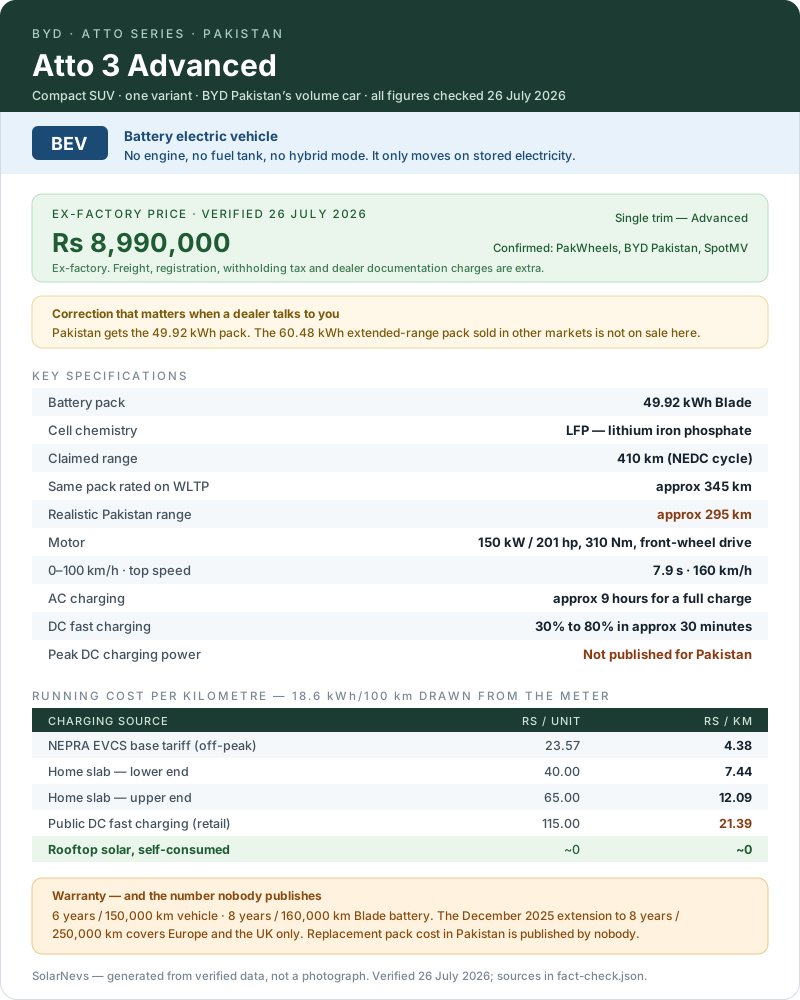
Specifications
| batteryKwh | 49.92 |
|---|---|
| claimedRangeKm | 410 |
| claimedRangeCycle | NEDC (approx 345 km WLTP for the same pack) |
| realisticRangeKm | 295 |
| kwhPer100km | 18.6 |
| acCharging | Approx 9 hours for a full charge (onboard AC) |
| dcCharging | 30% to 80% in approximately 30 minutes |
| motorKw | 150 |
| motorHp | 201 |
| torqueNm | 310 |
| zeroToHundred | 7.9 s |
| topSpeedKmh | 160 |
| Powertrain | BEV |
| Warranty | 6 years / 150,000 km vehicle and 8 years / 160,000 km Blade battery, per BYD Pakistan listings. BYD's 8-year / 250,000 km battery extension announced in December 2025 covers Europe and the UK, not confirmed for Pakistan. Replacement pack cost is unpublished here. |
BYD Atto 3
The BYD Atto 3 is a battery-electric (BEV) compact SUV — no engine, plug-in only — selling in Pakistan at Rs 8,990,000 ex-factory as of 26 July 2026 in a single Advanced trim. It is BYD Pakistan's volume car and, for many buyers, the first EV they seriously consider.
One correction up front, because it is widely repeated wrong. The Atto 3 sold in Pakistan uses the 49.92 kWh Blade pack, not the 60.48 kWh extended-range pack offered in some other markets. BYD Pakistan's own site and PakWheels both list 49.92 kWh. If a dealer quotes you 60 kWh, they are describing a car that is not on sale here.
Variants and price
Variant | Powertrain | Battery | Price (ex-factory) | Date verified |
|---|---|---|---|---|
Atto 3 Advanced | BEV | 49.92 kWh | Rs 8,990,000 | 26 Jul 2026 |
Single variant. The price has held steady across PakWheels, SpotMV and BYD's own listings since late 2025.
Specifications
Item | Figure |
|---|---|
Powertrain | BEV — battery electric, no engine |
Battery | 49.92 kWh Blade (LFP) |
Claimed range | 410 km (NEDC); approx 345 km WLTP for the same pack |
Realistic Pakistan range | approx 295 km |
Motor | 150 kW / 201 hp, 310 Nm, permanent-magnet synchronous, front-wheel drive |
0–100 km/h | 7.9 s |
Top speed | 160 km/h |
AC charging | approx 9 hours for a full charge |
DC fast charging | 30% to 80% in approx 30 minutes |
Peak DC charging kW | Not published for Pakistan {/* VERIFY: peak DC kW not stated by BYD Pakistan */} |
Suspension | MacPherson strut front, multi-link independent rear |
Display | 15.6-inch rotating touchscreen |
Boot | up to 1,340 litres with rear seats folded |
Seats | 5 |
Running cost per kilometre
The method, so you can audit it: a realistic 295 km from 49.92 kWh is 16.9 kWh/100 km at the wheels; add 10 percent for charging losses and you pull about 18.6 kWh per 100 km from the meter. Cost per km = (18.6 ÷ 100) × tariff.
Charging source | Rs / unit | Rs / km | Rs / 100 km | Rs / month at 1,500 km |
|---|---|---|---|---|
NEPRA EVCS base tariff (off-peak) | 23.57 | 4.38 | 438 | 6,570 |
Home slab — lower end | 40.00 | 7.44 | 744 | 11,160 |
Home slab — upper end | 65.00 | 12.09 | 1,209 | 18,135 |
Public DC fast charging (retail) | 115.00 | 21.39 | 2,139 | 32,085 |
Rooftop solar, self-consumed | ~0 | ~0 | ~0 | ~0 |
Petrol SUV for comparison | Rs 331.52/L @ 12 km/L | 27.63 | 2,763 | 41,445 |
Petrol at Rs 331.52 per litre, the OGRA rate effective 24 July 2026 — Pakistan now reprices fuel daily, so this is a snapshot. The 12 km/L consumption is our stated assumption for a comparable petrol SUV in mixed use, not a manufacturer figure.
The solar line. Charged off panels you already own, the marginal cost per kilometre is effectively Rs 0. A 585 W panel makes roughly 2.3 kWh a day in Pakistani conditions.
Your daily driving | Energy needed / day | 585 W panels to cover it |
|---|---|---|
30 km | 5.6 kWh | 3 |
50 km | 9.3 kWh | 5 |
80 km | 14.9 kWh | 7 |
The gap between the top and bottom rows of the cost table is the whole argument. Home or solar charging beats petrol by a factor of four to six. Public DC charging beats petrol by about 20 percent — barely enough to justify the car on running cost alone.
Honest assessment
Pros. The drivetrain is the best thing about it. A PakWheels owner review from a Pakistani Atto 3 buyer describes being so used to the smooth, quiet, immediately responsive drive that petrol cars now feel sluggish — that is a fair description of the experience. Interior material quality and equipment levels are ahead of most petrol SUVs at this money. LFP Blade chemistry is more heat-tolerant than nickel-based packs, which matters here, and can be charged to 100 percent routinely without the same degradation penalty.
Cons. 49.92 kWh is modest for a 4.4-metre SUV, and the 410 km NEDC claim sets an expectation the car will not meet — the same pack is rated about 345 km on the more realistic WLTP cycle, and Pakistani conditions take more off that again. There is no long-range option here to upgrade to. Peak DC charging rate is unpublished. And BYD Pakistan's delivery record in 2026 has been poor enough to generate sustained press coverage.
Who should buy it. A household with a home charging point and, ideally, rooftop solar, whose driving is predominantly urban and suburban with occasional intercity trips they are willing to plan around a charging stop. Someone who does Karachi–Hyderabad–Sukkur regularly should be honest with themselves about a 295 km real range and a thin charging network.
Pakistan reality check
Real versus claimed range. BYD claims 410 km on NEDC. NEDC is a lenient laboratory cycle; WLTP for the same 49.92 kWh pack is about 345 km. Pakistani owners report roughly 28 percent below claimed on highways at speed with AC running. Plan on 295 km, and less in peak summer with the AC fighting a 45 °C afternoon.
Battery replacement and warranty. Cover is 6 years / 150,000 km on the vehicle and 8 years / 160,000 km on the Blade battery, per BYD Pakistan listings. In December 2025 BYD announced an extended 8-year / 250,000 km battery warranty with a minimum 70 percent state-of-health guarantee — that announcement explicitly covers the European Economic Area, Switzerland and the UK. We could not confirm it applies to Pakistan-market cars. {/ VERIFY: whether BYD's 250,000 km battery warranty extension applies in Pakistan */} And on the question buyers actually care about — what a replacement pack costs — BYD Pakistan publishes nothing, and neither does any dealer we checked. {/ VERIFY: replacement Blade pack cost in PKR — unpublished in Pakistan */} Ask in writing. Note the answer, or the absence of one.
Charging at home after the February 2026 net-billing switch. Under net billing, exported units earn roughly Rs 11 while imported units cost Rs 50 or more. Exporting is now a poor trade. The best available use of a rooftop system is self-consumption during daylight, and an EV is the single most flexible large load a house has. Charge midday off your own generation rather than overnight off the grid — the difference is several thousand rupees a month.
Charging network and load-shedding. Pakistan has roughly 30–50 publicly accessible charging locations nationwide, overwhelmingly in Karachi, Lahore and Islamabad, against a 3,000-by-2030 government target and a licence count from NEECA that far exceeds energised sites. {/* VERIFY: count of genuinely operational public DC points — no authoritative register published */} Load-shedding means your home charger is not always available either. A car with 295 km of real range in a country with a few dozen public chargers is a city car with intercity ambitions, not the reverse.
Monsoon and flooding. EV packs are commonly sealed to IP67 and an EV is generally more flood-tolerant than an ICE air intake, but the IP rating for the Pakistan-spec Atto 3 is not published. {/* VERIFY: official IP rating of PK-spec Atto 3 pack */} The non-negotiable rule: if it has been submerged, do not restart it and do not plug it in. Flatbed recovery and inspection only. Karachi and Lahore make this a live August risk.
Resale and battery health. There is no established used-EV pricing in Pakistan and no accessible state-of-health readout at resale, so a buyer three years from now has no way to value the most expensive component in the car. Assume resale is opaque and discount accordingly.
Price context
Rival | Powertrain | Price (ex-factory) | Date |
|---|---|---|---|
Omoda E5 | BEV | Rs 8,990,000 | Apr 2026 |
Seres 3 | BEV | Rs 8,390,000 – 9,199,000 | Apr 2026 |
MG ZS EV (MCE Essence) | BEV | Rs 9,690,000 | 2026 |
The Atto 3 lands exactly on the Omoda E5's price, undercuts the MG ZS EV base car by Rs 700,000, and sits at the top of the Seres 3 range. Against all three, what BYD is selling is the battery — LFP Blade chemistry with an 8-year warranty and a brand with more service points than the newer entrants. Against all three, what BYD is not selling is a delivery date you can rely on.
Frequently asked questions
What does the BYD Atto 3 cost in Pakistan?
Rs 8,990,000 ex-factory for the Advanced variant as of 26 July 2026. That price is before freight, registration, withholding tax and dealer documentation charges.
Does the Pakistani Atto 3 have the 60 kWh battery?
No. Pakistan gets the 49.92 kWh Blade pack rated at 410 km NEDC. Both BYD Pakistan's own site and PakWheels confirm 49.92 kWh. The 60.48 kWh extended-range pack is not sold here.
Is the Atto 3 a hybrid or a full EV?
A full battery-electric vehicle (BEV). No engine, no fuel tank, no hybrid mode. It only moves on stored electricity.
What is the real-world range in Pakistan?
Around 295 km against a claimed 410 km. The claim uses the lenient NEDC cycle; the same pack is rated about 345 km on WLTP. Pakistani highway driving with AC lands roughly 28 percent below claimed.
How much does it cost to run per kilometre?
About Rs 4.38/km on the NEPRA EV tariff, Rs 7.44 to Rs 12.09/km on a home slab, and about Rs 21.39/km on public DC. An equivalent petrol crossover costs roughly Rs 27.63/km.
How many solar panels do I need for it?
Roughly five 585 W panels for a 50 km daily commute, assuming about 2.3 kWh per panel per day. Three cover 30 km/day; seven cover 80 km/day.
References
- PakWheels — BYD Atto 3 price and specifications — accessed 26 Jul 2026
- BYD Pakistan (Mega Motor) — Atto 3 official page — accessed 26 Jul 2026
- PakWheels — BYD pricelist — accessed 26 Jul 2026
- SpotMV — BYD car price in Pakistan 2026 — accessed 26 Jul 2026
- PakWheels Blog — BYD Atto 3 owner review — accessed 26 Jul 2026
- Express Tribune — NEPRA approves Rs 23.57/kWh tariff for EV charging stations — accessed 26 Jul 2026
- Charging Station Radar — EV charging prices in Pakistan 2026 — accessed 26 Jul 2026
- Daily Pakistan — New petrol price in Pakistan — accessed 26 Jul 2026
- Express Tribune — NEPRA rolls out new regulations abolishing net metering — accessed 26 Jul 2026
- BYD Global Media — BYD extends Blade Battery warranty to eight years or 250,000 km — accessed 26 Jul 2026