Haval H6 PHEV
Rs 12,895,000 verified 26 Jul 2026 — prices in Pakistan move weekly
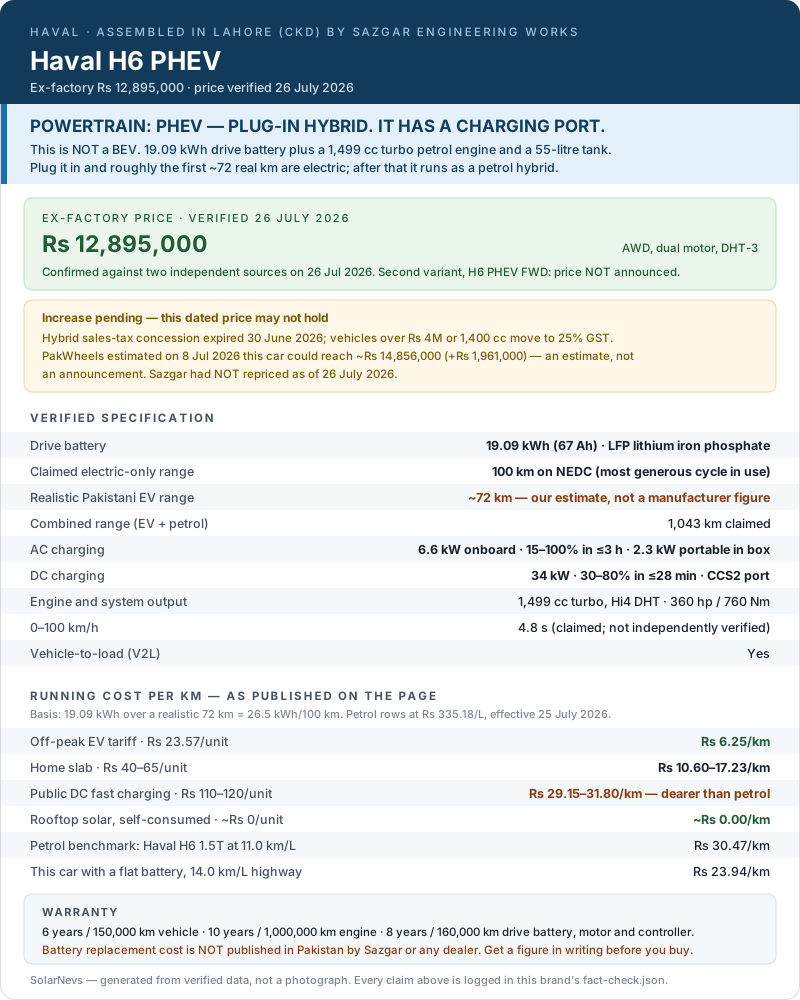
Specifications
| batteryKwh | 19.09 |
|---|---|
| batteryDetail | 67 Ah LFP (lithium iron phosphate) pack |
| claimedRangeKm | 100 |
| claimedRangeCycle | NEDC (EV-only); 1,043 km combined EV + petrol |
| realisticRangeKm | 72 |
| kwhPer100km | 26.5 |
| acCharging | 6.6 kW onboard AC, 15-100% in <=3 h; 2.3 kW portable charger in the box |
| dcCharging | 34 kW DC, 30-80% in <=28 min, CCS2 port |
| motorKw | Not published in kW by Sazgar. Combined system output 360 hp (~268 kW) / 760 Nm |
| zeroToHundred | 4.8 s (claimed) |
| Powertrain | PHEV |
| Warranty | 6 years / 150,000 km vehicle; 10 years / 1,000,000 km engine; 8 years / 160,000 km on the drive battery, motor and controller. Battery replacement cost is not published in Pakistan. |
Haval H6 PHEV
The Haval H6 PHEV is a plug-in hybrid mid-size SUV — a 19.09 kWh battery and a charging port, backed by a 1.5-litre turbo petrol engine — assembled in Lahore by Sazgar. Ex-factory price as of 26 July 2026: Rs 12,895,000, unchanged since the August 2025 launch but living on borrowed time.
Say this plainly, because Pakistani coverage gets it wrong constantly: this is not an electric car. It has a 55-litre tank and an exhaust. What it has that the H6 HEV does not is a plug. Charge it and roughly the first 72 real kilometres of your day are electric; after that it is a petrol hybrid.
Variants and prices
Variant | Drivetrain | Ex-factory (26 Jul 2026) |
|---|---|---|
H6 PHEV | AWD, dual motor, DHT-3, 360 hp | Rs 12,895,000 |
H6 PHEV FWD | FWD, single motor, DHT-1, 322 hp | Price not announced |
The FWD version reached dealers on 16 July 2026 claiming 106 km NEDC, but GWM Pakistan has not published its price.
Specifications
Item | Figure |
|---|---|
Powertrain | PHEV (plug-in hybrid) |
Battery | 19.09 kWh, 67 Ah, LFP |
Claimed EV range | 100 km (NEDC) |
Realistic PK EV range | ~72 km |
Combined range | 1,043 km |
Engine / output | 1,499 cc turbo, Hi4 DHT — 360 hp / 760 Nm |
0-100 km/h | 4.8 s (claimed) |
AC / DC charging | 6.6 kW, <=3 h · 34 kW, 30-80% in <=28 min, CCS2 |
V2L | Yes |
Outlets reporting "67 kWh" misread a table listing 67 Ah / 19.09 kWh — a 285 V pack.
Running cost per km
Basis: 19.09 kWh over a realistic 72 km = 26.5 kWh/100 km. Add ~10% for charging losses.
Electricity source | Rs/unit | At 26.5 (real) | At 19.1 (NEDC) |
|---|---|---|---|
Off-peak EV tariff | 23.57 | Rs 6.25 | Rs 4.50 |
Home slab | 40-65 | Rs 10.60-17.23 | Rs 7.64-12.41 |
Public DC fast | 110-120 | Rs 29.15-31.80 | Rs 21.00-22.91 |
Rooftop solar | ~0 | ~Rs 0.00 | ~Rs 0.00 |
Against petrol at Rs 335.18/L (25 July 2026): a Haval H6 1.5T at its claimed 11.0 km/L costs Rs 30.47/km. But once this car's battery is flat it is rated 14 km/L on the highway — Rs 23.94/km, barely better. The case for it collapses if you do not plug in nightly. Note the public row too: DC fast charging costs more than petrol.
Solar sizing at ~2.3 kWh/day per 585 W panel: 30 km/day needs 4 panels (2.34 kWp); 50 km/day needs 7 (4.10 kWp); a full 72 km needs 10 (5.85 kWp). Off your own roof the marginal cost is Rs 0/km.
Honest assessment
Pros. 19.09 kWh is a genuinely usable battery — a Lahore or Karachi commuter can go weeks without buying petrol. The 4.8-second claim makes it the quickest locally assembled C-SUV, and 34 kW DC plus V2L are rare here. Sazgar's volume is real: four-wheeler sales rose 74.5% year-on-year in May 2026 (1,604 against 919) and the H6 hit #2 in March 2026, so parts and service coverage are improving fastest here.
Cons. PakWheels owners repeatedly flag over-eager driver assists they switch off, and build quality below the price. Charging discipline is mandatory. And the payback is brutal: at Rs 3,971,014 over the H6 1.5T petrol, saving Rs 24.22/km across 15,000 all-electric km a year is Rs 363,000 — an ~11-year payback, assuming you never exceed 72 km in a day. Against the H6 HEV the premium is Rs 1,371,985 and payback falls to about 6.5 years.
Who should buy it. Someone with rooftop solar, a garage socket and a commute under 70 km who still wants one car that can do Lahore-Islamabad. If you cannot charge nightly, buy the H6 HEV and keep Rs 1.37 million.
The Pakistan reality
Real vs claimed range. The 100 km is NEDC — the oldest and most generous cycle in use, abandoned in Europe. Pakistani owners report roughly 28% below claim on highways at speed with the AC on, putting this car at ~72 usable electric km. City traffic does better; the M-2 in June does worse.
Battery replacement and warranty. 8 years / 160,000 km on battery, motor and controller; 6 years / 150,000 km vehicle; 10 years / 1,000,000 km engine. Strong on paper. But Sazgar does not publish what a replacement pack costs and no Pakistani price list carries it. LFP is durable and 19.09 kWh is small, so it should be far below a BEV's — an expectation, not a quotation. Get it in writing.
Charging at home after the February 2026 net-billing switch. Exports now earn about Rs 11/unit while you buy back at Rs 50+, so exporting and re-importing loses roughly Rs 40 a unit. Daytime self-consumption is now the best use of a rooftop system, and a car battery is the ideal daytime load. Agreements valid on 9 February 2026 keep old rates until expiry.
Charging network and load-shedding. Do not plan around the network. Pakistan has roughly 30-50 publicly accessible stations nationwide, no centralised official count, and 72 NEECA licences issued since October 2024 that mostly have not become working chargers, stalled on grid connections, meters and DISCO/OMC no-objection certificates. For a PHEV this matters less than for a BEV, since your tank is the backup. A 6.6 kW charge takes about three hours, so where evening load-shedding is routine, charge in daylight off solar.
Monsoon and flooding. The rule is absolute: if the car has been submerged, do not attempt to restart it. Do not switch on the ignition or plug it in. Recover it on a flatbed for inspection. A restart also voids warranty claims.
Resale and battery health. Pakistan has no established plug-in resale market and no independent battery state-of-health testing. A buyer in 2031 cannot verify how much of your 19.09 kWh remains — and neither can you.
Price context
Vehicle | Type | Ex-factory | Dated |
|---|---|---|---|
Haval H6 PHEV | PHEV, 19.09 kWh | Rs 12,895,000 | 26 Jul 2026 |
MG HS Super Hybrid | PHEV, 24.7 kWh, ~50 km EV | Rs 10,199,000 | 24 Apr 2026 |
Haval H6 HEV | HEV, no plug | Rs 11,523,015 | 26 Jul 2026 |
Haval H6 1.5T | Petrol | Rs 8,923,986 | 26 Jul 2026 |
The MG HS Super Hybrid undercuts this car by Rs 2,696,000 with a nominally larger battery, though on global specification it claims only ~50 km of electric range against the Haval's 100 km NEDC, and it is FWD with less power. BYD's Sealion 6 PHEV is still "call for price", so we invent nothing.
Price warning. The hybrid sales-tax concession expired 30 June 2026, moving vehicles above Rs 4 million or 1,400 cc to 25% GST. On 8 July 2026 PakWheels estimated this car would reach Rs 14,856,000 (+Rs 1,961,000). As of 26 July Sazgar had not repriced, having absorbed the 2025 NEV levy rather than pass it on. Confirm your price in writing at booking.
Frequently asked questions
Is the Haval H6 PHEV an electric car?
No. It is a plug-in hybrid — a 19.09 kWh battery plus a 1.5T petrol engine. You plug it in for about 72 real km of electric driving, then it runs as a petrol hybrid. It is not a BEV.
What does it cost per km in Pakistan?
About Rs 6.25/km on the Rs 23.57 off-peak EV tariff, Rs 10.60-17.23/km on a typical home slab, and Rs 29-32/km on public DC fast charging. A petrol H6 1.5T costs about Rs 30.47/km.
Can I actually get 100 km of electric range?
No. The 100 km figure is NEDC, the most optimistic test cycle. On a Pakistani highway at speed with the AC running, expect about 72 km. City driving in traffic gets closer to the claim.
What does a replacement battery cost?
Sazgar does not publish a price for a replacement H6 PHEV pack in Pakistan. Ask for it in writing before you buy and do not accept a verbal estimate.
Will the price go up?
Very likely. The hybrid sales-tax concession expired 30 June 2026 and PakWheels estimated on 8 July 2026 that the H6 PHEV could rise to about Rs 14.856 million. Sazgar had not repriced as of 26 July 2026.
How many solar panels do I need to run it?
About 7 x 585 W panels (4.1 kWp) covers 50 km a day. Ten panels (5.85 kWp) covers a full 72 km electric range daily.
References
- PakWheels — Haval H6 PHEV 2026 price, specs & features — accessed 26 Jul 2026
- PakWheels — H6 PHEV detailed specs & features — accessed 26 Jul 2026
- PakWheels — Haval hybrid model prices may rise by up to Rs 19.6 lakh (8 Jul 2026) — accessed 26 Jul 2026
- ProPakistani — GWM launches Haval H6 PHEV FWD in Pakistan (16 Jul 2026) — accessed 26 Jul 2026
- PakWheels — current petroleum prices (Rs 335.18/L w.e.f. 25 Jul 2026) — accessed 26 Jul 2026
- Express Tribune — Rs 23.57/kWh tariff for EV charging stations approved — accessed 26 Jul 2026
- ProPakistani — solar users to pay full unit price under net-billing rule (9 Feb 2026) — accessed 26 Jul 2026