Kia EV5
Rs 18,500,000 verified 26 Jul 2026 — prices in Pakistan move weekly
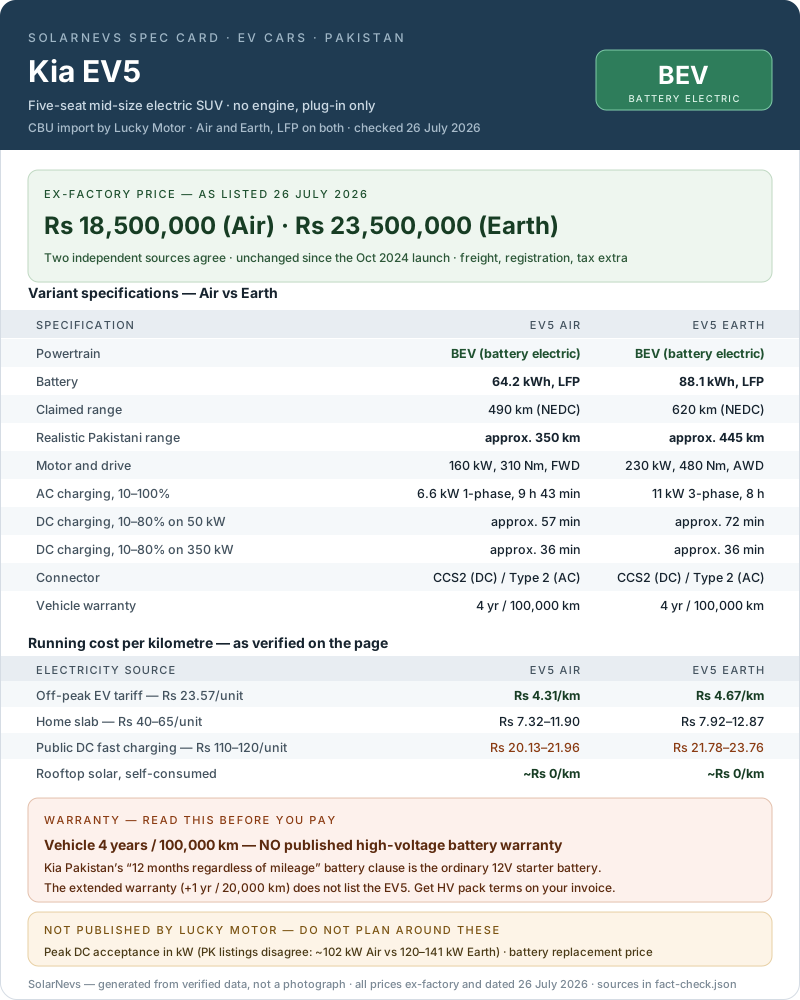
Specifications
| batteryKwh | 64.2 (Air) / 88.1 (Earth) |
|---|---|
| batteryChemistry | LFP (lithium iron phosphate) on both variants per PakWheels spec sheet |
| claimedRangeKm | 490 (Air) / 620 (Earth) |
| claimedRangeCycle | NEDC |
| realisticRangeKm | approx. 350 (Air) / approx. 445 (Earth) |
| kwhPer100km | 18.3 (Air) / 19.8 (Earth) |
| acCharging | Air 6.6 kW single-phase, 10-100% in 9 h 43 min; Earth 11 kW three-phase, 10-100% in 8 h |
| dcCharging | CCS2. On a 50 kW charger 10-80% takes approx. 57 min (Air) / 72 min (Earth); on a 350 kW charger approx. 36 min for both. Peak DC acceptance not published by Lucky Motor. |
| motorKw | 160 (Air, FWD single motor) / 230 combined (Earth, AWD dual motor) |
| motorNm | 310 (Air) / 480 (Earth) |
| zeroTo100 | 8.5 s (Air) / 6.5 s (Earth) |
| topSpeedKmh | 185 |
| dimensionsMm | 4615 x 1875 x 1715 |
| bootLitres | 513 |
| seats | 5 |
| Powertrain | BEV |
| Warranty | Kia Pakistan publishes 4 years / 100,000 km on the vehicle. No published high-voltage traction battery warranty for the EV5 — the '12 months regardless of mileage' clause on Kia Pakistan's warranty page is the ordinary 12V battery. The extended-warranty eligibility form does not list the EV5. Get HV pack terms in writing before paying. |
The Kia EV5 is a five-seat, mid-size battery-electric SUV (BEV — no engine, no fuel tank, plug-in only) imported as a CBU by Lucky Motor Corporation, priced at Rs 18,500,000 for the Air and Rs 23,500,000 for the Earth, ex-factory as listed on 26 July 2026. Those are also the October 2024 launch prices — unmoved through two budgets and a currency cycle, which is unusual enough to note. Air is a front-wheel-drive 64.2 kWh car; Earth is a dual-motor all-wheel-drive 88.1 kWh car.
Variants and prices
Variant | Powertrain | Drive | Battery | Claimed range | Ex-factory price (26 Jul 2026) |
|---|---|---|---|---|---|
EV5 Air | BEV | FWD, single motor | 64.2 kWh LFP | 490 km (NEDC) | Rs 18,500,000 |
EV5 Earth | BEV | AWD, dual motor | 88.1 kWh LFP | 620 km (NEDC) | Rs 23,500,000 |
Rs 5,000,000 separates them: 23.9 kWh more battery, a second motor, all-wheel drive, two seconds off 0-100 and a three-phase charger. It also pushes you above the Rs 20 million line where Federal Excise Duty now applies to EVs.
Specifications
Item | EV5 Air | EV5 Earth |
|---|---|---|
Powertrain | BEV (battery electric) | BEV (battery electric) |
Battery | 64.2 kWh, LFP | 88.1 kWh, LFP |
Claimed range | 490 km (NEDC) | 620 km (NEDC) |
Realistic PK range | approx. 350 km | approx. 445 km |
Motor | 160 kW / 310 Nm, FWD | 230 kW / 480 Nm combined, AWD |
0-100 km/h | 8.5 s | 6.5 s |
Top speed | 185 km/h | 185 km/h |
AC charging | 6.6 kW single-phase, 10-100% in 9 h 43 min | 11 kW three-phase, 10-100% in 8 h |
DC charging (50 kW) | 10-80% in approx. 57 min | 10-80% in approx. 72 min |
DC charging (350 kW) | approx. 36 min | approx. 36 min |
Connector | CCS2 | CCS2 |
Dimensions / boot | 4615 x 1875 x 1715 mm / 513 L | same |
Ground clearance | 175 mm | 166 mm |
Warranty | 4 yr / 100,000 km vehicle; no published HV battery term | same |
Peak DC acceptance in kW is not published by Lucky Motor. Pakistani listings variously suggest around 102 kW (Air) and 120-141 kW (Earth), but they disagree with each other and with the official charge times. {/* VERIFY */} Do not size a charging plan around an unconfirmed peak.
Running cost per kilometre
Basis: grid energy at the wall divided by realistic Pakistani range, which already absorbs charging losses and AC use. Air: 64.2 kWh over roughly 350 km = 18.3 kWh/100 km. Earth: 88.1 kWh over roughly 445 km = 19.8 kWh/100 km. Formula: cost/km = (kWh per 100 km / 100) x tariff.
Electricity source | Tariff (Rs/unit) | Air cost/km | Earth cost/km |
|---|---|---|---|
Off-peak EV tariff (NEPRA EVCS base, Apr 2025) | 23.57 | Rs 4.31 | Rs 4.67 |
Home slab — low | 40.00 | Rs 7.32 | Rs 7.92 |
Home slab — mid | 52.50 | Rs 9.61 | Rs 10.40 |
Home slab — high | 65.00 | Rs 11.90 | Rs 12.87 |
Public DC fast charging — low | 110.00 | Rs 20.13 | Rs 21.78 |
Public DC fast charging — high | 120.00 | Rs 21.96 | Rs 23.76 |
Rooftop solar (self-consumed) | ~0 marginal | ~Rs 0 | ~Rs 0 |
Equivalent petrol SUV at an assumed 11 km/L | Rs 331.52/L (24 Jul 2026) | Rs 30.14 | Rs 30.14 |
Over 20,000 km a year an Air charged off-peak costs about Rs 86,000 in electricity against roughly Rs 603,000 of petrol. That Rs 517,000 gap is the whole investment case — and it nearly vanishes on public DC, where the EV5 costs Rs 20-24/km against petrol's Rs 30/km.
The SolarNevs line
Charging from your own rooftop array is roughly Rs 0/km marginal. A 585 W panel yields about 2.3 kWh/day in Pakistani conditions.
Your daily driving | Air: energy / panels | Earth: energy / panels |
|---|---|---|
30 km/day | 5.5 kWh / 3 panels | 5.9 kWh / 3 panels |
50 km/day | 9.2 kWh / 4 panels | 9.9 kWh / 5 panels |
80 km/day | 14.6 kWh / 7 panels | 15.8 kWh / 7 panels |
Four 585 W panels — about 2.3 kW of array — covers a 50 km commute in an EV5 Air. That is the most useful number here.
Honest assessment
Pros. LFP chemistry on both variants is the right call for Pakistan: it tolerates heat and daily 100% charging far better than NMC. The Earth's 88.1 kWh pack is among the largest in the country and makes Lahore-Islamabad a non-event. CCS2 is the correct connector for what little public infrastructure exists. Lucky Motor's dealer network is genuinely national, which almost no other EV brand here can claim.
Cons. The Air's 6.6 kW single-phase charger is slow for a 64.2 kWh pack — nearly ten hours to fill, so overnight is your only option and a load-shedding window costs you a day's driving. NEDC is the most optimistic major test cycle, so treat 490/620 km with more scepticism than a WLTP figure. Peak DC rates are unpublished. And at Rs 18.5-23.5 million the EV5 is priced well above Chinese rivals with comparable hardware.
What owners report. Pakistan-specific data is thin — first deliveries landed January 2025 and there is no meaningful body of local long-term reviews yet. That absence is itself worth weighing. Internationally, EV5 owners report real-world range 18-25% below rating above 100 km/h, and a cold-weather European test recorded roughly 22 kWh/100 km. Those are consistent with the figures used above, not better.
Who should buy it. Someone with rooftop solar or a dedicated off-peak meter, a garage they can wire, and a preference for a national service network over a lower sticker price. If running cost alone is your reason, the arithmetic works far harder on a Rs 7-9 million EV.
Pakistan reality check
Real vs claimed range. Kia quotes NEDC, not WLTP — a lenient lab cycle with low speeds and no air conditioning. Pakistani owners across EV models report roughly 28% below claimed on highways at 110-120 km/h with AC running, giving about 350 km (Air) and 445 km (Earth). Because NEDC flatters more than WLTP, treat those as optimistic ceilings, not floors. City range lands much closer to the claim.
Battery replacement and warranty. Kia Pakistan publishes a 4-year / 100,000 km vehicle warranty and no high-voltage traction battery warranty for the EV5. The "original battery covered for the first 12 months regardless of mileage" line on its warranty page is the ordinary 12V starter-battery clause. The extended warranty (+1 yr / 20,000 km) lists Sportage, Picanto, Sorento and Stonic — the EV5 is absent. Kia's other markets give the HV pack 8 years / 100,000 miles (US) or 7 years / 150,000 km (Europe); nothing equivalent is published here. No replacement price is published either. Get written HV battery terms — years, kilometres, and the state-of-health threshold that triggers a claim — on your invoice before you pay.
Charging at home after the February 2026 net-billing switch. NEPRA's Prosumer Regulations 2026 ended unit-for-unit net metering. Connections approved after 9 February 2026 export at roughly Rs 11/unit and import at Rs 50-plus, so selling surplus to the grid is now a poor trade. Charging the car with your own midday generation displaces a Rs 50-plus import instead — the best available use of a Pakistani rooftop array. The Earth's 11 kW three-phase charger absorbs a decent array in real time; the Air's 6.6 kW unit caps what you can push in during daylight.
Charging network and load-shedding. NEECA has issued 72 EV charging licences since October 2024, but genuinely operational public points number roughly 20-plus nationwide, clustered in Karachi, Lahore and Islamabad/Rawalpindi. January 2026 reporting blamed DISCO connections, separate-meter delays and pending NOCs. Plan on charging at home and treat public charging as an emergency. Load-shedding will occasionally cost you an overnight charge; a timer and a habit of not dropping below 30% is the practical answer.
Monsoon and floods. EV packs are typically sealed to IP67 — 30 minutes at one metre, not indefinite submersion. The vulnerable systems are the 12V circuit, body control modules and cabin harness. Never restart a vehicle submerged above the wheel centres. Flatbed it, power it down, get a certified inspection before anyone reconnects the HV system.
Resale. Pakistan has no battery state-of-health reporting standard and no depreciation history for the EV5 nameplate. Used-EV buyers here cannot verify what is left in a pack, so they discount hard. Assume weak resale until the market proves otherwise.
Price context vs rivals
Car | Powertrain | Ex-factory price | Dated |
|---|---|---|---|
Kia EV5 Air | BEV | Rs 18,500,000 | 26 Jul 2026 |
Kia EV5 Earth | BEV | Rs 23,500,000 | 26 Jul 2026 |
BYD Sealion 7 | BEV | Rs 15,490,000 | 26 Jul 2026 |
Deepal S07 | BEV | Rs 14,999,000 | 26 Jul 2026 |
BYD Shark 6 | PHEV (plug-in hybrid, not BEV) | Rs 19,950,000 | 26 Jul 2026 |
The uncomfortable comparison is the BYD Sealion 7 at Rs 15,490,000 — a similarly sized electric SUV for Rs 3,010,000 less. The Kia offers LFP chemistry, a dealer footprint predating the EV era, and a badge Pakistani buyers trust for resale. It does not offer a published battery warranty, which BYD's Pakistani listings do carry. Treat that as the deciding document, not the price tag.
Note the Rs 20 million line too: from 1 July 2026 Federal Excise Duty applies to EVs above it, capturing the Earth and sparing the Air. If you are choosing between them on price, the gap may widen at invoice time even though list prices have not moved.
We do not sell cars and take no dealer money. Every price here is ex-factory and dated 26 July 2026. Confirm with two dealers before you book, and get the battery warranty in writing.
Frequently asked questions
What does the Kia EV5 cost in Pakistan right now?
Rs 18,500,000 for the Air and Rs 23,500,000 for the Earth, ex-factory on 26 July 2026. Unchanged from the October 2024 launch prices. Freight, registration, insurance and taxes are extra.
Is the EV5 a full electric car or a hybrid?
It is a full battery-electric vehicle (BEV). No petrol engine, no fuel tank, no self-charging mode. It must be plugged in.
What range should I actually expect in Pakistan?
Kia claims 490 km (Air) and 620 km (Earth) on NEDC, a lenient lab cycle. On a hot motorway at 110-120 km/h with AC running, plan for roughly 350 km and 445 km respectively.
How much does it cost per kilometre?
Air about Rs 4.31/km on the Rs 23.57 off-peak EV tariff, Rs 7.32-11.90/km at home, Rs 20.13-21.96/km on public DC. Earth is roughly 8 percent higher. Rooftop solar is about Rs 0/km marginal.
Is the EV5 assembled in Pakistan?
No. It is a CBU import. Lucky Motor assembles the Sportage, Sorento, Stonic and Picanto at Port Qasim, not the EVs.
What happens if the battery fails?
Unclear, and that is the honest answer. Kia Pakistan publishes no traction-battery warranty and no replacement price. Treat post-warranty pack cost as an unpriced risk.
References
- PakWheels - Kia EV5 2026 price, images, specs — accessed 26 Jul 2026
- PakWheels - Kia EV5 full specifications (Air vs Earth) — accessed 26 Jul 2026
- PakWheels Blog - PAPS 24 official price, specs and features of Kia EV5 — accessed 26 Jul 2026
- ProPakistani - Kia launches EV5 electric SUV in Pakistan — accessed 26 Jul 2026
- Business Recorder - Lucky Motor to launch Kia electric SUVs as CBUs — accessed 26 Jul 2026
- Kia Pakistan (Lucky Motor) - warranty terms — accessed 26 Jul 2026
- Charging Station Radar - EV charging prices Pakistan 2026 — accessed 26 Jul 2026
- Profit (Pakistan Today) - NEPRA ends net metering, shifts to net billing — accessed 26 Jul 2026