BYD Sealion 7
Rs 15,490,000 verified 26 Jul 2026 — prices in Pakistan move weekly
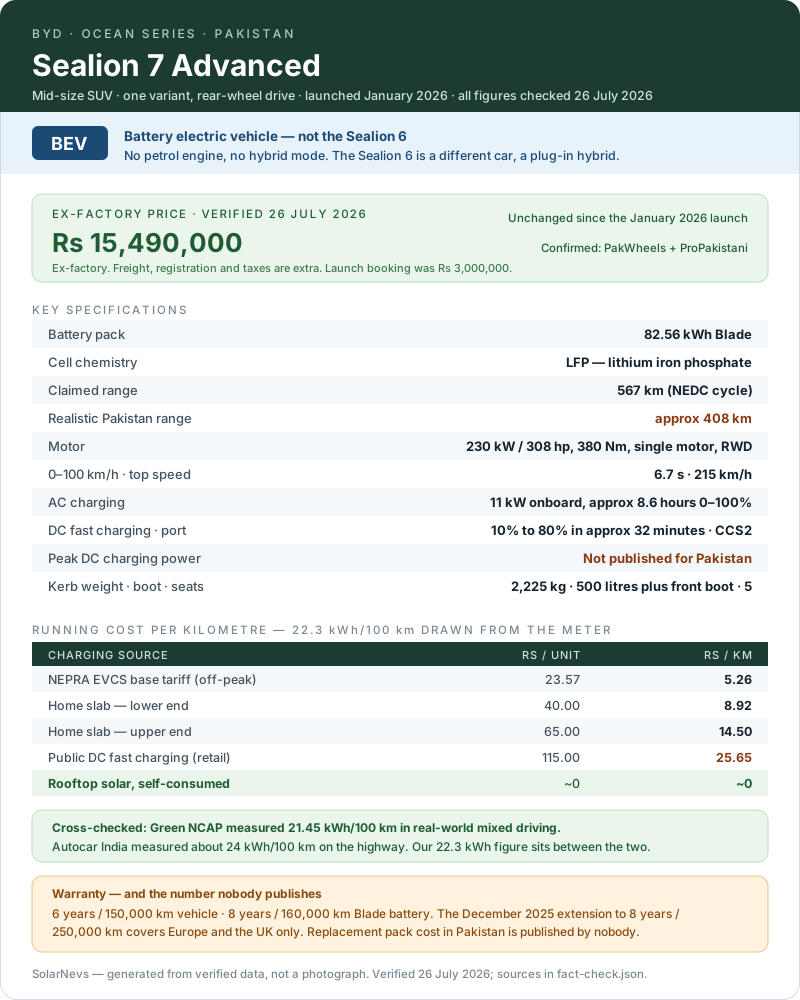
Specifications
| batteryKwh | 82.56 |
|---|---|
| claimedRangeKm | 567 |
| claimedRangeCycle | NEDC |
| realisticRangeKm | 408 |
| kwhPer100km | 22.3 |
| acCharging | 11 kW onboard charger, approx 8.6 hours 0-100% |
| dcCharging | 10% to 80% in approximately 32 minutes, CCS2 |
| motorKw | 230 |
| motorHp | 308 |
| torqueNm | 380 |
| zeroToHundred | 6.7 s |
| topSpeedKmh | 215 |
| drivetrain | RWD |
| Powertrain | BEV |
| Warranty | 8 years / 160,000 km on the Blade battery per PakWheels specifications, alongside BYD Pakistan's 6 years / 150,000 km vehicle cover. The December 2025 extension to 250,000 km applies to Europe and the UK, not confirmed for Pakistan. Replacement pack cost is unpublished here. |
BYD Sealion 7
The BYD Sealion 7 is a battery-electric (BEV) mid-size SUV — no engine, plug-in only — priced at Rs 15,490,000 ex-factory as of 26 July 2026. It launched in Pakistan in January 2026 alongside the Atto 2, with bookings set at Rs 3,000,000, and it is the model that gives BYD Pakistan a genuinely long-range family car.
Do not confuse it with the Sealion 6, which is a plug-in hybrid and a different vehicle. The Sealion 7 has no engine at all. It is also not currently on BYD Pakistan's pricelist under any other name.
Variants and price
Variant | Powertrain | Battery | Drivetrain | Price (ex-factory) | Date verified |
|---|---|---|---|---|---|
Sealion 7 Advanced | BEV | 82.56 kWh | RWD | Rs 15,490,000 | 26 Jul 2026 |
One variant, rear-wheel drive. The dual-motor AWD version sold in Europe is not on the Pakistani pricelist. {/* VERIFY: whether an AWD Sealion 7 is offered in Pakistan — absent from PakWheels BYD pricelist */}
Specifications
Item | Figure |
|---|---|
Powertrain | BEV — battery electric, no engine |
Battery | 82.56 kWh Blade (LFP) |
Claimed range | 567 km (NEDC) |
Realistic Pakistan range | approx 408 km |
Motor | 230 kW / 308 hp, 380 Nm, single motor, rear-wheel drive |
0–100 km/h | 6.7 s |
Top speed | 215 km/h |
AC charging | 11 kW onboard, approx 8.6 hours 0–100% |
DC fast charging | 10% to 80% in approx 32 minutes |
Charge port | CCS2 |
Boot | 500 litres rear, plus a front boot |
Kerb weight | 2,225 kg |
Dimensions | 4,830 × 1,925 × 1,620 mm |
Tyres | 235/50 R19 |
Seats | 5 |
Running cost per kilometre
Method: 82.56 kWh across a realistic 408 km is 20.2 kWh/100 km at the wheels; add 10 percent for charging losses and you draw about 22.3 kWh per 100 km from the meter. Cost per km = (22.3 ÷ 100) × tariff.
This one has an independent cross-check. Green NCAP measured 21.45 kWh/100 km in real-world mixed driving on the Sealion 7 Comfort RWD, and Autocar India measured about 24 kWh/100 km on the highway. Our 22.3 figure sits between them. Of all the cars in this catalogue, this is the running-cost estimate we are most confident in.
Charging source | Rs / unit | Rs / km | Rs / 100 km | Rs / month at 1,500 km |
|---|---|---|---|---|
NEPRA EVCS base tariff (off-peak) | 23.57 | 5.26 | 526 | 7,890 |
Home slab — lower end | 40.00 | 8.92 | 892 | 13,380 |
Home slab — upper end | 65.00 | 14.50 | 1,450 | 21,750 |
Public DC fast charging (retail) | 115.00 | 25.65 | 2,565 | 38,475 |
Rooftop solar, self-consumed | ~0 | ~0 | ~0 | ~0 |
Petrol SUV for comparison | Rs 331.52/L @ 9 km/L | 36.84 | 3,684 | 55,260 |
Petrol at Rs 331.52 per litre, OGRA rate effective 24 July 2026, now revised daily. The 9 km/L figure is our stated assumption for a comparable 2.0-litre petrol SUV in mixed use, not a manufacturer claim.
The solar line. Charged from panels you already own, the marginal cost per kilometre is effectively Rs 0. A 585 W panel yields roughly 2.3 kWh a day in Pakistani conditions.
Your daily driving | Energy needed / day | 585 W panels to cover it |
|---|---|---|
30 km | 6.7 kWh | 3 |
50 km | 11.2 kWh | 5 |
80 km | 17.8 kWh | 8 |
Note the public-charging row: at Rs 25.65/km the Sealion 7 saves only about 30 percent against a petrol SUV. The car's economics collapse without home charging. Eight panels and a wall box is the configuration that makes this vehicle make sense.
Honest assessment
Pros. The 82.56 kWh pack delivers a realistic 408 km, which is the first figure in BYD's Pakistani lineup that makes intercity driving genuinely relaxed rather than an exercise in charge planning. Rear-wheel drive with 230 kW gives it a better balance than the front-drive Atto models. The 11 kW onboard AC charger is a meaningful advantage in a country where public DC is scarce and expensive — it means a home charger can genuinely refill the car overnight. LFP Blade chemistry handles Pakistani summers well. And unlike most range claims in this market, its efficiency is corroborated by independent European and Indian testing.
Cons. At 2,225 kg it is a heavy car, and the efficiency figures show it: 22.3 kWh/100 km is roughly 20 percent thirstier than the Atto 3 for the same distance. The claimed 567 km is an NEDC number and will not be seen on a Pakistani motorway. Peak DC charging power is not published locally, so the 32-minute claim is untestable against what Pakistani chargers actually deliver. And BYD Pakistan's 2026 delivery performance drew sustained criticism, with documented cases of buyers waiting months past promised dates.
Who should buy it. A family that needs one car to do the school run and the Karachi–Hyderabad or Lahore–Islamabad trip, has a home charging point, and preferably has rooftop solar to feed it. If you are buying a second car for city use only, the Atto 3 does the same job for Rs 6.5 million less and uses less energy doing it.
Pakistan reality check
Real versus claimed range. BYD claims 567 km on the NEDC cycle. The same car is rated far lower on WLTP, and Pakistani owners report roughly 28 percent below claimed on highways at speed with the AC running. Plan on about 408 km. In Karachi in June, with the AC working hard, expect less again. The Green NCAP laboratory range of 19.9 to 31.3 kWh/100 km depending on conditions is a good illustration of how much the weather moves this number.
Battery replacement and warranty. PakWheels lists 8 years / 160,000 km on the Blade battery, alongside BYD Pakistan's standard 6 years / 150,000 km vehicle cover. BYD's December 2025 announcement extending battery cover to 8 years / 250,000 km with a 70 percent minimum state-of-health guarantee applies to the European Economic Area, Switzerland and the UK — we could not confirm it applies here. {/ VERIFY: applicability of BYD's 250,000 km battery warranty in Pakistan */} As for what an 82.56 kWh replacement pack costs in Pakistan: no source publishes a figure. {/ VERIFY: replacement 82.56 kWh Blade pack cost in PKR — unpublished in Pakistan */} On a Rs 15.49 million car that is a substantial unquantified liability. Ask for it in writing and record the non-answer.
Charging at home after the February 2026 net-billing switch. Exported solar now earns roughly Rs 11 per unit while imported grid power costs Rs 50 or more, so exporting is a losing trade. Daytime self-consumption is now the best use of a rooftop system, and the Sealion 7 — with an 11 kW onboard charger and a large pack — is close to an ideal daytime load. Charging midday off your own array instead of overnight off the grid is worth Rs 13,000–22,000 a month at 1,500 km.
Charging network and load-shedding. Pakistan has roughly 30–50 publicly accessible charging locations nationwide, concentrated in Karachi, Lahore and Islamabad, against a 3,000-by-2030 target and a NEECA licence count well in excess of energised working sites. {/ VERIFY: count of genuinely operational public DC points — no authoritative register */} Hubco Green and Mega Motor have announced a Karachi-to-Peshawar corridor with stations every 200–250 km; it was still described as forthcoming rather than live as of mid-2026. {/ VERIFY: operational status of the Hubco Green / Mega Motor charging corridor */} Load-shedding means home charging is not guaranteed on a given evening — another reason to charge in daylight.
Monsoon and flooding. EV packs are commonly sealed to IP67 and an EV is generally more flood-tolerant than an ICE air intake, though the Pakistan-spec Sealion 7's IP rating is not published. {/* VERIFY: official IP rating of PK-spec Sealion 7 pack */} The rule is absolute: if the vehicle has been submerged, do not restart it and do not plug it in. Flatbed recovery and inspection only.
Resale and battery health. No established used-EV pricing exists in Pakistan and there is no accessible state-of-health report at resale, so a future buyer cannot value the pack. Expect resale to be soft and unpredictable, and do not model it optimistically.
Price context
Rival | Powertrain | Price (ex-factory) | Date |
|---|---|---|---|
Deepal S07 | BEV | Rs 14,999,000 | Apr 2026 |
XPENG G6 | BEV | Rs 14,500,000 – 18,500,000 | Apr 2026 |
KIA EV5 | BEV | Rs 18,500,000 – 23,500,000 | Apr 2026 |
The Sealion 7 sits Rs 491,000 above the Deepal S07 and undercuts the cheapest KIA EV5 by Rs 3,010,000. Within BYD's own showroom it costs Rs 700,000 more than a Seal Dynamic and Rs 1,500,000 less than a Seal Premium, while offering the Premium's full 82.56 kWh battery in an SUV body. On that internal comparison the Sealion 7 is the best-value car BYD sells in Pakistan.
Frequently asked questions
What does the BYD Sealion 7 cost in Pakistan?
Rs 15,490,000 ex-factory for the Advanced variant as of 26 July 2026, unchanged since its January 2026 launch. Booking was set at Rs 3,000,000. Freight, registration and taxes are extra.
Is the Sealion 7 electric or hybrid?
A full battery-electric vehicle (BEV). No petrol engine, no hybrid mode, no range extender. It is not related to the Sealion 6 plug-in hybrid, which is a different car.
What is the real-world range in Pakistan?
About 408 km against a claimed 567 km NEDC. Independent testing elsewhere measured 21 to 24 kWh per 100 km, which lines up closely with our Pakistani estimate.
How much does it cost to run per kilometre?
About Rs 5.26/km on the NEPRA EV tariff, Rs 8.92 to Rs 14.50/km on a home slab, and roughly Rs 25.65/km on public DC charging. A comparable petrol SUV runs about Rs 36.84/km.
How fast does it charge?
11 kW AC gives a full charge in about 8.6 hours. On DC it claims 10 to 80 percent in about 32 minutes through a CCS2 port, though few Pakistani public chargers will deliver its peak rate.
How many solar panels cover my driving?
About five 585 W panels for a 50 km daily commute, assuming roughly 2.3 kWh per panel per day. Three cover 30 km/day; eight cover 80 km/day.
References
- PakWheels — BYD Sealion 7 specifications and features — accessed 26 Jul 2026
- BYD Pakistan (Mega Motor) — Sealion 7 official page — accessed 26 Jul 2026
- ProPakistani — BYD Atto 2 and Sealion 7 prices in Pakistan revealed — accessed 26 Jul 2026
- PakWheels Blog — Electric car (EV) prices in Pakistan 2026 — accessed 26 Jul 2026
- Autocar India — BYD Sealion 7 real-world range test — accessed 26 Jul 2026
- Green NCAP — BYD Sealion 7 Comfort RWD assessment 2025 — accessed 26 Jul 2026
- Express Tribune — NEPRA approves Rs 23.57/kWh tariff for EV charging stations — accessed 26 Jul 2026
- Charging Station Radar — EV charging prices in Pakistan 2026 — accessed 26 Jul 2026
- Daily Pakistan — New petrol price in Pakistan — accessed 26 Jul 2026
- Express Tribune — NEPRA rolls out new regulations abolishing net metering — accessed 26 Jul 2026