Kia EV9 GT-Line
Rs 43,200,000 verified 26 Jul 2026 — prices in Pakistan move weekly
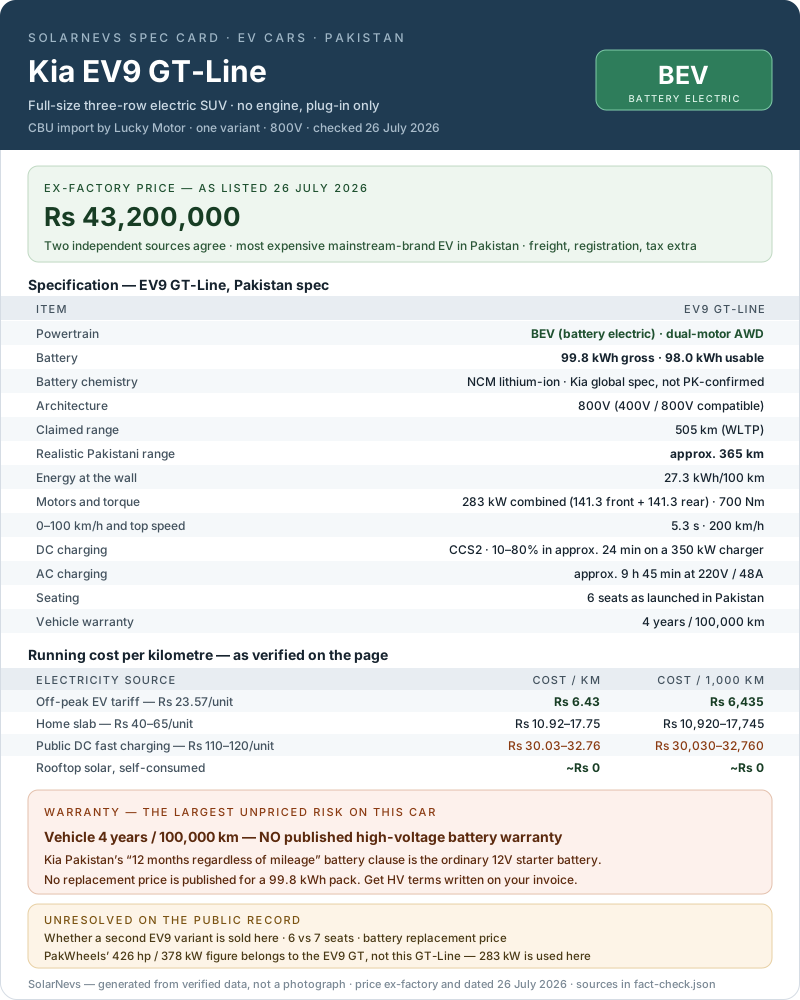
Specifications
| batteryKwh | 99.8 |
|---|---|
| batteryUsableKwh | 98 |
| batteryChemistry | NCM lithium-ion (Kia global spec; not separately confirmed by a Pakistani source) |
| claimedRangeKm | 505 |
| claimedRangeCycle | WLTP |
| realisticRangeKm | 365 |
| kwhPer100km | 27.3 |
| acCharging | approx. 9 h 45 min on 220V / 48A per Kia Pakistan launch material |
| dcCharging | CCS2, 800V architecture. 10-80% in approx. 24 minutes on a 350 kW charger. |
| motorKw | 283 combined (141.3 front + 141.3 rear), dual-motor AWD |
| motorNm | 700 |
| zeroTo100 | 5.3 s |
| topSpeedKmh | 200 |
| seats | 6 (Pakistan spec as launched; PakWheels also lists a 7-seat configuration) |
| Powertrain | BEV |
| Warranty | Kia Pakistan publishes 4 years / 100,000 km on the vehicle. No published high-voltage traction battery warranty for the EV9. The extended-warranty eligibility form does not list it. On a Rs 43.2 million car with a 99.8 kWh pack, this is the largest single unpriced risk in the Pakistani EV market. |
The Kia EV9 GT-Line is a full-size, three-row battery-electric SUV (BEV — no engine, no fuel tank, plug-in only) imported as a CBU by Lucky Motor Corporation, priced at Rs 43,200,000 ex-factory as listed on 26 July 2026. It launched in Pakistan in February 2025 and remains the most expensive electric vehicle in the mainstream Pakistani market — roughly Rs 19.7 million above Kia's own EV5 Earth. One variant is offered: the long-range dual-motor AWD GT-Line with a 99.8 kWh pack.
Variants and prices
Variant | Powertrain | Drive | Battery | Claimed range | Ex-factory price (26 Jul 2026) |
|---|---|---|---|---|---|
EV9 GT-Line | BEV | AWD, dual motor | 99.8 kWh | 505 km (WLTP) | Rs 43,200,000 |
PakWheels and gari.pk both list exactly one EV9 variant. Kia Pakistan's own price-list page appears to render two EV9 rows, but no prices load on it, so we cannot confirm a second variant exists. {/* VERIFY */} Treat the GT-Line as the only orderable car until a dealer shows you otherwise in writing.
Specifications
Item | EV9 GT-Line |
|---|---|
Powertrain | BEV (battery electric) |
Battery | 99.8 kWh gross, 98.0 kWh usable |
Architecture | 800V (400V/800V compatible) |
Claimed range | 505 km (WLTP) |
Realistic PK range | approx. 365 km |
Motors | 283 kW combined (141.3 kW front + 141.3 kW rear), dual-motor AWD |
Torque | 700 Nm |
0-100 km/h | 5.3 s |
Top speed | 200 km/h |
DC charging | CCS2, 10-80% in approx. 24 min on a 350 kW charger |
AC charging | approx. 9 h 45 min at 220V / 48A |
Seating | 6 seats as launched in Pakistan |
Warranty | 4 yr / 100,000 km vehicle; no published HV battery term |
PakWheels' EV9 model page lists 426 hp / 378 kW. That figure belongs to the higher-output EV9 GT, not the GT-Line. Kia's global spec, the Pakistani launch reporting and EV Database all agree on 283 kW, 700 Nm and 5.3 s for the GT-Line, so we have used those. {/* VERIFY */} Seating is a minor conflict too: launch coverage says six seats, PakWheels mentions six or seven.
Running cost per kilometre
Basis: grid energy at the wall divided by realistic Pakistani range, which absorbs charging losses and AC use. 99.8 kWh over roughly 365 km = 27.3 kWh/100 km. That is corroborated independently — EV9 owners report about 27-28 kWh/100 km at 130 km/h and 24-25 at 110 km/h. Formula: cost/km = (kWh per 100 km / 100) x tariff.
Electricity source | Tariff (Rs/unit) | Cost per km | Cost per 1,000 km |
|---|---|---|---|
Off-peak EV tariff (NEPRA EVCS base, Apr 2025) | 23.57 | Rs 6.43 | Rs 6,435 |
Home slab — low | 40.00 | Rs 10.92 | Rs 10,920 |
Home slab — mid | 52.50 | Rs 14.33 | Rs 14,333 |
Home slab — high | 65.00 | Rs 17.75 | Rs 17,745 |
Public DC fast charging — low | 110.00 | Rs 30.03 | Rs 30,030 |
Public DC fast charging — high | 120.00 | Rs 32.76 | Rs 32,760 |
Rooftop solar (self-consumed) | ~0 marginal | ~Rs 0 | ~Rs 0 |
Equivalent petrol 7-seat SUV at an assumed 8 km/L | Rs 331.52/L (24 Jul 2026) | Rs 41.44 | Rs 41,440 |
Read the public-charging rows carefully. At Rs 30-33 per kilometre, an EV9 charged exclusively at public DC costs roughly 75% of what a petrol Carnival costs to fuel. You did not spend Rs 43.2 million to save a quarter on running costs. This car's economics depend entirely on charging at home, preferably from your own generation.
The SolarNevs line
Charging from your own rooftop array is roughly Rs 0/km marginal. A 585 W panel yields about 2.3 kWh/day in Pakistani conditions.
Your daily driving | Energy needed | 585 W panels required |
|---|---|---|
30 km/day | 8.2 kWh | 4 panels |
50 km/day | 13.7 kWh | 6 panels |
80 km/day | 21.8 kWh | 10 panels |
120 km/day | 32.8 kWh | 15 panels |
Six 585 W panels — about 3.5 kW of array — covers a 50 km commute. An owner already running a 10 kW rooftop system can absorb this car's daily demand without adding a panel, and should.
Honest assessment
Pros. The 800V architecture is a real advantage — 10-80% in 24 minutes approaches petrol convenience where the infrastructure exists. 283 kW and 700 Nm move a 2.6-tonne three-row SUV to 100 km/h in 5.3 seconds, which no seven-seater in Pakistan at any price does. The 99.8 kWh pack gives roughly 365 km of real motorway range with a full cabin and the AC fighting Punjab in June — enough for Lahore-Islamabad without stopping. Build quality and safety equipment are a clear step above anything Chinese-badged here.
Cons. The price. Rs 43,200,000 buys a car costing roughly USD 55-58,000 in its home markets; the gap is duty, freight and low-volume import economics, not extra content. The 800V advantage is largely theoretical here, where 350 kW chargers are effectively absent — you are paying for a capability the country cannot deliver. AC charging at roughly 9 h 45 min makes a full recharge an overnight commitment. And 27.3 kWh/100 km is a lot of energy per kilometre; a solar array sized for a small EV will not cover this one.
What owners report. There is essentially no Pakistani long-term owner data — a very low-volume halo import that arrived in February 2025, with no body of local ownership reviews to cite. That absence is itself information: you would be an early adopter with few peers to ask, on a car with no published battery warranty. Internationally the hardware picture is reassuring, but that does not fix a Pakistani parts queue.
Who should buy it. Someone who wants a large, fast, well-built seven-seater, already has substantial rooftop solar, charges exclusively at home, and can treat a Rs 43.2 million asset with unknown battery warranty and unproven resale as discretionary. If any part of that does not describe you, the EV5 Earth does most of the same job for Rs 19.7 million less.
Pakistan reality check
Real vs claimed range. Kia quotes 505 km on WLTP — a stricter cycle than the NEDC figures used for the EV5, so it deserves more credit. Pakistani owners across EV models report roughly 28% below claimed on highways at 110-120 km/h with AC running, giving about 365 km realistic. That aligns with independent consumption data: 27-28 kWh/100 km at 130 km/h against a 98 kWh usable pack is roughly 350-360 km. Six occupants and luggage in July heat will push it lower.
Battery replacement and warranty. This should decide your purchase. Kia Pakistan publishes a 4-year / 100,000 km vehicle warranty and no high-voltage traction battery warranty for the EV9. The "original battery covered for the first 12 months regardless of mileage" clause on its warranty page is the ordinary 12V starter-battery term. The extended warranty (+1 yr / 20,000 km) lists Sportage, Picanto, Sorento and Stonic — the EV9 is not on it. Kia's other markets give the HV pack 8 years / 100,000 miles (US) or 7 years / 150,000 km (Europe). Kia Pakistan also publishes no replacement price for a 99.8 kWh pack. Buying a Rs 43.2 million car with an unwarranted and unpriced battery is defensible only if you do it knowingly. Get written HV battery terms — years, kilometres, and the state-of-health percentage that triggers a claim — on your invoice before you transfer money.
Charging at home after the February 2026 net-billing switch. NEPRA's Prosumer Regulations 2026 abolished unit-for-unit net metering. Connections approved after 9 February 2026 export at roughly Rs 11/unit and import at Rs 50-plus, so selling surplus to the grid is now a losing trade. Charging this car with midday generation displaces a Rs 50-plus import instead of a Rs 11 sale — and at 27.3 kWh/100 km, that swing is worth more than on any other EV in Pakistan. Charging at noon rather than midnight is the highest-value habit available to an EV9 owner with a rooftop array.
Charging network and load-shedding. NEECA has issued 72 EV charging licences since October 2024; genuinely operational public points number roughly 20-plus nationwide, concentrated in Karachi, Lahore and Islamabad/Rawalpindi. January 2026 reporting blamed DISCO connections, separate-meter delays and pending NOCs. Public DC units here run well below 350 kW, so the EV9's headline charging figure will not be reproduced on Pakistani infrastructure. On a 99.8 kWh pack with a roughly 9.75-hour AC charge, an interrupted night genuinely leaves you short.
Monsoon and floods. EV packs are typically sealed to IP67 — 30 minutes at one metre, not indefinite submersion. The vulnerable systems are the 12V circuit, body control modules and cabin harness. Never restart a vehicle submerged above the wheel centres. Flatbed it, power it down, get a certified inspection before anyone reconnects the HV system. At this value, flood-damage disclosure is also a resale issue — document everything.
Resale. Pakistan has no battery state-of-health reporting standard and no depreciation history for the EV9 nameplate. A used buyer cannot verify pack condition, and the pool able to spend Rs 30 million-plus on a used electric SUV is very small. Expect a thin secondary market and steep discounting; ordinary depreciation percentages translate into extraordinary rupee losses at this price.
Price context vs rivals
Car | Powertrain | Ex-factory price | Dated |
|---|---|---|---|
Kia EV9 GT-Line | BEV | Rs 43,200,000 | 26 Jul 2026 |
MG Cyberster | BEV | Rs 27,000,000 - 29,900,000 | 26 Jul 2026 |
Kia EV5 Earth | BEV | Rs 23,500,000 | 26 Jul 2026 |
BYD Shark 6 | PHEV (plug-in hybrid, not BEV) | Rs 19,950,000 | 26 Jul 2026 |
There is no direct rival. Nothing else in Pakistan is a large three-row battery-electric SUV, which is exactly why the EV9 can carry a Rs 13.3 million premium over the next-most-expensive EV — a two-seat MG Cyberster roadster that competes for no part of the same buyer's needs. The real comparison is internal: the EV5 Earth does the school run, the commute and the motorway trip for Rs 19,700,000 less, on the same dealer network, with the same missing battery warranty. The EV9 buys a third row, 800V charging you cannot yet use, and 5.3 seconds to 100 km/h.
One further note on price. From 1 July 2026 the Finance Act applied Federal Excise Duty to EVs above Rs 20 million for the first time, alongside a value-tiered customs duty structure in which the highest-value EVs sit in the top band. The EV9 is squarely inside both. As of 26 July 2026 the Rs 43,200,000 list price has not moved, but Lucky Motor's order terms place any new duties, taxes and currency movement between order and delivery on the customer — and at this price, a single duty notification can move the invoice by millions. Fix the price in writing, or understand that you are carrying a tax and currency position alongside the car.
We do not sell cars and take no dealer money. Every price here is ex-factory and dated 26 July 2026. Confirm with two dealers before you book, and do not pay until the high-voltage battery warranty is written down.
Frequently asked questions
What does the Kia EV9 cost in Pakistan right now?
Rs 43,200,000 ex-factory for the GT-Line, as listed on 26 July 2026. This is the most expensive mainstream-brand EV on sale in Pakistan. Freight, registration, insurance and taxes are extra.
Is the EV9 a hybrid?
No. It is a full battery-electric vehicle (BEV) with a 99.8 kWh pack, dual motors and no engine of any kind. It must be plugged in.
What range will it actually do here?
Kia claims 505 km WLTP. On a hot motorway at 110-120 km/h with AC and a full cabin, plan for roughly 365 km. Owner-reported consumption at 130 km/h is about 27-28 kWh/100 km, which matches.
How much per kilometre to run?
About Rs 6.43/km on the Rs 23.57 off-peak EV tariff, Rs 10.92-17.75/km on home slabs, and Rs 30.03-32.76/km on public DC charging. Rooftop solar is roughly Rs 0/km marginal.
Can Pakistan's chargers use its 800V system?
Rarely. The EV9 can take 350 kW and do 10-80% in 24 minutes, but chargers of that class are effectively absent here. On a typical Pakistani public DC unit you will see a fraction of that rate.
What does a replacement battery cost?
Kia Pakistan does not publish a figure, and does not publish a traction-battery warranty either. On a 99.8 kWh pack this is an unquantified liability, not a small one.
References
- PakWheels - Kia EV9 2026 price, images, reviews and specs — accessed 26 Jul 2026
- PakWheels Blog - Kia EV9 in Pakistan, official price and other details — accessed 26 Jul 2026
- Samaa TV - Kia launches EV9 in Pakistan, price and features — accessed 26 Jul 2026
- EV Database - Kia EV9 99.8 kWh AWD GT-Line specifications — accessed 26 Jul 2026
- Kia Pakistan (Lucky Motor) - warranty terms — accessed 26 Jul 2026
- Business Recorder - Lucky Motor to launch Kia electric SUVs as CBUs — accessed 26 Jul 2026
- PakWheels Blog - Auto sector after Budget 2026-27 — accessed 26 Jul 2026
- Charging Station Radar - EV charging prices Pakistan 2026 — accessed 26 Jul 2026