Home EV Charger Price in Pakistan 2026: The Real Cost
Updated 15 September 2026 · By SolarNevs Research Desk, Dealer surveys + verified sources · 22 sources · Method ↗
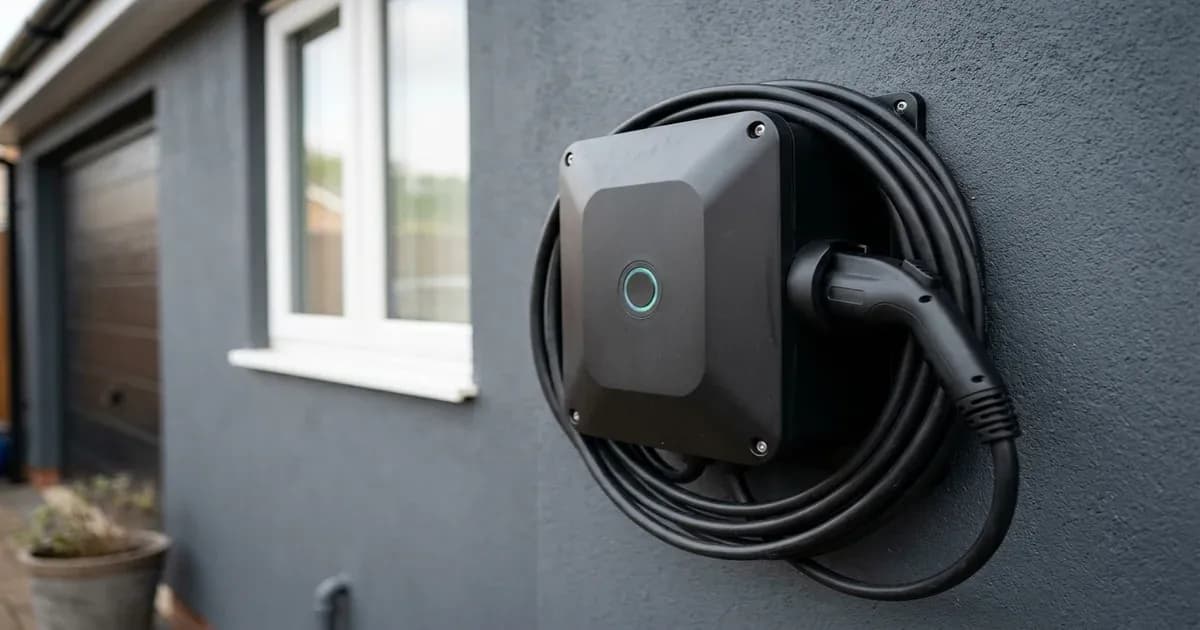
Key Takeaways
- A Wallbox Pulsar Max 7.2kW lists at Rs 250,000 and a Tesla Gen 3 Wall Connector at Rs 300,000 in Pakistan (July 2026), both discounted from Rs 350,000.
- An unbranded Type 2 7kW three-phase wallbox lists at Rs 105,000 and a 3.5kW single-phase unit at Rs 90,000, though both were showing sold out in July 2026.
- Since NEPRA S.R.O. 279(I)/2026 in February 2026, domestic fixed charges are billed per kilowatt of sanctioned load, at Rs 200 to Rs 675 per kW per month, whether you use the power or not.
- That makes the meter the expensive part, where a 10kW sanctioned load on the Time-of-Use band costs Rs 6,750 a month in fixed charges alone, or Rs 81,000 a year.
- The Rs 23.57/kWh figure circulating as a "home EV tariff" is the commercial charging-station rate. The actual domestic off-peak rate is Rs 34.53/kWh (S.R.O. 279(I)/2026).
What does a home EV charger cost in Pakistan?
Prices split into three tiers, and the gap between them is mostly brand and app software rather than charging speed.
Unit | Rating | Price (July 2026) | Notes |
|---|---|---|---|
CNC Electric AC wallbox | 3.5kW single-phase, 16A | Rs 90,000 (from Rs 100,000) | Type 2, showing sold out |
CNC Electric AC wallbox | 7kW three-phase, 16A | Rs 105,000 (from Rs 120,000) | Type 2, showing sold out |
Portable Type 2 charger | 7.2kW, 32A | Rs 100,000 (from Rs 120,000) | Plug-in, no wall unit |
Wallbox Pulsar Max | 7.2kW | Rs 250,000 (from Rs 350,000) | WiFi, app, PEN fault protection |
Tesla Wall Connector Gen 3 | 7kW / 22kW tethered | Rs 300,000 (from Rs 350,000) | Type 2 |
Wallbox Pulsar Max | 11kW | Rs 300,000 (from Rs 400,000) | Needs three-phase |
Wallbox Pulsar Max | 22kW | Rs 360,000 (from Rs 400,000) | Needs three-phase |
Installation typically adds Rs 20,000 to Rs 50,000 for a dedicated feeder, breaker, cable run and earthing.
Note the trap in row two. That Rs 105,000 "7kW" unit is a three-phase charger rated 380-415V at 16A. If your house is on a normal single-phase supply it will not work, and no wiring trick changes that. A 7kW single-phase charger pulls around 30 amps on one line instead. Check the phase rating before the kilowatt rating.
Is the Rs 30,000 wallbox real?
You will find a figure of "Rs 30,000-60,000 for a Type 2 home wallbox" repeated across buying guides. Treat it with suspicion.
Every priced listing from a Pakistani seller we could verify in July 2026 starts at Rs 90,000 for the cheapest real wall-mounted unit, and a January 2025 distributor price list put generic local 3.5-7kW chargers at Rs 100,000 to Rs 200,000. The Rs 30,000-60,000 band traces to a single unsourced buying guide and is contradicted by every priced listing we found.
What you can genuinely buy for that money is a portable granny-style cable, not a wallbox, which has no dedicated circuit, no residual-current protection of its own, no load management. If a seller offers you a "7kW Type 2 wallbox" for Rs 35,000, it is either a portable cable with a wall bracket or unbranded grey stock with no importer behind the warranty. Ask for the importer's name, the warranty term in writing, and the IEC 62196-2 conformity documentation. A seller who cannot produce all three will not honour a claim two years from now.
Does your meter and sanctioned load support 7kW?
Pull out your electricity bill and find the sanctioned load field, printed in kW. This is the number that governs everything, and most Pakistani domestic connections sit at 2kW to 5kW.
A 7kW single-phase charger draws roughly 30 amps continuously by itself, before air conditioning, fridge, pumps or lights. A 3kW house running a 7kW charger needs about 10kW of sanctioned load to be legitimate. Three options:
- Stay under your existing load and buy a 3.5kW charger. No DISCO paperwork, no change to your bill.
- Apply for a load extension on your existing single-phase connection, using the load extension form (CP Form-156 at LESCO) or the online ENC portal at enc.com.pk. Domestic applications typically take 7 to 15 working days.
- Upgrade to three-phase, which starts around Rs 63,000 and rises with distance and line extension work. The demand notice splits into a refundable security deposit and non-refundable capital and service charges.
Doing none of this and plugging in a 7kW charger anyway is how you cook your service cable and earn a DISCO detection bill.
What does raising your sanctioned load cost you every month, forever?
This is the part nobody selling you a charger will mention, and it is larger than the charger.
Under the February 2026 tariff rationalisation notified as S.R.O. 279(I)/2026, domestic fixed charges are no longer per connection. They are levied per kilowatt of sanctioned load, at Rs 200 to Rs 675 per kW per month. The Power Division's own worked examples:
Sanctioned load | Rate | Fixed charge per month |
|---|---|---|
2kW | Rs 200/kW | Rs 400 |
5kW | Rs 500/kW | Rs 2,500 |
6kW | Rs 675/kW | Rs 4,050 |
10kW (Time-of-Use band) | Rs 675/kW | Rs 6,750 |
You pay that every month whether you charge the car or not. Whether you travel. Whether the house is locked. It is a standing charge on a number you wrote on a form.
Go from a 3kW sanctioned load to 10kW to support a 7kW charger and your fixed charge goes from roughly Rs 600 to Rs 6,750 a month. That is Rs 73,800 a year in extra fixed charges, before a single unit of electricity. Over five years, Rs 369,000, which is more than the Tesla Gen 3 Wall Connector you were agonising over.
Against that, the honest counterweight is that analysis of the same reform found Time-of-Use consumers above 5kW sanctioned load came out roughly 7 percent better off on net, because the variable rate falls as the fixed charge rises. The reform is not purely punitive for EV owners. It just moves the cost somewhere you were not looking.
Should you buy a 7kW charger at all?
For most Pakistani households, no.
Work the arithmetic on time, not power. A 3.5kW charger delivers 21 kWh in a six-hour overnight window. A 7kW charger delivers 42 kWh in the same window. Unless your daily commute regularly exceeds what 21 kWh will carry, the second charger finishes earlier and then sits idle until morning while you pay for the sanctioned load that permits it.
The off-peak window is long. Peak is broadly 7pm to 11pm in summer and 5pm to 9pm in winter, with LESCO and IESCO consumers commonly advised to treat 5pm to 11pm as the year-round avoidance window. That leaves twelve or more off-peak hours a night. Charging speed is rarely the binding constraint at home; it binds at a motorway stop, which is a different article.
Buy 7kW if you drive genuinely high mileage, run two EVs off one charger, or already hold a three-phase connection so the marginal fixed charge is sunk. Otherwise the 3.5kW unit at Rs 90,000, on your existing sanctioned load, is the buyer-side answer.
How do you apply for the off-peak EV tariff at home?
There is no EV-specific residential tariff in Pakistan as of July 2026. What exists is the ordinary domestic Time-of-Use tariff, and that is what you should be applying for.
The published ToU domestic band applies to sanctioned load of 5kW and above, at a fixed charge of Rs 675/kW/month, Rs 46.85/kWh peak and Rs 34.53/kWh off-peak. Be aware of a live inconsistency here, namely that some DISCO summaries state that consumers with sanctioned load below 5kW may opt into ToU metering, while the published tariff table defines the category as 5kW and above. Ask your sub-divisional office which applies to your connection before you commit to a load extension, and get the answer on the demand notice rather than verbally.
The process itself runs through the same channel as a load change, by applying via enc.com.pk or your DISCO customer services centre, request a ToU meter alongside the load extension, expect a site inspection, then a demand notice covering the meter and any security deposit, then installation. Budget 7 to 15 working days for a domestic case and longer if line work is needed.
Is there really a Rs 23.57 per unit home EV tariff?
No, and this one is worth being blunt about because it is everywhere.
NEPRA cut the base tariff for electric vehicle charging stations from Rs 45.55 to Rs 23.57 per unit, approved in April 2025, billed under commercial category A-2(d) with fuel cost adjustments inapplicable. It is a rate for licensed operators building public charging infrastructure. After taxes and margins the effective figure was projected around Rs 39.70/kWh.
Several 2026 guides, including a widely-read Lahore charging guide, present Rs 23.57/kWh as an "Electric Car (Home Charging)" rate and attribute it to a "NEPRA S.R.O. 279(I)/2026 subsidised off-peak residential rate". S.R.O. 279(I)/2026 is real, but it is the February 2026 general tariff rationalisation, and the domestic ToU off-peak rate published under that very SRO is Rs 34.53/kWh, not Rs 23.57. The two figures have been welded together somewhere in the blog supply chain and the error has propagated.
Plan your payback on Rs 34.53/kWh off-peak, before GST and surcharges. If you budgeted on Rs 23.57 you have understated your running cost by about 46 percent. The same tariff confusion runs through public DC pricing, where retail rates of Rs 110-120/kWh are commonly reported, other sources quote around Rs 45, and the NEV policy references a cap near Rs 39.70 pre-tax. When three numbers disagree by a factor of three, assume the highest one is what you will pay at the terminal.
Frequently asked questions
How much does a 7kW home EV charger cost in Pakistan?
Rs 105,000 for an unbranded Type 2 wallbox, Rs 250,000 for a Wallbox Pulsar Max 7.2kW, Rs 300,000 for a Tesla Gen 3 (all July 2026). Installation adds Rs 20,000 to Rs 50,000.
Can my house run a 7kW EV charger?
A 7kW single-phase charger draws about 30 amps on its own. Most Pakistani domestic connections are sanctioned at 2kW to 5kW, so you will need a load extension and often a three-phase connection.
Is there a Rs 23.57 per unit home EV tariff in Pakistan?
No. Rs 23.57/kWh is the base tariff for licensed commercial charging stations under category A-2(d), cut from Rs 45.55 in April 2025. The domestic off-peak rate is Rs 34.53/kWh.
What are the off-peak hours for EV charging at home?
Peak is broadly 7pm to 11pm in summer and 5pm to 9pm in winter, though LESCO and IESCO consumers are commonly advised to treat 5pm to 11pm as peak. Everything outside that is off-peak.
References
- EV Chargers Pakistan — accessed 26 July 2026
- EV Chargers Pakistan — accessed 26 July 2026
- CNC Electric Pakistan — accessed 26 July 2026
- CNC Electric Pakistan — accessed 26 July 2026
- EV Chargers Pakistan — accessed 26 July 2026
- Acom Distributors EV charger price list — accessed 26 July 2026
- Alibaba — accessed 26 July 2026
- Dawn on fixed charge levied per kW, not per connection — accessed 26 July 2026
- Mettis Global on the 2026 tariff reform — accessed 26 July 2026
- The Express Tribune — accessed 26 July 2026
- IESCO tariff guide, domestic ToU rates under S.R.O. 279(I)/2026 — accessed 26 July 2026
- LESCO Bill Checker — accessed 26 July 2026
- pdfFiller — accessed 26 July 2026
- MEPCO — accessed 26 July 2026
- Check Your Bill — accessed 26 July 2026
- Bloom Pakistan — accessed 26 July 2026
- LESCO Online Bills — accessed 26 July 2026
- Online Bill Checker — accessed 26 July 2026
- The Nation on the EVCS tariff cut to Rs 23.57 — accessed 26 July 2026
- The Express Tribune — accessed 26 July 2026
- Profit by Pakistan Today — accessed 26 July 2026
- PakWheels Lahore guide, source of the home-tariff conflation — accessed 26 July 2026
Related guides
More from going electric in pakistan.