Hybrid vs On-Grid vs Off-Grid Inverter Post Net Billing Decision
Updated 2 August 2026 · By SolarNevs Research Desk, Dealer surveys + verified sources · 3 sources · Method ↗
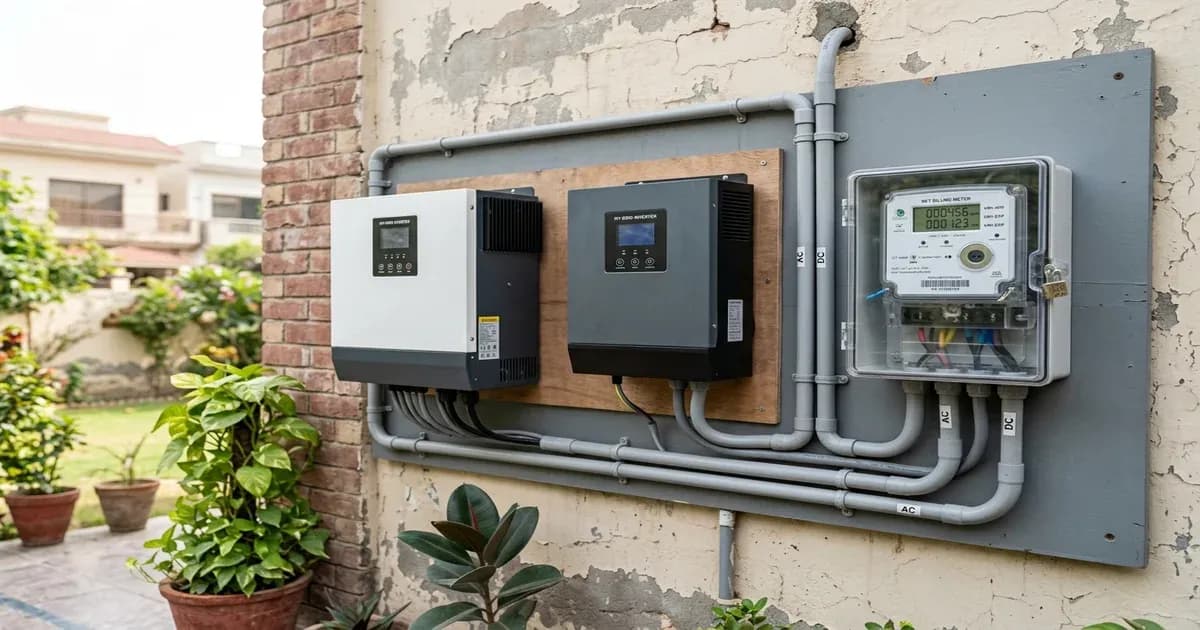
Hybrid vs On-Grid vs Off-Grid Inverter Post Net Billing Decision Guide 2026
{/* visual_plan: stat_block */}
Key Takeaways
- Selecting the right solar inverter is central to long-term energy savings and grid stability in Pakistan.
- Market prices across brands range from Rs 68,000 (July 2026) for entry units to Rs 780,000 (July 2026) for commercial hybrid systems.
- Post-net-billing economics favor hybrid inverters with lithium battery integration over simple grid-tied units.
- Warranty validity relies on official service center presence and certified installation practices across major cities.
What key factors determine the best solar inverter choice in Pakistan?
Selecting a solar inverter in Pakistan requires evaluating brand reliability, conversion efficiency, local warranty support, and technical features. Market options include premium international Tier-1 brands like Huawei, Deye, Solis, and Growatt, alongside popular local distributor brands such as Inverex, Knox, Fronus, and Crown.
Key evaluation criteria include conversion efficiency ratings above 97%, dual MPPT channels, IP65 weatherproof rating, and strong low-voltage battery management systems. The table below compares current market positioning and pricing across top solar inverter categories in Pakistan.
Category & Brand | Efficiency | Protection Rating | Warranty | Price Range |
|---|---|---|---|---|
Premium Tier-1 (Deye / Huawei) | 98.2% to 98.6% | IP65 Outdoor | 5 Years | Rs 280,000 to Rs 720,000 |
Standard Tier-1 (Growatt / Solis) | 98.0% to 98.4% | IP65 Outdoor | 5 Years | Rs 190,000 to Rs 590,000 |
Local Market Leader (Inverex) | 97.5% to 98.0% | IP21 / IP65 | 2 to 5 Years | Rs 75,000 to Rs 710,000 |
Value Local Brands (Knox / Fronus) | 96.5% to 97.5% | IP21 / IP65 | 2 Years | Rs 110,000 to Rs 540,000 |
Entry Local Brands (Crown / Maxpower) | 96.0% to 97.0% | IP21 Indoor | 2 Years | Rs 68,000 to Rs 495,000 |
Figures as of July 2026.
How does NEPRA net billing affect inverter selection and financial ROI?
The regulatory environment for solar inverters underwent a major shift following NEPRA net billing revisions. Under updated rules, exported solar electricity receives a buyback settlement rate of approximately Rs 11 (July 2026) per kWh. Meanwhile, grid electricity drawn during evening hours costs between Rs 50 and Rs 65 (July 2026) per kWh.
This wide price spread changes inverter selection logic. On-grid string inverters export daytime surplus power to DISCO grids at modest credit rates but supply zero backup power during load shedding. Hybrid inverters paired with 48V LiFePO4 battery arrays allow property owners to store daytime solar energy for evening self-consumption.
By discharging stored solar energy between 6 PM and 10 PM, households avoid purchasing expensive grid electricity during peak tariff periods. Smart hybrid inverters reduce total monthly utility expenses, achieving equipment payback timelines under three years under current tariff structures.
What is the reality of warranty claims and service center support in Pakistan?
Warranty reliability varies significantly between inverter brands in the local market. Premium Tier-1 manufacturers and established local brands operate dedicated company warranty service centers in Karachi, Lahore, Rawalpindi, Multan, and Faisalabad. These facilities stock original replacement circuit boards, power modules, and cooling fans.
Company service centers average 3 to 7 days for warranty repairs. In contrast, unbranded or grey market inverters depend on third-party repair shops on Hall Road in Lahore, where main PCB board repairs cost between Rs 15,000 and Rs 35,000 (July 2026) out of pocket.
To protect warranty validity, property owners must ensure installers follow electrical code requirements. Installers must fit certified AC circuit breakers, DC surge protection devices, and dedicated earthing rods. Service technicians verify installation records and error logs before approving free warranty replacements.
How do inverter monitoring applications compare in performance and features?
Remote telemetry monitoring applications play an essential role in system oversight. Modern inverters connect to cloud platforms via Wi-Fi or LAN telemetry dongles, uploading generation metrics, battery levels, and grid status every 5 minutes.
Leading app platforms like Huawei FusionSolar, SolisCloud, ShinePhone, SEMS Portal, and Solarman supply clear graphical dashboards. Users track daily kWh production, self-consumption ratios, battery charge states, and financial savings in real time on mobile devices.
For technical teams, cloud portals provide remote configuration and diagnostic capabilities. Installers can check string I-V performance, adjust export power limiters, and update inverter firmware versions without visiting the site, ensuring high long-term energy yield.
Why is a hybrid inverter recommended under 2026 NEPRA net billing rules?
NEPRA pays Rs 11 (July 2026) per kWh for exports but charges Rs 50 to Rs 65 (July 2026) per kWh for grid imports, making self-consumption with battery storage the most profitable strategy.
What is the cost difference between on-grid and hybrid inverters in Pakistan?
A 5kW on-grid inverter costs around Rs 190,000 (July 2026), while a 5kW hybrid inverter costs between Rs 195,000 and Rs 350,000 (July 2026).
Can an off-grid inverter export solar power to the DISCO utility grid?
No, off-grid inverters lack grid synchronization circuits and cannot export power to the utility grid.
References
Frequently asked questions
Why is a hybrid inverter recommended under 2026 NEPRA net billing rules?
NEPRA pays Rs 11 (July 2026) per kWh for exports but charges Rs 50 to Rs 65 (July 2026) per kWh for grid imports, making self-consumption with battery storage the most profitable strategy.
What is the cost difference between on-grid and hybrid inverters in Pakistan?
A 5kW on-grid inverter costs around Rs 190,000 (July 2026), while a 5kW hybrid inverter costs between Rs 195,000 and Rs 350,000 (July 2026).
Can an off-grid inverter export solar power to the DISCO utility grid?
No, off-grid inverters lack grid synchronization circuits and cannot export power to the utility grid.
References
- NEPRA — accessed 25 July 2026
- Solar Citizen — accessed 25 July 2026
- W11Stop — accessed 25 July 2026
Related guides
More from what to buy — and how not to get cheated.