N-Type vs P-Type Solar Panels: Worth It in Pakistan?
Updated 2 August 2026 · By SolarNevs Research Desk, Dealer surveys + verified sources · 19 sources · Method ↗
N-Type vs P-Type Solar Panels in Pakistan

Key Takeaways
- N-type TOPCon runs a temperature coefficient of about -0.29 to -0.30%/degC against P-type PERC at about -0.35%/degC (July 2026).
- At a 65 degC rooftop cell temperature, our arithmetic on those coefficients gives roughly 11.6% instantaneous loss for TOPCon against 14% for PERC, a gap of about 2.4 percentage points, not the double-digit gain often quoted.
- TOPCon suppresses light-induced degradation to under 0.3% and averages about 0.4% annual decline, against PERC's 1.5 to 2% first-year LID plus LeTID and about 0.55% annually (July 2026).
- P-type PERC was quoted at Rs 28 to Rs 36 per watt in Pakistan against Tier-1 N-type at Rs 39.30 to Rs 43.45 per watt (July 2026), a wider gap than the 5 to 10% premium quoted internationally.
- Since NEPRA's Prosumer Regulations 2026 were notified on 9 February 2026, new connections earn export credit at a fraction of the import tariff, which shifts the value of every extra watt into self-consumption.
What is the actual difference between N-type and P-type cells?
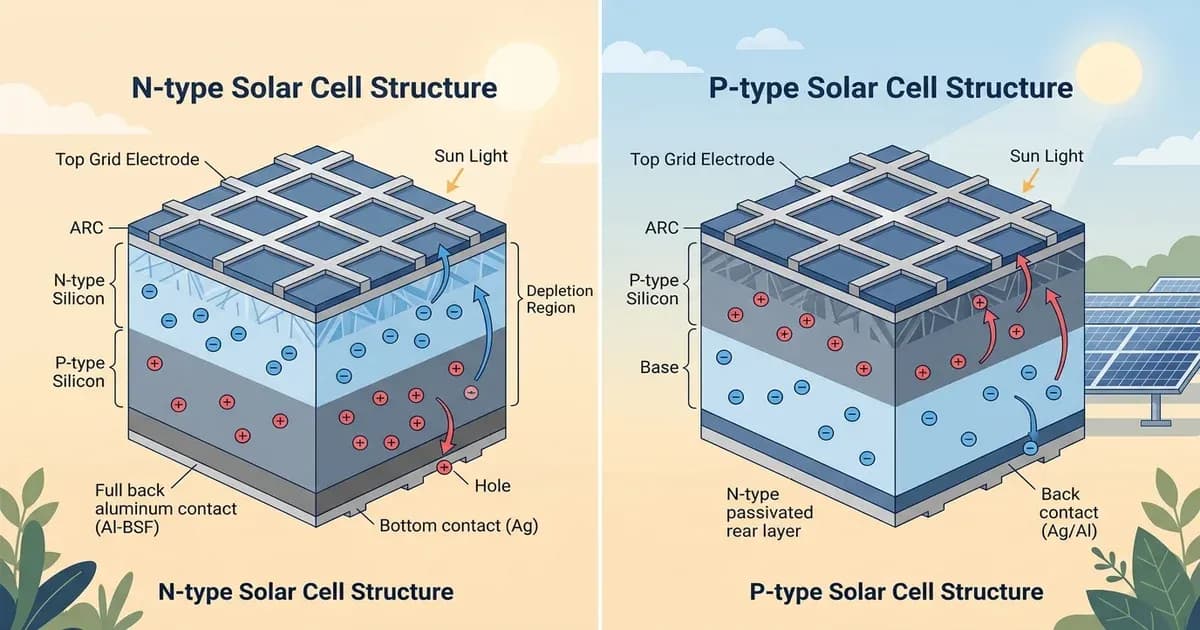
The difference is which impurity was added to the silicon wafer the cell is built on. P-type wafers are boron-doped; N-type wafers are phosphorus-doped. Everything else follows from that one choice.
P-type cells in the modern market are almost always PERC, or passivated emitter and rear cell, which adds a rear reflective layer to bounce unabsorbed light back through the silicon. PERC was the workhorse technology of the last decade and it is a mature, cheap, well-understood product.
N-type cells in the current market are mostly TOPCon, tunnel oxide passivated contact, which places an ultra-thin oxide layer and a doped polysilicon layer at the rear contact to cut recombination losses. Jinko sells it as Tiger Neo, LONGi as Hi-MO 7, Canadian Solar as TOPHiKu6, JA Solar as DeepBlue 4.0. Every one of those is the same underlying idea with different branding.
The commercially important consequence of boron doping is that P-type wafers contain boron-oxygen pairs which react to first light exposure and cause light-induced degradation. Phosphorus-doped N-type wafers largely avoid this. That single chemistry fact drives most of the performance gap discussed below.
How much Pakistani heat costs you

This is where the marketing and the arithmetic part company, so let us do the arithmetic openly.
Published temperature coefficients of Pmax sit at roughly -0.29 to -0.30%/degC for TOPCon and -0.35%/degC for PERC (July 2026). HJT, a third technology sold at a premium here, runs around -0.24%/degC. Panels are rated at a 25 degC cell temperature, not air temperature, and rooftop modules in Lahore, Karachi, Multan and Faisalabad can exceed 65 degC on concrete roofs with poor airflow.
Cell temperature | PERC loss at -0.35%/degC | TOPCon loss at -0.29%/degC | Gap |
|---|---|---|---|
45 degC | 7.0% | 5.8% | 1.2 points |
55 degC | 10.5% | 8.7% | 1.8 points |
65 degC | 14.0% | 11.6% | 2.4 points |
That is our own multiplication of published coefficients by the temperature rise above 25 degC. This figure is not a vendor estimate.
Notice what it says. At the worst moment of a Multan June afternoon, an N-type module gives you about 2.4 percentage points more of its nameplate than a P-type one. On a 10 kW array that is roughly 240 watts at that instant. Real, worth having, and nowhere near the "up to 8% more electricity annually" you will see quoted in showrooms.
Vendor-side sources put the annual energy yield gain for TOPCon at up to 6.8% in regions with more than 120 high-temperature days per year, which describes much of Sindh and southern Punjab. That figure bundles heat, low-light and degradation advantages together and comes from the side selling the product. Treat 2 to 4% annual yield gain as the defensible expectation and anything above 6% as a claim requiring evidence.
Does N-type really do better in low light and dust?
Yes, and this matters more in Pakistan than the heat argument does, though it gets discussed less.
TOPCon holds up better under irradiance below 100 W/m2, which is the condition you get at dawn, at dusk, under monsoon overcast, and during the winter smog that blankets Punjab from November to January. Those hours are not marginal here. A Lahore rooftop spends a meaningful share of December and January in diffuse light rather than direct sun.
Dust is a separate matter and the technology does not save you. Soiling losses on an unwashed Pakistani rooftop dwarf the two or three percentage points of technology difference we have been discussing. Washing your panels every few weeks in dry season will do more for your annual yield than choosing N-type over P-type. Nobody selling panels leads with this because there is no margin in a bucket of water.
How do the two technologies age?

Degradation is where the gap becomes genuinely material, because it compounds.
Published figures put TOPCon's light-induced degradation below 0.3% with average annual degradation around 0.4%, against monocrystalline PERC's first-year degradation of 1.5 to 2% from combined LID and LeTID, and average annual degradation around 0.55% (July 2026).
Run that out over ten years:
- PERC: about 2% lost in year one, then 0.55% for nine more years, totalling roughly 7%. You are at about 93% of nameplate.
- TOPCon: about 1% lost in year one, then 0.4% for nine more years, totalling roughly 4.6%. You are at about 95.4% of nameplate.
A gap of about 2.4 percentage points at year ten, widening slowly thereafter. Combine that with the 2.4 point heat advantage during peak hours and you have a coherent picture. N-type gives you a few percent more energy, fairly reliably, for decades. It does not give you a different category of product.
The warranty structures reflect this. Manufacturers back TOPCon lines with 30-year linear power warranties at 0.3 to 0.4% annual degradation, and product warranties of 12 years on Jinko Tiger Neo and LONGi Hi-MO 7, 15 years on LONGi Hi-MO X6 Max Explorer, and 25 years on Canadian Solar TOPHiKu6 (July 2026). Those numbers are only claimable on documented, serial-verifiable stock.
Is the N-type premium worth paying in Pakistan?

Here is the part that international comparisons get wrong about our market.
Global write-ups describe TOPCon as carrying a 5 to 10% price premium over PERC. In Pakistan in July 2026, P-type PERC was quoted at roughly Rs 28 to Rs 36 per watt while Tier-1 N-type TOPCon ran roughly Rs 39.30 to Rs 43.45 per watt. Taking mid-points, that is a premium closer to 30% than to 10%.
Why the discrepancy? Because you are usually not comparing like with like. The cheap PERC quotes circulating in Pakistan sit in the same price band as non-documents stock generally, and much of that inventory is older, off-channel, or grade-uncertain product. When you compare Rs 30 per watt PERC against Rs 42 per watt documented N-type, you are comparing an older technology plus a missing warranty channel against a newer technology plus a warranty. The technology gap is only part of what you are paying for.
So the honest framing avoids asking "is N-type worth 30% more". Instead, look at it as two separate decisions.
- Documents or non-documents? This is the bigger financial question and it applies to both technologies. It is worth roughly Rs 10 per watt.
- Given documented stock, N-type or P-type? Here the premium is much smaller, and for a system you will own past 2036, N-type wins on degradation alone.
Buy N-type if the system is going on a house you intend to keep, you are in a hot zone such as Multan, Jacobabad, Sukkur or interior Sindh, or you are roof-area constrained and need every watt from a fixed number of square feet.
P-type PERC is defensible if the install is short-horizon, low-stakes, or space-unconstrained. This includes agricultural pumps, shop backups, or rented properties. Even then, buy it as PERC knowingly, at a PERC price, with documents. Do not let anyone sell you PERC as N-type. The Pakistani price gap between the two, roughly Rs 9 per watt within a single brand's range in July 2026, is why relabelling happens, and from a ladder the two modules look identical.
How do NEPRA's 2026 rules change the calculation?
Substantially, and in N-type's favour.
NEPRA notified the Prosumer Regulations 2026 on 9 February 2026, abolishing one-to-one net metering for new connections and replacing it with net billing. Under the old regime, an exported unit offset an imported unit, so surplus generation was worth full retail value and the marginal extra watt from a better panel was worth a lot. Under net billing, surplus is bought at the national average energy purchase price, expected around Rs 11 per unit against retail import tariffs several times higher, and existing net metering agreements are grandfathered until they expire naturally.
The consequence for panel choice is specific. Value now lives in self-consumption during daylight hours, not in export credit. That raises the worth of generation during the hot afternoon hours when your air conditioning is running and when the PERC-versus-TOPCon heat gap is at its widest. It also lengthens the payback period on the whole system, which means the panel you install now has to keep performing for more years before it has paid for itself. Both effects push toward the module with the flatter degradation curve and the better heat behaviour.
That is not a reason to overpay. It is a reason to stop treating the panel choice as a pure upfront-cost decision, and to make sure whichever technology you pick arrives with a serial you can verify and paperwork you can claim against.
Frequently Asked Questions
Is N-type TOPCon really better in Pakistani heat?
Yes, but modestly. TOPCon runs about -0.29%/degC against PERC at -0.35%/degC. At a 65 degC rooftop cell temperature that is roughly 11.6% loss versus 14%, a gap of about 2.4 percentage points of output.
How much more do N-type panels cost in Pakistan?
P-type PERC was quoted around Rs 28 to Rs 36 per watt and Tier-1 N-type around Rs 39.30 to Rs 43.45 per watt in July 2026. That is a wider gap than the 5 to 10% premium quoted globally.
Should I buy P-type PERC in 2026?
Only for short-horizon or low-stakes installs. Most cheap PERC quotes in Pakistan are non-documents stock, so you are comparing an older technology and a missing warranty against a documented N-type module, not technology against technology.
References
- Tongwei - Monocrystalline solar panels vs N-type TOPCon regarding LID, conversion efficiency, and degradation rate
- SurgePV - Solar panel temperature coefficient 2026
- SurgePV - N-type vs P-type solar cells 2026
- SolarQuotes - How temperature affects solar panel output, Pmax and NOCT
- Enon Traders - N-type solar panels technology in Pakistan
- Enon Traders - Solar panel temperature coefficient explained
- LONGi - Hi-MO 7 product page
- ENF Panel Directory - Jinko Tiger Neo 72HL4-(V) datasheet
- ENF Panel Directory - CSI Solar TOPHiKu6 CS6.1-54TD datasheet
- Solar Pakistan Guide - JA Solar panel price in Pakistan
- Solar Panel Price in Pakistan - daily update, 24 July 2026
- Solar Panel Market PK - price list, 25 July 2026
- Express Tribune - NEPRA rolls out new regulations abolishing net metering
- Dawn - Nepra pulls the plug on net-metering
Frequently asked questions
Is N-type TOPCon really better in Pakistani heat?
Yes, but modestly. TOPCon runs about -0.29%/degC against PERC at -0.35%/degC. At a 65 degC rooftop cell temperature that is roughly 11.6% loss versus 14%, a gap of about 2.4 percentage points of output.
How much more do N-type panels cost in Pakistan?
P-type PERC was quoted around Rs 28 to Rs 36 per watt and Tier-1 N-type around Rs 39.30 to Rs 43.45 per watt in July 2026. That is a wider gap than the 5 to 10% premium quoted globally.
Should I buy P-type PERC in 2026?
Only for short-horizon or low-stakes installs. Most cheap PERC quotes in Pakistan are non-documents stock, so you are comparing an older technology and a missing warranty against a documented N-type module, not technology against technology.
References
- Tongwei Solar — accessed 26 July 2026
- SurgePV — accessed 26 July 2026
- SolarQuotes — accessed 26 July 2026
- Enon Traders — accessed 26 July 2026
- Enon Traders — accessed 26 July 2026
- LONGi Solar — accessed 26 July 2026
- SurgePV — accessed 26 July 2026
- MaxPower — accessed 26 July 2026
- Solar Pakistan Guide — accessed 26 July 2026
- Solar Panel Price in Pakistan — accessed 26 July 2026
- Solar Citizen — accessed 26 July 2026
- Solar Panel Market — accessed 26 July 2026
- JA Solar — accessed 26 July 2026
- ENF Solar — accessed 26 July 2026
- ENF Solar — accessed 26 July 2026
- ENF Solar — accessed 26 July 2026
- The Express Tribune — accessed 26 July 2026
- Dawn — accessed 26 July 2026
- The Express Tribune — accessed 26 July 2026
Related guides
More from what to buy — and how not to get cheated.