Jinko Panel Verification Guide: Spot a Fake Tiger Neo
Updated 2 August 2026 · By SolarNevs Research Desk, Dealer surveys + verified sources · 14 sources · Method ↗
Jinko Panel Verification Guide to Spotting a Fake Tiger Neo

Key Takeaways
- JinkoSolar's serial number verification tool asks for a 24-digit SN found in a corner of the module front and in the centre of the rear (July 2026).
- The portal's failure message covers two different problems at once. It flags outright fakes as well as genuine panels "sold through unofficial channels" that carry no Jinko warranty (July 2026).
- Documented Jinko N-type stock quoted Rs 37 to Rs 45.50 per watt across Pakistani price sheets on 24-25 July 2026; the same nameplate appears at Rs 30 to Rs 32.50 per watt on non-documents lists.
- Jinko Tiger Neo N-type carries a 12-year product warranty and a 30-year linear power warranty ending at 87.4% of nameplate (July 2026).
- A July 2026 search for Jinko verification returns several domains that are not jinkosolar.com. Type the manufacturer's own address yourself instead of clicking a search result.
What is Jinko panel verification and why does it matter in Pakistan?
Jinko panel verification means matching the serial number physically laminated into your module against JinkoSolar's own factory database, before you pay the balance and before the installer bolts anything to your roof. It is the only step in the whole purchase that a dealer cannot fake for you.
It matters more in Pakistan than in most markets because our demand ran ahead of our distribution. Industry reporting in Pakistan describes rejected B-grade and C-grade modules being relabelled with well-known brand stickers and pushed into the retail chain, with a LONGi representative telling ARY News that manufacturing has been "directly impacted" by the practice and that consumer awareness remains low. Jinko is one of the two or three names most worth faking here, precisely because buyers ask for it by name.
There is a second, quieter problem. A panel can be entirely genuine and still leave you with nothing to claim against. JinkoSolar's verification tool does not only flag counterfeits. It also flags modules sold through unofficial channels, and the message it returns says the serial number relates to a product not eligible for the Jinko Limited Warranty and supporting service. In Pakistani market language, that is the non-documents trade. You will not know which of the two you have bought until you run the serial.
Where is the Jinko serial number located?
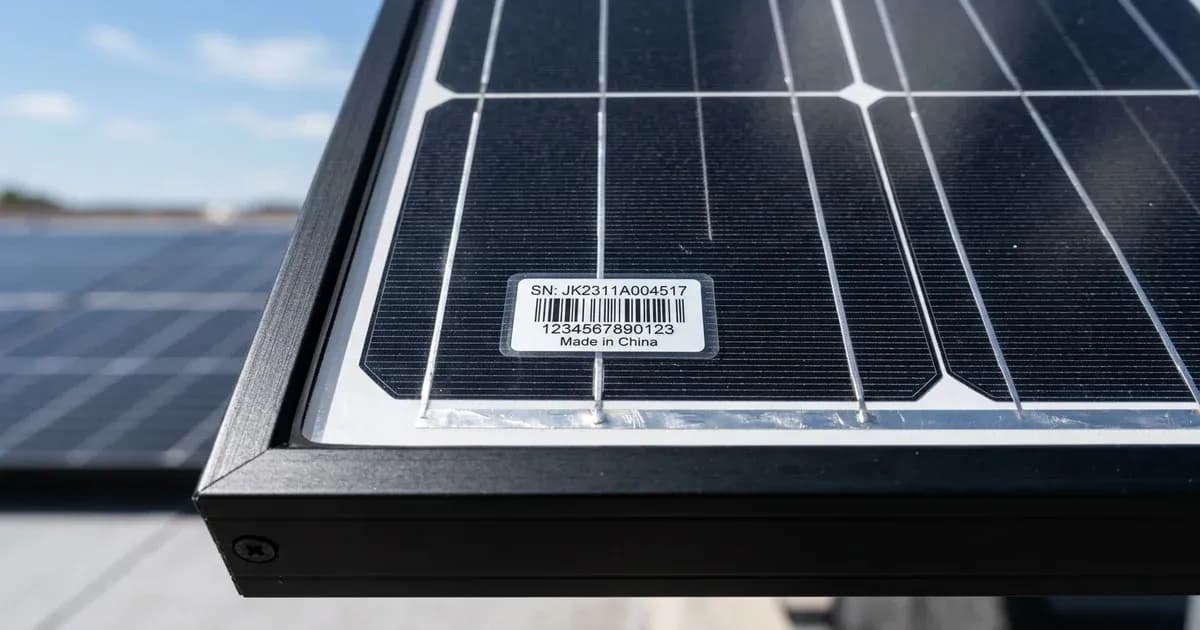
JinkoSolar's serial number verification tool describes the SN as a 24-digit code found in one of the corners on the front side of the module, and also in the centre of the rear side (July 2026). Both copies should read identically, character for character.
The front-side copy is the one that matters for fraud. On a genuine Tier-1 module the barcode strip is placed between the EVA encapsulant and the front tempered glass before lamination, so the glass, EVA and cells are fused into one sealed sandwich. Removing that strip without destroying the panel is not possible. That single manufacturing fact is the backbone of every honest verification guide in this market. A barcode you can feel with a fingernail, scratch, or lift a corner of is a sticker, and a sticker on the outside of the glass is not the panel's identity.
So the physical check is short. Run a nail across the front barcode. If it catches, stop. If it is smooth and clearly under glass, photograph it, then photograph the rear label, then compare the two strings before you leave the shop.

How to run the check on Jinko's portal
The sequence below takes about four minutes per pallet if you photograph first and type later.
- Pick the panels yourself. Do not let the dealer hand you three serials on a slip. Choose modules from different positions in the stack, including one from the middle.
- Photograph the front-glass barcode and the rear label for each chosen panel, with the frame edge in shot so you can prove which module it was.
- Open JinkoSolar's own site by typing the address, then open the serial number verification tool. Do not reach it from a search result or a WhatsApp link.
- Enter the 24-digit SN. Check the character count before you submit; a short string usually means a misread 0/O or 1/I.
- Read the result carefully. A pass should reflect the module you are holding. A failure message referring to ineligibility for the Jinko Limited Warranty means either a counterfeit or unofficial-channel stock, and you should treat it the same way in a negotiation.
- Repeat on the delivered pallet, not just the showroom sample. Sample-and-swap is the oldest trick in Hall Road.
One caution specific to July 2026. A search for Jinko verification returns several domains that are not jinkosolar.com, including jinkosolarverification.com and jinkosolarverify.com. We are not alleging anything about who operates them; the point is simply that you cannot tell from a search results page, and a verification portal is the kind of page worth spoofing. Type the manufacturer's domain into the address bar yourself.
What should the flash-test report show?
A flash-test report is the factory's electrical birth certificate for one specific module, recorded under standard test conditions of 1,000 W/m2 irradiance at 25 degrees Celsius. It lists maximum power, open-circuit voltage, short-circuit current, and the voltage and current at the maximum power point.
Ask for the serial-matched report, not a generic PDF of the model. The distinguishing feature of a real one is that the serial numbers on the sheet correspond to the panels in your consignment. A dealer who supplies a datasheet, or a flash report whose serials do not appear anywhere on your pallet, has not given you what you asked for.
This matters commercially, not just legally. Modules wired in series are limited by the weakest one in the string, so a pallet with quietly mismatched current ratings loses yield every single day for twenty years. On a 10 kW system, a few percent of permanent mismatch loss is worth more over its life than the discount that tempted you.
How do Jinko prices in Pakistan reveal the documents gap?

Three Pakistani price sheets published within 48 hours of each other in late July 2026 quoted Jinko very differently, and the spread is the story.
Source and date | Jinko quote | What it describes |
|---|---|---|
solarpanelpriceinpakistan.pk, 24 July 2026 | Rs 45.50 per watt | 585W N-type, described as A-grade documented |
pakistansolarmarket.com, 25 July 2026 | Rs 37 to Rs 39.50 per watt | General market rate, documentation status unstated |
solarpanelmarket.pk, 25 July 2026 | Rs 30 to Rs 32.50 per watt | Includes Tiger Neo 3.0 625W at Rs 32.50 per watt |
The same brand and roughly the same nameplate cannot honestly be worth both Rs 45.50 and Rs 30.50 per watt on the same week. What differs is the documentation. This includes a GST-paid import, a commercial invoice in your name, a packing list with the serial numbers, and an original warranty card instead of a photocopy. A 585W module at Rs 45.50 per watt costs about Rs 26,600 (July 2026); at Rs 30.50 per watt it costs about Rs 17,800. That Rs 8,800 per panel gap is what you are being offered in exchange for giving up a warranty channel.
We are not going to tell you the cheap route is always wrong. On a small off-grid pump where a dead panel is an afternoon's inconvenience, the arithmetic can favour it. On a 10 kW rooftop you intend to keep for twenty years, buying a 30-year power warranty you cannot ever invoke is not a saving, it is a fee.
What Jinko Tiger Neo warrants
Jinko's Tiger Neo N-type modules carry a 12-year product warranty covering manufacturing defects and workmanship, plus a 30-year linear power warranty. The 585W class datasheet figures place the temperature coefficient of Pmax at -0.29%/degC, and the 30-year linear warranty endpoint at 87.4% of nameplate output (July 2026). One datasheet listing gives the coefficient as -0.30%/degC, so treat -0.29 to -0.30 as the honest range rather than a precise selling point.
Read the product warranty and the power warranty as two different promises. The 12-year product warranty is what you claim against when a junction box fails, a diode cooks, or a backsheet delaminates. These are real, common, and expensive failures. The 30-year figure only pays out if you can demonstrate the module has fallen below its guaranteed curve, which requires measurement, access and paperwork. Buyers in Pakistan routinely value the 30-year number and ignore the 12-year one. It should be the reverse.
Every one of those promises is conditional on the module being traceable to Jinko's own records. That is why the serial check is not a formality performed after purchase. It is the purchase decision.
What are the common fake Jinko tells on a Pakistani rooftop?

- Peelable front barcode. A paper sticker on the outside of the glass instead of a strip laminated beneath it. This is the single fastest disqualifier.
- Front and rear serials that do not match. Relabelling usually replaces one, not both.
- A serial that is not 24 digits. Jinko's own tool expects 24; a 16-digit string on a "Jinko" module deserves an explanation.
- Cell colour drift within a panel. Genuine A-grade cells are visually uniform; patchy or mottled cells across one module suggest sorted rejects.
- Wandering busbars and solder splash. Busbars should run straight and clean. Drift and blobs indicate hand rework.
- Hand-applied junction box silicone. Uneven, smeared or gap-filled sealing at the box or the frame corners.
- No serial-matched flash report, offered as "not required in Pakistan". It is required by you, which is enough.
- A price far below the documented band with no explanation. Pakistani buying guides flag a gap of Rs 5 to Rs 8 per watt below market with no stated reason as a red flag, and the July 2026 spreads above are considerably wider than that.
Frequently Asked Questions
Where is the serial number on a Jinko Tiger Neo panel?
JinkoSolar states the 24-digit serial number sits in one of the corners on the front side of the module, and again in the centre of the rear side. The front copy is laminated under the glass and cannot be peeled off.
What does the Jinko portal say if the panel is grey stock?
JinkoSolar's tool returns a notice that the serial number relates to a product not eligible for the Jinko Limited Warranty and supporting service. That covers both counterfeits and genuine panels sold through unofficial channels.
Is a cheap Jinko panel at Rs 30 per watt real?
Documented Jinko N-type stock quoted Rs 37 to Rs 45.50 per watt in Pakistan (24-25 July 2026). Rs 30 per watt is non-documents pricing. The panel may be genuine, but you get no local warranty channel.
References
- JinkoSolar EU - PV Modules Serial Number Verification Tool
- JinkoSolar Service and Support
- ENF Panel Directory - Jinko Tiger Neo 72HL4-(V) datasheet
- Solar Panel Price in Pakistan - daily update, 24 July 2026
- Pakistan Solar Market - price list, 25 July 2026
- Solar Panel Market PK - price list, 25 July 2026
- ARY News - Counterfeit solar panels put Pakistan's solar ambitions in jeopardy
- Solar Hub Official - How to Check Fake A-Grade Solar Panels in Pakistan
Frequently asked questions
Where is the serial number on a Jinko Tiger Neo panel?
JinkoSolar states the 24-digit serial number sits in one of the corners on the front side of the module, and again in the centre of the rear side. The front copy is laminated under the glass and cannot be peeled off.
What does the Jinko portal say if the panel is grey stock?
JinkoSolar's tool returns a notice that the serial number relates to a product not eligible for the Jinko Limited Warranty and supporting service. That covers both counterfeits and genuine panels sold through unofficial channels.
Is a cheap Jinko panel at Rs 30 per watt real?
Documented Jinko N-type stock quoted Rs 37 to Rs 45.50 per watt in Pakistan (24-25 July 2026). Rs 30 per watt is non-documents pricing. The panel may be genuine, but you get no local warranty channel.
References
- JinkoSolar — accessed 26 July 2026
- JinkoSolar — accessed 26 July 2026
- JinkoSolar Verification Portal — accessed 26 July 2026
- JinkoSolar Verification Portal — accessed 26 July 2026
- ENF Solar — accessed 26 July 2026
- SurgePV — accessed 26 July 2026
- Solar Citizen — accessed 26 July 2026
- Solar Panel Price in Pakistan — accessed 26 July 2026
- Pakistan Solar Market — accessed 26 July 2026
- Solar Panel Market — accessed 26 July 2026
- Solar Hub — accessed 26 July 2026
- Enon Traders — accessed 26 July 2026
- ARY News — accessed 26 July 2026
- SolarQuotes — accessed 26 July 2026
Related guides
More from what to buy — and how not to get cheated.