JA Solar Verification: DeepBlue 4.0 and Grey Stock
Updated 2 August 2026 · By SolarNevs Research Desk, Dealer surveys + verified sources · 16 sources · Method ↗
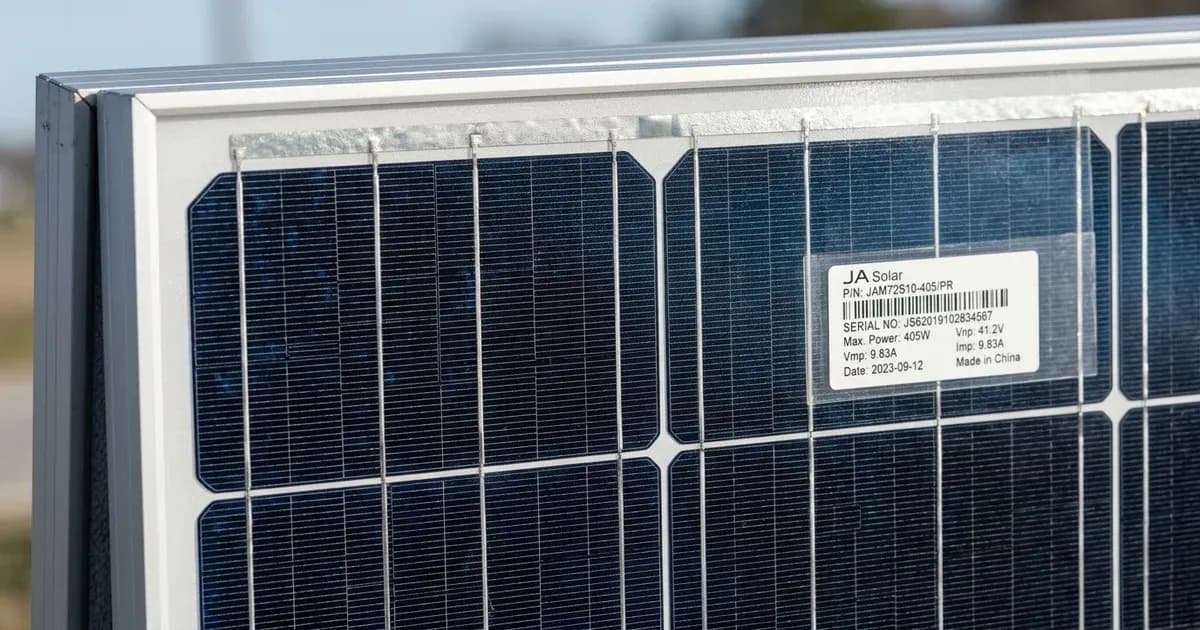
JA Solar Verification for DeepBlue 4.0 and Grey Stock

Key Takeaways
- JA Solar's module authenticity page asks for the module barcode plus a verification code, and returns a prompt to contact services@jasolar.com when a module is not found (July 2026).
- Pakistani price sheets quoted JA Solar at Rs 42 per watt documented (24 July 2026) against Rs 29 to Rs 31 per watt on non-documents lists (25 July 2026), a gap of roughly Rs 11 per watt.
- JA Solar publishes DeepBlue 4.0 as N-type TOPCon at around 22% module efficiency with a 30-year power warranty and 0.3% annual degradation (July 2026).
- The DeepBlue 4.0 product warranty is published as both 12 years and 25 years by different sources and regions. Do not accept a verbal figure.
- JA P-type PERC stock was quoted at Rs 26 to Rs 31 per watt against N-type bifacial at Rs 35 to Rs 40 per watt in Pakistan (July 2026), which is why relabelling P-type as N-type is profitable.
How do you verify a JA Solar panel online?
JA Solar runs a module authenticity query on its own product site. The page asks for two inputs. These are the product barcode, which it describes as "a string of numbers or a combination of letters and numbers", and a verification code. It also shows a diagram labelled "Module barcode position" so you know where to look on the laminate.
The failure response is worth memorising, because it is what a grey or counterfeit module produces: "Sorry, the module information you queried was not found. Please contact services@jasolar.com for details." That message does not distinguish between a typo, a counterfeit, and a genuine module outside JA's official channel. All three look identical from your side of the screen. This is why you run the query before payment clears, not after the panels are on the roof.
Note the barcode format difference from other brands. Jinko's tool expects a 24-digit numeric serial. JA Solar accepts letters as well as numbers. A dealer who tells you "JA serials are always 24 digits like Jinko" is repeating something he read rather than something he checked.

What is the correct step-by-step check on a JA pallet?
- Pick the modules yourself from at least three positions in the stack, including the middle. A dealer-supplied list of serials verifies the dealer's list, not your panels.
- Nail-test the front barcode. On a genuine laminated module the code sits under the front glass, between the encapsulant and the tempered glass, sealed during pressing. Anything you can scratch off is a sticker.
- Photograph the front barcode and the rear nameplate with the frame edge visible, so each photo is tied to a physical panel.
- Type jasolar.com yourself and open module authenticity. Do not use a search result or a link from the seller.
- Enter the barcode and the verification code. Watch for 0 versus O, since JA barcodes mix letters and digits.
- On a not-found result, email services@jasolar.com with the serials and photographs, and hold the balance payment until you have a written answer.
- Repeat on the delivered pallet. Sample-and-swap remains the most common failure in Pakistani retail.
- Ask for the serial-matched flash test report, listing your specific serials under standard test conditions of 1,000 W/m2 at 25 degrees Celsius. A generic model datasheet is not a flash report.
What separates documents from non-documents JA panels

This is the most consequential thing to understand about the JA Solar market in Pakistan, because JA sits at the value end of the Tier-1 bracket and therefore attracts the widest documentation spread of any major brand here.
Source and date | JA Solar quote | What it describes |
|---|---|---|
solarpanelpriceinpakistan.pk, 24 July 2026 | Rs 42 per watt | N-type bifacial 585W and 610W, 16 busbar, documented listing |
pakistansolarmarket.com, 25 July 2026 | Rs 28 to Rs 35 per watt | General market rate, documentation status unstated |
solarpanelmarket.pk, 25 July 2026 | Rs 29 to Rs 31 per watt | N-type bifacial 610W listed at Rs 28.20 per watt |
Roughly Rs 11 per watt separates the two ends. On a 610W module that is about Rs 25,600 against about Rs 17,700 (July 2026). Across a 10 kW rooftop of seventeen modules it is about Rs 134,000 (July 2026).
Here is what that money buys, and it is not the panel. Pakistani wholesale documentation for a legitimate purchase consists of a commercial invoice from the importer, a packing list carrying the panel serial numbers, an original warranty card rather than a photocopy, and import clearance documentation for container-level orders. Under the Finance Act 2025 official imports also carry general sales tax, which non-documents stock has not paid.
So non-documents stock falls into three different buckets that look identical in a shop:
- Genuine JA modules imported outside the official channel. The panel is real. The warranty channel inside Pakistan is not.
- Genuine B-grade factory stock. Modules the factory rejected for cell micro-cracks, colour mismatch or power variance, sold on without warranty backing and sometimes with the grade quietly removed.
- Relabelled or counterfeit modules. No-name laminates wearing a JA sticker, or a lower-wattage laminate renamed as a higher one.
Only the serial query separates the first from the third, and only a flash test separates the first from the second. A price alone tells you nothing except that something in the chain was skipped.
There is a specific relabelling incentive with JA worth naming. In Pakistan in July 2026, JA P-type PERC stock was quoted around Rs 26 to Rs 31 per watt while JA N-type bifacial ran Rs 35 to Rs 40 per watt. That Rs 9-plus per watt gap between two products from the same brand is the arbitrage that makes relabelling P-type as N-type worth someone's afternoon. Physically, a P-type module and an N-type module of the same size look the same from a ladder.
What does DeepBlue 4.0 promise?
JA Solar publishes DeepBlue 4.0 as an N-type TOPCon line spanning roughly 415W to 740W across 54-cell to 132-cell configurations, with module efficiency around 22%, a 30-year power warranty and an annual degradation rate of 0.3% (July 2026). Datasheet listings give the temperature coefficient of Pmax as -0.29%/degC.
Now the uncomfortable part. The product warranty is published inconsistently. Datasheet listings for DeepBlue 4.0 Pro show a 12-year product warranty, while at least one retail review of the same line states 25 years. That is not a small discrepancy; it is a thirteen-year difference on the warranty that covers the failures you will experience, such as junction box faults, diode failures and delamination.
We are not going to resolve it for you by picking the flattering number. Regional warranty terms genuinely differ, and the version that binds is the one attached to your consignment. Get the product warranty duration written on your invoice, with the model number, before you pay. If the dealer will not put it in writing, assume the shorter figure.
The 30-year power warranty gets quoted in every Pakistani showroom and is the least useful of the three numbers. It only pays out if you can demonstrate sustained underperformance against a published degradation curve, which needs instruments, roof access, and paperwork that begins with the serial-numbered packing list you were about to skip.
Should you ever buy non-documents JA stock?

The honest answer is sometimes, with your eyes open.
The case for it. The saving is real and large. On a 5 kW system the documents premium is roughly Rs 40,000 (July 2026). For an agricultural pump, a shop backup, or a rented property you will leave in a few years, a warranty you were never realistically going to invoke has limited value. A genuine module bought outside the official channel still produces power for decades.
The case against it. You are buying an asset whose entire brand premium is the warranty, then discarding the warranty. You cannot tell genuine grey stock from relabelled B-grade without a flash test that grey sellers rarely supply. Under NEPRA's Prosumer Regulations 2026, notified 9 February 2026, new connections are on net billing rather than one-to-one net metering, with surplus exported at a fraction of the import tariff, which means the value of your system now lives in self-consumption over twenty years rather than in quick export credits. Equipment that fails in year six hurts more under net billing than it did under net metering.
Our line. If the system is going on a house you intend to keep, pay for documents. If someone offers a Tier-1 nameplate at Rs 5 to Rs 8 per watt below market with no stated reason, that is the recognised red flag threshold in Pakistani wholesale guidance, and the July 2026 JA spread runs wider than that. Ask the question directly. Is this documents or non-documents stock? A straight answer is a good sign about the dealer. An evasive one has already answered you.
Frequently Asked Questions
How do I verify a JA Solar panel online?
Enter the module barcode, a string of numbers or a combination of letters and numbers, plus the verification code, on JA Solar's module authenticity page at product.jasolar.com. Unfound modules return a prompt to email services@jasolar.com.
What is the difference between documents and non-documents JA panels?
Documents stock carries GST-paid import, a commercial invoice in your name, a serial-numbered packing list and an original warranty card. Non-documents stock carries none of these, which is why it costs roughly Rs 10 per watt less.
Is JA Solar DeepBlue 4.0 warranty 12 years or 25 years?
Sources conflict by region and variant. JA Solar Europe publishes a 30-year power warranty at 0.3% annual degradation, while datasheet listings show 12-year and 25-year product warranties. Get the figure in writing on your invoice.
References
- JA Solar - Module authenticity query
- JA Solar Europe - DeepBlue 4.0 Pro
- ENF Panel Directory - JA Solar DeepBlue 4.0 Pro JAM72D40-580-605/MB datasheet
- OhmSnap - JA Solar DeepBlue 4.0 Pro 475W review
- Solar Panel Price in Pakistan - daily update, 24 July 2026
- Pakistan Solar Market - price list, 25 July 2026
- Solar Panel Market PK - price list, 25 July 2026
- Solar Pakistan Guide - JA Solar panel price in Pakistan
- Enon Traders - Pakistan Wholesale Solar Market 2026 buying guide
- Dawn - Nepra pulls the plug on net-metering
- Express Tribune - NEPRA rolls out new regulations abolishing net metering
Frequently asked questions
How do I verify a JA Solar panel online?
Enter the module barcode, a string of numbers or a combination of letters and numbers, plus the verification code, on JA Solar's module authenticity page at product.jasolar.com. Unfound modules return a prompt to email services@jasolar.com.
What is the difference between documents and non-documents JA panels?
Documents stock carries GST-paid import, a commercial invoice in your name, a serial-numbered packing list and an original warranty card. Non-documents stock carries none of these, which is why it costs roughly Rs 10 per watt less.
Is JA Solar DeepBlue 4.0 warranty 12 years or 25 years?
Sources conflict by region and variant. JA Solar Europe publishes a 30-year power warranty at 0.3% annual degradation, while datasheet listings show 12-year and 25-year product warranties. Get the figure in writing on your invoice.
References
- JA Solar — accessed 26 July 2026
- JA Solar — accessed 26 July 2026
- ENF Solar — accessed 26 July 2026
- SurgePV — accessed 26 July 2026
- OhmSnap — accessed 26 July 2026
- Solar Panel Price in Pakistan — accessed 26 July 2026
- Pakistan Solar Market — accessed 26 July 2026
- Solar Panel Market — accessed 26 July 2026
- Solar Pakistan Guide — accessed 26 July 2026
- Enon Traders — accessed 26 July 2026
- Solar Hub — accessed 26 July 2026
- The Express Tribune — accessed 26 July 2026
- Dawn — accessed 26 July 2026
- The Express Tribune — accessed 26 July 2026
- SolarQuotes — accessed 26 July 2026
- JinkoSolar — accessed 26 July 2026
Related guides
More from what to buy — and how not to get cheated.