Bifacial Solar Panels in Pakistan and Their Value
Updated 2 August 2026 · By SolarNevs Research Desk, Dealer surveys + verified sources · 4 sources · Method ↗
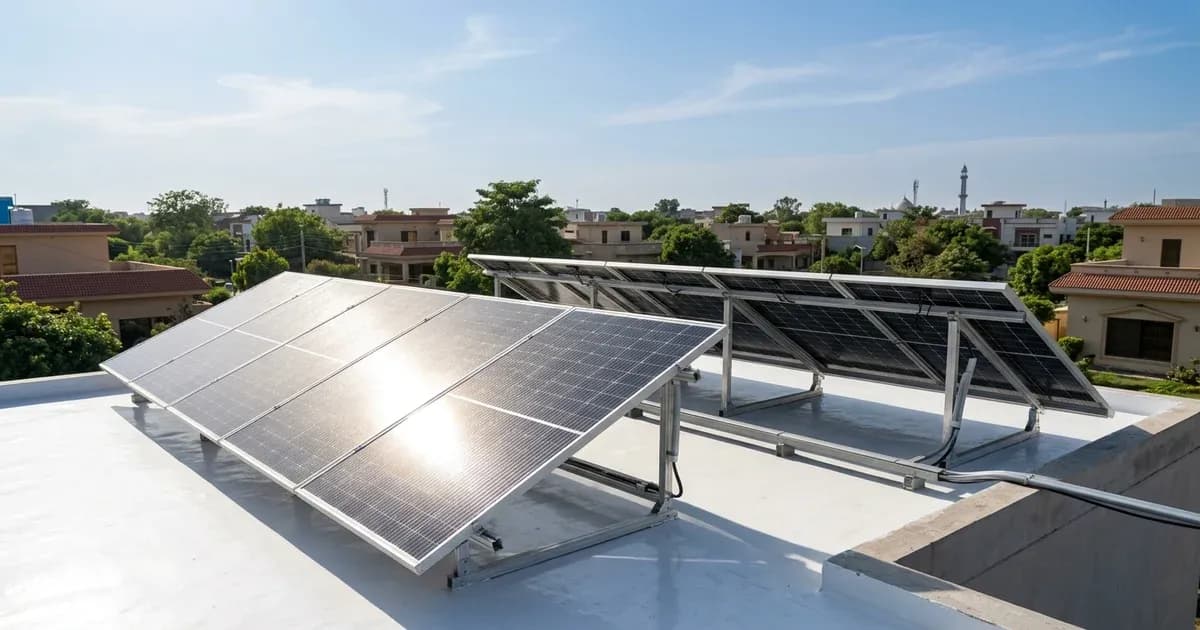
Bifacial Solar Panels in Pakistan and Their Value
{/* visual_plan: stat_block */}
Key Takeaways
- Bifacial solar panels capture sunlight from both front and rear surfaces, generating 5% to 15% additional energy on light-colored roofs.
- Tier-1 bifacial N-type TOPCon panels retail between Rs 40 and Rs 46 per watt (July 2026) in local markets.
- Elevated L1 or L2 mounting structures elevated 1.0 to 1.5 meters above the roof surface maximize rear-side albedo reflection.
- Dual-glass bifacial construction offers superior moisture resistance and mechanical strength against wind loads.
- Extra rear generation increases daily generation units, enhancing payback periods under NEPRA net billing export tariffs of Rs 11 per unit (July 2026).
What are bifacial solar panels and how do they generate power?
Bifacial solar panels feature transparent backsheets or dual-glass lamination, allowing solar cells to absorb light reflected from the roof surface beneath the array. While monofacial panels feature an opaque backsheet that absorbs only direct sunlight from the front, bifacial modules use scattered and reflected light, known as albedo reflection.
Modern N-type TOPCon bifacial panels achieve a bifaciality factor between 80% and 85%. This metric means the rear surface generates up to 85% of the power that the front surface produces under equivalent light intensity. On suitable mounting surfaces, this dual-sided generation adds significant daily kilowatt-hours without expanding the physical rooftop footprint.
Surface Type | Ground / Surface Albedo | Typical Rear Energy Gain | Recommended Structure Height |
|---|---|---|---|
White Painted Roof / Tiles | 60% to 80% | 12% to 15% Extra Yield | 1.2m to 1.5m Elevation |
Light Concrete / Sand | 25% to 40% | 7% to 10% Extra Yield | 1.0m to 1.2m Elevation |
Dark Concrete / Asphalt | 10% to 15% | 2% to 5% Extra Yield | 0.8m to 1.0m Elevation |
Green Grass / Gravel | 15% to 20% | 4% to 7% Extra Yield | 1.0m to 1.2m Elevation |
What is the price difference between bifacial and monofacial panels?
The price gap between bifacial and monofacial panels in Pakistan has narrowed significantly due to mass production of dual-glass N-type TOPCon modules in China. Tier-1 bifacial panels retail between Rs 40 and Rs 46 per watt (July 2026). A standard 585W bifacial panel from Jinko or Canadian Solar costs approximately Rs 25,418 to Rs 26,680 (July 2026).
Monofacial equivalents sell for Rs 39 to Rs 44 per watt (July 2026), representing a slight difference of Rs 1 to Rs 2 (July 2026) per watt. For a 10kW residential installation requiring 17 modules, choosing bifacial panels adds only Rs 10,000 to Rs 15,000 (July 2026) in total equipment cost.
All official imported solar panels carry a 10% GST under the Finance Act 2025. Purchasing tax-verified bifacial panels ensures full 30-year performance warranty protection from authorized distributor service centers in Lahore, Karachi, and Islamabad.
What mounting conditions are required to maximize bifacial energy gains?
To achieve maximum energy gains from bifacial solar panels, system designers must optimize three installation factors, including elevation height, surface reflectivity, and tilt angle.
First, elevation height is critical. Panels mounted flush against a roof surface leave no clearance for light to reach the rear glass, reducing rear gain to zero. Mounting arrays on elevated L2 or custom steel structures 1.0 to 1.5 meters above roof level allows reflected ambient light to enter beneath the modules.
Second, surface reflectivity plays a direct role. Applying white reflective roof paint or installing light-colored ceramic tiles increases roof albedo from 20% to over 70%. This simple surface treatment raises rear output from 4% up to 14%.
Third, racking design must avoid shading the rear glass. Using frameless mounting clamps or narrow mounting rails prevents shadow lines across the rear solar cells, preserving uniform current flow.
How does dual-glass construction improve long-term durability?
Most bifacial panels use dual-glass encapsulation, replacing plastic backsheets with a second layer of 2.0mm tempered glass. Dual-glass construction provides superior mechanical rigidity and environmental isolation for Pakistani climate challenges.
Pakistani coastal regions like Karachi expose solar panels to salty humidity, while inland desert areas face sandstorms and severe heat. Dual-glass modules prevent moisture ingress, eliminating potential induced degradation and frame corrosion. In addition, dual-glass panels carry a higher fire resistance rating, adding safety for commercial building roofs.
Are bifacial solar panels worth buying for your Pakistani home or business?
Bifacial solar panels are worth buying for homeowners and commercial building operators who can install elevated mounting structures on light-colored roofs. The small price premium of Rs 1 to Rs 2 (July 2026) per watt yields a 5% to 15% increase in annual generation output.
Under NEPRA prosumer net billing regulations, extra energy generation directly reduces monthly electricity bills. With grid import rates reaching Rs 50 to Rs 65 per unit (July 2026) and export tariffs set at Rs 11 per unit (July 2026), maximizing self-generation speeds up system payback.
However, if your installation relies on low-profile flush mounting on dark concrete roofs without surface whitewashing, monofacial panels remain the more cost-effective option.
Frequently Asked Questions
Are bifacial solar panels worth buying in Pakistan?
Bifacial solar panels are worth buying for whitewashed, tiled, or elevated rooftop structures where rear-side reflections generate 5% to 15% extra electricity.
How much extra do bifacial panels cost compared to monofacial panels?
Bifacial N-type TOPCon panels cost Rs 40 to Rs 46 per watt (July 2026), representing a minimal premium of Rs 1 to Rs 2 (July 2026) per watt over monofacial equivalents.
Do bifacial solar panels work on dark concrete roofs?
On dark concrete roofs with low reflectivity, bifacial panels generate minimal rear gain unless the roof surface is painted white or fitted with reflective sheeting.
References
Frequently asked questions
Are bifacial solar panels worth buying in Pakistan?
Bifacial solar panels are worth buying for whitewashed, tiled, or elevated rooftop structures where rear-side reflections generate 5% to 15% extra electricity.
How much extra do bifacial panels cost compared to monofacial panels?
Bifacial N-type TOPCon panels cost Rs 40 to Rs 46 per watt (July 2026), representing a minimal premium of Rs 1 to Rs 2 (July 2026) per watt over monofacial equivalents.
Do bifacial solar panels work on dark concrete roofs?
On dark concrete roofs with low reflectivity, bifacial panels generate minimal rear gain unless the roof surface is painted white or fitted with reflective sheeting.
References
- Solar Citizen — accessed 25 July 2026
- W11Stop — accessed 25 July 2026
- FBR — accessed 25 July 2026
- NEPRA — accessed 25 July 2026
Related guides
More from what to buy — and how not to get cheated.