Inverter Earth Fault Error - Pakistan's Bad-Install Symptom
Updated 2 August 2026 · By SolarNevs Research Desk, Dealer surveys + verified sources · 22 sources · Method ↗
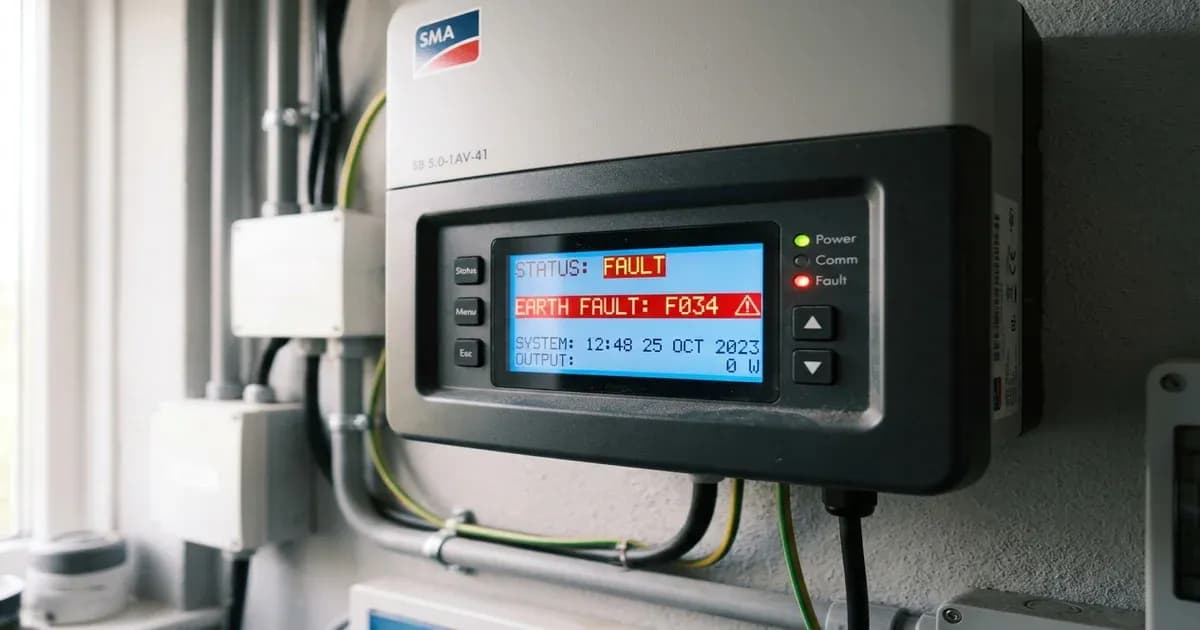
Inverter Earth Fault Error - Pakistan's Bad-Install Symptom
{/* visual_plan: stat_block */}
Key Takeaways
- Inverters raise an isolation or earth fault when measured resistance to earth falls to around 1 megohm, against 20 to 30 megohms for a healthy dry array and 40 megohms or more for a new one.
- The classic signature is a fault at 7am or right after rain that clears itself by late morning, which is moisture, not a broken inverter.
- Pakistani practice targets earth resistance under 5 ohms with separate AC and DC pits at least 10 feet apart, dug ideally to water-table depth; at least one manufacturer's warranty in Pakistan demands under 1 ohm at the electrode and rejects claims that fail the test (May 2026).
- A DC SPD costs around PKR 2,400 and an AC SPD around PKR 1,500-2,500 (May 2026), while the entire balance-of-system bucket that contains them is only 8-15% of a system's cost (2026), which is why it is the first thing cut.
- Punjab and KPK see 20 to 40 lightning strikes per square kilometre per year from July to September, and transformer ringing on grid restore produces 600V to 1,200V transients (May 2026).
What is an inverter earth fault or isolation error?
Your inverter continuously measures the electrical insulation between the DC side of your array and earth. In a healthy system that resistance is very high (a new installation typically measures above 40 megohms, and a working array in dry conditions should show at least 20 to 30 megohms). When the measured value collapses, the inverter concludes that DC current has found an unintended path to earth and shuts down. The alarm point is typically around 1 megohm, with some platforms stricter still, commonly under 600 kilohms for single-phase units and 1 megohm for three-phase. The label varies (Isolation Fault, ISO Fault, PV ISO-PROT, RISO low, Ground Fault) but the measurement behind all of them is the same.
This is the one fault family that is a genuine safety condition rather than a performance complaint. If current is leaking to earth, metal parts that should be dead may not be, and the inverter refusing to run is a feature. It is also the clearest fingerprint of a cheap installation in Pakistan, because almost everything that causes it is workmanship rather than component failure.
Why does the fault appear at 7am and vanish by 11am?
Because water conducts. Dew forming overnight on module frames, junction boxes and connectors, or rain sitting in a conduit, gives DC current a path to the earthed array frame that it does not have when everything is dry. The inverter senses the leakage and shuts the system down for safety; once the moisture evaporates in the sun, the system starts working again on its own.
If your fault log shows an isolation error at first light every day in monsoon season and nothing at all in May, you have moisture ingress, not a failing inverter. That narrows the search enormously. You are looking for a place where water can reach a conductor, and the suspects are a short list, such as a junction box seal degraded by constant wetting and bird droppings, cable insulation rubbed through where an unsecured cable has been flapping against a tile or parapet, a poorly made MC4 crimp, a cracked module backsheet, or a conduit with no drain that has become a reservoir.
The opposite pattern should worry you more, which is an isolation fault that persists in dry weather, or never clears. That is not condensation but a genuine insulation failure, and it needs a technician with an insulation resistance tester.
{/* visual_plan: comparison */}
What causes earth faults on a Pakistani rooftop?
Moisture is the trigger; bad installation is usually the cause, because moisture only matters where something is already compromised.
Poor MC4 terminations lead the list. Connectors hand-crimped on the roof with pliers rather than a proper tool create high-resistance joints that heat, degrade their seals, and then admit water. One documented case reached above 50 milliohms of contact resistance, melted its housing and arced into the roof membrane. Around 50 to 60% of PV fires trace to wiring and connector failures, mostly bad crimps.
Inconsistent bonding is second. If module frames, rails and mounting structure are not properly bonded together and to a single earth reference, or if metal parts are left floating, the inverter's monitoring circuit sees a confused picture and raises faults that no amount of connector-hunting will resolve.
Cable management is third, and it is visible from the ground. Unsecured DC cable dragging across a tile or parapet in the wind wears through its insulation in two or three seasons, and rodents do it faster.
Module quality is fourth, and here Pakistan has a specific exposure. Non-documents grey stock sells at Rs 29-31/W against Rs 38-47/W for genuine Tier-1 N-type panels (July 2026), and carries no valid warranty. A degraded backsheet on a panel you cannot claim against is a chronic isolation fault you will chase forever. Genuine Tier-1 modules carry the barcode laminated inside the glass; a paper sticker is a fake, and you should ask for the serial-matched factory flash-test report.
One caveat, because some repairers say the opposite, because isolation faults are not automatically a death sentence for your panels. That claim comes most often from businesses whose remedy is replacement. In this market the commoner root cause is workmanship, and a string-by-string insulation test tells you which it is before anyone sells you modules.
Why do cheap installs skip proper earthing and SPDs?
Because you cannot see them, and they are the easiest line items to delete from a quote without the customer noticing.
Consider where the money sits. In a typical Pakistani cost breakdown, balance-of-system, containing DC and AC cables, breakers, isolators, surge protection, earthing and distribution boards, is only about 8 to 15% of total system cost. On an illustrative 10kW on-grid system costing PKR 1,400,000, the whole BOS bucket is around PKR 140,000 (2026), with earthing and surge protection two line items inside it. A Type 2 AC SPD is around PKR 1,500-2,500 and a DC SPD around PKR 2,400 (May 2026), cartridges from PKR 650.
So the protection that prevents the fault is a rounding error against the panels. But it is also invisible on the roof, invisible in the app, and invisible in a WhatsApp price comparison between three installers. When a customer chooses purely on total price, the honest installer who quoted two earth pits, an inspection chamber, bentonite and two SPDs loses to the one who quoted a single short rod and no surge protection. That is the whole mechanism, a market failure caused by buyers comparing the wrong number.
The consequence arrives later. Punjab and KPK receive 20 to 40 lightning strikes per square kilometre per year from July to September, and transformer ringing on grid restore produces 600V to 1,200V transients (May 2026). An SPD diverts that to earth in tens of nanoseconds, but only if there is a real earth to divert it into. An SPD on a bad earth is decoration.
What does correct earthing look like in Pakistan?
There is no single national number everyone agrees on, so here are the figures in circulation, including where they conflict.
The common target is earth resistance under 5 ohms, cited consistently across Pakistani installers and referenced against NEPRA and PEC guidance that every solar system must be properly earthed. Practice calls for separate DC and AC earthing with a minimum 10 feet between the two pits, pits kept moist so resistance does not rise, and pits of roughly 6 to 10 feet depth with two rods typical for a residential system. The ideal is to bore down to water-table depth using uninsulated pure copper rope; the common shortcut is a single 10-foot rod and nothing else. A surge arrestor should sit on the rooftop above the PV module height.
{/* visual_plan: callout_card */}
Now the conflict. At least one manufacturer's warranty in Pakistan is stricter than the market norm, because it requires a dedicated earth electrode under 1 ohm, specifies a 4-foot copper or copper-clad steel rod, explicitly forbids galvanised iron, and two 2024 claims were rejected because the electrode test failed (May 2026). Meanwhile some Pakistani installer guidance lists GI or copper-bonded rods as acceptable. These cannot both be right for your warranty. Read your own manufacturer's manual before accepting an installer's habit, namely that the number that matters at claim time is the one in your warranty document, not local custom.
Whatever the target, insist on the measurement. An earth pit with no test report is just a hole.
How should an earth fault be properly diagnosed?
By measurement and elimination, in that order, and by someone qualified.
The technician should first isolate the inverter and test the array separately, because insulation testing that excludes the inverter confirms whether the reading is real or the inverter's own measuring circuit is at fault. Then the voltage check, where with the inverter disconnected from all voltage sources, you measure positive to earth, negative to earth, and positive to negative. A ground fault is indicated when all readings are stable and the two to-earth values sum to approximately the array voltage.
From there it is bisection by disconnecting strings one at a time and re-measuring until the reading recovers, then halving the offending string and repeating. Insulation resistance is compared against the theoretical value for the module count (roughly 40 megohms per thin-film module and 50 megohms per crystalline module) and a string deviating considerably from that calculation contains the fault.
Ask for the numbers in writing, specifically megohms per string before and after, earth electrode resistance in ohms, and what was found. A technician who cannot produce measurements is guessing with your money, and any later warranty claim depends on those records existing.
What are the red lines that mean stop immediately?
This fault family carries a hazard the others do not: if there is a ground fault, parts of the system may still be live, and touching live parts or cables can be fatal.
So, for an earth or isolation fault specifically, do not touch the array frame, the mounting rails, the conduit, or any metal on the roof. Do not touch DC cables at all. Do not go up to "have a look" in the rain. Do not repeatedly reset the fault to keep the system running, because you would be overriding the one thing standing between a leakage path and a person.
Stop everything and call for help if you smell burning plastic or a sharp ozone smell near the inverter, combiner or roof; if you see smoke, scorch marks, browned terminals or melted MC4 connectors; if you hear crackling, hissing or frying from DC cabling, which is very likely a DC arc and will not self-extinguish; if any DC cable, isolator or connector is too hot to hold comfortably; or if you feel a tingle from a tap, a metal door frame or the roof structure, which means the failure has already reached the building. Then, switch off the AC breaker, switch off the DC isolator only if it is safely reachable and not itself hot, keep everyone off the roof, and call your installer or the fire service.
Three rules that never bend. Never open an inverter, because internal capacitors hold lethal voltage for up to 5 minutes after full disconnection, there are no user-serviceable parts inside, and opening it ends the warranty. Never touch DC wiring, MC4 connectors or panel terminals; a rooftop string is live at hundreds of volts DC whenever daylight touches it, and no breaker in your house can switch the sun off. Never treat an earth fault as a nuisance alarm to be cleared, because it is the one code on the list explicitly telling you the system may have become dangerous to stand near.
Frequently Asked Questions
What does an earth fault error on a solar inverter mean?
The inverter has measured the insulation resistance between the DC array and earth and found it too low, typically alarming around 1 megohm against 20 to 30 megohms for a healthy dry array.
Why does my inverter show an earth fault only in the morning?
Dew and rain let DC current leak to earth through damaged insulation or wet connectors. Once the sun evaporates the moisture, resistance recovers and the inverter restarts by itself.
Can I reset an earth fault myself?
No. An earth fault means DC current is finding a path to earth and metalwork may be live. Do not touch the array frame or DC wiring; call a qualified installer with an insulation tester.
References
- In Balance Energy, Ground, Isolation and Insulation Resistance Faults
- Emazys, How to Find Isolation Resistance Faults in Solar Farms
- SMA, Checking the PV System for Ground Faults
- Solar Repair Service, Solar Panel Isolation Fault, a Common Cause
- GreenLancer, Solar Inverter Problems and Solutions
- Renac Power, Isolation Fault Troubleshooting Application Note
- MFES Pakistan, Solar Earthing System Explained
- Aimz Energy, Solar Earthing and Boring Services Pakistan
- TechTray, Solar Earthing in Pakistan
- Solarshop Pakistan, How to Install an On-Grid Solar System in Pakistan
- CNC Electric Pakistan, SPD Full Form and Why Pakistan Needs It
- CNC Electric Pakistan, SPD Collection and Prices
- Enon Traders, Solar System Cost Breakdown in Pakistan
- Solar Installation Lahore, Inverex Service and Warranty Review
- SolarVision AI, MC4 Connectors and Solar Safety
- GM Energy, Inverter Installation and Operation Manual
- NEPRA, Regulatory Authority of Pakistan
Frequently asked questions
What does an earth fault error on a solar inverter mean?
The inverter has measured the insulation resistance between the DC array and earth and found it too low, typically alarming around 1 megohm against 20 to 30 megohms for a healthy dry array.
Why does my inverter show an earth fault only in the morning?
Dew and rain let DC current leak to earth through damaged insulation or wet connectors. Once the sun evaporates the moisture, resistance recovers and the inverter restarts by itself.
Can I reset an earth fault myself?
No. An earth fault means DC current is finding a path to earth and metalwork may be live. Do not touch the array frame or DC wiring; call a qualified installer with an insulation tester.
References
- In Balance Energy — accessed 26 July 2026
- Emazys — accessed 26 July 2026
- Renac Power — accessed 26 July 2026
- SMA Manuals — accessed 26 July 2026
- Solar Repair Service — accessed 26 July 2026
- GreenLancer — accessed 26 July 2026
- SolarVision AI — accessed 26 July 2026
- AllShield Coatings — accessed 26 July 2026
- SurgePV — accessed 26 July 2026
- MFES — accessed 26 July 2026
- Aimz Energy — accessed 26 July 2026
- TechTray — accessed 26 July 2026
- Solar Shop PK — accessed 26 July 2026
- Solar Installation Lahore — accessed 26 July 2026
- CNC Electric Pakistan — accessed 26 July 2026
- CNC Electric Pakistan — accessed 26 July 2026
- Enon Traders — accessed 26 July 2026
- NEPRA — accessed 26 July 2026
- ECD Online — accessed 26 July 2026
- SolaX Power — accessed 26 July 2026
- GM Energy — accessed 26 July 2026
- Manuals+ — accessed 26 July 2026
Related guides
More from inverter errors & fixes.