Solar Battery Not Charging - Lithium vs Tubular Diagnosis
Updated 2 August 2026 · By SolarNevs Research Desk, Dealer surveys + verified sources · 28 sources · Method ↗
Solar Battery Not Charging - Lithium vs Tubular Diagnosis
{/* visual_plan: stat_block */}
Key Takeaways
- Most "battery not charging" calls are settings faults, not battery faults, including charge priority, battery type, or charge current limit set wrong at commissioning.
- A lithium pack showing zero charge current with healthy voltage is usually a BMS decision, not a dead cell. Read the BMS log before spending Rs 205,000-255,000 on a replacement 5kWh pack (2026).
- Lead-acid and tubular banks need charge voltage reduced by roughly 3 to 5 mV per cell for every degree above the 25C reference, which is a real correction of nearly 2V on a 48V bank at 45C.
- Matching the connector does not mean matching the protocol, as CAN and RS485 are not interchangeable, and Pylontech, Growatt, Victron and LuxPower protocols are not compatible with each other.
- Batteries stopped being optional in Pakistan after net metering was abolished for new connections on 8-9 February 2026, yet only about 4% of solar homes have storage (2025).
Why is your solar battery not charging?
Almost every case falls into one of four groups, and they are worth naming before you touch anything, because they need completely different responses.
Group one: the inverter has been told not to charge. Charge priority, charge current limit, grid-charge permission, and battery type are all settings, and all of them can silently produce zero charging with no fault code at all. This is the largest group by a wide margin, and it costs nothing to check.
Group two: the energy is not arriving, such as a blown DC fuse, an open battery breaker, a corroded lug, a tripped MPPT, or a solar array that is producing far less than you assume. The battery is fine and willing; nothing is being offered to it.
Group three is where the battery is refusing. On a lithium pack this is the Battery Management System declining charge for temperature, cell imbalance, or a voltage limit. On lead-acid it is a bank so sulphated or so imbalanced that it will not take a meaningful current even when offered.
Group four is where they are not talking. On a closed-loop lithium installation, if the inverter and the BMS lose communication, many inverters fall back to a conservative default or stop charging entirely rather than guess.
The financial context has changed enough to matter. Since NEPRA abolished net metering for new connections on 8-9 February 2026, exported units earn roughly Rs 11 each while imported units cost up to Rs 50-65 each (July 2026). A battery that has quietly stopped charging is no longer a minor inconvenience; it is the difference between self-consuming your own generation and buying it back at four to six times the price.
What should you check first, in every system?
Do these in order, before opening any menu deeper than the main settings page.
Check the charge priority setting. If it is set to "Solar Only" or the equivalent, the system will refuse to charge from the grid, which on a cloudy monsoon week or through long load shedding means it simply never charges. "Solar First" allows solar to lead with grid as backup. This one setting explains a startling share of complaints.
Check the maximum charge current setting. A commissioning default of zero, or a very low value left over from a temporary configuration, produces the symptom you are seeing.
Check the battery type setting against the battery you own. Lithium on a lead-acid profile will be undercharged and eventually alarm; lead-acid on a lithium profile will be cooked. This is the single most common commissioning error in the local market and it is free to fix.
Check the physical path. Is the battery breaker closed? Is the DC fuse intact? Are the lugs tight and clean, with no green or white corrosion? Loose or corroded terminals raise resistance, which drops voltage under current, which the inverter can read as a fault.
Check whether solar is producing. If the array is making 400W on a July afternoon, the problem is on the roof, not in the battery cabinet.
{/* visual_plan: comparison */}
How do you diagnose a tubular or lead-acid bank?
Tubular batteries dominate the Pakistani retail market for good reason, with an Osaka HT-2000 200Ah listing around Rs 48,970 including sales tax (2026), against roughly Rs 205,000-255,000 for a 5kWh lithium pack (2026), and they fail in specific, readable ways.
Start with resting voltage. Measure the bank with the inverter off and no load for at least an hour. A 48V bank sitting at 47V or below after a full sunny day has not been charging. Then measure each individual battery in the string. If one battery reads noticeably lower than its neighbours, you have a weak cell dragging the whole string, and the charger is throttling to protect the string rather than failing.
Check the electrolyte level and top up only with distilled water, never tap water and never acid. In Lahore and Multan summers a tubular bank can lose water fast enough to expose the plates within a few months, and exposed plates do not charge.
Check the charge profile. A three-stage charger should show bulk (current-limited, voltage climbing), absorption (voltage held), then float. Common defaults are 14.4V absorption and 13.8V float on a 12V basis, and charge current should be limited to no more than about 10% of the bank's amp-hour capacity. If your inverter never reaches absorption voltage, it is either current-starved or set wrong.
Then correct for heat, which almost nobody in this market does. Charge voltages are specified at a 25C reference, and above that they must come down by roughly 3 to 5 mV per cell per degree. A 48V lead-acid bank is 24 cells, so at a 45C battery-room temperature (an ordinary June afternoon in Multan) a 4 mV coefficient means dropping the absorption target by about 1.9V, from roughly 57.6V to roughly 55.7V. Left uncorrected, the bank gasses, loses water, and corrodes its plates faster every summer. If your inverter offers a battery temperature sensor, fit it; it is the cheapest life extension available.
The chronic killer is partial-state-of-charge operation. Under repeated partial charging, plates sulphate and the battery's life ends prematurely, and a deeply discharged flat-plate battery does not fully recover at normal float voltages. A bank that has spent three summers of load shedding never reaching a full charge is not going to be rescued by a setting change.
How do you diagnose a lithium LiFePO4 pack?
Lithium fails differently, and the difference is that a lithium pack usually tells you why, if you read it.
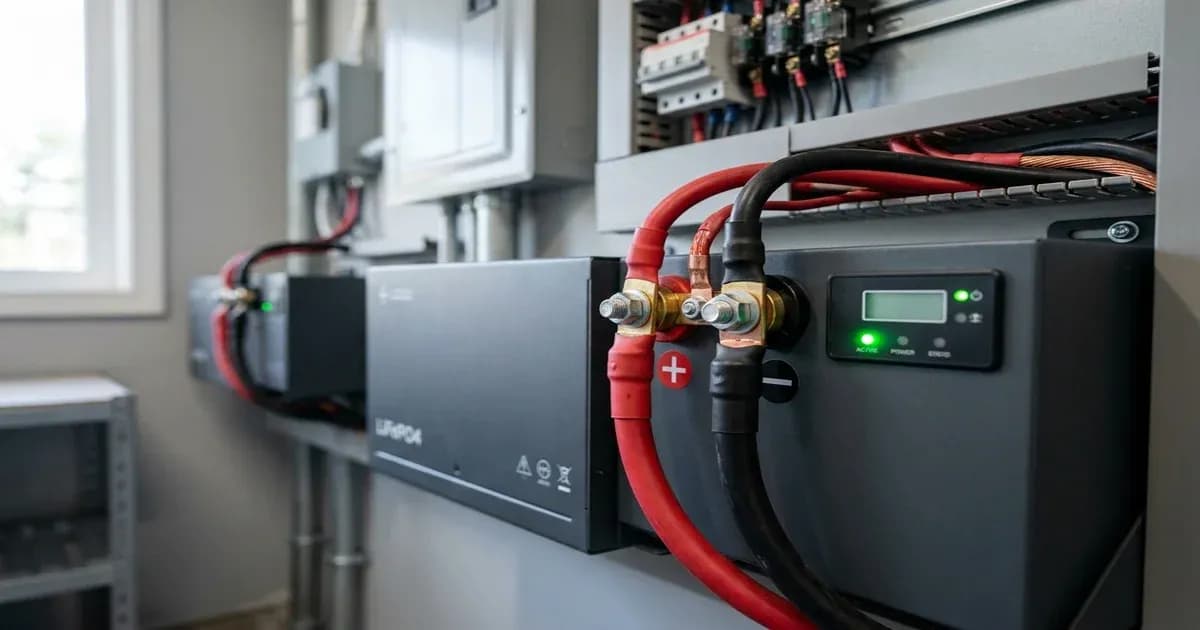
Zero charge current with a healthy pack voltage almost never means dead cells. It means the BMS has opened the charge path. Open the battery's own app or the BMS interface and read the alarm history for messages such as charge disabled, temperature protection, cell temperature low or high, cell overvoltage, or charge MOS off. These are the actual diagnosis; the inverter's generic fault code is just an echo.
Temperature is the most common cause. Most LiFePO4 packs specify a minimum charging temperature of 0C, and charging below that causes lithium plating and permanent capacity loss, so the BMS blocks it. In Karachi this will never happen. In Quetta, Skardu, Murree or a Gilgit winter, it happens routinely, and a battery that "died in January and recovered in March" was working properly as designed. The mirror image matters more here. BMS units also disable charge above their high-temperature limit, and a pack sitting in an unventilated store room in a Multan June will hit it.
Cell imbalance is the second cause. If one cell hits its overvoltage limit while the pack as a whole is at 80%, the BMS stops the charge to protect that cell. The pack is not dead; it needs a balancing cycle, which usually means a long slow charge held at absorption, and sometimes manual intervention by someone with the right tools.
What is BMS communication and why does it stop charging?
A closed-loop installation means the battery tells the inverter what it is allowed to do, including charge voltage, charge current limit, and state of charge, over a data cable. When that conversation breaks, many inverters stop charging rather than guess.
The trap is that this looks like a hardware fault and is almost always a configuration fault. Matching connectors prove nothing, because successful integration requires compatibility at every layer, and matching only the connector or port name is insufficient. CAN and RS485 are different physical protocols and will not talk to each other. Above that, the software protocols, including Pylontech, PACE, Growatt, Victron, LuxPower and others, are not compatible with each other, so a battery must be set to a protocol the inverter speaks, and the inverter set to expect it.
The diagnostic sequence is unglamorous and effective, requiring you to confirm pack voltage and that the BMS is powered; confirm you are using the correct communication port on both ends, because most packs have several that look identical; verify the cable with a continuity tester and confirm pin assignments, since RJ45 pinouts differ by brand; check termination where required; and confirm the battery addresses and master role. In a parallel bank, battery 1 is assigned as the primary and the others take unique addresses via DIP switches, display or configuration software. Only the master responds to the inverter.
If communication cannot be established, a competent installer can fall back to open-loop operation, where the inverter charges to fixed voltage parameters you set manually. It works, it is less optimal, and it must be set up deliberately rather than left as an accident.
What are the red lines that mean stop immediately?
Batteries add hazards that inverters do not have, and some of them give very little warning.
Stop and disconnect if any battery case is hot to the touch, swollen, bulging, cracked, or leaking. Stop if you smell rotten eggs or sulphur near a lead-acid or tubular bank, which is hydrogen sulphide from overcharging, the enclosure is also full of explosive hydrogen, and you should ventilate and leave, not investigate with a torch. Stop if you smell burning plastic or see melted or discoloured battery lugs, busbars or cable insulation. Stop if a lithium pack is hot, hissing, or venting anything at all; lithium thermal events do not give you a second warning, and water will not help.
In any of those cases, stop charging, switch off the battery breaker only if you can reach it without leaning over the battery, ventilate the space, keep flame and sparks away, get people out, and call your installer.
Three rules that never bend. Never open an inverter or a battery pack because inverter capacitors hold lethal voltage for up to 5 minutes after full disconnection, there are no user-serviceable parts, and opening either enclosure ends the warranty. Never touch DC wiring, MC4 connectors or panel terminals; a rooftop string sits at hundreds of volts DC whenever daylight touches it and no house breaker can switch that off. Never work on a battery bank with a metal spanner and no insulation, no gloves and no eye protection since a 48V bank will happily deliver hundreds of amps into a dropped tool, and the flash burn is instant.
One more, specific to storage because the weakest unit sets the behaviour of the whole bank, and you will have bought an expensive way to keep an old problem.
Frequently Asked Questions
Why is my solar battery not charging at all?
The most common causes are a charge priority set to solar only, a wrong battery type setting, a blown DC fuse, or a BMS blocking charge. Check settings before suspecting the battery.
How do I know if my BMS is blocking charging?
Look in the battery app or inverter log for messages like charge disabled, temperature protection, cell overvoltage, or charge MOS off. A blocking BMS shows zero charge current with healthy voltage.
Does Pakistani summer heat stop batteries charging?
Yes, indirectly. Lead-acid charge voltage must be reduced roughly 3 to 5 mV per cell for every degree above 25C, and lithium BMS units block charge above their high-temperature limit.
References
- Aforenergy, Inverter Not Charging Battery - Real Reasons and Fixes
- Ampinvt, Troubleshooting Hybrid Solar Charge Controllers
- Sona Solar, Why Your Inverter Is Not Charging the Battery
- Victron Energy, BlueSolar Charge Controller Operation Manual
- Su-vastika, How to Charge a Tubular Battery in an Inverter or UPS
- Rolls Battery, Calculating Proper Charge Settings for Flooded Lead-Acid
- Intercel, Temperature Effects on Batteries
- Vatrer Power, Why Lithium Batteries Need Low-Temperature Cut-Off Protection
- Lithium Battery Online, Low-Temperature Charging and BMS Protections
- Avepower, Battery Communication - CAN, RS485 and BMS Protocol Guide
- HIZN Lithium, LiFePO4 Battery Communication Failure with Inverter
- Solar Hub Official, 200Ah Tubular Battery Price in Pakistan
- Solar Panel Rates, Lithium Battery Price in Pakistan
- NEPRA, Regulatory Authority of Pakistan
- GM Energy, Inverter Installation and Operation Manual
Frequently asked questions
Why is my solar battery not charging at all?
The most common causes are a charge priority set to solar only, a wrong battery type setting, a blown DC fuse, or a BMS blocking charge. Check settings before suspecting the battery.
How do I know if my BMS is blocking charging?
Look in the battery app or inverter log for messages like charge disabled, temperature protection, cell overvoltage, or charge MOS off. A blocking BMS shows zero charge current with healthy voltage.
Does Pakistani summer heat stop batteries charging?
Yes, indirectly. Lead-acid charge voltage must be reduced roughly 3 to 5 mV per cell for every degree above 25C, and lithium BMS units block charge above their high-temperature limit.
References
- Sona Solar — accessed 26 July 2026
- Afor Energy — accessed 26 July 2026
- Suoer — accessed 26 July 2026
- Ampinvt — accessed 26 July 2026
- Innotinum — accessed 26 July 2026
- Suvastika — accessed 26 July 2026
- Victron Energy — accessed 26 July 2026
- Rolls Battery Support — accessed 26 July 2026
- Solar-Electric Forum — accessed 26 July 2026
- Intercel — accessed 26 July 2026
- Clore Automotive — accessed 26 July 2026
- DIY Solar Power Forum — accessed 26 July 2026
- Vatrer Power — accessed 26 July 2026
- Battery Energy Storage System — accessed 26 July 2026
- Lithium Battery Online — accessed 26 July 2026
- Hizn Lithium — accessed 26 July 2026
- DIY Solar Power Forum — accessed 26 July 2026
- AVE Battery — accessed 26 July 2026
- DIY Solar Power Forum — accessed 26 July 2026
- Solar Hub — accessed 26 July 2026
- Solar Price PK — accessed 26 July 2026
- Solar Panel Rates — accessed 26 July 2026
- Solar Hub — accessed 26 July 2026
- NEPRA — accessed 26 July 2026
- GM Energy — accessed 26 July 2026
- Manuals+ — accessed 26 July 2026
- SMA Manuals — accessed 26 July 2026
- ECD Online — accessed 26 July 2026
Related guides
More from inverter errors & fixes.