Inverter Overload Error - Why AC Startup Surge Trips Systems
Updated 2 August 2026 · By SolarNevs Research Desk, Dealer surveys + verified sources · 19 sources · Method ↗
Inverter Overload Error - Why AC Startup Surge Trips Systems
{/* visual_plan: stat_block */}
Key Takeaways
- Overload protection appears as OP, OVERLOAD, F07 or fault code 14 depending on platform; the category is identical even when the number is not.
- Motors and compressors surge to roughly 3 to 5 times their running wattage for the first 0.5 to 1.5 seconds, which is why most overload trips happen at startup, not during steady operation.
- A hybrid inverter's surge envelope is time-limited (roughly twice rated power for a few seconds and around 1.5 times for longer), and closely spaced surges build heat until it trips anyway.
- Keep steady load at about 70 to 80 percent of rated continuous output; the remainder is headroom for surge and for the thermal derating that a 45C Pakistani afternoon forces.
- A conventional 1.5-ton AC draws around 2,400W running against roughly 1,200-1,800W for a DC inverter unit of the same tonnage (2026), so the appliance choice often matters more than the inverter size.
What does an inverter overload error mean?
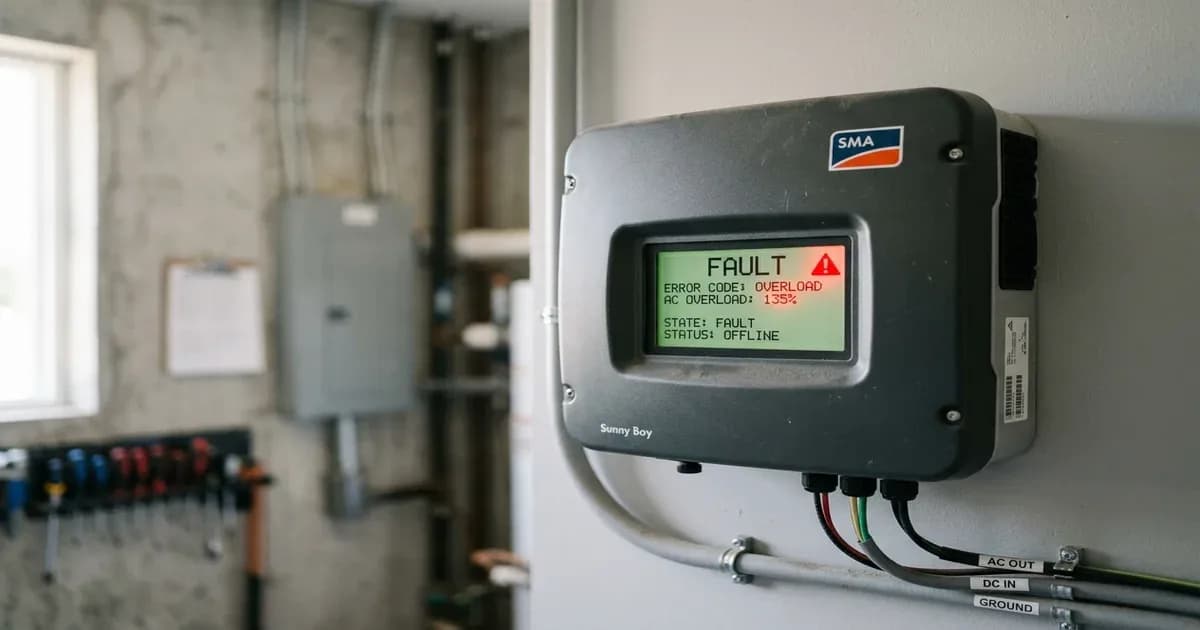
It means the inverter's output power or current has exceeded its rated range, so protection has triggered and output has stopped. Nothing has broken. The unit has refused a job it was not built to do.
Different platforms label this differently (OP, OVERLOAD, OL, F07, or fault code 14 are all the same family), but the meaning does not change with the badge. What changes is whether the overload is a steady-state problem or a startup problem, and this is the distinction that decides whether you need a settings change, an appliance change, or a different inverter.
Steady-state overload is simple, because you are asking for more continuous power than the plate rating, all day. It shows up as a trip that repeats predictably when the same combination of appliances is running, and it clears the moment you switch something off.
Startup overload is the more common and more confusing case. Everything runs fine, then one appliance starts, the inverter beeps and drops, and by the time you look at the screen the load reading is well within limits. This is a surge problem and no amount of staring at the running-watts figure will explain it.
Why does the overload happen the moment the AC starts?
Because a compressor's running current is not its starting current. Traditional compressors draw a very high current in the first 0.5 to 1.5 seconds, locked rotor amps, and the surge sits somewhere around 3 to 5 times the running wattage. Ceiling fans, water pumps, washing machines, and older refrigerators all do a smaller version of the same thing.
Your inverter has two separate envelopes. The continuous rating is the power it can deliver indefinitely. The surge rating is a short burst measured in seconds, and it is time-dependent, such as roughly twice rated power for a few seconds and around 1.5 times for longer. Importantly, closely spaced surges build heat, which pushes the unit into a protective trip even when each individual surge would have been survivable.
Put numbers on it. Suppose a 5kW hybrid is carrying 3.2kW of fans, lights, fridge and computers on a July evening. That leaves 1.8kW of continuous headroom. Now a conventional 1.5-ton split air conditioner starts, and its roughly 2,400W running draw (2026) briefly demands three to five times that. The inverter sees a demand well past its surge window, beeps, and trips. Ten seconds later the display says 3.2kW and everything looks fine, which is why people report the fault as random.
The same mechanism explains the classic Pakistani version of this fault, namely the trip that happens the instant load shedding ends. When utility power returns, every compressor, pump and fridge in the house that was waiting to restart does so at more or less the same moment, and their inrush currents stack.
{/* visual_plan: comparison */}
How do you find which load is tripping the inverter?
Bisection, not guesswork. This is the one diagnostic a homeowner can safely do alone, because it involves only the AC-side breakers in your distribution board.
Switch off every circuit breaker on the inverter's output. Restart the inverter with the load at zero and confirm it runs clean. Then close breakers one at a time, giving each thirty seconds before adding the next, and note the running load figure on the display as it climbs. When the fault reappears, you have identified the circuit.
Repeat inside that circuit at the appliance level, namely by unplugging everything on it, and then reconnecting items one by one. Pay particular attention to anything with a motor, and test it by starting it rather than leaving it plugged in idle because a compressor sitting in its off cycle draws nothing and will look innocent for twenty minutes.
Write down the running load your display shows with your normal evening set of appliances on. That number, compared against the plate rating, tells you immediately whether you have a steady-state problem or a surge problem, and it is the first thing any honest technician will ask for.
What sizing mistakes cause overload errors in Pakistan?
Four, and they repeat across thousands of installations.
The first is sizing the inverter to the panel array instead of to the peak load. A dealer sells "a 10kW system" and the conversation is entirely about panels, because panels are what the customer compares on price. But the inverter has to survive your worst simultaneous moment, not your average generation. Panels determine how much energy you make; the inverter determines what you can switch on at once. They are different questions.
The second is trusting the tonnage sales pitch. "This 5kW inverter runs three ACs" is a claim about running watts on a mild day with nothing else on. Three conventional 1.5-ton units at roughly 2,400W each (2026) are already 7.2kW of steady load before a single fan or fridge is counted, and their staggered compressor restarts will hit the surge envelope repeatedly all evening.
The third is ignoring derating. Most units automatically derate as temperature rises to protect the power electronics, and high ambient conditions, direct sun, and clogged or obstructed vents all cut available output. A 5kW inverter bolted to an unshaded west-facing wall in Multan in June is not a 5kW inverter at 4pm. Some Pakistani warranties explicitly exclude installations exceeding a 45C ambient limit in poorly ventilated spaces (May 2026), and claims have been rejected on that basis.
The fourth is designing with no margin at all. Sizing guidance in this market commonly recommends a 20-25% safety margin (2026), and keeping steady load to around 70-80% of rated continuous output. Systems sold at 100% of calculated load will overload in their first hot summer, and the customer will be told the inverter is faulty.
What does repeated overloading do?
Nothing dramatic on day one, and quite a lot by year three. Frequent overloads cause thermal derating to kick in earlier, producing lower conversion efficiency, more nuisance fault codes, and brief voltage dips or visible light flicker when loads step on and off.
Underneath that, the damage is cumulative. Excess heat accelerates ageing across the power stage and its supporting parts, including the IGBTs or MOSFETs, the magnetics, and above all the electrolytic capacitors, which are the components that quietly decide how long an inverter lives. Thermal cycling also fatigues solder joints. An inverter that is overloaded twice every evening for three summers does not fail on a specific date; it just becomes progressively less reliable and then dies in a heatwave, out of warranty, when replacement stock is scarce and expensive.
How do you fix it without buying a bigger inverter?
Usually you can, and usually it is cheaper.
Move the biggest surge off the inverter, or soften it. A DC inverter-type air conditioner ramps its compressor rather than slamming it and draws a far smaller starting surge than a conventional unit, while also cutting running draw to roughly 1,200-1,800W for 1.5 tons against about 2,400W conventional (2026). Where you are keeping an existing conventional AC, a soft starter limits the surge by ramping voltage more gradually, which lets a system with a modest surge rating start a compressor it otherwise could not.
Stagger the restarts. If everything in the house tries to start at once when the grid returns, the stack is the problem, not any single appliance. Timer plugs, a delayed-start setting on the AC, and simply not running the pump and the AC on the same schedule all remove trips for free.
Rebalance what sits on the inverter output. Not every circuit needs backup. Moving the water pump, the geyser or a workshop socket circuit onto a utility-only feed reduces both steady load and surge exposure, and costs an electrician's afternoon.
Fix the thermal environment. Shade the inverter, clear at least 30cm around it and 50cm above, and clean the heatsink and vents. A unit that is not derating has its full surge envelope available.
Only after all that does a bigger inverter make sense, and note that under the net billing regime in force since 8-9 February 2026, oversizing to export surplus no longer pays the way it did, since exports credit at roughly Rs 11/unit against imports at up to Rs 50-65/unit (July 2026). Size for your load, not for a subsidy that no longer exists.
What are the red lines that mean stop immediately?
Overload trips are usually benign. These symptoms are not, and they end the troubleshooting session.
Stop and shut down if you smell burning plastic, hot varnish, or a sharp ozone smell around the inverter or the distribution board. Stop if you see smoke, scorch marks, browned or melted terminals, or discoloured MC4 connectors. Stop if any cable, breaker, isolator or connector is too hot to hold comfortably, because a warm breaker under heavy load is normal, a breaker you cannot keep a finger on is not. Stop if you hear crackling, hissing or frying from the DC side; that is likely a DC arc, and DC arcs do not self-extinguish. Stop if the enclosure is bulging, or if the inverter trips instantly at zero load, which points at an internal fault rather than an overload.
In those cases, switch off the AC breaker, switch off the DC isolator if it is safely reachable and not itself the hot component, keep people clear, and call your installer.
Three rules regardless of how confident you are. Never open an inverter, because internal capacitors hold lethal voltage for up to 5 minutes after full disconnection, there are no user-serviceable parts inside, and opening the case ends the warranty. Never touch DC wiring, MC4 connectors or panel terminals; a rooftop string is live at hundreds of volts DC whenever daylight falls on it and no breaker in the house switches that off. Never repeatedly reset an inverter through the same overload; each cycle adds heat, and the fault you are hammering past is the protection that is keeping the unit alive.
Frequently Asked Questions
What does an overload error on an inverter mean?
The inverter's output power or current has exceeded its rated range, so it stops output to protect itself. Most overload trips happen at the moment a motor starts, not during steady running.
Why does my inverter overload when the AC turns on?
A conventional compressor draws roughly 3 to 5 times its running wattage for the first half-second to 1.5 seconds. That inrush exceeds the inverter's short surge envelope even though the running load fits.
What percentage of my inverter's rating should I load?
Keep steady household load around 70 to 80 percent of the rated continuous output, and leave the rest as headroom for motor starting surges and hot-weather thermal derating.
References
- SRNE Solar, What Happens If You Overload a Hybrid Inverter
- Gigacity Solar, What Happens If You Overload a Hybrid Inverter
- Suoer, Why Does My Solar Inverter Shut Down, Trip or Reduce Power
- Xindun Power, Parallel Hybrid Inverter Fault Codes and Protection Functions
- Solar Valley, Common Causes of Inverter Beeping and Fault Codes
- EcoFlow, LRA, Surge Power and Inverter Matching Guide
- Generator Checker, Inverter AC vs Standard AC on Battery Power
- Hetco Pakistan, Running a 1.5 Ton AC on Solar Power in Pakistan
- PV Pakistan, How Many Solar Panels Required for a 1.5 Ton AC
- Solar Installation Lahore, Inverex Service and Warranty Review
- GM Energy, Inverter Installation and Operation Manual
- NEPRA, Regulatory Authority of Pakistan
Frequently asked questions
What does an overload error on an inverter mean?
The inverter's output power or current has exceeded its rated range, so it stops output to protect itself. Most overload trips happen at the moment a motor starts, not during steady running.
Why does my inverter overload when the AC turns on?
A conventional compressor draws roughly 3 to 5 times its running wattage for the first half-second to 1.5 seconds. That inrush exceeds the inverter's short surge envelope even though the running load fits.
What percentage of my inverter's rating should I load?
Keep steady household load around 70 to 80 percent of the rated continuous output, and leave the rest as headroom for motor starting surges and hot-weather thermal derating.
References
- Xindun Power — accessed 26 July 2026
- Solar Valley — accessed 26 July 2026
- Bluesun Solar — accessed 26 July 2026
- EcoFlow — accessed 26 July 2026
- Generator Checker — accessed 26 July 2026
- GigaCity Solar — accessed 26 July 2026
- SRNE Solar — accessed 26 July 2026
- Suoer — accessed 26 July 2026
- HETCO — accessed 26 July 2026
- PV Pakistan — accessed 26 July 2026
- Generator Checker — accessed 26 July 2026
- Solar Installation Lahore — accessed 26 July 2026
- NEPRA — accessed 26 July 2026
- GM Energy — accessed 26 July 2026
- Manuals+ — accessed 26 July 2026
- GreenLancer — accessed 26 July 2026
- SMA Manuals — accessed 26 July 2026
- ECD Online — accessed 26 July 2026
- Afor Energy — accessed 26 July 2026
Related guides
More from inverter errors & fixes.