GoodWe Inverter Error Codes - ES and ET Hybrid Guide Pakistan
Updated 2 August 2026 · By SolarNevs Research Desk, Dealer surveys + verified sources · 12 sources · Method ↗
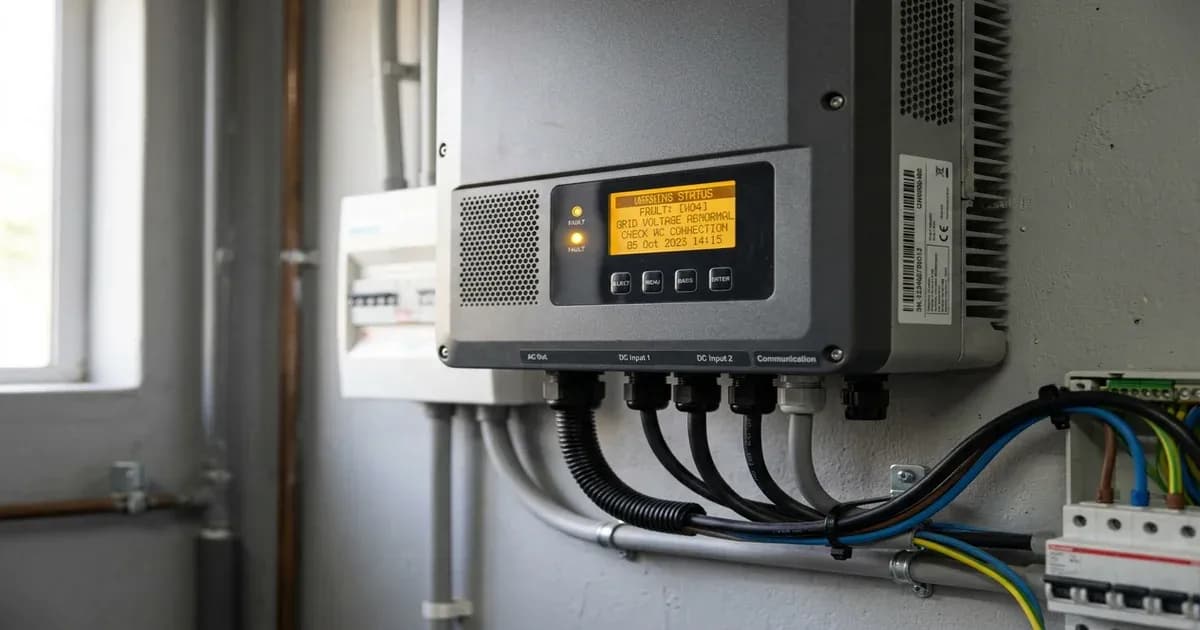
GoodWe Inverter Error Codes - ES and ET Hybrid Guide Pakistan
{/* visual_plan: stat_block */}
Key Takeaways
- GoodWe's official ESS Troubleshooting Guide V1.0, dated 10 March 2023, covers ET, ET PLUS+, EH, ESA, ES, EM, EHB and ES G2 hybrids plus the BT, BH, BP, SBP and SBP G2 AC-coupled range.
- Several codes carry an "ETU" suffix, meaning the same number means something different on an ET-series inverter. Code 12 is Internal Fan Failure, but 12ETU on an ES is back-up overload.
- GoodWe gives you measurable pass/fail numbers, where earth-to-frame voltage should read close to 0V for code 10; grid neutral-to-ground under 10V and back-up neutral-to-ground resistance under 10 ohms for code 25; PV-to-ground resistance above 30k ohms for code 11.
- Alarms are read in the SolarGo or PV Master app and on SEMS Portal, and GoodWe states that administrator and technician accounts are the ones that can check alarms for troubleshooting.
- Pakistani pricing, June to July 2026, places the GW10K-ET three-phase hybrid around Rs 455,950 and a 10kW single-phase hybrid around Rs 420,000, on a standard 5-year warranty extendable to 10 years on selected models.
Where do GoodWe error codes appear, and who can see them?
A GoodWe hybrid does not show you a fault number on its face. The cover carries LED indicators, and the numeric error code lives in the app. GoodWe's own escalation order requires reading the LEDs first, and then connecting SolarGo or PV Master and reading the alarm, then acting on the code.
On an ET, ET PLUS+ or BT the LED block is unusually informative. SYSTEM on means ready, blinking means starting. BATTERY on is charging, one blink is discharging, two blinks means low state of charge, off means disconnected. GRID on means active and connected, blinking means active but not connected. ENERGY on means importing, one blink means export limited to zero, two blinks means exporting. COM tells you what is broken. One blink means BMS communication failed while the meter is fine, while two blinks means the opposite. FAULT on means a fault occurred. FAULT blinking once means the back-up output is overloaded.
Here is the uncomfortable part. GoodWe documents that on SEMS Portal, administrator and technician accounts are the ones that check alarms for troubleshooting and maintenance, and the SolarGo alarm screen is an installer function. In Pakistan that creates a familiar hostage situation. The customer paid for the system but only the dealer can read why it stopped. Before you sign, insist on your own SEMS plant account and get SolarGo access written into the handover note.
What do GoodWe error codes 00 to 08 mean?
{/* visual_plan: comparison */}
- 00 GFCI Check Timeout. The GFCI value was too high during self-check. Restart once; if the fault does not return it was intermittent.
- 01 AC HCT Check Failure. Either an intermittent external influence such as a stray magnetic field, or a faulty internal component.
- 02ETU AFCI Fault. Arc-fault circuit alarm on ET-series units.
- 04 DCI Consistency Failure. The two independent DC-injection measurements disagree.
- 05ETU DC bus low. Listed in the guide without a documented cause or remedy.
- 06 GFCI Consistency Failure / device check failure. Same intermittent-or-internal pattern.
- 07 Relay Device Failure. The relay self-check failed at device level.
- 08 AC HCT Failure. AC output current sensor failure, an intermittent external influence, or a faulty control board. GoodWe adds a step here that the others do not have. Update the inverter to the latest firmware first.
For 00, 01, 04, 06 and 07, GoodWe's documented procedure is identical and worth internalising. Restart the inverter, see whether the fault reoccurs, and if it does not, treat it as intermittent. If it remains, it goes to the service centre. That is the whole owner-level protocol. There is no third step where you open the lid.
What do the grid and earthing codes mean?
- 09, 17 and 29 Utility Loss / AC Failure / FAC Failure. Grid power failure, AC not connected well, failed AC breaker, or grid simply not connected. GoodWe's checklist includes confirming grid power is available, measuring AC terminal voltage with a multimeter, checking every termination along the AC path is tight, checking the AC breaker functions, verifying L and N are in the correct terminals, and if all that is fine, switching the AC breaker off and on again after five minutes.
- 10 Ground I failure. Three named causes, including neutral and ground not well connected at the AC terminals, leakage from panels to ground in high humidity, or utility ground loss. The test is concrete. Measure with a multimeter between earth and the inverter frame; it should be close to 0V. If there is a voltage, neutral and ground are not properly connected at the AC terminals. If it only appears on humid rainy days, it is panel leakage.
- 25 Relay check failure. Caused by poor neutral-and-ground connection at the AC terminals or utility ground loss. Two measurements are required. Grid neutral-to-ground voltage should be under 10V, and back-up-output neutral-to-ground resistance should be under 10 ohms.
- 22 Fac Consistency Failure and 23 Vac Consistency Failure. The redundant frequency or voltage measurement channels disagree; intermittent or internal.
- 14ETU Phase order Fault and 27ETU Phase Angle Failure. AC phases connected in the wrong order on a three-phase ET. Swap L2 and L3, then update firmware.
Codes 10 and 25 define GoodWe ownership in Pakistan. A house with one corroded earth rod in dry Punjab soil, a DB where neutral and earth were never properly bonded, and a back-up output wired by whoever was cheapest, will throw 10 and 25 for years. No firmware update fixes an earth electrode.
Why does the same code number mean two different things?
This is the trap that catches Pakistani technicians who learned GoodWe on older grid-tie units.
An older GoodWe string-inverter numbering set is still widely circulated by service outfits. These include 1 SPI Failure, 2 EEPROM R/W Failure, 3 Fac Failure, 7 Relay Check Failure, 13 DC Injection High, 14 Isolation Failure, 15 Vac Failure, 17 PV Over Voltage, 19 Over Temperature, 21 DC BUS HIGH, 22 Ground I Failure, 23 Utility Loss, 24 AC HCT Failure, 26 GFCI Failure, 30 REF 1.5V Failure.
Now compare with the current hybrid app numbering above. In the old set, 17 is PV over-voltage and 23 is utility loss. In the current hybrid set, 17 belongs to the utility-loss group and 23 is Vac Consistency Failure. In the old set, 13 is DC injection high and 19 is over temperature; in the hybrid set, 13 is over temperature. Same brand, same code number, completely different diagnosis.
On top of that, GoodWe appends "ETU" to several codes precisely because the ET series reuses numbers. For example, 12 is Internal Fan Failure generally, but 12ETU on an ES means the back-up loads exceed the inverter's maximum output. So before anyone acts on a GoodWe number, establish two things, namely which series the unit is, and whether the number came from the app or from somebody's memory of a 2018 grid-tie unit.
Which GoodWe codes are heat, dust and PV-string faults here?
{/* visual_plan: callout_card */}
- 13 Over Temperature. Ambient too high for an extended period, insufficient airflow, or obstructed cooling fins. GoodWe's remedies include reducing surrounding temperature, meeting the manual's clearance requirements, clearing the fins, and switching the inverter off for 15 minutes before restarting. A hybrid mounted in a closed store room with a battery bank underneath is a code 13 waiting to happen.
- 12 Internal Fan Failure. Fan blocked by debris, or the fan cable not seated. Dust is the local enemy; the fan is the local casualty.
- 11 DC bus high. Internal DC bus voltage too high, PV voltage exceeding the inverter maximum, or PV current leaking to ground. Restart, confirm PV voltage is inside the manual's range, and measure resistance between PV positive and negative to ground, which should be more than 30k ohms.
- 15 PV overvoltage. Total string open-circuit voltage exceeds maximum DC input. Measure the string, remove panels if it is too high, and size against the temperature coefficient rather than a warm afternoon reading. Pakistan's PV over-voltage season is January, not July.
- ISO failure (unnumbered in the guide). PV ground cable missing or poorly connected, damaged DC cable insulation, poor neutral-and-ground connection at AC terminals, or high humidity at dawn, dusk or in rain. Connect strings one at a time to find the culprit.
- 26 Battery Licence Fault. The battery activation code is incorrect, and the only listed remedy is to contact the service centre. Treat this as a commercial risk, not a technical one. Ask in writing, before payment, who holds your battery's activation code and what a reissue costs if your installer leaves the business.
When should you stop and call a GoodWe technician?
Stop after one clean restart if the code returns. GoodWe's own wording draws the line for you. Restart, check whether the fault reoccurs, and if it remains, contact the service centre. That instruction is attached to 00, 01, 02ETU, 04, 06, 07, 08, 22, 23, 24ETU, 28ETU, 30 and 31, representing most of the code list.
Stop immediately, without restarting, if code 10 or 25 is present together with any tingling from metal enclosures, or if you measure a voltage between earth and the inverter frame. That is a live earthing defect and it is a shock hazard before it is an inverter problem. Stop if 11 is present and your PV-to-ground resistance measures below 30k ohms, because that is a real insulation fault on the roof. Stop if you see ISO failure on a dry, sunny afternoon, since morning-damp excuses do not apply.
Everything else (09, 17, 29 during load-shedding, 13 in a July heatwave, 15 on a January morning) is the system telling you about the world outside it. Fix the world by shading the inverter, clearing the fins, resizing the string, and mending the earth. In our experience most GoodWe "faults" in Pakistan are installation and site faults wearing an inverter's error code.
Frequently Asked Questions
What does GoodWe error code 10 Ground I failure mean?
Code 10 means residual current to earth. GoodWe's check is to measure voltage between earth and the inverter frame with a multimeter, where it should read close to 0V. Any reading means neutral and ground are poorly connected at the AC terminals.
Why does my GoodWe show error 09, 17 or 29?
All three are the utility-loss group, including grid power failure, loose AC connection, failed AC breaker, or no grid at all. During load-shedding this is normal. GoodWe suggests turning the AC breaker off and back on after five minutes.
What is GoodWe error code 26 Battery Licence Fault?
Code 26 means the battery activation code is incorrect. It is a licensing lock, not a hardware fault, and GoodWe's only listed remedy is to contact your service centre. Confirm before purchase who holds your battery activation code.
References
- GoodWe ESS Troubleshooting Guide, hybrid and AC-coupled series, V1.0 (2023-03-10)
- GoodWe SolarGo App user manual
- GoodWe SEMS Portal user manual
- GoodWe error code list, Inverter Service
- GoodWe fault code overview, Solair Electrical
- GoodWe 10kW three-phase hybrid GW10K-ET listing, Solar Trade Pakistan
- GoodWe 10kW single-phase hybrid ES-series listing, C-Power Pakistan
- Nizam Energy, GoodWe authorised distributor in Pakistan
Frequently asked questions
What does GoodWe error code 10 Ground I failure mean?
Code 10 means residual current to earth. GoodWe's check is to measure voltage between earth and the inverter frame with a multimeter, where it should read close to 0V. Any reading means neutral and ground are poorly connected at the AC terminals.
Why does my GoodWe show error 09, 17 or 29?
All three are the utility-loss group, including grid power failure, loose AC connection, failed AC breaker, or no grid at all. During load-shedding this is normal. GoodWe suggests turning the AC breaker off and back on after five minutes.
What is GoodWe error code 26 Battery Licence Fault?
Code 26 means the battery activation code is incorrect. It is a licensing lock, not a hardware fault, and GoodWe's only listed remedy is to contact your service centre. Confirm before purchase who holds your battery activation code.
References
- GoodWe — accessed 26 July 2026
- Universe Solar — accessed 26 July 2026
- Omvormer Service — accessed 26 July 2026
- Solair Electrical — accessed 26 July 2026
- Solar Trade PK — accessed 26 July 2026
- Solar Panel Price in Pakistan — accessed 26 July 2026
- C-Power — accessed 26 July 2026
- Kamal Solar — accessed 26 July 2026
- Nizam Energy — accessed 26 July 2026
- Powerhouse Express — accessed 26 July 2026
- GoodWe — accessed 26 July 2026
- GoodWe — accessed 26 July 2026
Related guides
More from inverter errors & fixes.