Inverter Shows Error But No Output - Safe Triage Guide
Updated 2 August 2026 · By SolarNevs Research Desk, Dealer surveys + verified sources · 18 sources · Method ↗
Inverter Shows Error But No Output - Safe Triage Guide
{/* visual_plan: stat_block */}
Key Takeaways
- An inverter can show a fault code and be mechanically perfect, because grid-tied and hybrid units are designed to stop output when the grid is absent or outside its voltage window.
- The safe restart order never changes, requiring AC off, DC off, waiting 5 to 10 minutes, DC on, then AC on.
- Internal capacitors remain at lethal voltage for up to 5 minutes after every switch is off, which is why no homeowner should open the enclosure.
- Pakistani residential voltage routinely swings between 160V and 260V and can spike to 280-300V for a few seconds when load shedding ends (2026), which is the single biggest cause of nuisance grid faults.
- With net metering abolished for new connections on 8-9 February 2026, every unit your system fails to produce is a unit you buy back at up to Rs 50-65/unit (July 2026).
What does "error but no output" mean?
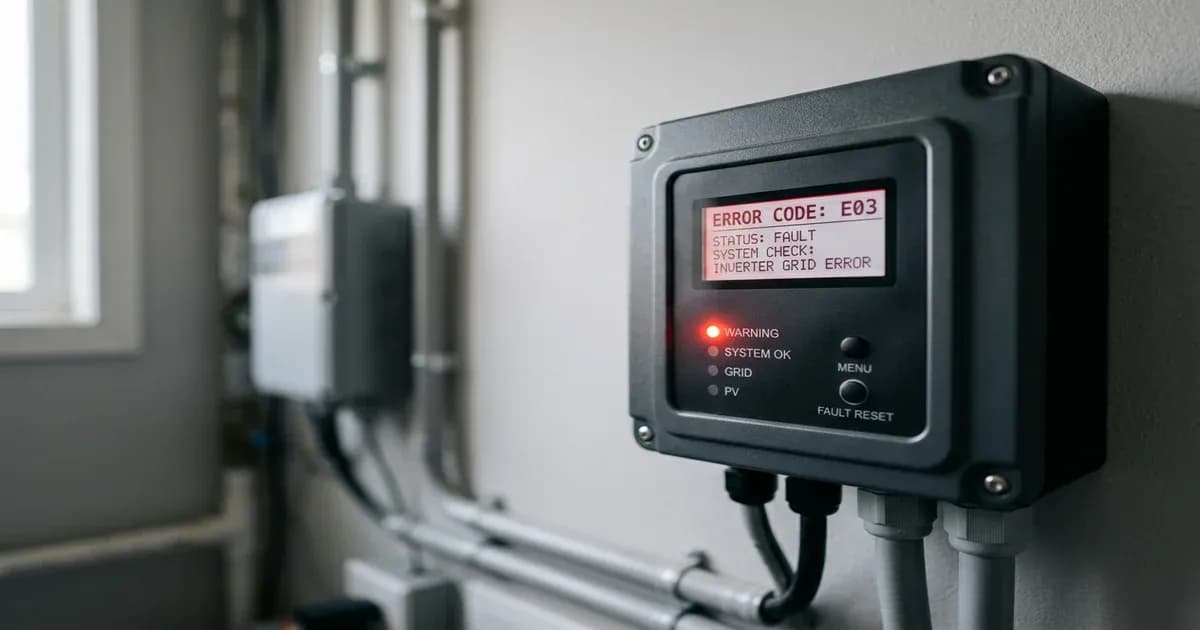
It means two separate things that people collapse into one complaint. "Error" is a message on the screen or in the app. "No output" is the absence of power on the AC side. They are often unrelated, and treating them as one problem is why so many people pay for a service visit they did not need.
A very large share of the calls installers get in Lahore and Karachi during July and August fall into three buckets. First, the inverter is doing what it was designed to do, namely refusing to energise because the grid is missing or out of tolerance. Second, an isolator or breaker somewhere in the chain is open, often left off after a maintenance visit or a meter change. Third, there is a genuine internal fault, and this is the smallest of the three groups.
The financial stakes changed this year. Before February 2026, an unnoticed outage cost you an export credit. Now, under the Prosumer Regulations issued by NEPRA on 8-9 February 2026, new connections receive roughly Rs 11 per exported unit while importing at up to Rs 50-65 per unit (July 2026). A system that has been silently dead for three weeks is now an expensive thing to discover late.
What should you check before touching anything?
Start with the things that cost nothing and carry no risk. Read the actual code on the screen or in the monitoring app and write it down, including any letters. Note the time of day and the weather. An error that appears only at 6:30am, only after rain, or only when the air conditioner starts is telling you far more than the code itself.
Then look at the AC side of the house. Is the rest of the house on utility power? Is the main breaker feeding the inverter's AC input closed? Is the dedicated MCB or RCD in the distribution board tripped? A tripped RCD downstream of the inverter will produce "no output" with no inverter fault at all.
Now check the DC side visually, from the ground. Is the DC isolator handle in the ON position? On many models the control electronics are powered from the PV string, so a DC isolator left off means a completely dark screen even when the AC supply is healthy. If the screen is dark, this is the first suspect, not a failed board.
Finally, check the time. A grid-tied inverter cannot start without the grid, and after the grid returns the unit reconnects on its own after a short built-in delay rather than instantly. If load shedding ended ninety seconds ago, you are not looking at a fault. You are looking at a countdown.
{/* visual_plan: step_flow */}
How do you safely restart a solar inverter?
There is one correct sequence and it exists for a reason. Switching DC off while AC is still connected, or vice versa, can force current through paths the designer never intended.
Switch off the AC breaker or AC isolator first. Then switch off the DC isolator. If you have a battery, switch off the battery breaker last. Wait five to ten minutes without touching anything (this is the capacitor discharge window, and it is not optional). Then reverse the order to bring it back by switching the battery breaker on, DC isolator on, waiting sixty seconds for the screen to boot and settle, and then switching the AC breaker on.
Do this once. If the same error returns within minutes, you have a real condition, not a glitch, and repeating the cycle five more times achieves nothing except heat. Two failed restarts is the point at which you stop and call someone.
Some faults will not clear with a restart by design. Isolation and earth faults, arc-fault trips, and hardware relay failures are latched deliberately so that a homeowner cannot reset their way past a safety condition. If your unit refuses to clear, respect that.
Which errors point to the grid and which point to your roof?
Grid-side faults are the noisy majority in Pakistan and the least alarming. Anything worded as grid overvoltage, grid undervoltage, grid frequency, or "no utility" is describing the incoming supply, not your equipment. Residential voltage in many areas swings between 160V and 260V through the summer peak, and phase imbalance means one phase can sit at 250V while another sits at 180V on the same street (2026). When power restores after a long cut, transformer ringing can produce transients of 600V to 1,200V and a visible spike of 280-300V for a few seconds (May 2026). Inverters trip on all of this and then reconnect on their own.
If grid faults are constant rather than occasional, the fix is upstream, starting with a complaint to your DISCO about the tap setting on your transformer, and a Type 2 surge protective device at your main distribution board. AC SPDs were quoted around PKR 1,500 to PKR 2,500 (May 2026), which is trivial money against a control board.
Roof-side faults are the quieter and more serious group. Isolation or insulation resistance faults, PV overvoltage, string current imbalance, and arc-fault detection all describe your DC array. An isolation fault typically raises when total measured resistance to earth falls to around 1 megohm, against the 20 to 30 megohms a healthy dry array should show. These deserve a proper technician with an insulation tester, not a reset.
Inverter-side faults, including bus voltage, relay check failure, temperature, and fan failure, are internal. Temperature faults are seasonal and largely self-inflicted, often caused by a west-facing wall with no shade in a Multan July will thermally derate almost anything. Some warranties in Pakistan explicitly exclude installations that exceed a 45 degree ambient limit in poorly ventilated spaces (May 2026), and claims have been rejected on that clause.
When is no output completely normal?
More often than people expect. Early morning and late dusk produce short beeps and clicking as the MPPT tries to start on marginal light and gives up; this is the inverter waking and sleeping, not failing. During any grid outage, a pure grid-tied system must shut down entirely under anti-islanding rules (that is a legal safety requirement to protect linemen), and it is why a grid-tied-only system gives you nothing during load shedding. Heavy cloud, dust storms, and unwashed panels after a Ravi-valley dust event all cut output sharply without any fault at all.
The test that separates normal from abnormal is comparison. Look at yesterday's generation curve in the app at the same hour, and look at whether a neighbour's system is producing. A single flat day is weather. A flat week is a fault.
What are the red lines that mean stop immediately?
Everything above assumes a system that is boring. Some symptoms are not boring, and the correct response to them is to shut down and get out.
Stop immediately and do not restart if you smell burning, hot plastic, or that sharp ozone smell near the inverter or the DC combiner. Stop if you see smoke, scorch marks, discoloured or melted MC4 connectors, or brown staining around any terminal. Stop if you hear a crackling, sizzling, or frying sound from DC cabling or the combiner box, which is very likely a DC arc, and unlike AC there is no zero crossing to extinguish it. Stop if any DC cable, isolator, or connector is too hot to hold comfortably. Stop if the enclosure is bulging, or if water is visibly inside it.
In those cases, switch off the AC breaker, switch off the DC isolator if you can reach it safely and it is not the thing that is hot, keep people away from the roof, and call your installer or the fire service. Do not spray water on it. Around half of residential PV fires trace back to wiring and connector failures rather than the panels themselves, and the great majority of those start at a badly crimped connector that got hot slowly over months.
Three absolute rules, regardless of how confident you feel. Never open an inverter. Capacitors hold lethal charge for up to 5 minutes after full disconnection, there are no user-serviceable parts inside, and opening it ends your warranty. Never touch DC wiring, connectors, or panel terminals; a rooftop string sits at several hundred volts DC in full sun and cannot be switched off by any breaker in your house because the panels are live whenever light falls on them. Never separate MC4 connectors under load; that is how you create an arc with your hands in it.
What should a service visit cost and what should you demand?
Get a documented diagnosis, not a parts swap. In Lahore, an out-of-warranty bench fee of PKR 2,500 (May 2026) plus priced parts is a normal structure, and a cooling fan replacement runs around PKR 3,500 (May 2026). In-warranty diagnostics at an authorised centre should be free, with typical turnaround of four to seven working days, stretching to ten to fourteen days for an MPPT board in peak summer (May 2026).
Ask for three things in writing, namely the exact fault code and its logged timestamps, the measured values the technician took (grid voltage, string voltage, insulation resistance in megohms, earth electrode resistance in ohms), and what was replaced. If a technician cannot produce a measurement, they are guessing with your money. Any warranty claim later will depend on those numbers existing.
Frequently Asked Questions
Why is my solar inverter showing an error but still no output?
Most commonly the grid is out of limits, a DC isolator is off, or the inverter is in a timed reconnect delay. Check the isolators and the grid before assuming hardware failure.
What is the correct order to restart a solar inverter?
Switch off AC first, then DC, wait 5 to 10 minutes for capacitors to discharge, then switch DC on, wait a minute, then switch AC on. Never reverse this order.
Can I open my inverter to check inside?
No. Internal capacitors hold lethal voltage for up to 5 minutes after full disconnection, and opening the case voids every warranty in Pakistan. Call the service centre.
References
- GreenLancer, Solar Inverter Problems and Solutions
- SMA, Checking the PV System for Ground Faults
- In Balance Energy, Ground, Isolation and Insulation Resistance Faults
- SolaX, Why Is My Inverter Beeping
- CNC Electric Pakistan, Voltage Regulator vs Voltage Protector
- CNC Electric Pakistan, SPD Full Form and Why Pakistan Needs It
- Solar Installation Lahore, Inverex Service and Warranty Review
- GM Energy, Inverter Installation and Operation Manual
- SolarVision AI, MC4 Connectors and Solar Safety
- NEPRA, Regulatory Authority of Pakistan
Frequently asked questions
Why is my solar inverter showing an error but still no output?
Most commonly the grid is out of limits, a DC isolator is off, or the inverter is in a timed reconnect delay. Check the isolators and the grid before assuming hardware failure.
What is the correct order to restart a solar inverter?
Switch off AC first, then DC, wait 5 to 10 minutes for capacitors to discharge, then switch DC on, wait a minute, then switch AC on. Never reverse this order.
Can I open my inverter to check inside?
No. Internal capacitors hold lethal voltage for up to 5 minutes after full disconnection, and opening the case voids every warranty in Pakistan. Call the service centre.
References
- GreenLancer — accessed 26 July 2026
- Afor Energy — accessed 26 July 2026
- GM Energy — accessed 26 July 2026
- Manuals+ — accessed 26 July 2026
- CNC Electric Pakistan — accessed 26 July 2026
- CNC Electric Pakistan — accessed 26 July 2026
- CNC Electric Pakistan — accessed 26 July 2026
- NEPRA — accessed 26 July 2026
- In Balance Energy — accessed 26 July 2026
- Emazys — accessed 26 July 2026
- Solar Installation Lahore — accessed 26 July 2026
- SolarVision AI — accessed 26 July 2026
- AllShield Coatings — accessed 26 July 2026
- Solar Tech Support — accessed 26 July 2026
- Elec-Mate — accessed 26 July 2026
- SolaX Power — accessed 26 July 2026
- SMA Manuals — accessed 26 July 2026
- ECD Online — accessed 26 July 2026
Related guides
More from inverter errors & fixes.