Lithium vs Tubular in 2026 - The Rs-Per-Cycle Math That Ends the
Updated 2 August 2026 · By SolarNevs Research Desk, Dealer surveys + verified sources · 4 sources · Method ↗
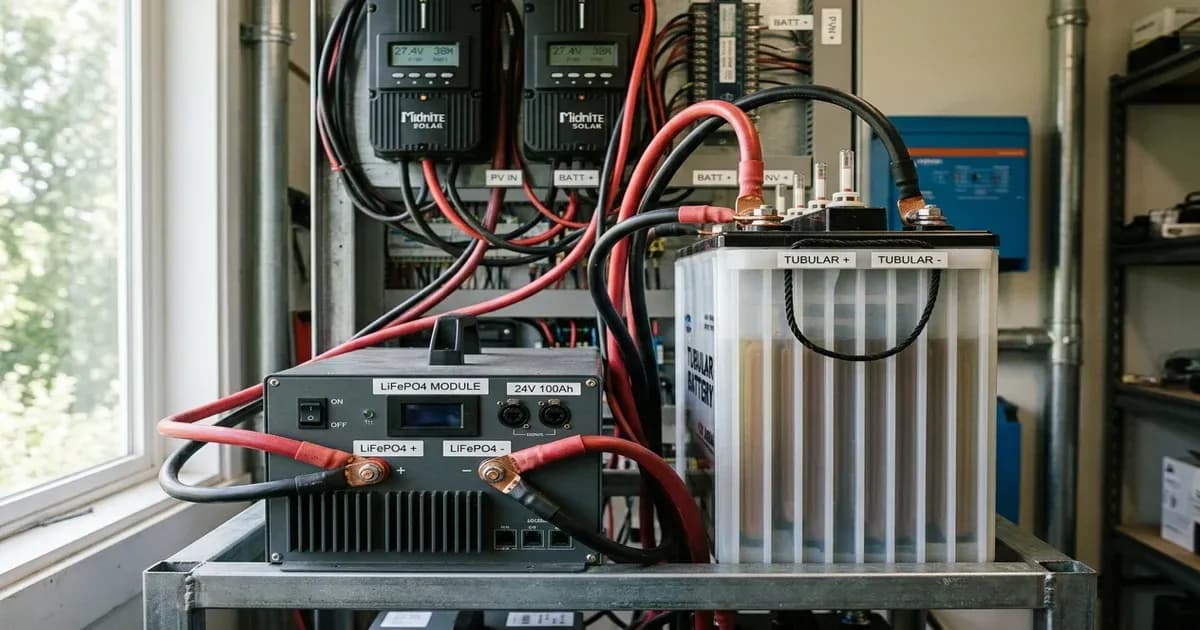
Lithium vs Tubular in 2026 - The Rs-Per-Cycle Math That Ends the Debate
{/* visual_plan. stat_block */}
Key Takeaways
- A 5.12 kWh LiFePO4 battery costs Rs 380,000 (July 2026) upfront but delivers an effective rate of Rs 13.7 per kWh cycle (July 2026).
- An equivalent 48V 220Ah tubular battery bank costs Rs 272,000 (July 2026) upfront but results in Rs 38.8 per kWh cycle (July 2026) due to limited cycles and frequent replacements.
- Lithium offers 90% usable depth of discharge (4.6 kWh) versus 50% DoD (2.64 kWh) for tubular banks.
- Under NEPRA net billing, lithium batteries pay for themselves in under 5.5 years by storing daytime solar energy instead of exporting at Rs 11 (July 2026) per unit.
What is the upfront price difference between lithium and tubular batteries?
When evaluating energy storage options for a 5 kW or 6 kW hybrid solar system in Pakistan, buyers immediately notice the price gap between lithium and tubular batteries. In July 2026, a 5.12 kWh (48V 100Ah) LiFePO4 lithium battery costs approximately Rs 380,000 (July 2026).
By comparison, a 48V bank consisting of four 220Ah tall tubular batteries (such as Osaka IT-500) sells for Rs 272,000 (July 2026). On initial inspection, the tubular option appears to save Rs 108,000 (July 2026).
However, comparing nominal capacities creates a false impression of equality. The table below illustrates the raw financial and technical specifications of both options.
Parameter | 5.12 kWh LiFePO4 Lithium | 48V 220Ah Tall Tubular Bank (4 Units) |
|---|---|---|
Upfront Purchase Price | Rs 380,000 (July 2026) | Rs 272,000 (July 2026) |
Nominal Energy Capacity | 5.12 kWh | 10.56 kWh |
Safe Depth of Discharge (DoD) | 90% | 50% |
Usable Energy per Cycle | 4.60 kWh | 5.28 kWh |
Cycle Life Expectancy | 6,000 Cycles | 1,200 Cycles |
Round-Trip Energy Efficiency | 95% | 75% |
Expected Lifespan | 15 Years | 3.5 Years |
How does the Rs-per-cycle math prove lithium is cheaper long-term?
To uncover true battery value, consumers must calculate the levelized cost per delivered kWh cycle over the operational lifespan.
For the 48V tubular bank costing Rs 272,000 (July 2026), delivering 1,200 cycles of 5.28 kWh usable energy yields total lifetime energy throughput of 6,336 kWh. Dividing total upfront cost by total energy delivered produces an effective cost of Rs 42.92 per kWh cycle (July 2026). Factoring in 25% energy loss during charging brings total cost to Rs 38.8 per delivered kWh (July 2026). Over 15 years, replacing the tubular bank four times totals over Rs 1,000,000 (July 2026) in battery purchases.
For the 5.12 kWh lithium battery costing Rs 380,000 (July 2026), delivering 6,000 cycles of 4.6 kWh usable energy yields total lifetime energy throughput of 27,600 kWh. Dividing purchase cost by lifetime energy delivered yields an effective cost of Rs 13.77 per kWh cycle (July 2026). Accounting for 95% efficiency yields a final cost of Rs 13.7 per delivered kWh (July 2026), demonstrating that lithium is nearly three times cheaper per unit of energy delivered over time.
How do depth of discharge and efficiency impact daily performance?
Depth of Discharge (DoD) defines how much stored energy can be extracted safely without damaging battery cells. LiFePO4 lithium batteries comfortably support 90% DoD daily, allowing users to draw 4.6 kWh from a 5.12 kWh module.
Tubular batteries are restricted to 50% DoD. Discharging a tubular battery beyond 50% causes acid breakdown and plate sulfation, cutting cycle life in half. Consequently, a 10.56 kWh tubular bank yields only 5.28 kWh of safe usable energy per night.
Round-trip efficiency creates another cost variance. Lithium batteries return 95% of energy charged into them. Tubular batteries lose 25% of input energy as resistance heat and gas generation during charging, requiring extra solar panels to supply identical usable evening power.
How do net billing tariffs accelerate lithium battery payback?
NEPRA prosumer net billing regulations have redefined solar battery payback math across Pakistan. Grid export power receives a credit rate of Rs 11 per kWh (July 2026), while evening grid import power costs between Rs 50 per kWh and Rs 65 per kWh (July 2026).
Storing 4.6 kWh of solar energy in a lithium battery each day avoids buying peak power at Rs 50 per kWh (July 2026), saving Rs 39 per kWh (July 2026) compared to exporting for Rs 11 (July 2026). This produces daily bill savings of Rs 179.4 or Rs 65,481 (July 2026) annually.
At an upfront cost of Rs 380,000 (July 2026), the lithium battery achieves full payback in 5.8 years. Because tubular batteries require replacement every 3.5 years, a tubular setup never reaches complete payback before needing full capital replacement.
What operational factors should dictate your final battery decision?
Beyond direct financial calculations, physical and operational factors influence system choice. Lithium batteries are compact, lightweight, and wall-mountable, requiring minimal floor space. Tubular banks weigh over 240 kilograms and require dedicated ventilated floor racks.
Lithium batteries operate without maintenance and include internal BMS safety shutoffs. Tubular batteries require monthly distilled water top-ups, terminal corrosion cleaning, and careful room ventilation to disperse hydrogen gas generated during charging.
For homeowners intending to reside in their property for 5 years or longer, lithium is the clear economic and operational choice. Tubular batteries remain useful primarily for temporary installations or situations where upfront capital is severely constrained.
Frequently Asked Questions
What is the cost per kWh cycle for lithium versus tubular batteries in Pakistan?
Lithium batteries cost approximately Rs 13.7 per delivered kWh cycle (July 2026), whereas tubular batteries cost Rs 38.8 per delivered kWh cycle (July 2026) over their lifetime.
Why is initial purchase price misleading when choosing a solar battery?
Tubular batteries cost less upfront but only deliver 50% usable capacity and last 3 years, requiring multiple replacements compared to a 15-year lithium battery.
Which battery technology pairs better with NEPRA net billing regulations?
Lithium batteries pair far better with net billing because their 90% depth of discharge and 95% round-trip efficiency allow full daily use of stored daytime solar power.
References
Frequently asked questions
What is the cost per kWh cycle for lithium versus tubular batteries in Pakistan?
Lithium batteries cost approximately Rs 13.7 per delivered kWh cycle (July 2026), whereas tubular batteries cost Rs 38.8 per delivered kWh cycle (July 2026) over their lifetime.
Why is initial purchase price misleading when choosing a solar battery?
Tubular batteries cost less upfront but only deliver 50% usable capacity and last 3 years, requiring multiple replacements compared to a 15-year lithium battery.
Which battery technology pairs better with NEPRA net billing regulations?
Lithium batteries pair far better with net billing because their 90% depth of discharge and 95% round-trip efficiency allow full daily use of stored daytime solar power.
References
- Solar Citizen — accessed 25 July 2026
- W11Stop — accessed 25 July 2026
- NEPRA — accessed 25 July 2026
- FBR — accessed 25 July 2026
Related guides
More from what to buy — and how not to get cheated.