Irish Dairy Solar Load Shifting And Slurry Aeration Guide
Updated 19 September 2026 · By SolarNevs Research Desk, Dealer surveys + verified sources · 1 source · Method ↗
<!-- visual_plan -->
Key Takeaways
- Daily electricity demand on Irish dairy farms is concentrated during morning milking (6:00 to 8:00 am) and evening milking (3:00 to 6:00 pm).
- South-facing arrays yield up to 1,000 kWh per kWp annually, whereas east-west orientations produce around 850 kWh per kWp (a 10% reduction) but deliver superior milking self-consumption.
- Plate coolers paired with Direct Expansion bulk tanks deliver efficient milk cooling without the high capital costs and mechanical complexity of ice storage systems.
- Diverting surplus daytime generation to water heating and slurry aeration reduces expensive battery capacity requirements.
- Farm battery storage is benchmarked at 0.5 kWh per 1 kWp of PV, delivering a 10,000-cycle design lifespan, 90% depth of discharge, and 80% to 90% round trip efficiency.
Dairy Energy Profiles and Milking Load Patterns
Dairy farming in Ireland presents distinct electrical demand dynamics. According to extensive research from Teagasc Moorepark, peak electricity usage happens during morning milking (6:00 to 8:00 am) and evening milking (3:00 to 6:00 pm). The primary power consumers during these windows include vacuum pumps, milk transfer pumps, milk cooling compressors, and high-temperature water heaters.
Because traditional south-facing solar arrays generate peak power between 11:00 am and 2:00 pm, dairy operators must implement deliberate load-shifting strategies to prevent uncompensated export and maximise self-consumption savings.
Array Orientation: South-Facing vs. East-West Splitting
The physical orientation of farm building rooftops strongly influences diurnal generation alignment:
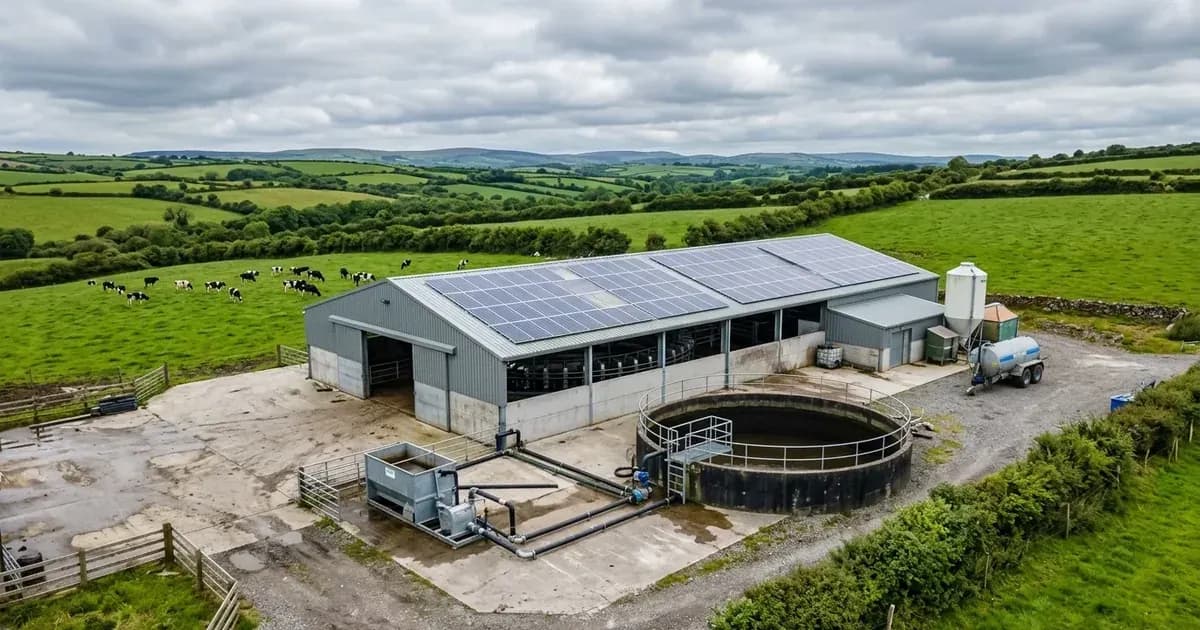
- South-Facing Generation: A south-facing solar PV system with a 20 pitch will generate the most electricity, producing up to 1,000 kWh per kWp of panels annually. This configuration maximises total energy volume but generates the majority of its yield when parlour demand is low.
- East-West Splitting: Splitting the array across east- and west-facing shed roofs reduces overall generation by about 10% (producing around 850 kWh per kWp annually). However, it shifts electricity production closer to the farm's peak demand times, improving self-consumption efficiency. The eastern panels ramp early to support morning milk cooling, while western panels sustain evening parlour wash-down cycles.
Milk Cooling Technologies and Thermal Load Diversion
Milk cooling constitutes roughly 30% of total electrical consumption on pasture-based dairy farms. Teagasc evaluates cooling strategies based on capital expenditure and thermal efficiency:
- Plate Coolers and Direct Expansion: While some dairy farms use ice storage systems for milk cooling, the most common method is using plate coolers and Direct Expansion bulk tank cooling systems. These systems are preferred because they efficiently cool milk without the high initial costs and complexity associated with ice storage systems.
- Water Heating Diversion: Farm water heaters require substantial energy to maintain wash temperatures. Farms that can divert excess solar energy to a hot water heater or an ice bank may need less battery storage, converting surplus midday solar directly into stored thermal energy.
- Continuous Load Integration: Unlike batch milking parlours, automated milking systems operate continuously, spreading electricity demand throughout the day. This consistent energy demand aligns well with solar PV generation, which typically peaks during daylight hours, allowing farms to maximise the self-consumption of solar energy.
Battery Storage Benchmarks and Cycling Performance
Where electrochemical storage is installed to support parlour startups or slurry aeration base loads, Teagasc recommends clear sizing ratios:
Operational Metric | Technical Specification Benchmark | Dairy Farm Implementation Note |
|---|---|---|
Recommended Battery Sizing | 0.5 kWh per 1 kWp of solar PV panels | Balances capital payback with daily self-consumption capture |
Operating Cycle Life | 10,000 cycles (approx. 14-year lifespan) | Based on cycling twice per day across morning and evening sessions |
Usable Depth of Discharge (DoD) | Up to 90% discharge | Enables 90% usable output from nominal pack capacity |
Round Trip Efficiency (RTE) | 80% to 90% | Efficiency of combined charge and discharge power conversion |
Frequently asked questions
When do peak electricity demand spikes occur on Irish dairy farms?
On a typical dairy farm, peak electricity usage occurs during morning milking from 6:00 to 8:00 am and evening milking from 3:00 to 6:00 pm.
What generation difference exists between south-facing and east-west farm solar?
A south-facing 20-degree pitched array generates up to 1,000 kWh per kWp annually, while an east-west split yields around 850 kWh per kWp but aligns better with milking demand.
What milk cooling technology is recommended alongside solar PV?
Teagasc research identifies plate coolers combined with Direct Expansion bulk tanks as the preferred, cost-effective cooling method compared to complex ice banks.
How should battery storage be sized on a dairy farm?
A general Teagasc recommendation is to size battery storage at 0.5 kWh per 1 kWp of solar panels, with batteries typically rated for 10,000 cycles and up to 90% depth of discharge.
References
- Teagasc Solar Energy Guide for Dairy Farms — accessed 28 August 2026
Related guides
More from schemes, subsidies & financing.