Knox Krypton 9055 6.5 kW Hybrid Solar Inverter (PV9055)
Rs 165,000–185,000 verified 2 Aug 2026 — the spread is real, not an estimate; see the table below for what sits at each end
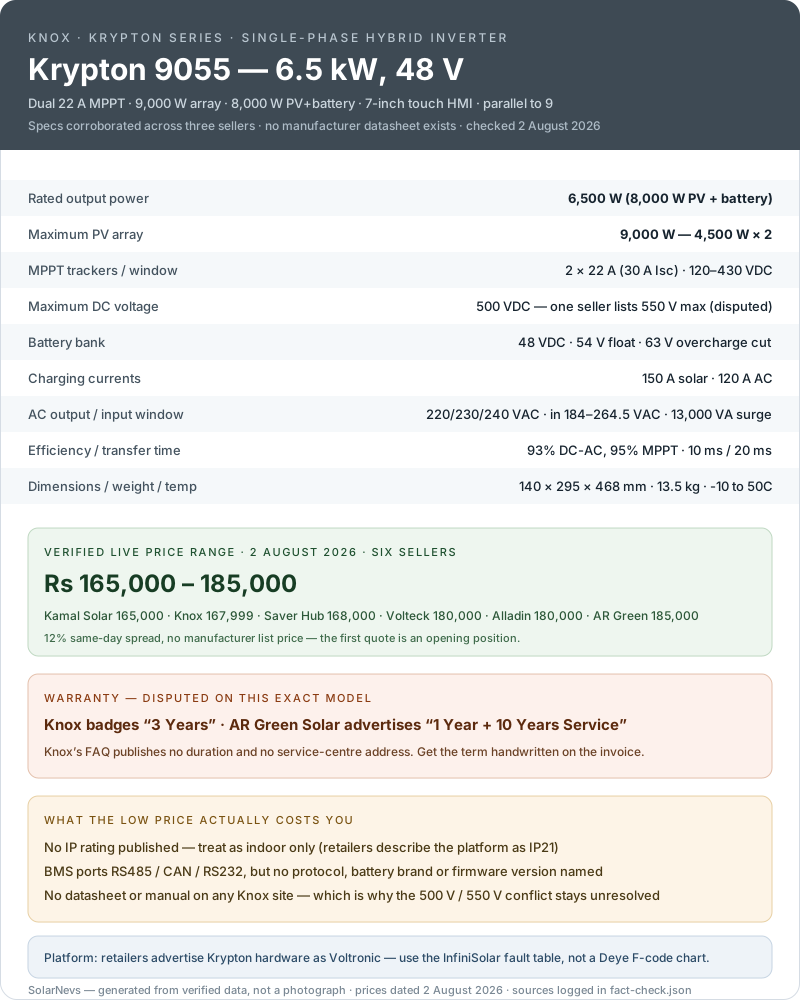
Specifications
| type | Single-phase hybrid, on-grid with energy storage, batteryless operation supported |
|---|---|
| modelCode | 6.5kW-48-PV9055-TWIN (retailer spec table) |
| ratedOutputPowerW | 6500 |
| combinedPVPlusBatteryOutputW | 8000 |
| maxPVInputPowerW | 9,000 (4,500 x 2) |
| mpptTrackers | 2 (dual), 22 A each, 30 A Isc each |
| mpptVoltageRangeVDC | 120-430 |
| maxDCVoltageVDC | 500 on Knox's own page; one retailer lists 500 nominal / 550 max - unresolved |
| batteryVoltageVDC | 48 nominal, 54 float, 63 overcharge protection |
| maxSolarChargingCurrentA | 150 |
| maxACChargingCurrentA | 120 |
| surgePowerVA | 13000 |
| acOutputVoltage | 220 / 230 / 240 VAC selectable |
| acInputWindowVAC | 184-264.5 / 195.5-253 |
| transferTimeMs | 10 (PCs) / 20 (appliances) |
| efficiency | 93% DC-AC, 95% MPPT |
| parallelUnits | 9 |
| display | 7-inch touch HMI |
| communication | Built-in WiFi, USB, RS232, RS485, dry contact; BMS ports RS485 / CAN / RS232 |
| bmsProtocolList | None published by Knox - no battery brand or protocol version named anywhere |
| dimensionsMm | 140 x 295 x 468 (D x W x H) |
| weightKg | 13.5 |
| operatingTemperatureC | -10 to 50 |
| humidity | 0-90% RH non-condensing |
| ipRating | Not published by Knox or any retailer opened 2 August 2026 |
| certificationsQuotedByRetailer | IEC 62109-1/-2, IEC 61683, LVD 2014/35/EU |
| Warranty | Advertised three ways at once. Knox's own product page badges 3 Years Warranty. AR Green Solar advertises 1 Year Complete plus 10 Years Service Warranty on the identical model - a one-year parts term with a paid-service promise, not a ten-year warranty. Knox's FAQ publishes no duration for any product and gives no service-centre address; claims require the invoice and serial number and are handled per unstated manufacturer guidelines. Whatever a seller says, get the term, the covered parts and the physical claim address written on the invoice. |
| Monitoring app | Built-in WiFi with Android and iOS apps. Knox names no app on its own product page. Retail listings for sibling Krypton models identify it as SmartESS, the Voltronic-platform monitoring app. Have the dealer log in on the actual unit before you pay. |
The Knox Krypton 9055 is Knox's flagship single-phase hybrid: 6.5 kW rated output, 8,000 W combined PV-plus-battery output, dual 22 A MPPT trackers carrying 9,000 W of array, a 7-inch touch HMI and parallel stacking to nine units. It sells in Pakistan for Rs 165,000 to Rs 185,000 (verified 2 August 2026) across six live listings - a 12% same-day spread on an identical SKU.
On specification per rupee it is genuinely strong. The catch is not in the box: no IP rating is published for it, no datasheet or manual exists, no BMS protocol list names a single battery, and its warranty is advertised as both "3 Years" (by Knox) and "1 Year Complete + 10 Years Service" (by AR Green Solar) in the same week. That is what the low price actually costs you, and it is all recoverable at the counter if you know to ask.

Specifications
Specification | Value |
|---|---|
Type | Single-phase hybrid, on-grid with storage; batteryless operation supported |
Model code (retailer spec table) | 6.5kW-48-PV9055-TWIN |
Rated output power | 6,500 W |
Combined PV + battery output | 8,000 W |
Maximum PV input power | 9,000 W (4,500 W x 2) |
MPPT trackers | 2 x 22 A (30 A Isc each) |
MPPT voltage range | 120-430 VDC |
Maximum DC voltage | 500 VDC (Knox); one retailer lists 500 V nominal / 550 V max - unresolved |
Battery voltage | 48 VDC nominal, 54 VDC float, 63 VDC overcharge protection |
Maximum solar charging current | 150 A |
Maximum AC charging current | 120 A |
Surge power | 13,000 VA |
AC output | 220 / 230 / 240 VAC selectable, pure sine wave |
AC input window | 184-264.5 VAC / 195.5-253 VAC |
Transfer time | 10 ms (PCs) / 20 ms (appliances) |
Efficiency | 93% DC-AC, 95% MPPT |
Parallel capability | Up to 9 units |
Display | 7-inch touch HMI |
Communication | Built-in WiFi, USB, RS232, RS485, dry contact; BMS ports RS485 / CAN / RS232 |
Published BMS protocol list | None |
Dimensions / weight | 140 x 295 x 468 mm / 13.5 kg |
Operating temperature / humidity | -10 to 50 C / 0-90% RH non-condensing |
IP ingress rating | Not published |
Certifications (retailer-quoted) | IEC 62109-1/-2, IEC 61683, LVD 2014/35/EU |
Warranty | Disputed: 3 years (Knox) vs 1 year + 10 years service (AR Green Solar) |
Charging currents, surge, efficiency and certification rows come from Kamal Solar's spec table; power, MPPT, battery, display and communication rows are corroborated by Knox's own product page. The one figure no two sources agree on is the DC ceiling: Knox states 500 VDC, AR Green Solar states 500 V nominal / 550 V maximum, and Kamal Solar publishes no ceiling at all - only the 120-430 VDC operating window. All three positions are printed rather than averaged.
Honest assessment
What holds up. The power section is not a budget compromise. Two independent 22 A trackers across 9,000 W of array is a genuinely useful feature on a Pakistani roof, where east-west or shaded-string layouts are common and a single-MPPT unit forces everything onto one orientation. The 150 A solar charging current, 120 A AC charging and 13,000 VA surge are comfortable for a 6.5 kW class unit; 8,000 W combined PV-plus-battery output means the inverter can pull from both sources at once rather than capping at nameplate. The -10 C bottom of the temperature band covers northern winters, and nine-unit parallel stacking gives a real expansion path. Two independent retailers publish substantially the same spec table, so these numbers are corroborated, not copy-pasted from one listing.
What does not. The paperwork. There is no Knox datasheet PDF and no user manual for this model anywhere on Knox's three websites - a buyer is reading retailer copy, which is exactly how the 500 V / 550 V DC conflict survives unresolved. No IP rating is published, so a legally meaningful ingress claim does not exist for a unit that many Pakistani installs mount in a semi-open utility space. The BMS ports are listed as RS485 / CAN / RS232 but no protocol, battery brand or firmware version is named, which makes "supports lithium" an unverifiable phrase. And the warranty is advertised two contradictory ways by the brand and its own resellers, with Knox's FAQ declining to publish a duration at all.
Owner feedback: effectively none, and SolarNevs will not invent sentiment. Knox's own product page shows a 5.00 rating badge on a store the brand controls; no independent model-specific owner reviews were retrievable on 2 August 2026, and the Daraz listing for a sibling Krypton model carries "No Ratings". A five-star badge on the seller's own storefront is not owner feedback.
Who should buy. Someone with a dual-orientation roof and a trusted local installer, buying in person, who will photograph the rating plate, get the warranty handwritten on the invoice, and set battery parameters manually. Who should not. Anyone mounting outdoors or in a damp utility space without a published IP rating, anyone specifying closed-loop lithium against a named protocol, anyone buying online sight-unseen, and anyone whose decision rests on a warranty term - because the term is disputed.
Pakistan reality check
The platform is the good news. Retail evidence consistently places the Krypton hybrids on Voltronic Power's InfiniSolar architecture - the sibling Krypton 8000 is sold as "Pure Voltronic" with SmartESS monitoring and an IP21 body, the Krypton 5600 as "Infini V4", and this model's own retailer code reads PV9055-TWIN, matching InfiniSolar TWIN naming. The practical benefit is repairability: an independent Pakistani repair trade already works on these boards, and the fault table on the screen is the InfiniSolar table, not a Deye F-code chart. If your screen shows a bare two-digit code and someone hands you an F-prefixed chart, they are diagnosing the wrong inverter - see the Knox error-code guide.
No IP rating means indoors. Knox reserves its IP66 badges for the Xenon and Zynex lines; nothing in the Krypton range carries a published ingress rating, and retailers describe the platform as IP21. In practice that is a fan-cooled, dust-vulnerable box: over-temperature and locked-fan faults are the classic second-summer failures on this platform in Punjab and Sindh. Mount it shaded and indoors, leave clearance above and below, keep it off the wall shared with the battery bank, and blow the intakes out with dry compressed air before each summer.
Grid behaviour. The 184-264.5 VAC input window and 195.5-253 VAC nominal band sit inside Pakistan's grid code allowance of plus or minus 5% normally and plus or minus 10% under contingency, so a legally high 253 V evening feeder should not trip this unit. Output voltage faults on this platform are documented against a 190-260 VAC window, which is the number to check against your own feeder readings before blaming the inverter.
Cold mornings, not hot afternoons, break strings. The MPPT window is 120-430 VDC against a 500 V DC ceiling. Panel open-circuit voltage rises as cell temperature falls, so a string sized against a 42 C June reading can climb past the ceiling at 7am on a clear January morning. Size the string to winter Voc, not summer operating voltage.
Warranty and service - the part to negotiate. Knox publishes no warranty duration and no service-centre address. Its Pakistani storefront lists one Lahore office (69 Gulshan Block, Allama Iqbal Town), one mobile number and one email; its FAQ says only that "warranty details vary by product model" and that claims need "your invoice and product serial number". Two resellers advertise 1 year complete plus 10 years service on this exact model while Knox's own page badges 3 years. Before you pay, make the seller write on the invoice: the model code from the rating plate, the serial number, the warranty duration in years, what "service warranty" covers if that phrase is used, and the street address a faulty unit physically goes to.
Verify the app on the unit, not in the listing. Knox names no monitoring app on this product page - only "Built-in WiFi" and Android/iOS support. Sibling Krypton listings name SmartESS. Ask the dealer to connect and log in on the actual unit in front of you; a WiFi badge is not a working cloud account.
Price context vs rivals (August 2026)
Same store, same day - Volteck, 2 August 2026:
6 kW-class single-phase hybrid | Price (2 Aug 2026) | What it publishes that Knox does not |
|---|---|---|
SolarMax Orion 6 kW | Rs 135,000 | |
Itel 6 kW Pro IP54 | Rs 142,000 | Published IP54 ingress rating |
Inverex Veyron II Premium 4.2 kW | Rs 155,000 | Manufacturer datasheet and service network |
Knox Krypton 9000 6.2 kW | Rs 160,000 | (same brand, single MPPT) |
Knox Krypton 9055 6.5 kW | Rs 180,000 | |
GoodWe 6 kW LCD | Rs 225,000 | Datasheet, IP rating, BMS compatibility list |
SolarMax Onyx 6 kW IP65 | Rs 225,000 | Published IP65 |
Solis 6 kW IP66 | Rs 240,000 | Datasheet, IP66, documented battery compatibility |
At Volteck's Rs 180,000 the 9055 is mid-shelf, not bottom - a useful correction to the assumption that Knox is automatically the cheap option. The Rs 60,000 step up to a Solis 6 kW buys a manufacturer datasheet, a named IP66 rating and a documented battery compatibility list. The Rs 38,000 step down to the Itel IP54 buys an ingress rating Knox does not print. Buy the 9055 at the Rs 165,000-168,000 end of its own range, where the specification-per-rupee argument is strongest, and spend the saving on getting the warranty in writing.
Related
- Knox brand hub - the three-website corporate picture, the full lineup and the warranty conflict
- Knox Krypton Eco 4000 - the Rs 73,000 entry unit and what its nameplate does not tell you
- Knox inverter error codes - the InfiniSolar fault table that applies to this screen
- Ziewnic inverters - the local-brand comparison with 18 published service centres
Frequently asked questions
What is the price of the Knox Krypton 9055 in Pakistan?
Rs 165,000 to Rs 185,000, verified across six live listings on 2 August 2026 - Rs 165,000 at Kamal Solar, Rs 167,999 on Knox's own store, Rs 168,000 at The Saver Hub, Rs 180,000 at Volteck and Alladin, Rs 185,000 at AR Green Solar. That is a 12% same-day spread on an identical SKU, and Knox publishes no list price, so the first quote is an opening position.
How much warranty does the Krypton 9055 actually carry?
Unresolved, and it is the single most important thing to settle before paying. Knox's own product page badges 3 Years Warranty; AR Green Solar advertises 1 Year Complete plus 10 Years Service Warranty on the same model. Knox's FAQ publishes no durations at all and names no service centre. SolarNevs will not adjudicate between them - insist the number, the covered parts and the claim address are handwritten on your invoice.
Is the Krypton 9055 weatherproof? Can I mount it outside?
No IP rating is published for the Krypton 9055 by Knox or by any retailer SolarNevs opened on 2 August 2026. Knox badges IP66 only on its Xenon and Zynex lines, and retailers describe the Krypton platform as IP21 - indoor, drip-protected. Treat it as an indoor unit: shaded, ventilated, with clearance, away from the battery bank.
Does the Krypton 9055 support closed-loop lithium batteries?
It has the ports - Knox lists BMS communication as RS485 / CAN / RS232 - but Knox publishes no protocol list and names no battery brand or firmware version anywhere. Assume open-loop voltage-based charging with manually set parameters until the dealer demonstrates a live BMS handshake on the actual unit and battery, and get the battery brand plus protocol setting written on the invoice.
How much solar can the Krypton 9055 take?
9,000 W of array across two independent MPPT trackers, 4,500 W each, at 22 A per tracker (30 A Isc) with a 120-430 VDC MPPT window. Knox's page gives 500 VDC as the DC maximum; one retailer lists 500 V nominal and 550 V maximum, which is unresolved - design your string open-circuit voltage to 500 V absolute and keep the operating window inside 120-430 V. Remember that panel Voc rises on cold mornings, which is how PV over-voltage faults appear in January, not July.
Krypton 9055 or Krypton 9000 - what is the difference?
About Rs 20,000 buys a second MPPT tracker and a touchscreen. The 9000 is 6.2 kW with a single high-current MPPT at Rs 145,000-160,000; the 9055 is 6.5 kW with dual 22 A trackers, a 7-inch touch HMI and 13,000 VA surge at Rs 165,000-185,000. If your roof needs two differently-oriented strings, the 9055 is the one that earns the difference. If it does not, it does not.
References
- KNOX Pakistan - Krypton 9055 product page (price, specs, 3-year badge) — accessed 2 Aug 2026
- Kamal Solar - Krypton 6.5kW PV9055 (full spec table, model code, certifications) — accessed 2 Aug 2026
- AR Green Solar - Krypton 6.5kW PV9055 (price and conflicting warranty) — accessed 2 Aug 2026
- The Saver Hub - Krypton 9055 — accessed 2 Aug 2026
- Volteck - Knox price list (9055 Rs 180,000) — accessed 2 Aug 2026
- Volteck - all-brand inverter shelf (rival prices, same store) — accessed 2 Aug 2026
- Alladin Store - Knox inverters collection (9055 Rs 180,000) — accessed 2 Aug 2026
- KNOX Pakistan - FAQs (warranty wording, no durations, no service centres) — accessed 2 Aug 2026
- KNOX Pakistan - Contact Us (single Lahore address) — accessed 2 Aug 2026
- Burn Cart - Krypton 8000 sold as Pure Voltronic with SmartESS and IP21 — accessed 2 Aug 2026
- KNOX Pakistan - Krypton 9000 product page (sibling model comparison) — accessed 2 Aug 2026