Maxpower Suntronic PV6000 Pro Hybrid Inverter
Rs 120,000–125,000 verified 2 Aug 2026 — the spread is real, not an estimate; see the table below for what sits at each end
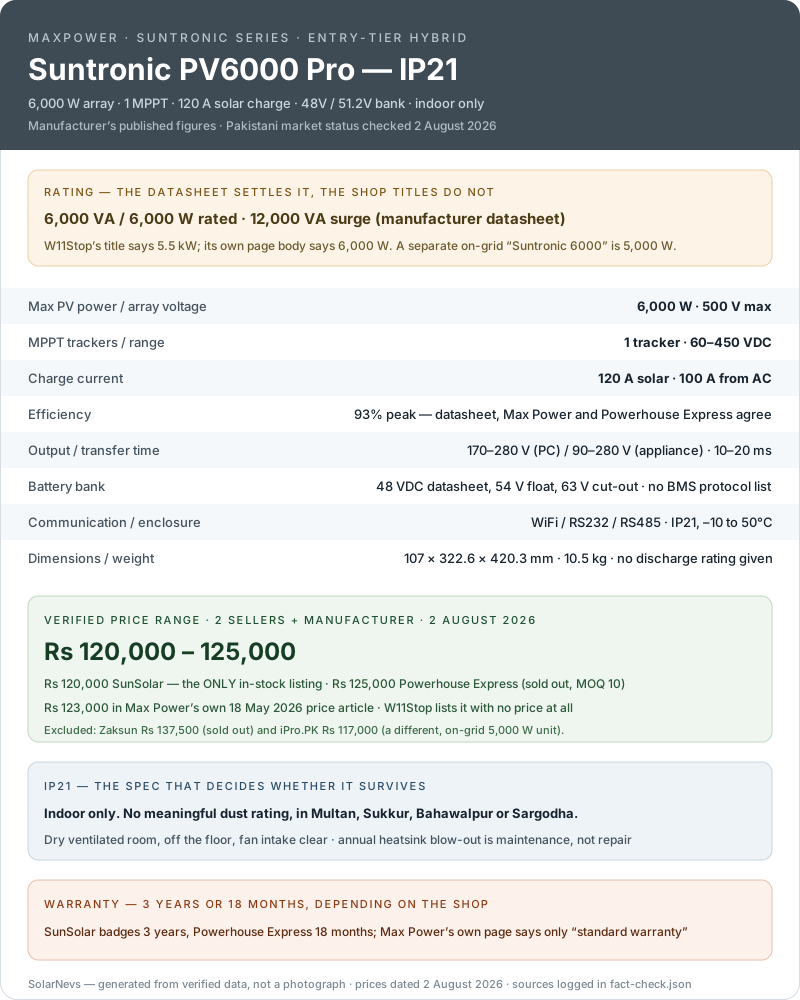
Specifications
| ratedOutput | 6,000 VA / 6,000 W on the manufacturer datasheet; W11Stop's product title says 5.5 kW while its own page body says 6,000 W |
|---|---|
| surgePower | 12,000 VA (datasheet) |
| maxPvInput | 6,000 W; max PV array open-circuit voltage 500 VDC; max PV input current 27 A |
| mppt | 1 tracker, 60-450 VDC MPPT range |
| acInput | 230 Vac nominal; selectable input range 170-280 Vac (PC mode) or 90-280 Vac (appliance mode), 50/60 Hz auto-sensing |
| chargeCurrent | 120 A solar / 100 A AC; 120 A maximum combined |
| efficiency | 93% peak (manufacturer datasheet, Max Power's own page and Powerhouse Express all agree) |
| transferTime | 10 ms (PC mode) / 20 ms (appliance mode) |
| battery | 48 VDC on the datasheet - float 54 VDC, overcharge protection 63 VDC; retailers advertise 48 V / 51.2 V lithium or lead-acid |
| dimensionsWeight | 107 D x 322.6 W x 420.3 H mm; 10.5 kg |
| comms | WiFi / RS232 / RS485 interface |
| ingressProtection | IP21 - indoor only (stated by Max Power and W11Stop; the datasheet gives no IP rating) |
| operatingRange | -10 to 50 C operating, -15 to 60 C storage, 5-95% RH non-condensing |
| Warranty | Max Power's own page promises only a "standard warranty" with WhatsApp support and local service in Lahore - no duration anywhere, and unlike the Voltas datasheet the Suntronic datasheet has no warranty row either. SunSolar badges 3 years; Powerhouse Express badges 18 months. On SunSolar's own shelf the sibling PV Tech 6000 is also 3 years while the Sunglow 3000 is 18 months, so the term appears to travel with the retailer rather than the product. Get the number written on the invoice. |
| Monitoring app | Max Power lists a WiFi/RS232/RS485 interface and retailers advertise WiFi/App monitoring, but nobody names the app or the cloud platform. Ask the dealer to register the dongle and show you live data before you pay. |
The Maxpower Suntronic PV6000 Pro is the entry-tier hybrid inverter in Maxpower's range: one MPPT, 6,000 W of array, an IP21 indoor enclosure, 120 A of solar charging into a 48 V bank and a 93% peak efficiency figure that Max Power, Powerhouse Express and the manufacturer datasheet all agree on. As of 2 August 2026 it lists at Rs 120,000 to Rs 125,000, though only one of those listings - SunSolar at Rs 120,000 - is actually in stock today.
The rating looks contested until you find the datasheet. Max Power's own page says 6,000 W; W11Stop titles the identical product "Suntronic 5.5kW PV6000" while its own page body says 6,000 W. The one-page manufacturer datasheet - which Max Power does not publish but W11Stop hosts as a PDF - settles it: RATED POWER 6000VA/6000W, with a 12,000 VA surge, 10.5 kg and 107 x 322.6 x 420.3 mm. Two cautions survive that. "PV6000" is still an array-size designator Maxpower shares with a 4 kW Knox and a 6 kW Solar Max, so it tells you nothing on another badge. And Max Power sells a separate on-grid "Suntronic 6000" - 5,000 W rated, 12 kg, 140 x 295 x 468 mm - which at least one Pakistani shop lists under a nearly identical name at a nearly identical price. Make the invoice say PV6000 Pro hybrid.
Specifications
Spec | Value |
|---|---|
Rated power | 6,000 VA / 6,000 W (manufacturer datasheet); W11Stop's title says 5.5 kW, its page body says 6,000 W |
Surge power | 12,000 VA |
Max PV array power / open-circuit voltage | 6,000 W / 500 VDC; max PV input current 27 A |
MPPT | 1 tracker, 60-450 VDC |
Input voltage | 230 Vac nominal; selectable 170-280 Vac (PC mode) or 90-280 Vac (appliance mode), 50/60 Hz auto-sensing |
Output | 230 Vac +/-5% in battery mode, pure sine wave |
Transfer time | 10 ms (PC mode) / 20 ms (appliance mode) |
Battery bank | 48 VDC on the datasheet - float 54 VDC, overcharge protection 63 VDC; retailers advertise 48 V / 51.2 V, lithium or lead-acid |
Solar charge current | 120 A |
AC charge current | 100 A (120 A maximum combined) |
Efficiency (peak) | 93% - datasheet, Max Power's own page and Powerhouse Express agree |
Communication | WiFi / RS232 / RS485 |
Operating / storage temperature | -10 to 50 C operating; -15 to 60 C storage; 5-95% RH non-condensing |
Dimensions / weight | 107 D x 322.6 W x 420.3 H mm / 10.5 kg |
Enclosure | IP21 - indoor only (Max Power and W11Stop; the datasheet states no IP rating) |
Warranty as advertised | 3 years (SunSolar) vs 18 months (Powerhouse Express); no term on Max Power's page and no warranty row on the datasheet |
Published documentation | One-page manufacturer datasheet PDF - hosted by the retailer W11Stop, not by Max Power. No user manual, no fault-code table, no BMS protocol list |
The datasheet is one page, and the gaps in it are as informative as the entries. There is no discharge-current figure - only a combined 120 A charge maximum - no BMS communication row, no efficiency curve, no IP rating and no warranty term. Max Power's own product page publishes none of it: the "Technical Specifications" tab there is a JPEG image uploaded in July 2024.
Honest assessment
Pros. It is cheap, widely listed and it does the entry-tier job: 120 A of solar charge current is generous for the money and will refill a 5 kWh lithium bank from a decent array inside a working day, the 10-20 ms transfer time is quick enough that computers and fans do not notice a grid drop, and the 60-450 VDC MPPT window accepts sensible string lengths of modern 585-600 W panels. Unlike most badges at this price it comes with Maxpower's published customer-care list - 50 entries across 47 towns with addresses and mobile numbers - so if the board dies in Sahiwal or Nowshera there is a named shop to take it to.
Cons. 93% peak efficiency is the headline number and it is below the 96-97% band our own cluster guides assign to this brand tier, and far below the Voltas line's 97.90% - at 6 kW that is roughly 240 W of extra heat you paid for. IP21 means indoor-only in a country where the dust is the failure mode. There is one MPPT, so a split-orientation roof loses yield. The only document that exists is a single datasheet page that Max Power does not host itself - there is no user manual, no fault-code table, no BMS protocol list, no efficiency curve and no named monitoring app. Retailers cannot even agree on the nameplate: W11Stop's title says 5.5 kW while its own body copy says 6,000 W. And the warranty is 3 years or 18 months depending on which shop you walk into.
Who should buy. Buyers replacing a dead Axpert-class box on a single-orientation roof, with an indoor, dust-controlled mounting position, a modest lead-acid or lithium bank, and a hard budget under Rs 130,000 - who value a repair shop in their own town over documentation. Anyone planning a lithium bank they intend to cycle daily, a split-orientation array, or an outdoor mount should skip this tier and price the Voltas 6K-H4 or the IP66 Voltas H6, and anyone who wants a downloadable datasheet should look at Solis instead.
Pakistan reality check
Only one seller can actually sell it today. Three independent sources quote a price on 2 August 2026 - SunSolar Rs 120,000, Powerhouse Express Rs 125,000 and Max Power's own dated article Rs 123,000 - and they agree within Rs 5,000, which is a genuine market consensus. What they do not agree on is availability: only SunSolar shows the unit in stock. Powerhouse Express is sold out and carries a 10-unit minimum order, and Zaksun's Rs 137,500 listing (excluded from our range) is sold out behind a currency-devaluation disclaimer. W11Stop lists the model with no price at all. We also excluded iPro.PK's Rs 117,000: that listing is titled "Suntronic 6000 On-Grid Inverter" and its own spec table gives 5,000 W rated, 12 kg and 140 x 295 x 468 mm against this model's 6,000 W, 10.5 kg and 107 x 322.6 x 420.3 mm - it is Max Power's separate on-grid unit, which Powerhouse Express also stocks as its own SKU. If a dealer quotes you materially above Rs 125,000 for a PV6000 Pro, the number is not the market.
IP21 is the specification that will decide whether it survives. Dripping-water protection and no meaningful dust rating, in Multan, Sukkur, Bahawalpur or Sargodha, means a sealed indoor room, off the floor, out of the direct dust path, with the fan intake clear - and an annual heatsink blow-out as routine maintenance, not a repair. This is the same constraint that governs the whole entry tier: the Rs 90,000-100,000 step up to the IP65/IP66 Voltas family buys an enclosure, not just watts.
One MPPT is a roof decision, not a spec-sheet detail. With a single tracker, every panel on the array is optimised together, so an east-and-west or shaded-and-unshaded split drags the whole string to the weakest condition. On a single-plane south-facing roof this costs you nothing; on a typical Lahore rooftop with a water tank, a parapet and two orientations it costs real generation every day. The Voltas H4's two trackers exist for exactly this.
Lithium: unproven, not unsupported. Listings say 48V/51.2V lithium and there is an RS485 port, but the datasheet has no BMS row at all - it specifies a plain 48 VDC battery with a 54 V float and a 63 V overcharge cut-out - and no protocol list or compatibility table exists for this model. That means the dealer, not the manufacturer, is your evidence. Demand a live demonstration with your exact battery - including Maxpower's own MP-5000, for which Max Power also publishes no protocol list - and get the comms cable in the box. Running a lithium pack on manual voltage settings is Pakistan's most common route to a dead pack and a refused claim.
The datasheet exists - the manufacturer just does not publish it. The "Technical Specifications" tab on Max Power's own PV6000 Pro page is a single JPEG uploaded in July 2024. The real one-page manufacturer datasheet is a PDF, and the retailer W11Stop hosts it under the Documents heading on its PV6000 product page - it is page 17 of a Max Power catalogue that Max Power itself does not offer for download. Ask your dealer for that page before you buy, because it is the only place the surge rating, weight and dimensions appear. What it does not contain is a user manual or an error-code list, so a technician diagnosing a fault still has nothing to read the code against. Photograph the fault screen before power-cycling; our Maxpower error-code page is being built from observed codes because no manufacturer fault table has surfaced.
Price context vs rivals (August 2026)
Same store, same day - the entry end of W11Stop's 6 kW hybrid shelf, 2 August 2026, with this model's own live price from SunSolar:
6 kW-class entry hybrid | Price (2 Aug 2026) | IP | Note |
|---|---|---|---|
Stabimatic 6 kW | Rs 108,000 | not stated | W11Stop |
Maxpower PV Tech 9000 6 kW | Rs 116,000 | not stated | Maxpower's own cheaper 6 kW |
Maxpower Suntronic PV6000 Pro | Rs 120,000 | IP21 | SunSolar, in stock, 3 years |
Tesla HLE 6 kW | Rs 125,000 | not stated | W11Stop |
Maxpower Suntronic PV7000 Infini 6 kW | Rs 137,000 | not stated | Powerhouse Express, sold out |
Maxpower Suntronic PV8000 Ultra 6.2 kW | Rs 146,000 | not stated | W11Stop |
Tesla HLE 6 kW IP65 | Rs 185,000 | IP65 | W11Stop |
Rs 190,000 | IP66 | W11Stop |
The honest reading is that this is a commodity. Six 6 kW-class boxes inside Rs 40,000 of each other, most without an IP rating on the listing at all - and Maxpower's own PV Tech 9000 undercuts its own Suntronic by Rs 4,000. In a market this undifferentiated, the tiebreaker is not the spec sheet, it is who will fix it: on that measure Maxpower's 47-town care list is a real, checkable advantage over Knox's single Lahore address, and it is the reason to prefer this box over the Stabimatic beside it.
If your loads or your roof are more demanding than this tier can serve, step up inside the same brand: the Voltas 6K-H4 at Rs 206,000-284,999, or read the full ladder on the Maxpower brand hub.
Frequently asked questions
What does the Maxpower Suntronic PV6000 Pro cost in Pakistan today?
Rs 120,000 to Rs 125,000 as of 2 August 2026, but only one of those listings is actually purchasable - SunSolar at Rs 120,000, in stock. Powerhouse Express shows Rs 125,000 but is sold out with a 10-unit minimum order. Max Power's own May 2026 price article quotes Rs 123,000, inside the range. Zaksun's Rs 137,500 listing is sold out behind a currency-devaluation disclaimer and is excluded as a stale shelf price.
Is the PV6000 Pro actually a 6 kW inverter?
Yes on the manufacturer datasheet, which prints "RATED POWER 6000VA/6000W" and a 12,000 VA surge. The confusion is retail, not electrical - W11Stop's product title calls it a "Suntronic 5.5kW PV6000" while the body of that same W11Stop page says 6,000 W. Note also that Max Power sells a separate on-grid "Suntronic 6000" (5,000 W rated, 12 kg) which some shops list under a near-identical name; check the invoice says PV6000 Pro hybrid.
What is the difference between the Suntronic PV6000 Pro and the Voltas 6K-H4?
Everything except the badge and the kW number. The PV6000 Pro is IP21 indoor-only, one MPPT, 6,000 W of array, 93% claimed efficiency, RS232/RS485/WiFi. The Voltas 6K-H4 is IP65, dual MPPT, 9,000 W of array, 97.90% peak efficiency, 140 A battery charge and discharge, and CAN plus RS485 to the battery BMS. On 2 August 2026 the Voltas costs Rs 206,000-284,999 against this unit's Rs 120,000.
Can I run a lithium battery on it?
Retail listings say it supports 48V/51.2V lithium and lead-acid, and the interface includes RS485. But the datasheet specifies a 48 VDC battery with a 54 V float and 63 V overcharge cut-out and says nothing about a BMS handshake, and Max Power publishes no protocol list or compatibility table for this model. Treat lithium support as unproven until your dealer demonstrates the handshake with your exact battery. A lithium pack left on manual voltage settings is how packs get overcharged and warranty claims get refused.
Where can I safely install an IP21 inverter in Pakistan?
Indoors only, in a dry, ventilated room, off the floor and away from the direct dust path - IP21 offers protection against dripping water and finger-sized objects, essentially nothing against dust. In Multan, Sukkur, Bahawalpur or Sargodha budget an annual blow-out of the heatsink and fan. If you need an outdoor or semi-outdoor mount, the IP66 Voltas H6 6 kW at Rs 210,000-222,000 is the family answer, not this one.
Is it worth Rs 120,000 against a Knox or Tesla at the same money?
On W11Stop's 6 kW shelf on 2 August 2026, a Stabimatic 6 kW is Rs 108,000, Maxpower's own PV Tech 9000 6 kW is Rs 116,000 and a Tesla HLE 6 kW is Rs 125,000 - this unit sits in the middle of a crowded, undifferentiated entry tier. What Maxpower adds over most of them is a published 47-town customer-care list and a one-page datasheet you can actually download from W11Stop; what it still does not add is a user manual, a fault-code table, a BMS protocol list or a named monitoring app.
Is there a datasheet I can download for this inverter?
Yes, but not from Max Power. maxpower.com.pk states the specs in prose and puts the "Technical Specifications" tab up as a JPEG image, with no PDF. The retailer W11Stop hosts the real one-page manufacturer datasheet as a PDF on its PV6000 product page (w11stop.com/files/voltas/maxpower-suntronic-6kw-hybrid-inverter1.pdf, page 17 of a Max Power catalogue), and that is where the 6,000 VA rating, 12,000 VA surge, 10.5 kg weight and 107 x 322.6 x 420.3 mm dimensions come from. It is one page and it contains no fault-code table and no BMS protocol list.
References
- Max Power official - Suntronic PV6000 Pro product page (specs as prose + a JPEG tab; 93% efficiency, IP21, 120 A solar / 100 A AC) — accessed 2 Aug 2026
- Manufacturer datasheet PDF (Suntronic PV 6000 Pro, catalogue page 17) hosted by retailer W11Stop - 6000VA/6000W rated, 12000VA surge, 93% peak, 10.5 kg, 107 x 322.6 x 420.3 mm — accessed 2 Aug 2026
- Max Power official - Suntronic category, 7 models, no prices — accessed 2 Aug 2026
- Max Power official - hybrid inverter price article, 18 May 2026 (PV6000 Pro at Rs 123,000) — accessed 2 Aug 2026
- SunSolar - Suntronic PV6000 Pro Rs 120,000, 3 years, in stock, IP21, 1 MPPT — accessed 2 Aug 2026
- Powerhouse Express - Suntronic PV6000 6kW Pro Rs 125,000, 18-month warranty, sold out, 10-unit minimum — accessed 2 Aug 2026
- iPro.PK - 'Max Power Suntronic 6000 On-Grid Inverter' Rs 117,000, out of stock - EXCLUDED as a different product: 5,000 W rated, 12 kg, 140 x 295 x 468 mm, 96% efficiency, against the PV6000 Pro datas — accessed 2 Aug 2026
- Powerhouse Express - Max Power collection, listing the on-grid 'Suntronic 6000/6000W Pro Single Phase On Grid Solar Inverter' as a separate SKU from the PV6000 Pro hybrid — accessed 2 Aug 2026
- Zaksun - Suntronic PV6000 Pro Rs 137,500, sold out (excluded from range) — accessed 2 Aug 2026
- W11Stop - Suntronic 5.5kW PV6000 product page: no price, titled 5.5 kW — accessed 2 Aug 2026
- W11Stop - Maxpower shelf (PV Tech 9000 6 kW Rs 116,000, Suntronic PV8000 6.2 kW Rs 146,000) — accessed 2 Aug 2026
- W11Stop - full 6 kW shelf search, same store same day rival prices — accessed 2 Aug 2026
- Kamal Solar - Knox 4kW PV6000 (same OEM model designator, different brand and rating) — accessed 2 Aug 2026
- Zaksun - Solar Max ORION-DUAL-PV6000 6kW (same OEM model designator, third brand) — accessed 2 Aug 2026
- Max Power official - contact page (customer-care network) — accessed 2 Aug 2026