Maxpower Lithium BMS Fault and Inverter Comms Fix Guide
Updated 6 September 2026 · By SolarNevs Research Desk, Dealer surveys + verified sources · 5 sources · Method ↗
Key Takeaways
- Max Power warns that running LiFePO4 batteries on lead-acid charge settings causes chronic undercharging or overcharging, and calls it one of the most common causes of premature lithium battery failure in Pakistan.
- Beware of the MP-5000 model variant trap: the MP-5000 Alpha is a 51.2V/100Ah pack (with a 40–58.4V operating range referenced to 25°C), while the MP-5000 PRO is a 25.6V/200Ah pack (24V class, with 28.8V bulk and 27.6V float; setpoints referenced to 25°C, noting that ambient heat derates charging within the 0–55°C operating window).
- Communication faults trace to a wrong protocol selection — a generic-lithium mode instead of the specific BMS protocol — or to the physical layer, where a miswired RJ45, a loose plug, or a cable in the wrong port is the cause field guides report most often.
- Max Power officially recommends pairing MP-series batteries with its Voltas or Sofar hybrid inverter range for optimal closed-loop integration.
Why is my inverter displaying a Maxpower BMS fault or communication error?
A solar inverter connected to a Maxpower LiFePO4 battery (such as the MP-2500, MP-5000 Alpha/PRO, or MP-10000) displays errors such as Deye and Sunsynk's "BMS comm fail", Growatt's "Warning 20", or Solis's "CAN_Comm-Fail" when digital data exchange fails. Because lithium batteries rely on closed-loop Battery Management System (BMS) communication to dynamically command charge current limits and voltage cutoffs, a communication breakdown forces the inverter to suspend charging or shut down AC output.
Max Power's own publications attribute these failures to two causes: a protocol mismatch between battery and inverter (or a lead-acid-only inverter), and running lithium packs on lead-acid charge profiles. Independent inverter-troubleshooting guides add the physical-layer causes seen most often in the field: cable faults, loose plugs, and communication cables plugged into the wrong port.
Step-by-step diagnosis and communication fault resolution
Follow these sequential diagnostic steps to resolve Maxpower BMS communication errors:
- Verify Battery Model and Voltage Architecture:
- Action: Inspect the product rating label on your battery casing.
- The MP-5000 Model Trap: Confirm whether your unit is an MP-5000 Alpha (51.2V nominal, 40–58.4V operating range referenced to 25°C) or an MP-5000 PRO (25.6V nominal, 24V class, bulk 28.8V, float 27.6V, low cutoff 25.6V; all setpoints referenced to 25°C, noting that ambient heat derates charging within the published 0–55°C operating window). Applying 48V class inverter settings to a 24V MP-5000 PRO is the classic wrong-variant error: the assumption, not the hardware, is what produces out-of-range voltage readings and a pairing that never completes. The same split exists one size up — MP-10000 PRO (51.2V/200Ah) versus MP-10000 Alpha (51.2V/205Ah).
- Verify Physical Cable Connections and Ports:
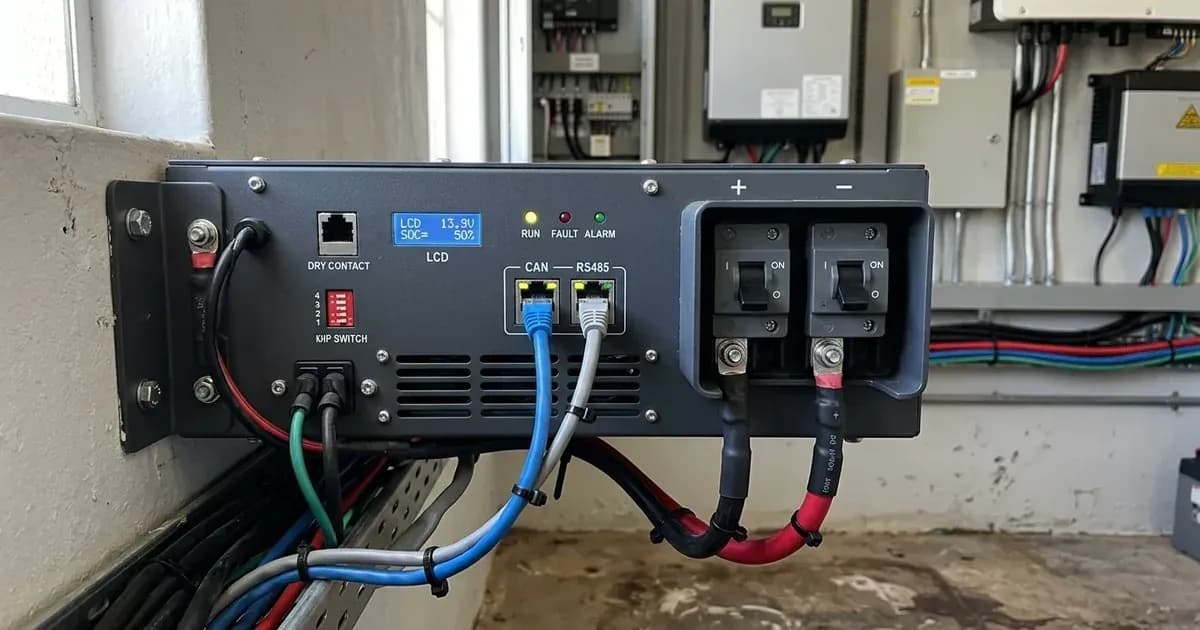
- Action: Ensure the communication cable is plugged into the battery CAN or RS485 master port and routed to the inverter's dedicated battery-comms port. Disconnect battery and inverter power first and use insulated tools when working near terminals to prevent short circuits that discharge hundreds of amperes. A CAN cable sitting in an RS485 socket — or the reverse — is one of the documented causes of a battery that simply never appears.
- Use the boxed cable: No Maxpower pinout is published. The industry convention these 48V packs follow is the Pylontech RJ45 layout — pin 2 GND, pin 4 CAN-H, pin 5 CAN-L, with RS485 multi-group on pins 7 (A) and 8 (B) and nothing else connected. A plain LAN cable is not a substitute; the pin assignments have to line up exactly.
- Multi-Module Installations: In parallel battery stacks, verify that Link-In and Link-Out cables run in the correct daisy-chain order, that no RJ45 pin is bent, and that a 120Ω terminator sits at each end of the CAN bus — no more and no fewer, since a duplicate terminator faults the bus just as a missing one does. DIP switches set the master/slave addresses on rack units.
- Confirm Inverter Protocol Selection:
- Growatt SPF Series: Configure Program 05 to "Li", then set the protocol code — installers use "L52" on CAN (Program 36 on newer firmware) or profile 2 on RS485. On the master unit the RS485 port sits below the CAN port, which is where half of the "wrong port" cases start.
- Voltronic-Family Inverters (Inverex Veyron/Aerox; Maxpower's own Voltas shares this lineage per community reports): Test Program 5 setting "PYL" (Pylontech) or "LIb", which auto-sets programs 02, 26, 27 and 29. In manual voltage mode ("USE"), common practice for a 51.2V class LiFePO4 pack is roughly 56.8–57.6V boost/absorb, 55.2V float or float disabled, and a cutoff no lower than 48V (all referenced to 25°C standard operating temperature). Those are community-reported figures, not Max Power numbers: the only charge voltages the company publishes are the 24V MP-5000 PRO's 28.8V bulk / 27.6V float / 25.6V low (referenced to 25°C, where ambient heat derates charging), and doubling them for the 48V class is arithmetic, not a published spec. Voltronic inverters switch to SOC-based cutoffs in the range 5–95% once lithium is configured.
- Deye Hybrid Inverters: Navigate to Battery Setup, set Mode to "Lithium", then enter the protocol number from Deye's own brand table and set the capacity plus the max charge and discharge currents the BMS allows. CAN runs on pins 4/5. The Pylontech CAN entry is commonly 00, but configuration guidance is explicit that generic codes such as 00 or 12 should never be picked without checking that compatibility table first.
- Dealer Protocol Verification: Max Power does not publish a standalone protocol manual; always obtain the exact protocol ID for your inverter from the authorized dealer in writing.
- Perform a System Cold Restart:
- Action: Turn off the solar inverter, switch off the external DC battery breaker, turn off the battery power switch (using insulated tools and isolating DC power to prevent dead shorts), wait for the inverter display to go fully dark, then bring the battery up first and the inverter second.
- Not a lockout override: A cold restart clears a stale communication link. It does not clear a protection event. The convention repeated across lithium packs of this class is that a standing protection state is the BMS refusing charge or discharge for cause — community-reported, since Max Power documents none of it — so a pack that drops straight back into protection needs diagnosis, not another hard cycle.
Inverter-Specific Maxpower Communication Alarm Table
Max Power publishes no battery-side fault-code list, LED table or alarm manual — not on the official site, not at retailers, not in any datasheet upload we could find. Every code below is therefore an inverter-side message, not the battery's own diagnosis — most are the inverter's word for a battery that has stopped answering; the exceptions are the Voltas/Sofar row's F02 and F03, thermal and charge-parameter faults raised by the hybrid inverter itself.
Inverter Platform (PK) | Displayed Error Message | Likely Root Cause | Exact Remedy |
|---|---|---|---|
Growatt SPF 3500–5000 ES | | Protocol mismatch or wrong RJ45 pins | Set Program 05 to "Li", then the protocol code — "L52" on CAN (Program 36 on newer firmware) or profile 2 on RS485. |
Solis S5/S6 Hybrid | | Profile unset or CAN cable unseated | Select "Pylon"/"PylonLV", after which the voltages lock and are CAN-fed; "User-define" unlocks manual voltages if closed-loop cannot be established. |
Deye SUN-xK hybrids (also Sunsynk) | | CAN cable in wrong port or protocol unset | Battery Setup → Mode "Lithium", then the protocol number from Deye's brand table; CAN uses pins 4/5; Deye guidance says a straight Ethernet cable works for standard Pylontech-pinout packs — but with no Maxpower pinout published, still use the boxed cable. |
Inverex / Knox (Voltronic family) | | Program 5 set to the wrong battery type | Test Program 5 "PYL" or "LIb", or switch to "USE" with manual voltage thresholds. |
Max Power Voltas / Sofar | | Thermal or charge-parameter fault raised by the hybrid inverter, not a battery fault code | Max Power's technical team confirms voltage compatibility and the correct battery profile settings; the company lists no service network beyond its Lahore address. |
One caveat runs through every row of that table. Max Power does not publish which protocol its packs emulate, and no per-model protocol matrix exists for Pakistani pairings. Pylontech-protocol emulation on CAN is what installers here report using — a community-reported inference, not a manufacturer statement — so treat "L52", "Pylon" and the Deye brand-table entry as starting points and confirm the exact code for your inverter with the dealer in writing.
Sizing and Multi-Module Expansion Rules
When designing and commissioning Maxpower lithium battery banks:
- Current Ratings: MP-5000 Alpha modules are rated 50A charge and 100A discharge; MP-10000 PRO modules are rated 100A standard charge, 200A maximum, and 10.24 kW discharge.
- Depth of Discharge (DoD): Max Power quotes its cycle ratings at 80% depth of discharge, and puts that in energy terms for the MP-10000 Alpha: 8 kWh of real backup energy per cycle.
- Parallel Stacking: The MP-5000 Alpha and MP-10000 PRO pages both state support for up to 15 modules in parallel. The MP-10000 Alpha page claims 63 — a printed inconsistency in the manufacturer's own material, not a spec you should design around. Where the published figures disagree, get the number for your exact variant from the dealer, and keep every paralleled unit on the same variant and voltage class.
For broader compatibility troubleshooting, review our guide on lithium battery inverter compatibility errors. If the inverter shuts down without output, consult inverter shows error but no output. Understand internal protection mechanics in our guide on BMS functions and battery protection.
Safety: Working with LiFePO4 Lithium Battery Systems
Observe these mandatory safety protocols during installation and troubleshooting:
- Operating Temperatures: The published windows are 0–55°C for charging and −30–60°C for discharging (PRO pages). In Pakistan the binding constraint is the 55°C top end: a closed, unventilated room derates charging long before the cold end of the range ever matters.
- Indoor IP20 Installation: Maxpower MP-series modules carry an IP20 rating; install indoors in shaded, dry, well-ventilated areas away from direct sunlight.
- High-Current DC Isolation: A 200A-class DC circuit at MP-10000 size demands correct cable gauge, properly torqued lugs, and a dedicated DC breaker between the pack and the inverter. Always kill power before tightening or disconnecting terminals and use insulated tools; a spanner across battery terminals shorts hundreds of amperes.
- Never Override a Protection State: Do not try to force a locked-out pack back into service by repeatedly hard-cycling it. The convention installers repeat for packs of this class — community-reported, because Max Power documents no protection behaviour of its own — is that a protection state is the BMS refusing charge or discharge for cause, and that cause does not go away because the pack was power-cycled.
- Do Not Open the Enclosure: Maxpower battery modules contain no user-serviceable components. Two absences make DIY intervention worse than usual here: Max Power publishes no written warranty terms on maxpower.com.pk, so nothing in print tells you where opening the case leaves a claim, and the cell maker and assembly location are undisclosed, so there is no cell datasheet to work from either.
When to call a technician instead
Contact a certified solar technician, or Max Power's technical team at its Lahore address, under the following conditions:
- The pack trips back into protection every time and will not stay online after one full, correctly sequenced restart.
- Pack terminal voltage sits below the operating floor of the MP-5000 Alpha's published 40–58.4V range (referenced to 25°C).
- Physical swelling, abnormal heat, or burnt terminal smell is detected.
- Warranty processing: Maxpower is a brand of Maxell Power (Pvt) Ltd, 203 D-II Gulshan Ravi, Lahore. The 5 years warranty is dealer-quoted — no written warranty terms are published on maxpower.com.pk, and no service-centre network beyond that Lahore address is listed, so get the term, its conditions and the claim route from your dealer in writing at the time of purchase.
For professional maintenance standards, consult our guide on when to call a solar technician and our diagnostic guide on solar battery not charging.
Figures as of August 2026.
Still showing the fault? Book a technician
If the steps above did not clear it, tell us the inverter or battery and the exact code. We pass it to a technician who covers your city; visit charges are quoted before they come.
How this pays for the site: the technician or verifier pays SolarNevs a fixed introduction fee. Nobody pays to be recommended, and you are free to use our free guides instead.
Frequently asked questions
What causes a BMS fault or communication error on a Maxpower lithium battery?
Max Power's official technical releases attribute communication failures to mismatched communication protocols or an inverter configured only for lead-acid charging. Independent troubleshooting guides add physical cable faults — miswired RJ45 cables, loose plugs, or cables in the wrong port — as the most common field causes.
What happens if a Maxpower lithium battery is charged on lead-acid settings?
Max Power warns that running LiFePO4 batteries on lead-acid charging curves causes chronic undercharging or overcharging, and calls this one of the most common causes of premature lithium battery failure in Pakistan.
How do I fix BMS communication loss between Maxpower batteries and Growatt inverters?
Use the cable supplied with the battery, plug it into the CAN port, and set Growatt Program 05 to 'Li'. Installers then select the Pylontech protocol — 'L52' on CAN (Program 36 on newer firmware), or profile 2 on RS485. Max Power does not publish which protocol its packs emulate, so treat that setting as reported installer practice and get the correct code for your inverter from the dealer in writing.
Why is my Maxpower MP-5000 battery showing 25.6V instead of 51.2V?
Maxpower sells electrically distinct variants under the MP-5000 name: the MP-5000 Alpha is a 51.2V/100Ah battery (with a 40–58.4V operating range referenced to 25°C), whereas the MP-5000 PRO is a 25.6V/200Ah battery (24V class, with 28.8V bulk and 27.6V float; setpoints referenced to 25°C, where high ambient heat derates charging within its published 0–55°C window). Verify your model nameplate before configuring inverter voltages.
Can I clear a Maxpower BMS protection lockout by power-cycling the battery?
A full system restart — inverter off, DC battery breaker open, battery rocker off, then back on in reverse order — is a fair step for a stale communication link. It is not a lockout override. The convention installers repeat for these packs is that a standing protection state is the BMS refusing charge or discharge for cause, so if the pack drops straight back into protection, have the fault diagnosed rather than hard-cycling it again.
References
- Max Power Official MP Series Lithium Catalogue 2026 — accessed 23 August 2026
- Max Power Top 7 Mistakes Buying Lithium Batteries — accessed 23 August 2026
- Max Power Common Hybrid Inverter Problems Guide — accessed 23 August 2026
- Max Power MP-5000 PRO Product Page — accessed 23 August 2026
- Max Power MP-5000 Alpha Product Page — accessed 23 August 2026
Related guides
More from inverter errors & fixes.