Grey-Import Solar Panels in Saudi Arabia: How to Check What You Are Buying
Updated 15 September 2026 · By SolarNevs Research Desk, Dealer surveys + verified sources · 6 sources · Method ↗
Also available in العربية
Key Takeaways
- A grey import is usually genuine hardware sold outside the official channel. It can pass every physical inspection and still fall outside the manufacturer's warranty.
- Wattage does not identify a module. LONGi's own Hi-MO 9 page spans 635W to 660W, and other current series overlap that band with different cell technology — so "650W" names a rating, not a product.
- The formal Saudi control is SASO's SALEEM/SABER conformity regime. Ask which conformity documentation covers your specific consignment, before delivery.
- The manufacturer's own serial-verification tool is the check that matters, reached by typing the manufacturer's domain yourself.
What is actually being sold when a panel is "grey"?
Three different things get lumped together under one word, and the buyer's exposure is different in each case:
Module Category | Physical Authenticity | Warranty & Operational Risk | Primary Verification Method |
|---|---|---|---|
Genuine, Undocumented Stock | Factory genuine, physically identical | Manufacturer warranty declined due to unofficial sales channel | Channel confirmation in writing from supplier |
Off-Specification / B-Grade | Genuine factory laminate with defects/derating | Reduced output, cell defects, void/limited warranty | Flash-test data & physical visual inspection |
Counterfeit Hardware | Fake module with fraudulent brand markings | High safety/fire risk, complete absence of support | Manufacturer serial verification & anti-counterfeit scanning |
Genuine, undocumented stock. A real module from a real factory, sold through a channel the manufacturer did not sanction. Physically identical. The exposure is the warranty: eligibility follows the sales channel, and a manufacturer can decline a claim on a module it did not sell into that market.
Off-specification or B-grade stock. Modules that did not meet the flash-test bin they were built for, or carry cosmetic or performance defects. Sometimes sold openly and cheaply, which is legitimate; sometimes sold as A-grade, which is not.
Counterfeit. A module wearing a brand it did not come from. Rarer than the internet suggests, and the one case where the manufacturer's own verification tool is decisive.
Only the third is fraud in the plain sense. The first is the one most Saudi buyers actually meet, and it is the one that quietly costs money years later.
Why does wattage tell you so little?
Because current module families overlap heavily, and Saudi retail listings frequently publish a wattage without a series or model code.
Take the brand with the deepest publicly-priced presence in the Kingdom. LONGi's own Hi-MO 9 product page describes a 635W to 660W range built on HPBC 2.0 cells, with module codes running LR7-72HYD-635M through LR7-72HYD-660M, module efficiency up to 24.80%, and a stated 12-year product and 30-year power warranty. Other current LONGi series reach into the same wattage band on different cell technology and different glass construction.
Now compare that with what the Saudi retail channel publishes. In-stock listings at solarcells.sa were recorded simply as Longi 630W, 640W, 645W, 650W and 660W at SAR 750 to SAR 950 (August 2026) — wattages, without series designations. A 630W listing cannot be a Hi-MO 9 at all on those figures, since that series starts at 635W. So the buyer is choosing between products that may differ in cell architecture, bifaciality, temperature behaviour and warranty, with only a number to go on.
Ask for the full model code. It is one line in a quote and it converts a rating into an identifiable product with a datasheet you can read.
What does SASO conformity actually cover?
Saudi Arabia runs an electronic conformity regime — SALEEM, operated through the SABER platform and administered by SASO — under which imported goods require product and shipment certificates of conformity before they clear customs. The system exists precisely to keep non-conforming and counterfeit goods out of the market and to make product entry traceable.
For a solar buyer, that gives you a document to ask for rather than a vibe to assess. Ask your supplier which conformity documentation covers the exact modules on your order, and ask before delivery rather than after. A supplier importing properly has this; one who cannot produce it is telling you something about the route the hardware travelled.
Two honest limits. Conformity documentation attests to regulatory compliance for market entry, not to the manufacturer's warranty status of a particular serial number — those are separate questions and you need both. And we have not independently audited how uniformly the regime is enforced on solar hardware specifically; we are pointing you at the official mechanism, not certifying its coverage.
How do you verify a module's identity?
Through the manufacturer, and only through the manufacturer.
LONGi publishes a module authenticity check on its own site and has rolled out a per-module anti-counterfeiting identity system it calls One Module One Code, attaching a unique code to each module so authenticity and documentation can be confirmed by scanning it. Other Tier-1 manufacturers publish comparable serial-verification tools.
Three rules make the check meaningful rather than theatrical:
- Type the manufacturer's domain yourself. A verification link supplied by the seller verifies the seller's page, not the panel.
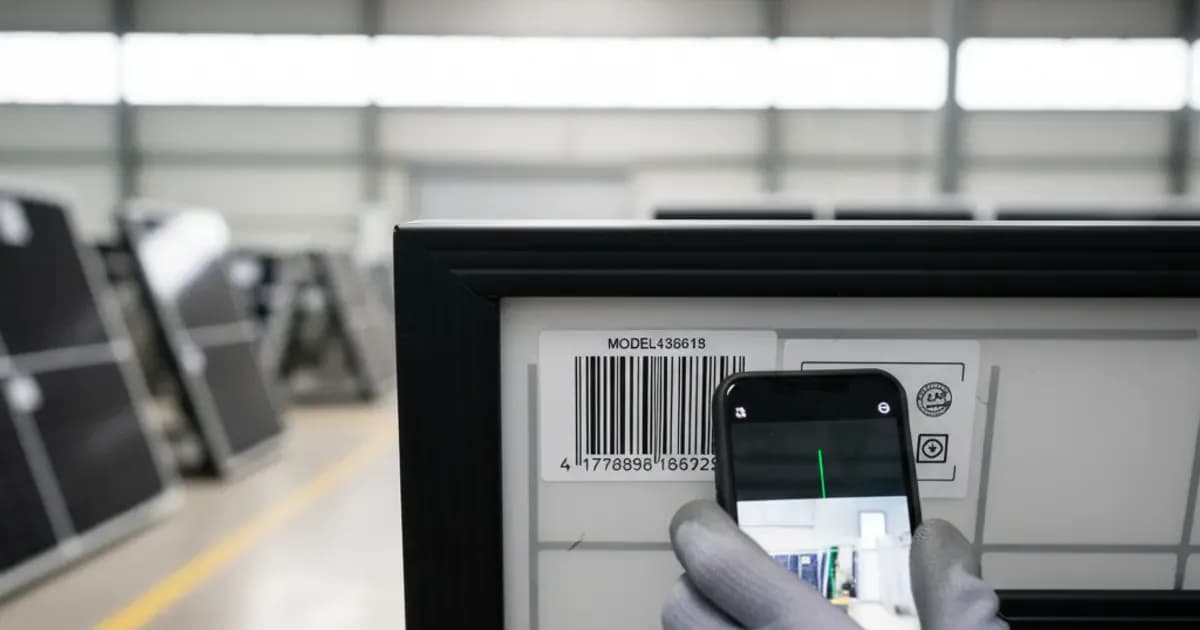
- Use the laminated identity, not a sticker. A barcode you can peel off is packaging. The identity that matters is the one laminated into or permanently applied to the module.
- Check a sample across the consignment, not one panel. Mixed pallets are exactly how a good sample and a bad batch arrive together.
Then close the loop that verification alone does not cover: ask the supplier to confirm in writing that the serial numbers on your consignment are covered by the manufacturer's warranty through their distribution channel. Genuine and covered are two different claims.
What should you check at delivery?
The moment the pallet arrives is the cheapest point at which to refuse a substitution, and the most expensive point to be busy elsewhere.
Check the model code on the module labels against the model code in the quote — not the wattage, the code. Check that the serial numbers on the delivery note match the modules physically present. Photograph the labels before installation, because after mounting they are on the underside of a roof array.
Look at the glass and frames for shipping damage and for cosmetic irregularities that suggest B-grade sorting. And confirm the count matches the array size you were quoted; an array short by two modules is a real and boring form of loss.
If anything does not match, that is a delivery to reject, not a conversation to have later. Our guide to reading a Saudi solar quote sets out the paperwork that makes this check possible in the first place.
Does cheap mean grey in Saudi Arabia?
Not reliably, and the distinction matters.
Our own 5 August 2026 survey recorded a 270W polycrystalline module at Riyadh-registered dlel.sa at SAR 0.93 per watt — cheaper per watt than any brand-name large-format listing we found. That is legacy technology honestly priced, not a grey import, and our guide to the solar panel price in KSA explains why old small-format stock can undercut modern modules on the per-watt sticker while costing more per watt installed.
The signal that actually correlates with grey stock is a current-generation, high-wattage, brand-name module priced like clearance, offered by a seller who will not name the model code or produce warranty-channel confirmation. Price alone is noise; price plus missing documentation is the pattern.
The wider commercial red flags — quotes that will not itemise, localised pages for companies registered abroad, payback claims built on the wrong scheme — are collected in our guide to avoiding solar scams in Saudi Arabia. Our method page explains how every figure on this page was checked before we published it.
Frequently asked questions
What is a grey-import solar panel?
A module that is genuine but was sold outside the manufacturer's official distribution channel. It can be physically identical to a documented panel and still fall outside the manufacturer's warranty, because warranty eligibility follows the sales channel, not the laminate.
How do I verify a solar panel serial number?
Use the manufacturer's own verification tool, reached by typing the manufacturer's domain yourself rather than following a link from a seller. LONGi, for example, publishes a module authenticity check and attaches a per-module anti-counterfeiting code under its One Module One Code system.
What is SABER and does it apply to solar panels?
SABER is the electronic platform of Saudi Arabia's SALEEM conformity regime, administered by SASO. Imported goods require product and shipment certificates of conformity before customs clearance. Ask your supplier which conformity documentation covers your specific consignment.
Does a wattage on a listing identify the panel?
No. LONGi's own Hi-MO 9 page covers 635W to 660W, and other current series overlap the same band with different cell technology. Two panels both listed as '650W' can be materially different products with different warranties. Insist on the full model code.
References
- LONGi — official module authenticity verification tool — accessed 5 August 2026
- LONGi — 'One Module One Code' per-module anti-counterfeiting identity system — accessed 5 August 2026
- LONGi — Hi-MO 9 product page (635-660W, HPBC 2.0 cells, LR7-72HYD codes, 12-year product / 30-year power warranty) — accessed 5 August 2026
- SASO — Saudi Standards, Metrology and Quality Organization, conformity certificates (SALEEM/SABER regime) — accessed 5 August 2026
- Solar Cells KSA — solar panels category listings by wattage without series designation — accessed 4 August 2026
- SolarNevs own price survey — Saudi index, 5 August 2026 — accessed 5 August 2026
Related guides
More from what to buy — and how not to get cheated.