Risen Hyper-ion HJT Bifacial 700-740W
Rs 29,400 verified 26 Jul 2026 — prices in Pakistan move weekly
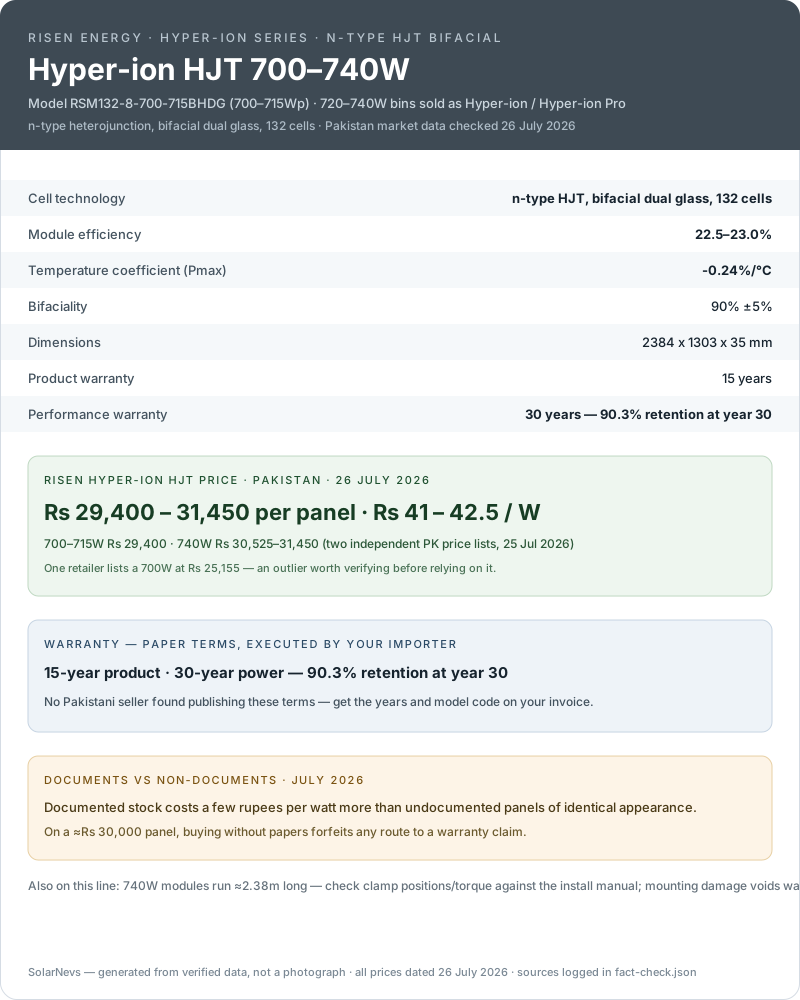
Specifications
| model | RSM132-8-700-715BHDG (700-715Wp); 720-740W bins listed in Pakistan as Hyper-ion / Hyper-ion Pro |
|---|---|
| cellTech | n-type HJT (heterojunction), bifacial dual glass, 132 cells |
| efficiency | 22.5-23.0% (RSM132-8-700-715BHDG) |
| tempCoefficient | -0.24%/°C (Risen official HJT series page) |
| bifaciality | 90% ±5% (Risen official HJT series page) |
| dimensions | 2384 x 1303 x 35 mm (RSM132-8-700-715BHDG) |
| warranty | 15-year product / 30-year power, 90.3% retention at year 30 |
| Warranty | 15-year product warranty and 30-year power warranty to 90.3% retention on the RSM132-8-700-715BHDG datasheet. No Pakistani seller found publishing these terms — get the years and the model code written on your invoice. |
Hyper-ion is Risen's heterojunction (HJT) module line — n-type HJT cells in a bifacial dual-glass laminate, 132 cells, sold in Pakistan in 700W to 740W bins. As of 26 July 2026 it costs Rs 29,400 per panel for the 700-715W and Rs 30,525-31,450 for the 740W, working out to about Rs 41-42.5 per watt. That makes it the most interesting Risen product in this market: heterojunction cells, which normally carry a premium, priced under LONGi's Hi-MO X7 band.
Specifications
Spec | Value | Source |
|---|---|---|
Model (700W class) | RSM132-8-700-715BHDG | Risen datasheet |
Power bins on PK lists | 700-715W, 720-725W (Pro), 730-735W, 740W | PK price lists, Jul 2026 |
Cell technology | n-type HJT, bifacial dual glass, 132 cells | Risen official |
Module efficiency | 22.5-23.0% | RSM132-8-700-715BHDG datasheet |
Temp coefficient (Pmax) | -0.24%/°C | Risen official HJT page |
Bifaciality | 90% ±5% | Risen official HJT page |
Dimensions | 2384 x 1303 x 35 mm | RSM132-8-700-715BHDG datasheet |
Warranty | 15-yr product / 30-yr power, 90.3% at year 30 | RSM132-8-700-715BHDG datasheet |
PK price, 26 Jul 2026 | Rs 29,400 (700-715W); Rs 30,525-31,450 (740W) | Two PK price lists |
Risen's own HJT series page also advertises a Hyper-ion Pro 132 at 745Wp and a headline "up to 24.7%" efficiency. That figure belongs to the top of the series, not to the 700-715W module you are likely being sold — hold the seller to the number on the actual datasheet.
Honest assessment
Pros. The -0.24%/°C temperature coefficient is the best number on any panel commonly available in Pakistan, TOPCon included, and heat is this market's main yield killer. Bifaciality near 90% is genuinely high, so on an elevated frame over a light-coloured surface the rear gain is real rather than notional. The 740W format cuts panel count, clamps, rails and DC connections per kilowatt, which matters on commercial roofs. And the warranty terms — 15 years product, 30 years power to 90.3% — are as strong as anything in the segment.
Cons. Pakistani listings for this panel disagree badly. One retailer shows a 700W HJT at Rs 25,155 (Rs 35.9/W) while another shows the same wattage at Rs 32,900 (Rs 47/W), and the two sites carry those identical figures attached to opposite models — evidence that at least one list is copied rather than quoted. Neither Solar Citizen nor SolarPanelRates tracks Risen, so there is no daily benchmark. HJT cells are also more sensitive to soldering and handling damage than TOPCon, and Pakistan has few installers with HJT-specific experience. Physically these are large, heavy modules that punish a careless installation.
Who should buy. Commercial and large-residential buyers with structure suited to 2.38m modules, buyers on hot west-facing or unshaded roofs where the temperature coefficient earns its keep, and anyone who can get documented stock with flash-test reports at Rs 41/W or better. Small rooftops and inexperienced crews should stay with the 585W class.
Pakistan reality check
Heat and dust. At -0.24%/°C, a 40°C rise above test conditions costs roughly 10% of nameplate, so a 715W module delivers around 640W at the array on a hot afternoon — about two percentage points better than an equivalent TOPCon panel and four better than PERC. That advantage disappears entirely under a month of unwashed dust, so budget for cleaning every 2-4 weeks in the dry season. On large-format modules, also check mid-clamp positions and torque against the installation manual: wind load on a 2.38m panel is substantial, and mounting damage is not a warranty event.
Documents versus non-documents. Documented stock carries import papers, a warranty card and a serial-traceable invoice, and costs a few rupees per watt more than undocumented panels of identical appearance. On a panel costing Rs 30,000 apiece, buying without papers to save a few thousand rupees is a poor trade — you forfeit any route to a warranty claim.
Counterfeit check — do this before paying. Genuine Risen modules carry a serial laser-etched inside the glass laminate. A barcode that exists only on a paper sticker is worth nothing; sticker sheets are printed locally and applied to B-grade or relabelled panels. Match the in-glass serial to the frame sticker and to the invoice, then demand the factory flash-test report for those exact serials showing each panel's measured wattage against nameplate. Ask the importer to verify the serials with Risen before delivery. Be especially careful here: HJT commands a premium worldwide, which makes "HJT" a profitable word to print on a cheaper panel.
Warranty claim reality. Thirty years of power warranty is a factory promise executed locally by whoever imported your container. Risen has no visible national service operation in Pakistan, so if your supplier folds the paper is worthless. Keep the invoice, photographs of the in-glass serials and the datasheet PDF together, and buy from a dealer with a checkable multi-year record.
Price context versus rivals (26 July 2026)
- LONGi Hi-MO X7 — Rs 42.50-46.20/W (Solar Citizen, Jul 2026), the closest premium comparison and dearer per watt than Risen HJT.
- Canadian Solar TOPCon — Rs 41.00-46.00/W (Solar Citizen and SolarPanelPriceInPakistan.online, Jul 2026), overlapping Risen HJT at the bottom and well above it at the top.
- Jinko Tiger Neo 585W — Rs 40.50-43.45/W (SolarPanelPriceInPakistan.online, 25 Jul 2026), the volume mainstream option, similar per watt but TOPCon rather than HJT.
Per watt, Hyper-ion is priced like a mainstream TOPCon panel while offering a better temperature coefficient and a higher power class. That is the case for buying it. The case against is entirely about the channel: verify the serials, get the flash-test report, and make sure the dealer will still exist in five years.
Frequently asked questions
What does a Risen Hyper-ion HJT panel cost in Pakistan?
As of 26 July 2026, Rs 29,400 for the 700-715W and Rs 30,525-31,450 for the 740W — about Rs 41-42.5 per watt. One retailer lists a 700W at Rs 25,155, an outlier worth verifying before relying on it.
Is HJT actually better than TOPCon in Pakistani heat?
On paper yes. Risen rates Hyper-ion at -0.24%/°C against -0.29%/°C for its TOPCon line, so roughly 2% less loss at a 40°C temperature rise. Useful, but smaller than the loss from unwashed dust.
Are 740W panels harder to install?
Yes. They are around 2.38m long and heavy, need two people to place, and catch serious wind load. Insist on the manufacturer's clamp positions and torque, because mounting damage voids every warranty.
Why is HJT cheaper than LONGi here?
Local pricing, not global cost. Risen HJT lists at Rs 41-42.5/W while LONGi Hi-MO X7 sits at Rs 42.5-46.2/W (Solar Citizen, Jul 2026). It reflects brand demand in Pakistan, not manufacturing economics.
How do I verify a Hyper-ion panel is genuine?
Check the serial laser-etched inside the glass, match it to the frame sticker and invoice, demand the serial-matched factory flash-test report, and have the importer confirm the serials with Risen before delivery.
References
- SolarPanelPriceInPakistan.online daily price list (25 Jul 2026) — accessed 26 Jul 2026
- Pakistan Solar Traders — solar panel price in Pakistan — accessed 26 Jul 2026
- PhoneWorld — solar panel price in Pakistan (11 Jun 2026) — accessed 26 Jul 2026
- SolarApp.pk — Risen 700W HJT bifacial listing — accessed 26 Jul 2026
- Risen Energy — official HJT Hyper-ion module series page — accessed 26 Jul 2026
- Risen Energy — RSM132-8-700-715BHDG datasheet PDF (2026H1) — accessed 26 Jul 2026
- Solarbe Global — Risen back on BNEF Tier 1 list — accessed 26 Jul 2026
- Solar Citizen — Pakistan brand price table (Jul 2026) — accessed 26 Jul 2026