UK Schools Solar Energy Display Telemetry and DEC Ratings Guide
Updated 6 September 2026 · By SolarNevs Research Desk, Dealer surveys + verified sources · 4 sources · Method ↗
Key Takeaways
- State schools, academies, and public educational buildings installing rooftop solar are legally obligated to display energy efficiency ratings.
- Under the Energy Performance of Buildings Regulations 2012, public buildings must prominently display a valid Display Energy Certificate (DEC).
- DECs benchmark actual operational energy consumption, showing measurable carbon reductions from on-site solar generation.
- School solar arrays operate under Class A statutory generation licence exemptions.
- Facilities under 50 megawatts permitted capacity are exempt from Section 36 consents.
- Unlicensed generation outside statutory exemptions constitutes an offence under the Electricity Act 1989.
Statutory Duties for Display Energy Certificates (DEC)
Educational institutions must comply with building performance transparency laws:
- Public Building Criteria: Mandated for buildings occupied by public authorities and frequently visited by the public.
- Prominent Display Mandate: Occupiers must display at all times a valid display energy certificate in a prominent place clearly visible to members of the public who visit the building.
- Approved Rating Standards: Certificates must express the operational rating of the building in a way approved by the Secretary of State.
- On-site solar arrays reduce imported grid kilowatt-hours, directly lifting the school's operational energy rating from a low band (e.g. Band D or E) toward Band A or B.
Telemetry Displays and Educational Engagement
Modern school solar schemes combine compliance certification with interactive pupil education:
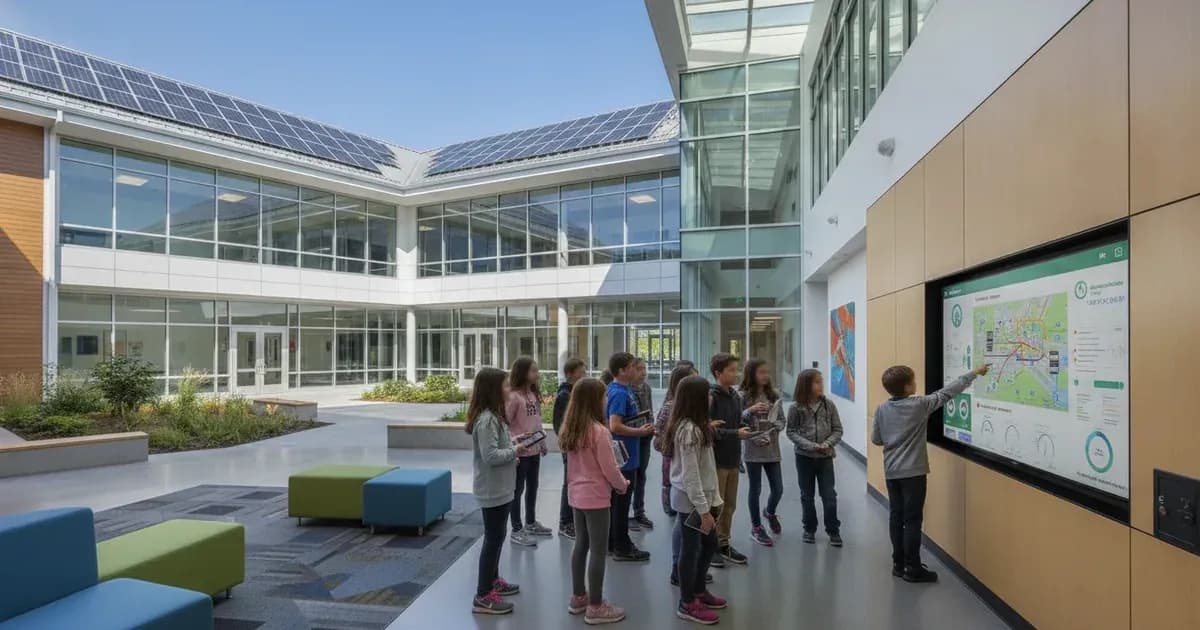
- Foyer Energy Kiosks: Public reception screens display live inverter generation, daily solar yields, and equivalent trees planted.
- Smart Sub-Metering: Modbus telemetry measures classroom lighting, heat pump electricity consumption, and kitchen loads separately.
- Curriculum Integration: Science and geography classes utilize real site generation data to study renewable physics and climate change.
Statutory Licensing under the Electricity Act 1989
Generating clean power on public school rooftops operates within national statutory boundaries:
- Generation Restriction: Covers any entity that generates electricity for the purpose of giving a supply to any premises or enabling a supply to be so given.
- Supply Prohibition: Restricts unauthorized parties that supplies electricity to any premises.
- Offence Provision: Confirms that an unauthorized party shall be guilty of an offence unless he is authorised to do so by a licence or exemption.
- Physical Delivery: Defines that in relation to electricity, means supply through electric lines.
Class A Exemptions and Section 36 Thresholds
Educational solar installations are protected by statutory capacity exemptions:
- Small Generator Relief: Protects Persons (other than licensed generators) who do not at any time provide more electrical power from any one generating station than specified caps.
- Declared Capacity: Covers 50 megawatts in the case of a generating station with a declared net capacity of less than 100 megawatts.
- On-Site Supply: Recognizes power delivered to a single consumer who occupies premises which are on the same site as the premises where the generating station is situated and who consumes all the power provided to him from that generating station at those premises.
- Ministerial Consent: Outlines that a generating station shall not be constructed, extended or operated except in accordance with a consent granted by the Secretary of State.
- Fifty Megawatt Exemption: Exemption applies where capacity does not exceed the permitted capacity, that is to say, 50 megawatts.
Frequently asked questions
What legal requirement mandates Display Energy Certificates for UK schools?
Under Regulation 14 of the 2012 EPB Regulations, buildings occupied by public authorities frequently visited by the public must prominently display a valid DEC.
How often must a school Display Energy Certificate be renewed?
DECs are valid for 12 months for buildings over 1,000m², and 10 years for smaller public buildings.
What information must a school Display Energy Certificate express?
The certificate must express the operational rating of the building in a way approved by the Secretary of State.
What licensing exemption covers rooftop solar generation on school premises?
Class A of the 2001 Class Exemptions Order exempts small generators not exceeding 10MW or 50MW supplying electricity to on-site educational facilities.
Does school solar generation require ministerial consent under Section 36?
No, consent is not required where generating capacity does not exceed the permitted capacity of 50 megawatts.
References
- Energy Performance of Buildings Regulations 2012 Regulations 14 and 15 — accessed 28 August 2026
- Electricity Class Exemptions from the Requirement for a Licence Order 2001 — accessed 28 August 2026
- Electricity Act 1989 Section 4 Prohibition on Unlicensed Supply — accessed 28 August 2026
- Electricity Act 1989 Section 36 Consent for Generating Stations — accessed 28 August 2026
Related guides
More from what to buy — and how not to get cheated.