Australian AS/NZS 4509 and AS/NZS 5139 Off-Grid Battery Compliance Guide
Updated 18 September 2026 · By SolarNevs Research Desk, Dealer surveys + verified sources · 2 sources · Method ↗
Key Takeaways
- Australian off-grid battery systems must comply with AS/NZS 4509 and AS/NZS 5139 for safety and performance.
- Accredited installers through Solar Accreditation Australia (SAA) are essential for compliant installations.
- Battery room ventilation is a critical safety requirement under AS/NZS 5139 to manage potential hazards.
- Consulting an accredited installer is necessary for specific compliance details and system design.
Understanding Australian Off-Grid Battery Compliance
In Australia, off-grid battery systems, also known as stand-alone power systems (SAPS), must meet specific Australian Standards to ensure safety, reliability, and performance. The primary standards governing these installations are AS/NZS 4509 for stand-alone power systems and AS/NZS 5139 for battery energy storage systems. These standards cover aspects from system design and installation to battery room safety and generator integration.
The Role of Australian Standards in Off-Grid Systems
Australian Standards provide a framework for the safe and effective deployment of solar and battery technology. For off-grid systems, AS/NZS 4509 outlines requirements for the entire stand-alone power system, including the solar array, inverter, battery bank, and associated wiring. AS/NZS 5139 specifically addresses the safety aspects of battery energy storage systems, which is crucial for off-grid setups that often involve larger battery banks.
The Clean Energy Council (CEC) plays a role in upholding the integrity of consumer energy resources and provides input into the development of Australian Standards. They also maintain lists of approved products, including PV modules, inverters, and battery storage products, which are verified to meet Australian safety benchmarks.
Key Compliance Areas for Off-Grid Batteries
Compliance for off-grid battery systems involves several critical areas, as outlined by AS/NZS 4509 and AS/NZS 5139. These standards address the technical requirements for safe installation and operation.
Battery Room Safety and Ventilation (AS/NZS 5139)
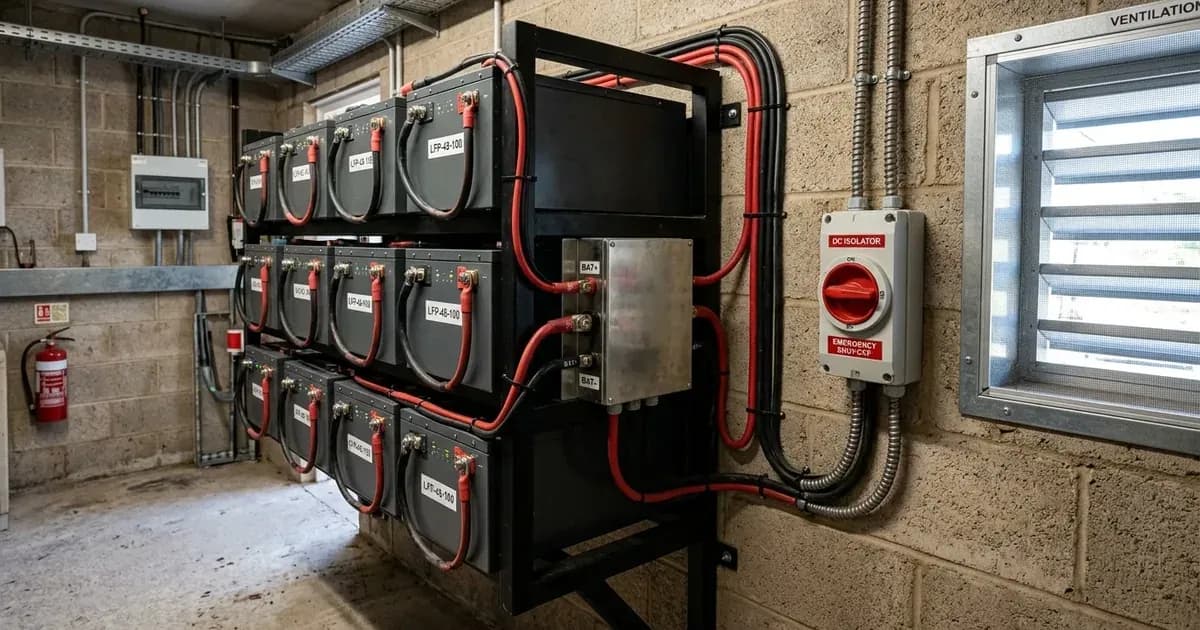
AS/NZS 5139 specifies safety requirements for battery energy storage systems. For off-grid installations, this often includes dedicated battery rooms or enclosures. Proper ventilation is a critical aspect of battery room safety, particularly for lead-acid batteries which can produce hydrogen gas during charging. Adequate ventilation prevents the accumulation of flammable gases, reducing the risk of explosion.
If your system uses lead-acid batteries, ensure the battery room is adequately ventilated. This typically involves both high and low-level vents to allow for natural convection, or mechanical ventilation if natural airflow is insufficient. Consult your accredited installer for specific ventilation requirements based on your battery type and system size.
Generator Autostart and Changeover Wiring
Many off-grid systems incorporate a backup generator with an autostart function. The wiring for generator autostart and the automatic changeover switch must comply with AS/NZS 4509 and relevant electrical wiring rules (AS/NZS 3000). This ensures safe and seamless transfer of power between the solar-battery system and the generator, preventing back-feeding into the inverter or grid (if a hybrid system).
The generator's control system communicates with the inverter or system controller to initiate starting and stopping based on battery state of charge or load demand. The changeover switch isolates the generator from the inverter's output when the generator is running, protecting both systems and ensuring stable power supply.
System Design and Installation (AS/NZS 4509)
AS/NZS 4509 covers the overall design and installation of stand-alone power systems. This includes:
- Component Selection: Ensuring all components, such as PV modules, inverters, and batteries, are suitable for off-grid use and meet Australian Standards. The Clean Energy Council maintains an Approved Batteries list and an Approved Inverters list for verified products.
- Wiring and Protection: Correct sizing of cables, appropriate overcurrent protection, and earthing arrangements to prevent electrical hazards.
- Inverter Configuration: Proper configuration of inverter settings for battery charging, low-voltage disconnects, and generator control.
- Labelling and Documentation: Clear labelling of all components and provision of comprehensive documentation to the system owner.
What you can check yourself, and what you cannot
As a system owner, you can perform basic visual checks and monitor your system's performance. You can check for obvious signs of damage, ensure ventilation openings are clear, and monitor your battery's state of charge through your system's display or app.
However, any work involving electrical connections, battery maintenance beyond simple visual inspection, or changes to inverter settings must be performed by an accredited installer. Grid-protection settings and other critical parameters are set by an accredited installer and changing them can breach your connection agreement or compromise system safety. Opening battery enclosures or working with live electrical components can be extremely dangerous. Always contact your accredited installer for any technical issues or maintenance requiring access to internal components.
What the published sources do not tell you
Direct verbatim text of paywalled Standards Australia publications, such as AS/NZS 3000, AS/NZS 4509, AS/NZS 4777, AS/NZS 5033, and AS/NZS 5139, is copyright Standards Australia. These documents are accessed via licensed practitioner portals and are not publicly available. This means specific technical details, such as precise ventilation rates or wiring diagrams, are not published in general guides. Your accredited installer will have access to these standards and can confirm specific requirements for your installation.
Australia has thirteen distribution networks, and while off-grid systems are not connected to the main grid, local council regulations or state-specific electrical safety bodies may have additional requirements. Always check with your local authorities or an accredited installer for any regional variations.
Frequently asked questions
What Australian standards apply to off-grid battery systems?
AS/NZS 4509 covers stand-alone power systems, and AS/NZS 5139 addresses battery energy storage system safety, including battery room ventilation.
Who ensures compliance for off-grid solar installations in Australia?
Installers and designers accredited by Solar Accreditation Australia (SAA) are responsible for ensuring compliance with relevant Australian Standards.
What is the Clean Energy Council's role in off-grid compliance?
The Clean Energy Council maintains lists of approved products, administers the New Energy Tech Consumer Code (NETCC), and provides input into Australian Standards development.
What is the purpose of AS/NZS 5139 for off-grid systems?
AS/NZS 5139 specifies safety requirements for battery energy storage systems, including provisions for off-grid battery room safety and ventilation.
How do installers maintain their accreditation for off-grid systems?
Installers must apply for accreditation with Solar Accreditation Australia (SAA) and maintain a valid electrical licence. They can also earn Continuing Professional Development (CPD) points through the Clean Energy Council.
References
- Clean Energy Council: Compliance Toolkit - Standards — accessed 26 August 2026
- Clean Energy Council: Main Page — accessed 26 August 2026
Related guides
More from schemes, subsidies & financing.