Australian Solar Battery Backup Circuits: Essential Sub-Board Wiring Guide
Updated 18 September 2026 · By SolarNevs Research Desk, Dealer surveys + verified sources · 1 source · Method ↗
Key Takeaways
- Essential loads in a home require segregation onto a dedicated sub-board for battery backup.
- The Main Earthing Neutral (MEN) connection in your switchboard needs careful management for safety.
- Automatic Transfer Switches (ATS) are used to safely switch between grid and battery power.
- All wiring and electrical work for battery backup systems must be performed by an accredited electrician.
Understanding Essential Loads for Battery Backup
When installing a solar battery backup system in Australia, a key consideration is how to ensure critical appliances continue to operate during a power outage. This involves identifying "essential loads" – those circuits you want to keep powered – and segregating them from non-essential loads.
Essential loads typically include items like refrigeration, lighting in key areas, communication devices, and medical equipment. Non-essential loads might be air conditioning, electric ovens, or pool pumps, which draw significant power and can quickly deplete a battery.
The Role of the Essential Loads Sub-Board
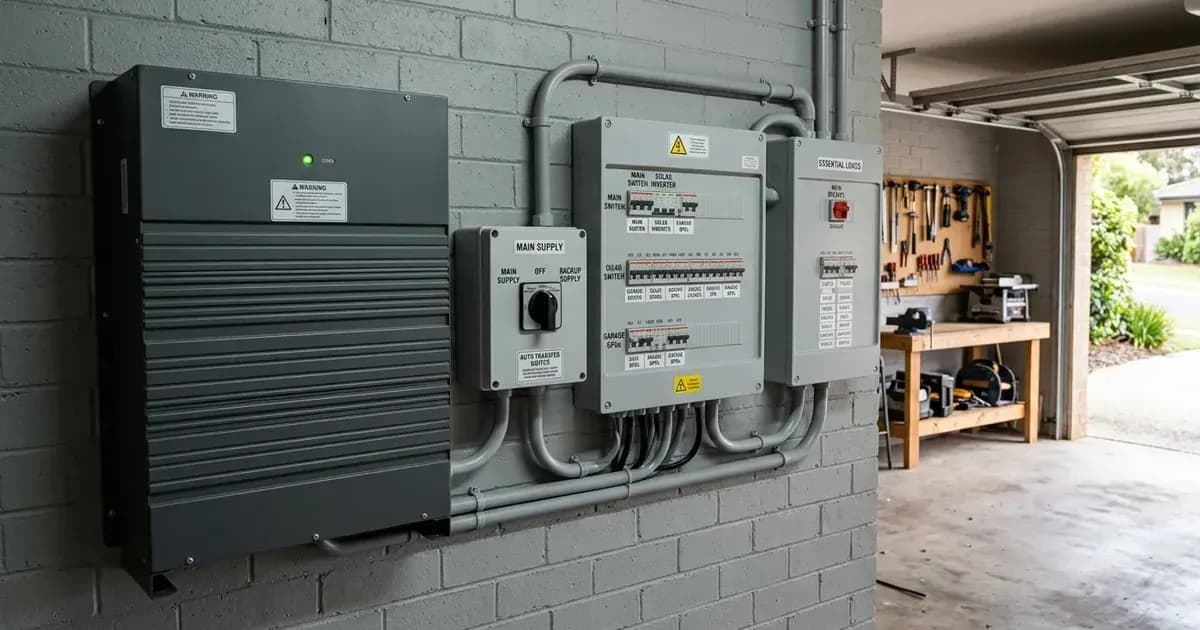
To manage essential loads effectively, a dedicated sub-board is installed. This sub-board acts as a separate electrical panel within your home's main switchboard. Only the circuits designated as essential are connected to this sub-board.
During a grid outage, the battery backup system powers only the circuits connected to this essential loads sub-board. This segregation ensures that your battery capacity is reserved for critical functions, extending the duration of your backup power. The design and installation of this sub-board must comply with Australian electrical standards to ensure safety and proper operation.
Main Earthing Neutral (MEN) Link Management
The Main Earthing Neutral (MEN) link is a fundamental safety component in Australian electrical installations. It connects the neutral conductor to the earth electrode at the main switchboard, providing a protective earthing system.
In a solar battery backup system that can operate both grid-connected and in islanded mode (off-grid during an outage), the management of the MEN link is critical. When the system is connected to the grid, the MEN link functions as normal. However, when the system disconnects from the grid and operates in islanded mode, the earthing arrangement must be correctly configured to maintain safety. This often involves specific switching mechanisms to ensure the MEN link is only active at one point in the system, preventing dangerous earth loops or loss of protective earthing. Correct MEN link management is a complex task that requires expert knowledge of AS/NZS 3000 and other relevant standards.
Automatic Transfer Switches (ATS) for Seamless Power
An Automatic Transfer Switch (ATS) is a device that automatically switches your home's electrical supply between the main grid and your battery backup system. Its primary function is to provide a safe and seamless transition during power outages.
The ATS operates on a "break-before-make" principle. This means it completely disconnects your home from the grid before connecting it to the battery backup system, and vice-versa. This prevents the battery system from back-feeding power into the grid during an outage, which could endanger utility workers. It also protects your battery system from grid fluctuations when reconnecting. The correct selection and installation of an ATS are vital for the safe and compliant operation of any solar battery backup system.
Compliance with Australian Standards and Professional Installation
All aspects of solar battery backup circuit wiring, sub-board installation, MEN link management, and ATS integration in Australia are governed by strict Australian Standards. Key standards include AS/NZS 3000 (Wiring Rules), AS/NZS 4777.2 (Grid connection of energy systems via inverters), and AS/NZS 5139 (Electrical installations – Safety of battery energy storage systems).
Due to the complexity and safety implications of working with high-voltage DC and AC systems, all installation, modification, and maintenance of solar battery backup circuits must be performed by an accredited electrician. The Clean Energy Council (CEC) maintains lists of approved products and provides input into the development of Australian Standards, while Solar Accreditation Australia (SAA) manages installer and designer accreditation for Small-scale Technology Certificates (STCs). An accredited professional ensures your system is installed safely, compliantly, and is eligible for any applicable government incentives.
What you can check yourself, and what you cannot
As a homeowner, you can visually inspect your solar battery backup system for any obvious signs of damage or unusual operation. You can also familiarise yourself with your system's monitoring app or display to understand its performance and battery charge status. Knowing which appliances are connected to your essential loads sub-board will help you manage your power consumption during an outage.
However, you must not attempt any electrical wiring, open any electrical enclosures, or modify any system settings related to grid protection or wiring configurations. These tasks require specific electrical qualifications and accreditation. Tampering with your system can void warranties, create safety hazards, and breach your connection agreement with your electricity distributor. Always contact an accredited solar electrician for any work beyond basic monitoring.
What the published sources do not tell you
Specific wiring diagrams, detailed cable sizing calculations, precise protection device ratings, and step-by-step installation procedures for Australian solar battery backup systems are not publicly available. This information is contained within the paywalled Australian Standards, such as AS/NZS 3000, AS/NZS 4777.2, and AS/NZS 5139. These standards are copyright protected and require a licensed practitioner to access and interpret.
This guide provides an overview of the key concepts and requirements. It does not, and cannot, provide the detailed technical specifications or instructions necessary for the physical installation of these systems. Such specifics are the domain of accredited electricians who possess the necessary training and access to these standards.
Frequently asked questions
What is an essential loads sub-board in a solar battery backup system?
An essential loads sub-board is a dedicated electrical panel that segregates critical circuits in your home, ensuring they can be powered by a battery backup system during a grid outage. This segregation is a key part of compliant Australian solar battery backup installations.
Why is the Main Earthing Neutral (MEN) link important for battery backup systems?
The Main Earthing Neutral (MEN) link is crucial for safety and correct operation in Australian electrical systems. Its management is particularly important in battery backup systems to ensure proper earthing and fault protection, especially when switching between grid-connected and islanded (off-grid) modes.
What does an Automatic Transfer Switch (ATS) do in a solar battery backup system?
An Automatic Transfer Switch (ATS) automatically switches your home's power supply between the grid and your battery backup system. It ensures a safe 'break-before-make' transition, preventing simultaneous connection to both sources and protecting your system and the grid.
Who can install solar battery backup circuits and sub-boards in Australia?
All solar battery backup circuit and sub-board wiring in Australia must be performed by an accredited electrician. This ensures compliance with Australian Standards and safe operation of the system.
Where can I find specific wiring diagrams for Australian solar battery backup systems?
Specific wiring diagrams, cable sizes, and detailed installation procedures are contained within paywalled Australian Standards such as AS/NZS 3000, AS/NZS 4777.2, and AS/NZS 5139. These standards require professional interpretation and are not publicly available.
References
- Clean Energy Council: Compliance Toolkit - Standards — accessed 26 August 2026
Related guides
More from schemes, subsidies & financing.