SaskPower Net Metering Guide: Interconnection Rules in Saskatchewan
Updated 19 September 2026 · By SolarNevs Research Desk, Dealer surveys + verified sources · 2 sources · Method ↗
Key Takeaways
- SaskPower allows customer-sited renewable generation up to a 100 kW nameplate capacity limit.
- Excess energy exported to the grid receives a wholesale credit of 7.50 cents per kWh.
- Credits carry forward indefinitely month to month without annual expiration.
- Utility-grade bifacial panels like the LONGi 540W leverage 70% bifaciality to boost production from snow reflection (albedo).
- Interconnection requires bi-directional meter installation and electrical permitting through TSASK.
SaskPower Net Metering Regulatory Architecture
Saskatchewan possesses some of the premier solar irradiance resources in Canada, averaging over 2,200 hours of bright sunshine annually. Grid interconnection for customer-owned generation is administered by SaskPower under provincial utility regulations.
Under the current program rules, the SaskPower Net Metering Program allows customer self-generation up to 100 kW nameplate capacity. This 100 kW threshold accommodates urban residential rooftops, large rural acreages, and agricultural farm operations.
In November 2019, SaskPower transitioned from legacy 1:1 retail net metering to the current compensation structure:
- Retail Consumption Offset: Electricity generated on-site directly offsets domestic or farm power consumption at standard retail rates (~15¢/kWh).
- Wholesale Export Credit: Excess electricity sent back to the grid receives a credit rate of 7.50 cents per kWh.
- Indefinite Credit Carryforward: Unlike utilities with hard annual expiries, unused net metering credits in Saskatchewan carry forward indefinitely without an annual expiry date. This allows producers to bank massive summer surplus generation to offset winter heating loads.
- Metering Infrastructure: SaskPower installs bi-directional revenue metering to track generation exports and grid imports accurately.
Rural Ground Mounts and Bifacial Technology: LONGi LR5-72HBD-540M
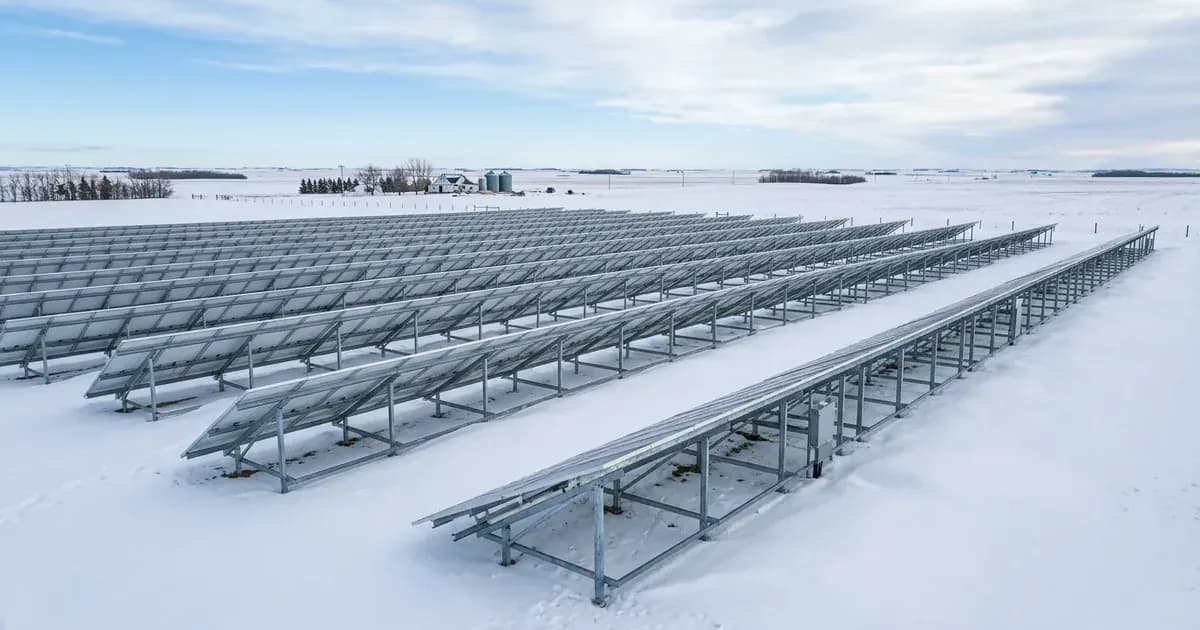
Because agricultural and acreage properties dominate Saskatchewan installations, ground-mounted arrays are exceedingly common. Ground mounts allow unrestricted orientation, optimal 45° to 53° tilt angles, and the deployment of high-power bifacial solar modules.
The LONGi LR5-72HBD-540M exemplifies the modern standard for prairie solar arrays:
- Utility-Grade Design: 540W bifacial solar panels are top-tier solar panels designed for ultra-large power plants and rugged agricultural applications.
- Bifacial Energy Yield: Bifacial energy yield meaning they can generate power from both sides of the panel maximizing energy production. On snowy prairie fields, the rear side absorbs reflected radiation (albedo), boosting winter output by 15% to 25%.
- Dual-Sided Output: Bifacial energy yield: these panels are renowned for their bifacial energy yield allowing them to generate power from both the front and back sides of the panel.
- Half-Cell Thermal Stability: By utilizing half-cell technology these panels operate at lower temperatures, reducing thermal resistive losses.
- Cell Innovation: 540W bifacial solar panels incorporate cutting-edge module technology such as the M10 gallium-doped wafer smart soldering and 9-busbar half-cut cell design.
- Mechanical Robustness: 540W bifacial solar panels boast exceptional durability with minimal power degradation over severe winter freeze-thaw cycles.
- Warranty Protection: 540W bifacial solar panels come with a comprehensive warranty package offering peace of mind to users.
- Linear Output Warranty: Modules carry an impressive 30-year warranty for extra linear power output these panels provide long-term protection and assurance.
- Extreme Operating Range: Modules operate across temperature: -40°C ~ +85°C, power output tolerance: 0 ~ +5 W, Voc and Isc tolerance: ± 3%, maximum system voltage: 1500V DC (IEC/UL), and maximum series fuse rating: 30A.
- Safety and Bifaciality Ratings: Rated for temperature: 45 ± 2°C, protection class: Class II, fire rating: UL Type 29, and bifaciality: 70 ± 5%.
Technical Metric | Specification Rating | Operational Significance in SK |
|---|---|---|
Nameplate Power Rating | 540W DC rated output | High power density for ground arrays |
Bifaciality Factor | 70 ± 5% rear-side efficiency | Captures winter snow albedo reflections |
Operating Temperature | -40°C to +85°C operational range | Fully rated for severe Saskatchewan winter extremes |
System Voltage Rating | 1500V DC maximum voltage | Permits extended series strings under CEC rules |
Power Output Warranty | 30-year linear performance warranty | Long-term asset protection for farm infrastructure |
Technical Safety Authority of Saskatchewan (TSASK) and CEC Compliance
All electrical installations connecting to the SaskPower grid require permitting and inspection through Technical Safety Authority of Saskatchewan (TSASK).
Installations must comply with Canadian Electrical Code (CSA C22.1) Section 64. When modules are installed on residential rooftops, Rule 64-218 rapid shutdown devices must be installed at the module level. Ground-mounted arrays outside residential boundaries are typically exempt from rapid shutdown requirements if conductors enter directly into inverter equipment without traversing residential structures.
While federal Greener Homes Grant and Loan programs are closed to new applicants, SaskPower's 100 kW capacity cap and indefinite credit rollover provide exceptional stability for prairie clean energy investments.
Frequently asked questions
What is the generator capacity limit under SaskPower Net Metering?
SaskPower allows residential, farm, and commercial customer self-generation installations up to a maximum nameplate capacity of 100 kW.
What is SaskPower's excess solar export credit rate?
Excess electricity sent back to the grid receives a credit rate of 7.50 cents per kWh against monthly electricity charges.
Do net metering credits expire in Saskatchewan?
No, unused net metering credits in Saskatchewan carry forward indefinitely from month to month as long as the account remains active.
Why are bifacial solar modules popular for Saskatchewan rural solar?
Bifacial modules like the LONGi 540W generate power from both sides, capturing reflected light from prairie snow cover to maximize winter energy yield.
References
- LONGi Solar LR5-72HBD-540M Bifacial Datasheet and Specifications — accessed 28 August 2026
- Saskatchewan Power Corporation Act Net Metering Regulations — accessed 28 August 2026
Related guides
More from schemes, subsidies & financing.