Solar Panel Snow Load Shedding Angles Canada: Winter Tilt & Racking Clearance
Updated 19 September 2026 · By SolarNevs Research Desk, Dealer surveys + verified sources · 1 source · Method ↗
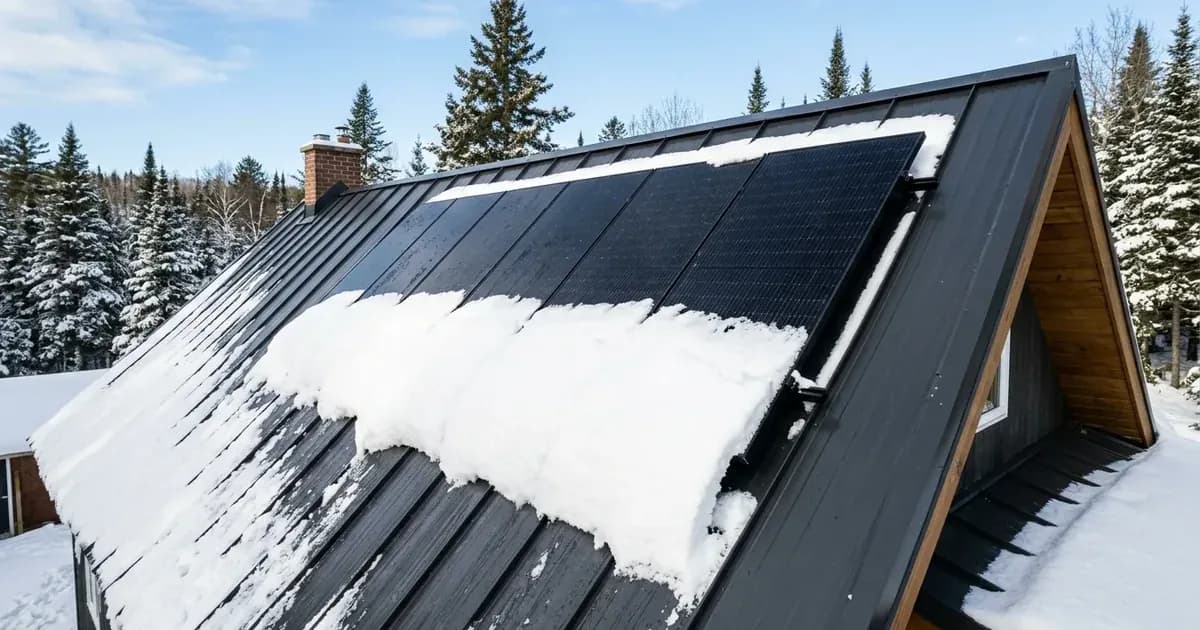
Snow accumulation is the single greatest cause of winter photovoltaic yield loss across Canada. When rooftop solar panels are installed flush against standard residential roof slopes—typically pitched between 18° and 26° (4/12 to 6/12 pitch)—snow accumulates across the entire array and remains frozen in place for weeks. Field research from northern test facilities demonstrates that flush rooftop arrays can lose up to 100% of their generation capacity during December and January when covered in dense snow crusts.
Overcoming winter snow coverage requires engineered racking that optimizes tilt angles and clears ground drift. Systems like the introducing the maple leaf canada goose adjustable ground mount. the unique adjustable tilting structure design increases optimum solar energy production capacity allow owners to adapt array inclination to match seasonal solar elevations and ensure rapid snow clearing.
Seasonal Tilt Optimization: 30° Summer vs 60° Winter
Canada's northern latitude creates extreme seasonal variation in the solar zenith angle. In southern Canadian latitudes (43°N to 51°N), the noon sun reaches nearly 65° above the southern horizon in June, but drops to a mere 15° to 22° in late December.
Fixed solar arrays mounted at typical summer angles capture very little direct irradiance in winter and lack the steep incline needed for gravity shedding. Deploying adjustable racking allows operators to customize your solar panel setup with ease thanks to the adjustable angle feature ranging from 30 degrees to 60 degrees..
Steepening the array inclination from 30° to 60° in late October delivers two decisive operational benefits:
- Perpendicular Sun Alignment: A 60° tilt places the glass surface nearly perpendicular to low-altitude winter sun rays, maximizing photon capture through short daylight windows.
- Gravity Snow Shedding: Snow cannot establish a mechanical bond on steep glass surfaces. As sunlight penetrates thin snow layers, dark solar cells warm up, creating a microscopic melt layer that causes snow sheets to slide off cleanly.
Array Tilt Angle | Seasonal Focus | Snow Shedding Rate | Relative Winter Solar Capture |
|---|---|---|---|
20° to 30° Tilt | Optimal for May to August | Very poor (snow dams and remains frozen) | Baseline winter yield (30% to 50% loss) |
40° to 45° Tilt | Year-round fixed compromise | Moderate (sheds under direct afternoon sun) | 70% to 80% of theoretical winter yield |
55° to 60° Tilt | Optimal for November to February | Excellent (slides off rapidly by gravity) | 95% to 100% of maximum winter yield |
Furthermore, the maple leaf canada goose ground mount boasts a unique tilting structure that significantly increases optimum solar energy production, ensuring that systems operating off-grid or under net billing frameworks capture critical power when grid demand peaks.
Racking Engineering and Structural Load Capacities
Winter racking in Canada must withstand intense mechanical stress from blizzard winds and heavy snow loads. Wet packed snow can exert downward loads exceeding 1.5 kPa, while freezing winter gales produce severe uplift forces.
To withstand these extreme conditions, the rails and beams are manufactured from high-strength extruded aluminum to withstand all weather conditions and harsh environments. Modern adjustable ground mounts are engineered with a design capable of enduring 1/50 hourly wind pressure of 0.43 kpa 1/50 ground snow load of 1.6 kpa and 1/50 associated rain load of 0.1 kpa. For locations exposed to severe prairie winds or coastal squalls, installers can add a goose mount hurricane upgrade kit - reinforcement beams can be installed on the goose mount for high-wind areas and additional torsional rigidity..
Hardware dimensions must accommodate standard high-wattage modules: each section of cross-rail allows for up to 1700mm of total solar panel width allowing for unparalleled customization. Racking investments are protected by long-term manufacturer coverage, providing rest easy with a comprehensive 25-year warranty offering assurance of top-notch product quality and durability..
Ground Clearance and Foundation Anchoring
When snow slides off a 60° solar array, it accumulates directly beneath the bottom rail. If racking lacks sufficient ground elevation, fallen snow piles up and dams against the lower module frame, preventing subsequent snow from sliding off. Ground mounts must provide adequate clearance above expected regional snowpack depths.
Anchoring must resist ground frost heaving, where freezing soil expands and pushes footings upward. Standard installations ensure that the maple leaf canada goose adjustable ground mount can be mounted using a variety of different base styles including ballast poured concrete concrete blocks. For larger rural arrays, each ground mount can be expanded using the included cross-rail splice connectors to create a continuous row of solar panels..
Homeowners planning solar installations should note that the federal Canada Greener Homes Grant and Loan programs are closed to new applicants, making private system optimization and durable equipment selection paramount. For further technical details on how snow reflection enhances module output, see our analysis of bifacial solar panels snow reflection and albedo.
Safe Snow Clearing and Racking Maintenance
Clearing snow from solar equipment requires strict safety procedures to prevent physical injury and module glass damage:
- No Metal Tools: Never scrape solar module glass with metal shovels, automotive ice scrapers, or hard rakes. Scratching the anti-reflective glass coating permanently degrades power yield, and impact point loads can shatter tempered glass. Use soft foam snow rakes or allow natural gravity shedding at 60° tilt.
- Roof Fall Protection: Never climb onto snow-covered roofs to clear panels manually. Slippery metal roofing and icy shingles create severe fall hazards. Roof-mounted snow clearing should only be conducted from ground level using telescoping poles or left to passive gravity shedding.
- Mechanical Lockout During Tilt Adjustment: When adjusting ground-mount tilt angles between 30° and 60°, secure the locking pins and structural braces before releasing mechanical hoist handles. Never stand beneath an unsecured array during tilt adjustment.
References
- Maple Leaf Canada Goose Adjustable Ground Mount Specifications — accessed 28 August 2026
Related guides
More from sizing, net billing & installation.