How Many Solar Panels for Home in Canada: Sizing, Tariffs & Payback Guide
Updated 19 September 2026 · By SolarNevs Research Desk, Dealer surveys + verified sources · 1 source · Method ↗
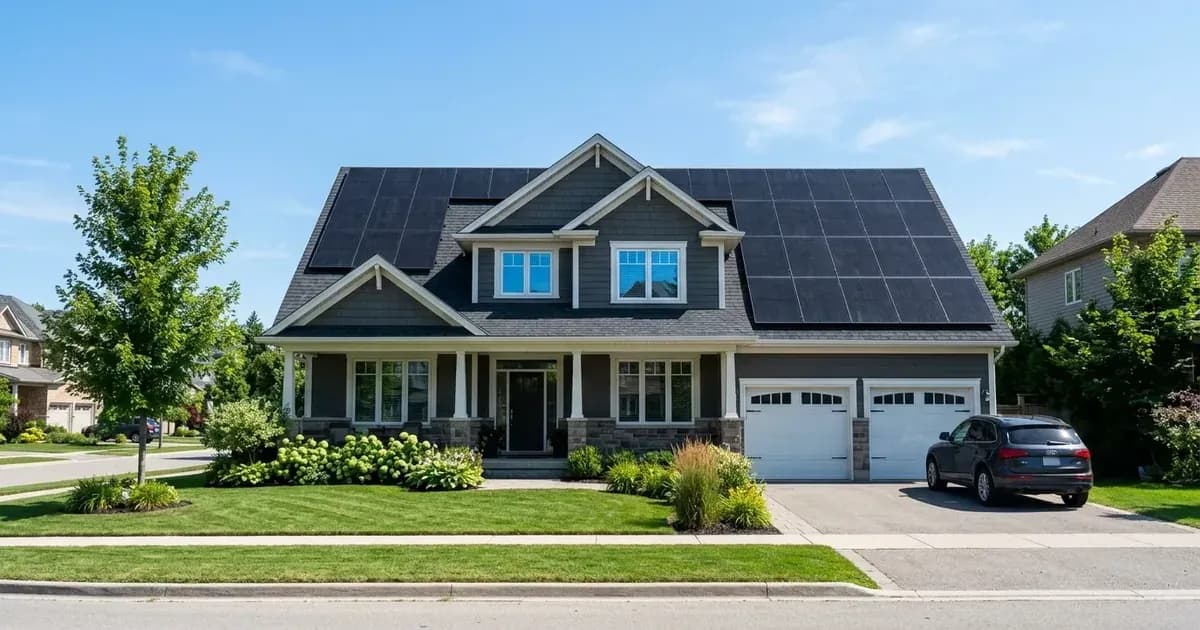
Determining how many solar panels are required to power a Canadian home requires balancing four primary factors: annual household electricity consumption in kilowatt-hours (kWh), regional solar irradiance (peak sun hours), roof azimuth and seasonal pitch, and the specific provincial utility interconnection framework. Across Canada, average residential electricity usage ranges from 8,500 kilowatt-hours annually in urban Ontario homes to over 14,000 kWh in all-electric homes across Alberta, Saskatchewan, and Atlantic Canada.
Understanding provincial grid connection limits is critical. For example, under Manitoba Hydro interconnection rules, customer generation less than 100 kw in size your excess energy can be sold back to us at the excess energy price using net billing .. The utility currently provides the excess energy price is $0.07173/ kwh until march 31 2027..
Calculating Panel Count: The Sizing Formula
To determine the exact module count for your residence, follow a standard engineering calculation:
- Determine Annual Energy Demand: Review your past 12 months of utility electric bills to find your total annual consumption (e.g., 10,000 kWh/year).
- Determine Regional Specific Yield: In southern Canada, 1.0 kW of nameplate solar capacity produces approximately 1,100 to 1,350 kWh per year, depending on longitude and local shading.
- Calculate Required System Capacity: Divide annual consumption by local specific yield: $$\text{System Capacity (kW)} = \frac{10,000 \text{ kWh/year}}{1,200 \text{ kWh/kW/year}} = 8.33 \text{ kW}$$
- Calculate Panel Quantity: Divide required system capacity by individual panel wattage (e.g., modern 420-watt monocrystalline modules): $$\text{Number of Panels} = \frac{8,330 \text{ watts}}{420 \text{ watts/panel}} = 19.8 \rightarrow 20 \text{ panels}$$
Annual Household Usage | Recommended System Size | Standard Panel Count | High-Output Panel Count | Approximate Roof Area Required |
|---|---|---|---|---|
6,000 kWh / year (Small home / gas heat) | 5 kilowatt capacity | 13 panels | 11 panels | 26 m² (280 sq ft) |
9,000 kWh / year (Average urban home) | 7.5 kilowatt capacity | 19 panels | 17 panels | 39 m² (420 sq ft) |
12,000 kWh / year (Large home / heat pump) | 10 kilowatt capacity | 25 panels | 22 panels | 52 m² (560 sq ft) |
16,000 kWh / year (Rural estate / EV charging) | 13.5 kilowatt capacity | 34 panels | 30 panels | 70 m² (750 sq ft) |
Seasonal Production Imbalance and Self-Consumption Economics
Canada's northern latitude creates a massive seasonal production swing between summer solstices and winter months. Because production is at its highest during long summer days your energy requirements are much lower resulting in more excess energy. A system producing 1,400 kilowatt-hours in July may only yield 250 kilowatt-hours in December.
Under traditional 1:1 net metering (such as in Ontario, BC, and Nova Scotia), summer surplus credits bank on your account to offset winter consumption. However, under net billing regimes (such as Manitoba), export credits are lower than retail rates. Consequently, utility engineers advise that a properly sized system that uses most of the energy generated rather than selling excess to us will typically provide a better payback.
When evaluating overall project viability, homeowners must calculate their financial return: divide the total cost of your system from step 1 by your annual financial benefits. For market transparency, the table below contains historical excess energy prices over the last 6 years..
Roof Orientation, Mounting Tilt, and Permitting Requirements
Where and how panels are mounted fundamentally impacts total annual production:
- Azimuth Orientation: True South is ideal. Southwest or Southeast orientations yield approximately 5% to 8% less annual energy, requiring 1 to 2 additional modules to achieve equivalent output.
- Pitch and Tilt Angles: For fixed rooftop arrays, roof pitch generally dictates module tilt. In ground-mount installations, fixed panel systems facing due south at 40, balancing summer generation with winter snow-clearing incline.
- Mounting Architecture: Systems utilize either solar photovoltaic (pv) panels installed on roof-tops or mounted on the ground.
Before any equipment is procured, homeowners must recognize that all solar panel installations need an electrical permit. An installation must satisfy Section 64 of the Canadian Electrical Code (CSA C22.1) and receive a provincial certificate of inspection.
Budgeting for a complete installation requires looking beyond module prices: taxes permit costs a bi-directional meter electrical service upgrades and ongoing maintenance? what kinds of warranties.
Homeowners should note that the federal Canada Greener Homes Grant and Loan programs are closed to new applicants, meaning provincial rebates and utility net metering provide the primary financial mechanisms for solar investments. For provincial code mandates and plan review thresholds, review our guide to Canadian Electrical Code Section 64 solar rules.
Electrical Safety and Site Assessment Considerations
Planning and installing residential solar requires strict adherence to workplace safety and electrical hazard prevention:
- Structural Roof Loading: Ensure roof trusses are inspected by a structural engineer or qualified installer before mounting 20 or more panels. Wet snow loads combined with solar racking weight must not exceed municipal building code limits.
- Service Panel Capacity: High-power solar systems backfeed current through the main electrical panel. Ensure your primary service panel rating (typically 100-amp or 200-amp) complies with the CEC 120% busbar rule or budget for a service panel upgrade.
- Licensed Contractor Mandate: All high-voltage AC inverter connections, bi-directional utility meter bases, and system grounding must be completed by a licensed electrical contractor under an active provincial inspection permit.
References
- Manitoba Hydro Customer Generation Guidelines — accessed 28 August 2026
Related guides
More from sizing, net billing & installation.