Haval Jolion HEV
Rs 9,116,216 verified 26 Jul 2026 — prices in Pakistan move weekly
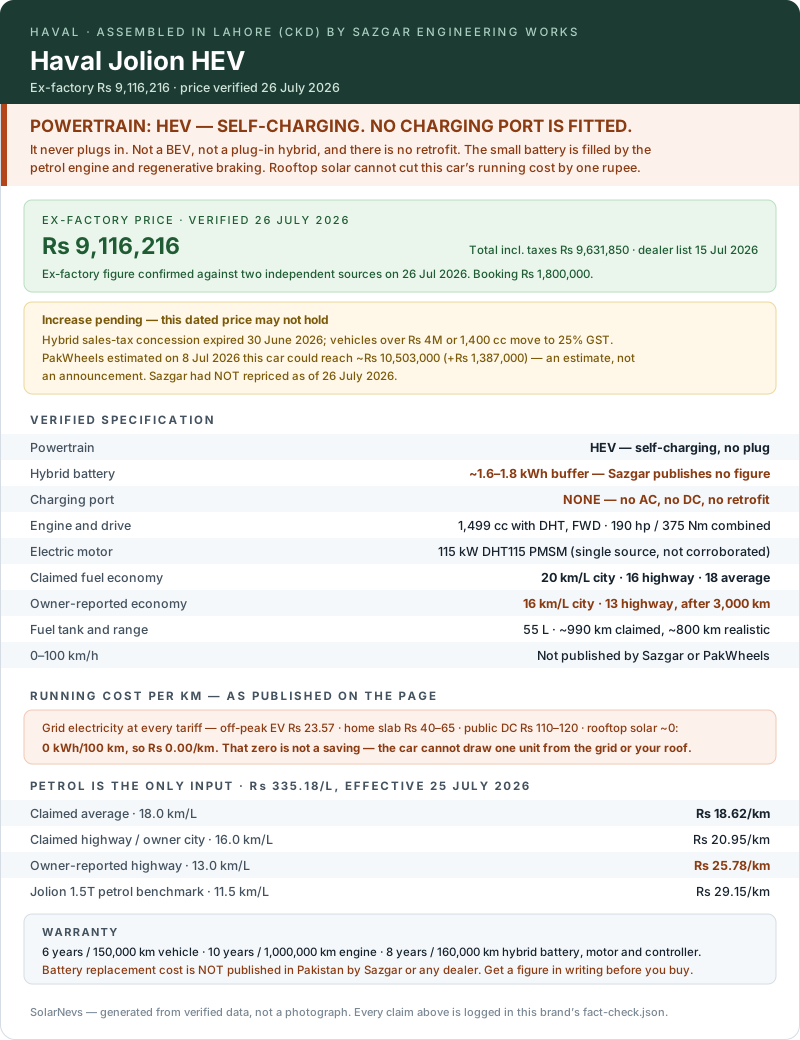
Specifications
| batteryKwh | 1.6-1.8 (not published by Sazgar; sources conflict) |
|---|---|
| batteryDetail | Small lithium-ion buffer pack. There is no charging port. |
| claimedRangeKm | 990 (55 L tank x 18 km/L claimed average) — petrol range, NOT electric range |
| claimedRangeCycle | Manufacturer claim; no EV-only range exists for this car |
| realisticRangeKm | 800 (55 L x ~14.5 km/L owner-reported) |
| kwhPer100km | 0 |
| acCharging | None — no charge port fitted |
| dcCharging | None — no charge port fitted |
| motorKw | 115 (DHT115 permanent-magnet synchronous motor) |
| zeroToHundred | Not published by Sazgar or PakWheels |
| Powertrain | HEV |
| Warranty | 6 years / 150,000 km vehicle; 10 years / 1,000,000 km engine; 8 years / 160,000 km on the hybrid battery, motor and controller. Battery replacement cost is not published in Pakistan. |
Haval Jolion HEV
The Haval Jolion HEV is a self-charging hybrid compact SUV, assembled in Lahore by Sazgar Engineering Works since March 2024. Ex-factory price as of 26 July 2026: Rs 9,116,216.
Now the sentence most Pakistani coverage refuses to write clearly: the Jolion HEV never plugs in. There is no charging port. It is not an EV, it is not a plug-in hybrid, and no amount of rooftop solar will cut its running cost by a rupee. Its small battery — roughly 1.6-1.8 kWh, a figure Sazgar does not publish — is charged by the engine and by regenerative braking. Every kilometre is ultimately paid for in petrol at Rs 335.18/litre.
Variants and prices
Variant | Powertrain | Ex-factory (26 Jul 2026) | Total incl. taxes |
|---|---|---|---|
Jolion 1.5T | Petrol, no electrification | Rs 7,796,106 | Rs 8,245,470 |
Jolion HEV | HEV — self-charging, no plug | Rs 9,116,216 | Rs 9,631,850 |
Booking Rs 1,800,000; dealer list, 15 July 2026.
Specifications
Item | Figure |
|---|---|
Powertrain | HEV — self-charging, no plug |
Engine / transmission | 1,499 cc with DHT, FWD |
Combined output | 190 hp / 375 Nm |
Battery | ~1.6-1.8 kWh Li-ion buffer {/* VERIFY: Sazgar publishes no figure; Wikipedia states 1.6 kWh, other sources 1.8 kWh */} |
Charging port | None |
Claimed economy | 20 km/L city, 16 highway, 18 average |
Fuel tank | 55 L |
0-100 km/h | Not published {/* VERIFY */} |
Running cost per km
The electricity-tariff table, presented honestly:
Electricity source | Rs/unit | Grid kWh/100 km | Cost/km |
|---|---|---|---|
Off-peak EV tariff | 23.57 | 0 | Rs 0.00 |
Home slab | 40-65 | 0 | Rs 0.00 |
Public DC fast | 110-120 | 0 | Rs 0.00 |
Rooftop solar | ~0 | 0 | Rs 0.00 |
Those zeros are not a saving. This car draws zero kWh from the grid because it cannot. Its energy comes from one place:
Fuel economy basis | km/L | Cost/km at Rs 335.18/L |
|---|---|---|
Claimed average | 18.0 | Rs 18.62 |
Claimed highway / owner city | 16.0 | Rs 20.95 |
Owner-reported highway | 13.0 | Rs 25.78 |
Jolion 1.5T petrol | 11.5 | Rs 29.15 |
A plug-in H6 PHEV on the Rs 23.57 off-peak EV tariff runs at about Rs 6.25/km. This car cannot reach that at any tariff.
Solar sizing: zero panels. Not because it is efficient, but because it cannot accept a charge. A 585 W panel making ~2.3 kWh/day in Pakistani conditions cuts your household bill and nothing else. Buying a hybrid because you have solar? Look at the H6 PHEV instead.
Honest assessment
Pros. The cheapest hybrid SUV in Pakistan by a clear margin, and it works. PakWheels owners rate it 4.0/5 across 14 reviews, praising styling (5/5), performance (5/5), the panoramic roof, cabin space and quiet low-speed running; one called it "the lowest price in this category" with excellent comfort and build. Blind-spot monitoring, autonomous emergency braking, lane-keep assist and adaptive cruise are generous kit here, the warranty leads the segment, and it needs no charging infrastructure at all.
Cons. The economy claim does not survive Pakistani roads. One owner who bought specifically for the advertised figures reported 16 km/L city and 13 km/L highway after 3,000 km against a 20/16 claim. Several find the driver assists intrusive enough to switch off, and reviews cite build quality, stiff suspension, no seat memory and a manual boot. The financial case is thin: at Rs 1,320,110 over the Jolion 1.5T, real savings of roughly Rs 10/km give about Rs 156,000 a year at 15,000 km, an ~8.5-year payback.
Who should buy it. A high-mileage city driver, mostly stop-start, with no home charging and a budget under Rs 10 million. Anyone with solar hoping to charge a car should look elsewhere.
The Pakistan reality
Real vs claimed. There is no WLTP, CLTC or NEDC electric range here, because there is no electric range. The claim under scrutiny is fuel economy: 20 km/L city and 16 highway, against owner reports of 16 and 13 — roughly 20% short, in line with the ~28% shortfall Pakistani owners report on electrified vehicles generally. Budget on 14-16 km/L and a tank range near 800 km.
Battery replacement and warranty. Coverage is 8 years or 160,000 km on battery, motor and controller, plus 6 years / 150,000 km vehicle and 10 years / 1,000,000 km engine. But Sazgar publishes no replacement price for the pack in Pakistan; it appears in no price list we could find. The mitigating fact is scale: a 1.6-1.8 kWh buffer is perhaps a fiftieth of a BEV pack, and such packs routinely outlast the cars they sit in because they are never deeply cycled. Manageable rather than a write-off — an expectation, not a quotation. Demand a figure in writing.
Charging at home after the February 2026 net-billing switch. Not applicable here, and worth saying because that change reshaped the economics of every other vehicle on this site. Exports now earn about Rs 11/unit against Rs 50+ to import, so daytime self-consumption is the best use of a rooftop system and EV charging is the ideal daytime load. This car cannot participate in any of it.
Charging network — the one genuine advantage. Pakistan has roughly 30-50 publicly accessible charging stations nationwide, no centralised count, and 72 NEECA licences issued since October 2024 that have largely not become working chargers, stalled on grid connections, metering and pending DISCO and OMC no-objection certificates. For a Jolion HEV owner none of this matters: you refuel at any pump, and load-shedding is irrelevant. That immunity is this car's strongest argument.
Flood safety. It still carries a high-voltage system, so the monsoon rule applies as to any plug-in: if the vehicle has been submerged, do not attempt to restart it. Recover it on a flatbed for inspection. A restart risks electrical injury and a voided warranty claim.
Resale. Pakistan has no independent battery state-of-health testing and no settled used-hybrid valuation, so a 2026 Jolion HEV sold in 2032 is priced on guesswork. The small pack limits the exposure, but the opacity is real.
Price context
Vehicle | Type | Ex-factory | Dated |
|---|---|---|---|
Haval Jolion HEV | HEV, no plug | Rs 9,116,216 | 26 Jul 2026 |
MG HS Hybrid+ | HEV, 1.83 kWh, no plug | Rs 9,499,000 | 24 Apr 2026 |
Toyota Corolla Cross 1.8 HEV | HEV, no plug | Rs 9,849,000 | 1 Jul 2026 |
MG HS Super Hybrid | PHEV — plugs in, 24.7 kWh | Rs 10,199,000 | 24 Apr 2026 |
The Jolion HEV is the cheapest here, Rs 382,784 under the MG HS Hybrid+ and Rs 732,784 under the Corolla Cross HEV. But read the last row: for Rs 1,082,784 more, the MG HS Super Hybrid actually plugs in.
Price warning. The hybrid sales-tax concession expired 30 June 2026, pushing vehicles above Rs 4 million or 1,400 cc onto 25% GST. On 8 July 2026 PakWheels estimated this car could reach Rs 10,503,000 (+Rs 1,387,000). As of 26 July Sazgar had not repriced, having absorbed the 2025 NEV levy rather than pass it on. Get your price in writing at booking.
Frequently asked questions
Do I plug the Haval Jolion HEV in?
No. Never. It has no charging port. It is a self-charging hybrid that makes its own electricity from the petrol engine and regenerative braking. Every kilometre it travels is ultimately paid for in petrol.
What does it cost per km?
At the claimed 18 km/L average and petrol at Rs 335.18/L, about Rs 18.62/km. At owner-reported real figures of 16 km/L city and 13 km/L highway, Rs 20.95 to Rs 25.78/km.
Will rooftop solar reduce my running cost?
No. Not by one rupee. The car cannot accept electricity from anywhere except its own engine. Solar cuts your house bill, not this car's fuel bill.
Is it worth the premium over the petrol Jolion?
The HEV costs Rs 1,320,110 more than the Jolion 1.5T. Real-world savings of roughly Rs 10/km mean about eight and a half years to break even at 15,000 km a year.
What does a replacement hybrid battery cost?
Sazgar does not publish a figure in Pakistan. The warranty runs 8 years or 160,000 km. Get a written replacement quote from your dealer before buying.
Will the price rise?
Possibly. The hybrid tax concession expired 30 June 2026. PakWheels estimated on 8 July 2026 that the Jolion HEV could reach Rs 10,503,000. Sazgar had not repriced as of 26 July 2026.
References
- PakWheels — Haval Jolion HEV 2026 price, specs & features — accessed 26 Jul 2026
- PakWheels — locally assembled Haval Jolion HEV specs & features — accessed 26 Jul 2026
- PakWheels — Haval Jolion fuel average — accessed 26 Jul 2026
- PakWheels — Umer Butt ki Haval Jolion HEV owner review — accessed 26 Jul 2026
- PakWheels — Haval hybrid model prices may rise by up to Rs 19.6 lakh (8 Jul 2026) — accessed 26 Jul 2026
- PakWheels — current petroleum prices (Rs 335.18/L w.e.f. 25 Jul 2026) — accessed 26 Jul 2026
- ProPakistani — solar users to pay full unit price under net-billing rule (9 Feb 2026) — accessed 26 Jul 2026