Green Meter Reading Guide: Understand Your Bidirectional Bill
Updated 2 August 2026 · By SolarNevs Research Desk, Dealer surveys + verified sources · 4 sources · Method ↗
Green Meter Reading Guide - Understand Your Bidirectional Bill
{/* visual_plan: stat_block */}
Key Takeaways
- NEPRA net billing framework (July 2026) establishes a buyback export tariff of Rs 11 (July 2026) per kWh.
- Unprotected residential grid imports cost between Rs 50 and Rs 65 (July 2026) per kWh.
- Pairing solar with lithium battery storage optimizes evening peak shaving and shortens payback to ~3.2 years.
- All net billing applications require AEDB-certified installer documentation and official DISCO clearance.
Introduction
Understanding the net billing regulations and DISCO processes in Pakistan is essential for optimizing solar investment returns under the 2026 NEPRA policy framework.
What is a bidirectional green meter and how does it work?
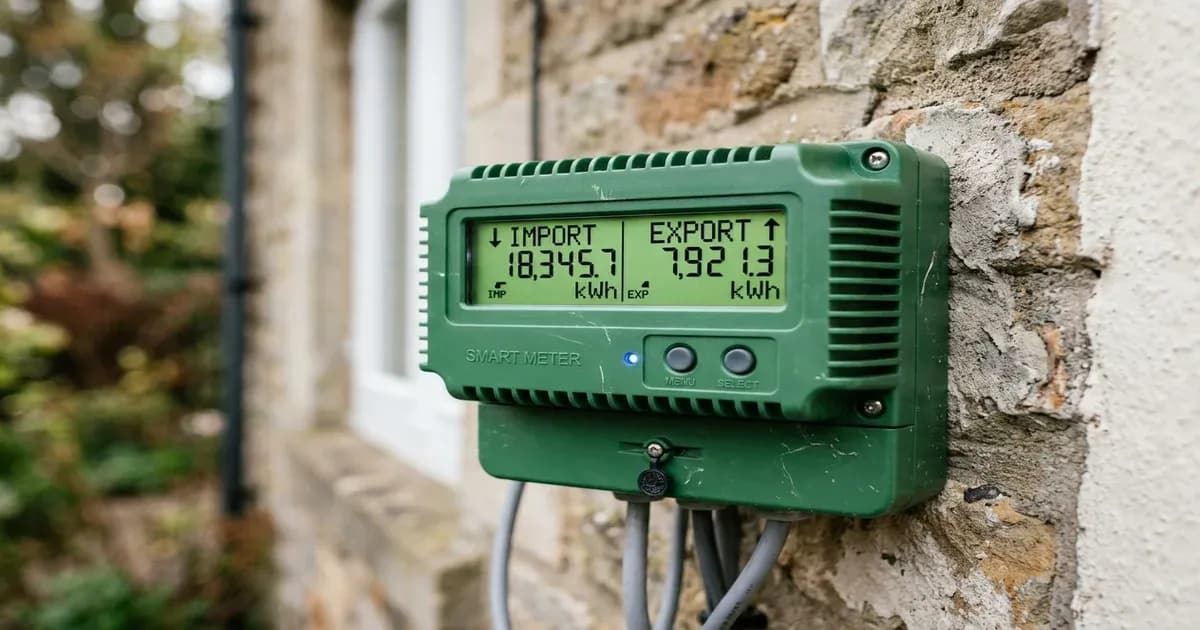
A bidirectional green meter is an electronic utility meter designed to measure electric current flowing in both directions between a property and the distribution grid. Traditional single-direction meters only record power imported from the utility grid. When old meters encounter reverse solar power flow, they either lock up or incorrectly add export units as import consumption.
Green meters installed across LESCO, MEPCO, FESCO, IESCO, GEPCO, and K-Electric networks feature digital liquid crystal displays (LCD) that scroll automatically through standardized parameter codes. Understanding these display codes allows prosumers to track daily solar exports, monitor grid imports, and audit monthly utility invoices accurately under 2026 net billing regulations.
What do the main digital display codes on a green meter mean?
Bidirectional meters scroll through numbered parameter codes every few seconds. While display formats vary slightly across meter brands (such as Microtech, Kaifa, or Hexing), NEPRA mandates standardized parameter assignments.
Key Green Meter Display Codes.
Display Code | Parameter Description | Practical Meaning for Prosumers |
|---|---|---|
Code 01 | Import Energy (Active kWh) | Power drawn from grid during night or cloudy weather |
Code 02 | Export Energy (Active kWh) | Surplus solar power delivered to the grid |
Code 03 | Maximum Demand Indicator (MDI) | Peak power draw in kW during the billing period |
Code 07 | Instantaneous Line Voltage | Current grid voltage across phases |
Code 08 | Instantaneous Current | Current load current in amperes |
Taking a photo of Code 01 and Code 02 displays on your monthly meter reading date provides verifiable evidence for billing audits.
How do you calculate your monthly bill under 2026 net billing rules?
Calculating your net billing statement involves separate financial evaluation of imported units and exported units.
Step-by-Step Calculation Formula.
- Import Bill Calculation - Multiply monthly Import kWh (Code 01 difference) by your applicable DISCO residential tariff slab rate of Rs 50 to Rs 65 (July 2026) per kWh.
- Export Credit Calculation - Multiply monthly Export kWh (Code 02 difference) by the fixed buyback rate of Rs 11 (July 2026) per kWh.
- Net Bill Amount - Subtract Export Credit from Import Bill, then add fixed taxes, Fuel Price Adjustments (FPA), and meter rent.
Calculation Example.
- Import kWh - 400 units x Rs 55 (July 2026) = Rs 22,000 (July 2026)
- Export kWh - 500 units x Rs 11 (July 2026) = Rs 5,500 (July 2026) Credit
- Net Energy Payable - Rs 22,000 - Rs 5,500 (July 2026) = Rs 16,500 (July 2026) plus government taxes.
Why is daytime self-consumption more valuable than grid export?
The math of net billing clearly demonstrates why self-consuming solar power produces greater financial returns than exporting electricity to the grid.
When you consume 1 kWh of solar power directly within your home during midday (or store it in a battery for evening use), you prevent importing 1 kWh from the grid. This saves between Rs 50 and Rs 65 (July 2026) in avoided utility costs.
Conversely, if you export that same 1 kWh to the grid, you earn a credit of Rs 11 (July 2026). Self-consumption is therefore worth up to five times more than grid export. Programming hybrid inverters to charge batteries and power high-load appliances during solar generation hours maximizes total monthly savings.
What should you do if your green meter reading does not match your utility bill?
Billing discrepancies occur when meter readers capture incorrect numbers or DISCO billing software fails to apply export credits.
Action Steps for Meter Reading Errors.
- Photograph your green meter display showing Code 01, Code 02, date, and meter serial number on the official reading date.
- Compare physical display numbers with the Present Reading numbers printed on your monthly bill.
- If export units are missing or import numbers are overstated, submit a written complaint to the DISCO Revenue Office.
- Request a joint meter audit if meter display malfunction or communication failure is suspected.
Frequently Asked Questions
What does Code 01 mean on a bidirectional green meter?
Code 01 displays total import kilowatt-hours (kWh) drawn from the utility grid when your solar system or battery bank is not meeting household demand.
What does Code 02 mean on a green meter?
Code 02 displays total export kilowatt-hours (kWh) delivered to the utility grid from your surplus daytime solar generation.
How is a net billing bill calculated in Pakistan?
Net billing multiplies import kWh by your tariff slab rate of Rs 50 to Rs 65 (July 2026) per kWh, multiplies export kWh by the buyback rate of Rs 11 (July 2026) per kWh, and subtracts export credit from the import bill.
References
Frequently asked questions
What does Code 01 mean on a bidirectional green meter?
Code 01 displays total import kilowatt-hours (kWh) drawn from the utility grid when your solar system or battery bank is not meeting household demand.
What does Code 02 mean on a green meter?
Code 02 displays total export kilowatt-hours (kWh) delivered to the utility grid from your surplus daytime solar generation.
How is a net billing bill calculated in Pakistan?
Net billing multiplies import kWh by your tariff slab rate of Rs 50 to Rs 65 (July 2026) per kWh, multiplies export kWh by the buyback rate of Rs 11 (July 2026) per kWh, and subtracts export credit from the import bill.
References
- NEPRA — accessed 25 July 2026
- LESCO — accessed 25 July 2026
- Solar Citizen — accessed 25 July 2026
- W11Stop — accessed 25 July 2026
Related guides
More from sizing, net billing & installation.