Solar Pump Inverter VFD Selection Guide for Farmers in Pakistan
Updated 30 October 2026 · By SolarNevs Research Desk, Dealer surveys + verified sources · 16 sources · Method ↗
Key Takeaways
- Veichi's tables mostly pair an inverter with a pump of the same kW, such as a 15 kW inverter with a 15 kW pump, and INVT's checklist says motor power must match inverter power. The "buy one size higher" advice appears in dealer blogs; the manufacturer documents we read do not state it, though some installations use a larger drive.
- MPPT efficiency figures are peak claims. Veichi prints up to 99.8% and INVT prints up to 99%. We found no independent test.
- DC input depends on the model: 250 to 780 V on the Veichi SI23-D5, 300-850 V (MPPT range 300-800 V) on the SI30-D5, and a recommended 300-750 V on INVT's 380 V class, whose maximum DC voltage is listed as 800 V or 900 V.
- Enclosure ratings differ: the Veichi SI23 is IP20, the SI30 is IP65, and an INVT drive is IP20 as standard with IP54 as an option.
- Retail prices vary several-fold at the same rating. On 28 October 2026 one retailer listed 15 kW drives from Rs. 89,000 to Rs. 460,200.
- Veichi and INVT both document dry-run protection and tank-full or level inputs. A hybrid input is documented for the Veichi SI23 (utility power) and the INVT GD100-PV (grid or generator).
Introduction
A solar tube well runs only as well as its drive. The inverter, often called a VFD, decides how much of the array's power reaches the motor, what happens when the well runs dry, and what you pay for the unit. This guide uses the manufacturers' own manuals and datasheets for the specifications, and keeps retailers' prices and opinions labelled as such.
What does a solar pump inverter do?
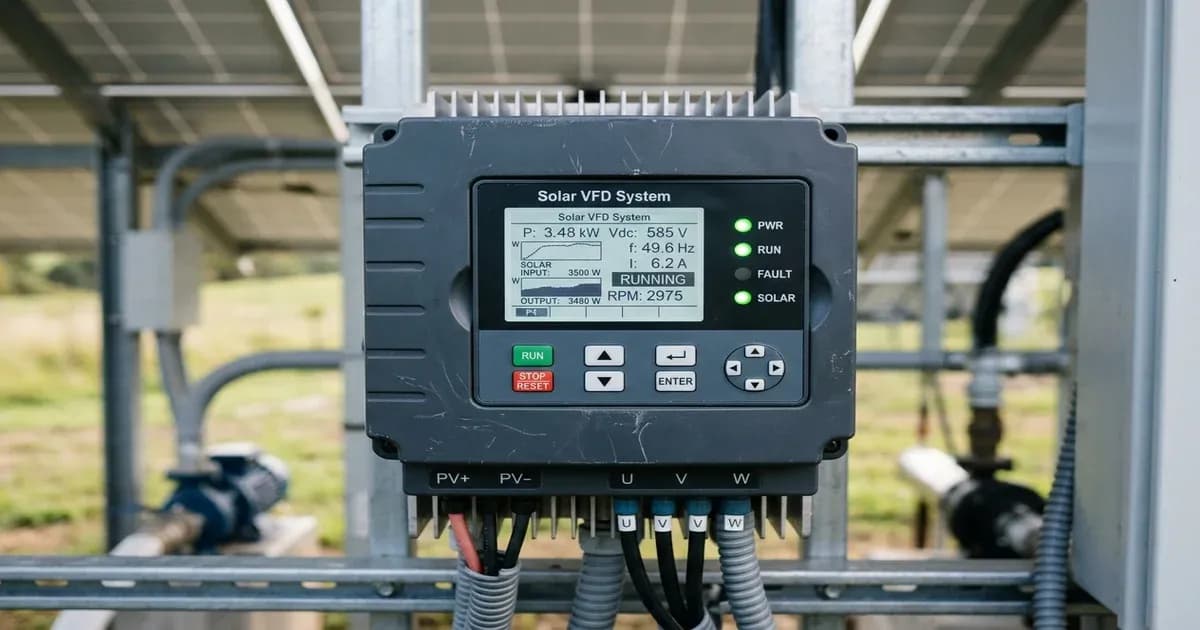
The FAO and GIZ brief calls the electronic controller the key device, which adapts the available power from the solar generator to the solar pump, using Maximum Power Point Tracking to optimize the water output. The World Bank adds that power conditioners convert DC power from the solar panels to match the pump motor's requirements. Larger systems use AC motors, which require a DC/AC inverter, because DC motors were not available beyond 5 kW at the time of the World Bank's 2018 report.
The drive also stops the pump when the sun is weak. Veichi's manual says the inverter goes into sleep state when the DC voltage from the panels is lower than a set threshold. That is by design, not a fault. Integrators sometimes rebrand third-party drives, so check the model on the nameplate, not the brand on the cabinet.
How do the common drives compare?
Figures below come from the manufacturers' own documents, not from retailers.
| Veichi SI23-D5 | Veichi SI30-D5 | INVT GD100-PV (380 V class) |
|---|---|---|---|
Rating range | 0.75 kW to 30 kW | Up to 11 kW | 0.75-500 kW |
DC input | 250 to 780 V (250 to 850 V for the D5(H) variant) | 300-850 V, MPPT range 300-800 V | Recommended 300-750 V, start-up 300 V, minimum working 250 V, maximum 800 V or 900 V |
Recommended array open-circuit voltage, 380 V pumps | 620-750 V | 620-750 V | Not given in the same terms |
Maximum MPPT efficiency | Up to 99.8% | Up to 99.8% | Up to 99% |
Enclosure | IP20 | IP65 | IP20 standard; IP54 is offered as a cabinet product |
INVT's manual lists a maximum DC voltage of 800 V and 900 V for its 380 V class and marks H versions as DC high-withstand-voltage products, while its catalog gives 900 V on the 380-440 V AC class. Ask which version you are buying and what maximum DC voltage its datasheet gives before you fix the number of panels in series. The 620-750 V figure is a recommended open-circuit voltage for the array, not the MPPT window, which differs by model. All three MPPT numbers are "up to" figures from the makers. Do not read them as typical or average values.
How should you size the inverter against the motor?
The manufacturers' tables are straightforward. Veichi's SI23 table pairs a 7.5 kW inverter with a 7.5 kW pump, a 15 kW inverter with a 15 kW pump and a 22 kW inverter with a 22 kW pump, and lists a maximum solar input of 10 kW, 19.5 kW and 28.6 kW for those three. One SI30 row lists a 4 kW inverter with a 3.7 kW pump. Its operating guidance says to confirm that the solar pump drive matches the motor. INVT's commissioning check says the motor type, voltage, and power match the inverter type, voltage, and power. An INVT overload fault lists selecting an inverter with larger power as one remedy, which is a fault fix, not a sizing rule.
Veichi adds one caution for the opposite case: when the rating current of the motor is far smaller than that of the solar pump inverter, adjust the protective value to ensure safe running.
Field practice varies. On Veichi's Pakistan project pages, a Lahore system pairs a 7.5 kW inverter with a 7.5 kW pump and a 9.6 kW array, and an Islamabad system pairs an 11 kW inverter with an 11 kW pump and a 13.5 kW array. Another Lahore system puts an 11 kW inverter on a 7.5 kW pump with a 10 kW array. INVT's own site list is mixed and not Pakistani: a farm near Dubai (March 2017) pairs a 4 kW pump with a drive whose model code 5R5 means 5.5 kW, while sites in Morocco (March 2017) pair 37 kW and 4 kW pumps with drives of the same ratings, and another site pairs a 2.2 kW pump with a 2.2 kW drive.
The upsizing rule appears in dealer blogs. One tells buyers never to buy a VFD that perfectly matches the motor size and gives a 10 HP (7.5 kW) motor with an 11 kW VFD as the example. Another says a 15 HP motor needs a minimum 15kW VFD, which treats horsepower as kilowatts. INVT's own rating table lists 11 kW as 15 Hp and 15 kW as 20 Hp, so a 15 HP motor is nearer 11 kW. Read the motor nameplate in kW and ask the seller which row of the manufacturer's table they are using. A Pakistani dealer says undersizing the VFD causes overcurrent tripping in low sunlight and that oversizing slightly is safe. The World Bank notes that variable speed drives coupled with AC pumps tend to suffer degraded performance under stop-start solar conditions.
What protections should you look for?
- Dry run. The Veichi SI23 can detect dry running without a sensor, by output current, or with a sensor. It also has an input for an external dry-running sensor. The SI30 stops the pump when it detects the output current is too low. INVT can judge dry pumping from output power or from output current.
- Tank full and low level. Veichi's SI23 detects the water full alarm and low water level through two X terminals to realize automatic level control. INVT reports a tank-full alarm from a water-level switch and then sleeps.
- Hybrid input. The Veichi SI23 switches to utility power when the solar panel power is lower than a set value. INVT says its hybrid mode uses the energy of both PV modules and grid (or generator) at the same time, and offers an optional auto-switch module. A hybrid input is not a feature of every drive, so ask.
What do solar pump inverters cost in Pakistan?
We found no single price, and no listing price for a Veichi or INVT GD100-PV on any fetchable page. One dealer that stocks both asks buyers to message for a quote. The table shows one retailer's asking prices on 28 October 2026 for the drive only. The page's "updated on" stamp equals the day we read it, so treat these as prices seen that day, not verified price changes.
Drive (w11stop listing) | Rating | Asking price (28 October 2026) |
|---|---|---|
Voltronic Power Aspire | 7.5 kW | Rs. 54,000 |
SAJ VFD Drive | 7.5 kW | Rs. 60,000 |
SAJ VFD Drive | 11 kW | Rs. 79,000 |
SAJ VFD Drive | 15 kW | Rs. 89,000 |
SAJ VFD Drive | 22 kW | Rs. 135,500 |
Knox HOBER-HSPH7500H | 7.5 kW | Rs. 247,800 |
Knox HOBER-HSPH15KH | 15 kW | Rs. 460,200 |
One JFY 7.5 kW listing shows two different prices on the same page, Rs. 129,800 and Rs. 125,000, so do not average listings. A dealer blog dated 6 April 2026 gave estimates of Rs. 45,000 - 50,000 for a 7.5 kW VFD and Rs. 75,000 - 85,000 for a 15 kW VFD, labelled as estimates for INVT, Veichi and Frecon. Prices differ several-fold between brands at the same kW. Ask for the brand, model and enclosure rating on every quote.
Which brands are sold in Pakistan?
Veichi's own site lists named Pakistan projects, including SI30 systems in Islamabad and Lahore. INVT's site lists a GD100-PV site in Pakistan with a GD100-1R5G-SS2-PV drive and eight 270 W panels. One dealer names INVT, Veichi, and Frecon as the most popular and reliable VFD brands in the local market; another stocks INVT GD100-PV, Veichi and Aspire Voltronic. One retailer lists Hober-model (HSPH) pump inverters under the brand name Knox. We found no official Hober or Frecon manual, and no market-share data. "Most common" here means dealer opinion.
Summary and Recommendations
- Choose the drive from the manufacturer's table row for your motor's kW, taken from the nameplate, not from a horsepower rule of thumb.
- Check the array's open-circuit voltage against the recommended range (Veichi gives 620-750 V for 380 V controllers) and against the maximum DC voltage of the exact version you buy.
- Treat MPPT efficiency numbers as peak claims and ask what test they come from.
- Match the enclosure to where the drive will be mounted. IP20 and IP65 are not the same product.
- Ask for dry-run and tank-full inputs, and for a hybrid input if you want a generator or grid backup.
- Get itemised quotes with brand, model and enclosure at the same kW. Do not compare a Rs. 89,000 drive with a Rs. 460,200 one as if they were alike.
- Related guides: drip irrigation and solar combo economics and solar tube well versus diesel.
Correction, 28 October 2026: earlier versions of this guide printed a price table, a ">99%" MPPT figure, a "250V-800V" input range, an IP54 enclosure for every unit and a "one size higher" sizing rule. None could be traced to a source and they have been replaced.
Solar tube-well quotes from installers who work in your district
Tell us pump size and district. We pass your number to installers who quote against the surveyed prices on this page.
How this pays for the site: installers pay SolarNevs a fixed introduction fee when we pass them a genuine enquiry. They cannot pay to appear higher, and our surveyed prices are published before any introduction. You can also take our dated price tables straight to any installer.
Frequently asked questions
Why is a VFD inverter required for a solar tube well?
Larger solar pumps use AC motors, and the World Bank says AC motors need a DC/AC inverter while DC motors were not available beyond 5 kW at the time of its 2018 report. The drive adapts the solar array's power to the pump and uses MPPT to optimise water output (FAO and GIZ). Manufacturer documents list protections such as dry-run and tank-full inputs; none we read promises that it prevents motor burnout.
How should farmers size a solar pump VFD relative to motor horsepower?
Start from the manufacturers' documents. Veichi's tables mostly list an inverter with a pump of the same kW, for example 15 kW with 15 kW, and INVT's commissioning check says the motor power must match the inverter power. The advice to buy one size higher comes from dealer blogs, and one mixes HP with kW: INVT's own rating table lists 11 kW as 15 Hp. A dealer adds that undersizing causes overcurrent tripping in low sunlight. Match on the kW printed on the motor nameplate and ask the seller which table row they used.
What is the price of a 15kW solar pump VFD drive in Pakistan?
There is no single price. On 28 October 2026 one retailer listed 15 kW pump inverters from Rs. 89,000 (SAJ) to Rs. 460,200 (Hober). We found no listing price for a Veichi or an INVT GD100-PV. One dealer blog gives April 2026 estimates of Rs. 75,000 - 85,000 for a 15 kW VFD across INVT, Veichi and Frecon, and one dealer asks buyers to message for a quote.
References
- Veichi solar pump inverter catalog — accessed 28 October 2026
- Veichi SI23 solar pump inverter manual v1.3 — accessed 28 October 2026
- Veichi SI23 datasheet — accessed 28 October 2026
- Veichi SI30 solar pump inverter manual v1.2 — accessed 28 October 2026
- Veichi SI30 datasheet — accessed 28 October 2026
- Veichi project page, Lahore, Pakistan (7.5 kW) — accessed 28 October 2026
- Veichi project page, Islamabad, Pakistan (11 kW) — accessed 28 October 2026
- Veichi project page, Lahore, Pakistan (SI30 11 kW) — accessed 28 October 2026
- INVT GD100-PV manual V2.1 — accessed 28 October 2026
- INVT GD100-PV catalog V3.0 — accessed 28 October 2026
- INVT GD100-PV solar water pump applications — accessed 28 October 2026
- FAO and GIZ, solar powered irrigation systems technology brief — accessed 28 October 2026
- World Bank, Solar Pumping: The Basics (2018), SuSanA library copy — accessed 28 October 2026
- w11stop - solar pump inverter listings — accessed 28 October 2026
- Solar Hub - VFD inverter price in Pakistan (dealer blog) — accessed 28 October 2026
- Pakistan Solar Traders - solar pump inverter VFD page — accessed 28 October 2026
Related guides
More from sizing, net billing & installation.