Huawei SUN2000 Error Codes - Pakistan Troubleshooting Guide
Updated 2 August 2026 · By SolarNevs Research Desk, Dealer surveys + verified sources · 12 sources · Method ↗
Huawei SUN2000 Error Codes - Pakistan Troubleshooting Guide
{/* visual_plan: stat_block */}
Key Takeaways
- Huawei grades every SUN2000 alarm as Major, Minor or Warning. Major means the inverter has shut down or is functioning abnormally; Warning means it still works but output has dropped for external reasons (SUN2000-(2KTL-6KTL)-L1 User Manual, Issue 14, 2023-08-23).
- Alarm 2064 Device Fault represents multiple possible issues, carrying twelve cause IDs from a short-circuited DC-DC input to DC bus voltage imbalance, and only an installer-level login shows the specific cause.
- Grid alarms 2032, 2033 and 2034 dominate Pakistani sites because the grid code permits a 5% deviation on voltage normally and 10% under contingency, so a 230V feeder can legally sit at 253V.
- Alarm 2011 String Reversed has a safety rule to wait until PV string current falls below 0.5 A, and then set the DC switch to OFF before touching polarity.
- Huawei SUN2000 pricing in Pakistan sits around Rs 1.5 to 2 lakh for a 5KTL and Rs 2.5 to 3.5 lakh for a 10KTL (dealer listing updated 21 June 2026), on a stated 10-year manufacturer warranty extendable to 15 or 20 years.
How do you read a SUN2000 alarm in FusionSolar?
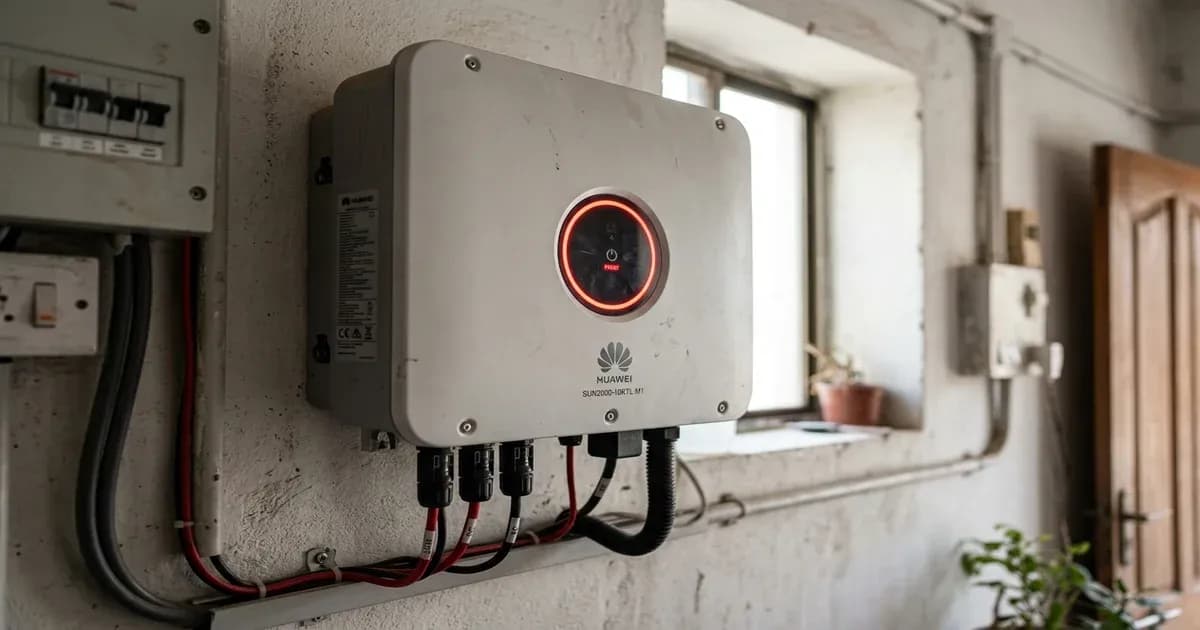
Huawei does not put fault text on a screen the way a cheap hybrid does. The SUN2000 has status LEDs and a Bluetooth or Wi-Fi link to the FusionSolar app. The alarm itself lives in the app and in the FusionSolar management portal. Each alarm has a numeric Alarm ID in the 2000 range, an alarm name, a severity, and a Cause ID.
The Cause ID is where most Pakistani diagnoses fall apart. Alarm 2001 with Cause ID 1 means the PV1 input voltage is high, while Cause ID 2 means PV2. Alarm 2064 has twelve cause IDs pointing at different components. An owner-level FusionSolar account typically shows the alarm name. The cause detail and the deeper commissioning parameters sit behind an installer or non-owner account.
Practical consequence. When you pay for a Huawei system, insist on a plant-owner account in your own name and email, plus written confirmation of who holds the installer account. If your installer disappears in two years and nobody can log in at that level, your premium inverter becomes far less diagnosable.
What do the PV-side SUN2000 alarms mean?
{/* visual_plan: comparison */}
- 2001 High String Input Voltage (Major). Too many modules in series, so string open-circuit voltage exceeds the inverter's maximum operating voltage. Huawei's fix is to correct the series configuration; the alarm then clears on its own. In Pakistan this shows up in December and January, not in June, because open-circuit voltage climbs as cell temperature falls.
- 2002 and 2003 DC Arc Fault (Major). String power cables are arcing or in poor contact. This is the alarm to take most seriously on a rooftop. Mixed-brand MC4 connectors, crimps done with pliers instead of a proper tool, and water sitting in a junction box are the usual local causes.
- 2011 String Reversed (Major). The string is connected in reverse polarity. Huawei's procedure is specific and worth quoting in full because installers ignore it. Check whether the string is reversed, then wait until the PV string current decreases below 0.5 A, set the DC switch to OFF, and adjust polarity. Pulling a live DC connector under load is how people lose fingers and burn combiner boxes.
- 2021 AFCI Check Failure (Major). The arc-fault self-check failed, either because the check circuit is abnormal or the AFCI circuit is faulty. Turn off the AC output switch and the DC input switch, wait five minutes, turn them back on. If it persists, it is a dealer or Huawei support case.
- 2080 Abnormal PV Module Configuration (Major). Module or optimiser configuration does not meet requirements, or output is reversed or short-circuited. Cause ID 9 specifically covers a string voltage exceeding the inverter input specification in partial-configuration scenarios.
- 2081 Optimizer Fault (Warning). An individual optimiser is faulty. Severity Warning, so the plant keeps producing.
What do the grid-side alarms mean on a weak Pakistani feeder?
This block is where most Pakistani SUN2000 owners live.
- 2032 Grid Failure (Major). Either the grid is out or the AC circuit is disconnected or the AC breaker is off. Check AC voltage, and then check the breaker. During load-shedding this is normal and self-clears.
- 2033 Grid Undervoltage (Major). Grid voltage below the lower threshold, or a low-voltage event lasting longer than the low-voltage ride-through setting allows.
- 2034 Grid Overvoltage (Major). Grid voltage above the upper threshold, or a high-voltage event beyond the high-voltage ride-through setting.
- 2036, 2037, 2038 Grid Overfrequency, Underfrequency, Unstable Frequency (Major). Frequency outside, or changing faster than, the local standard permits.
- 2039 Output Overcurrent (Major). Grid voltage dropped sharply or the grid faulted, and transient output current exceeded the upper threshold.
- 2040 Output DC Component Overhigh (Major). DC content of the AC output exceeded the allowed threshold.
- 2070 Active Islanding (Major). During an AC outage the inverter proactively detected islanding and disconnected. This is the anti-islanding protection doing its job.
- 2072 Transient AC Overvoltage. Phase voltage exceeded the protection threshold momentarily.
Huawei's advice on 2033, 2034, 2036, 2037 and 2038 follows one shape. If it happens occasionally, the grid was temporarily abnormal and the inverter recovers by itself. If it happens frequently, check whether grid voltage or frequency is within the allowed range, and if the values lie outside limits, contact the power operator. Only if the grid is genuinely inside the permitted band should the protection threshold be modified, and Huawei explicitly says that must be done with the consent of the local power operator.
Read that last line twice. Pakistani installers routinely widen the over-voltage trip window to stop customers complaining about daytime shutdowns. That practice represents a temporary bypass rather than a repair, masking a distribution problem and doing nothing about the transformer tap causing 250V at your meter.
What do the earthing and insulation alarms mean?
{/* visual_plan: callout_card */}
- 2051 Abnormal Residual Current (Major). Insulation impedance from the input side to PE has fallen while the inverter is running. Occasional occurrence means a temporary external abnormality and the inverter recovers automatically. Frequent or persistent occurrence means the impedance between the PV string and ground is genuinely too low.
- 2062 Low Insulation Resistance (Major). Either a short circuit between the PV array and ground, or damp ambient air around the array giving poor insulation. Huawei's troubleshooting steps include checking array-to-ground output impedance and rectifying any short or insulation loss, verifying that the inverter's PE cable is correctly connected, and only then, if impedance drops below threshold specifically on rainy and cloudy days, considering adjusting the insulation resistance protection setting. The app reports the current insulation resistance in megohms and a possible short-circuit position as a percentage along a single string.
- 2061 Abnormal Grounding. Neutral or ground cable disconnected.
These three are the Pakistan alarms. Most Pakistani rooftops sit on houses with a single copper rod, dry soil and no periodic earth-resistance testing. Add monsoon humidity, dust cementing onto DC insulation and rodents in cable trays, and 2051 and 2062 become seasonal visitors. The correct order of work requires measuring earth resistance, re-terminating the PE cable, drying and re-sealing junction boxes, and only then considering a software threshold.
What do the device, meter and battery alarms mean?
- 2063 Overtemperature (Minor). Poor ventilation, ambient above the upper threshold, or the inverter is not working properly. Check ventilation and ambient temperature at the mounting position first. In Multan, Sukkur or Jacobabad, a west wall in June is not a mounting position.
- 2064 Device Fault (Major). An unrecoverable internal circuit fault, with cause IDs 1 to 12. These include DC-DC input short-circuited, DC-DC input overcurrent, control circuit faulty, inverter circuit abnormal, residual current sensor faulty, temperature detection failure, EEPROM read/write failure, auxiliary power supply abnormal, grid-tied relay abnormal, DC bus overvoltage, DC bus undervoltage, and DC bus voltage imbalance. Turn off AC and DC, wait five minutes, restart. If it persists, contact the dealer or Huawei support.
- 2065 Upgrade Failed or Version Mismatch (Minor). Main controller software and hardware mismatch, controller version mismatch, monitoring and power controller version mismatch, a failed upgrade, or a failed optimiser upgrade. Retry the upgrade once.
- 2067 Faulty Power Collector (Major). The smart power sensor is disconnected. Check the configured meter model matches the real one, that RS485 parameters match, and that the meter is powered with its cable connected.
- 2068 Battery Abnormal (Minor). Cause IDs cover abnormal battery communication, battery port overcurrent, an improperly connected enabling cable, and abnormal battery port voltage.
- 2077 Off-grid Output Overload (Major). Output overloaded or short-circuited.
- 61440 Monitoring Unit Faulty (Minor). Flash memory insufficient or with bad sectors. Restart after five minutes; otherwise the monitoring board may need replacing.
Alarm 2067 deserves a Pakistani footnote. Net metering was abolished for new connections under the NEPRA Prosumer Regulations notified on 8 to 9 February 2026, with export now credited at roughly Rs 11 per unit against import at up to Rs 50 to 65 per unit. That has changed why the meter matters, not whether it matters. On a new connection the smart power sensor is what lets the inverter hold export at zero. If 2067 is live, your export limiting is blind.
When should you stop and call the installer?
Stop and call if you see 2002 or 2003 DC Arc Fault. Arcing on a DC string is a fire risk and there is no owner-level fix. Stop if you see 2011 String Reversed and you are not equipped to verify string current is below 0.5 A before opening the DC switch. Stop if 2064 returns after one clean five-minute restart, because the cause ID list is entirely internal hardware. Stop if 2062 persists on dry, sunny days, because that is real insulation damage rather than morning dew.
You can reasonably wait out 2032, 2033, 2034, 2036, 2037, 2038 and 2070 as those are grid conditions, and Huawei's own guidance is that the inverter recovers automatically once the grid normalises. Log the frequency though. If your app shows the same grid alarm five days a week at the same hour, the conversation belongs with your DISCO, and a written complaint with timestamped app screenshots is far more effective than a phone call.
Frequently Asked Questions
What is alarm 2062 on a Huawei SUN2000?
Alarm 2062 is Low Insulation Resistance, rated Major. Either the PV array has a ground short or the array is damp. It is common at dawn and in monsoon. Check array-to-ground impedance and the PE cable before changing any protection threshold.
Why does my Huawei inverter show 2034 grid overvoltage?
Alarm 2034 indicates that grid voltage exceeded the upper threshold. On Pakistani feeders that is usually a real network condition rather than an inverter fault. Huawei's manual recommends checking whether grid voltage is within the allowed range and contacting the power operator if not.
What does alarm 2064 Device Fault mean?
The alarm 2064 indicates an unrecoverable internal circuit fault with twelve possible cause IDs, from a shorted DC-DC input to DC bus imbalance. Turn off AC and DC, wait five minutes, restart once. If it returns, request a service call.
References
- Huawei SUN2000-(2KTL-6KTL)-L1 User Manual, Issue 14 (2023-08-23)
- [Huawei SUN2000-(2KTL-6KTL)-L1 User Manual, Issue 20 (2024-05-30)](https://nastechsolar.com/content/INVERTERS/HUAWEI/Manuals/SUN2000-(2KTL-6KTL)-L1%20User%20Manual.pdf)
- Huawei enterprise support - SUN2000-(3KTL-10KTL)-M0 troubleshooting
- Huawei SUN2000 alarm code list, Solar Analytica
- Huawei Smart PV Pakistan
- Huawei inverter Pakistan range and pricing, Solar Citizen
- NEPRA Draft Grid Code 2021
- NEPRA net-metering reference guide, PPIB
Frequently asked questions
What is alarm 2062 on a Huawei SUN2000?
Alarm 2062 is Low Insulation Resistance, rated Major. Either the PV array has a ground short or the array is damp. It is common at dawn and in monsoon. Check array-to-ground impedance and the PE cable before changing any protection threshold.
Why does my Huawei inverter show 2034 grid overvoltage?
Alarm 2034 indicates that grid voltage exceeded the upper threshold. On Pakistani feeders that is usually a real network condition rather than an inverter fault. Huawei's manual recommends checking whether grid voltage is within the allowed range and contacting the power operator if not.
What does alarm 2064 Device Fault mean?
The alarm 2064 indicates an unrecoverable internal circuit fault with twelve possible cause IDs, from a shorted DC-DC input to DC bus imbalance. Turn off AC and DC, wait five minutes, restart once. If it returns, request a service call.
References
- VP Solar — accessed 26 July 2026
- Solar Analytica — accessed 26 July 2026
- Nastech Solar — accessed 26 July 2026
- Solar Citizen — accessed 26 July 2026
- Huawei FusionSolar — accessed 26 July 2026
- Huawei Support — accessed 26 July 2026
- NEPRA — accessed 26 July 2026
- LinkedIn — accessed 26 July 2026
- WorldStandards — accessed 26 July 2026
- Sinalda — accessed 26 July 2026
- PPIB — accessed 26 July 2026
- Qbits Energy — accessed 26 July 2026
Related guides
More from inverter errors & fixes.